The Edvocate

Top Menu

Main Menu

  • Start Here
    • Our Brands
    • Governance
      • Lynch Education Consulting, LLC.
      • Dr. Lynch’s Personal Website
      • Careers
    • Write For Us
    • Books
    • The Tech Edvocate Product Guide
    • Contact Us
    • The Edvocate Podcast
    • Edupedia
    • Pedagogue
    • Terms and Conditions
    • Privacy Policy
  • PreK-12
    • Assessment
    • Assistive Technology
    • Best PreK-12 Schools in America
    • Child Development
    • Classroom Management
    • Early Childhood
    • EdTech & Innovation
    • Education Leadership
    • Equity
    • First Year Teachers
    • Gifted and Talented Education
    • Special Education
    • Parental Involvement
    • Policy & Reform
    • Teachers
  • Higher Ed
    • Best Colleges and Universities
    • Best College and University Programs
    • HBCU’s
    • Diversity
    • Higher Education EdTech
    • Higher Education
    • International Education
  • Advertise
  • The Tech Edvocate Awards
    • The Awards Process
    • Finalists and Winners of The 2026 Tech Edvocate Awards
    • Finalists and Winners of The 2025 Tech Edvocate Awards
    • Finalists and Winners of The 2024 Tech Edvocate Awards
    • Finalists and Winners of The 2023 Tech Edvocate Awards
    • Finalists and Winners of The 2021 Tech Edvocate Awards
    • Finalists and Winners of The 2022 Tech Edvocate Awards
    • Finalists and Winners of The 2020 Tech Edvocate Awards
    • Finalists and Winners of The 2019 Tech Edvocate Awards
    • Finalists and Winners of The 2018 Tech Edvocate Awards
    • Finalists and Winners of The 2017 Tech Edvocate Awards
    • Award Seals
  • Apps
    • GPA Calculator for College
    • GPA Calculator for High School
    • Cumulative GPA Calculator
    • Grade Calculator
    • Weighted Grade Calculator
    • Final Grade Calculator
  • The Tech Edvocate
  • Post a Job
  • AI Powered Personal Tutor

logo

The Edvocate

  • Start Here
    • Our Brands
    • Governance
      • Lynch Education Consulting, LLC.
      • Dr. Lynch’s Personal Website
        • My Speaking Page
      • Careers
    • Write For Us
    • Books
    • The Tech Edvocate Product Guide
    • Contact Us
    • The Edvocate Podcast
    • Edupedia
    • Pedagogue
    • Terms and Conditions
    • Privacy Policy
  • PreK-12
    • Assessment
    • Assistive Technology
    • Best PreK-12 Schools in America
    • Child Development
    • Classroom Management
    • Early Childhood
    • EdTech & Innovation
    • Education Leadership
    • Equity
    • First Year Teachers
    • Gifted and Talented Education
    • Special Education
    • Parental Involvement
    • Policy & Reform
    • Teachers
  • Higher Ed
    • Best Colleges and Universities
    • Best College and University Programs
    • HBCU’s
    • Diversity
    • Higher Education EdTech
    • Higher Education
    • International Education
  • Advertise
  • The Tech Edvocate Awards
    • The Awards Process
    • Finalists and Winners of The 2026 Tech Edvocate Awards
    • Finalists and Winners of The 2025 Tech Edvocate Awards
    • Finalists and Winners of The 2024 Tech Edvocate Awards
    • Finalists and Winners of The 2023 Tech Edvocate Awards
    • Finalists and Winners of The 2021 Tech Edvocate Awards
    • Finalists and Winners of The 2022 Tech Edvocate Awards
    • Finalists and Winners of The 2020 Tech Edvocate Awards
    • Finalists and Winners of The 2019 Tech Edvocate Awards
    • Finalists and Winners of The 2018 Tech Edvocate Awards
    • Finalists and Winners of The 2017 Tech Edvocate Awards
    • Award Seals
  • Apps
    • GPA Calculator for College
    • GPA Calculator for High School
    • Cumulative GPA Calculator
    • Grade Calculator
    • Weighted Grade Calculator
    • Final Grade Calculator
  • The Tech Edvocate
  • Post a Job
  • AI Powered Personal Tutor
  • Flashcard Game Grades 3-5

  • The Disturbing ‘Cat in the Hat’ Hoax Fueling Panic in Schools — And What Parents MUST Know

  • The Chilling Truth: Why Parents Are Erasing Every Photo of Their Kids Online

  • Baffling: Feds Slash Youth Mental Health Funding Amid Crisis — What It Means For Your Kids

  • Apply to Get a Free Kinsa Smart Thermometer for Every Family at Your School

  • California’s Game-Changing Move: Can New Laws Finally Protect Kids from Big Tech’s Grasp?

  • This Bill Could Devastate Vulnerable Kids, Warns Veteran Lawman

  • Revealed: The Untold 9/11 Health Crisis Quietly Affecting a New Generation

  • Unprecedented AI Restrictions in Schools: Why Millions of Students Are Losing Access

  • The Future of Instructional Design Careers: Skills Needed for Success with AI Tools like ezSuite™

Uncategorized
Home›Uncategorized›Fast16: The Pre-Stuxnet Malware That Targeted Iran’s Nuclear Program

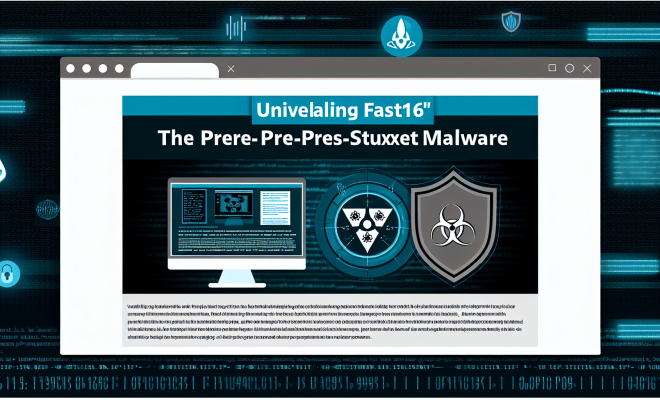
Fast16: The Pre-Stuxnet Malware That Targeted Iran’s Nuclear Program
By Matthew Lynch
April 25, 2026
0
Spread the love

In the ever-evolving landscape of cybersecurity, revelations about past cyber threats can provide critical insights into the origins of modern cyber warfare. Recent findings by cybersecurity researchers at SentinelOne have unveiled a significant piece of malware known as ‘fast16’, which predates the infamous Stuxnet worm by several years. Discovered in 2023, this Lua-based malware, created in 2005, was specifically designed to undermine Iran’s nuclear program by targeting high-precision calculation software and ultimately destroying uranium enrichment centrifuges.

Historical Context of Cyber Warfare

The emergence of fast16 is a stark reminder of the increasing importance of cyber capabilities in geopolitical conflicts. With the rise of state-sponsored cyber operations, understanding the tools and techniques employed in early cyber sabotage can help analysts evaluate current threats and potential future attacks.

The Genesis of Fast16

Fast16’s journey began with an artifact named ‘svcmgmt.exe’, which researchers identified with a timestamp of August 30, 2005. This discovery indicates that the malware was likely developed to operate within critical infrastructure, a tactic that has become more common in recent years as nations seek to achieve their strategic objectives without resorting to traditional military engagements.

Technical Insights into Fast16

According to the detailed report by SentinelOne researchers Vitaly Kamluk and Juan Andrés Guerrero-Saade, fast16 utilized a kernel driver to execute precision sabotage operations. This technical sophistication allowed it to manipulate essential software controlling centrifuge operations, a crucial component in uranium enrichment processes.

  • Kernel Driver Utilization: Fast16 employed a kernel driver to gain low-level access to system resources, enabling it to perform its malicious activities without being detected.
  • Self-Propagation Mechanism: The malware’s self-propagation capabilities allowed it to spread throughout entire facilities, making it a formidable threat to Iran’s nuclear infrastructure.
  • Targeting High-Precision Software: By compromising high-precision calculation software, fast16 could orchestrate failures in centrifuge operations, thereby sabotaging the uranium enrichment process.

Link to NSA Leaks and Broader Implications

Fast16’s discovery is particularly noteworthy due to its connection to a 2017 leak attributed to the National Security Agency (NSA). This leak exposed various cyber tools and techniques used by U.S. intelligence agencies, shedding light on the capabilities and strategies employed in cyber warfare. The link between fast16 and these NSA tools highlights the malware’s significance as an early instance of advanced cyber sabotage.

Impact on Iran’s Nuclear Program

The implications of fast16 on Iran’s nuclear ambitions cannot be overstated. Iran’s pursuit of nuclear capabilities has long been a point of contention in international relations, drawing the ire of multiple nations, particularly the United States and its allies. The introduction of a sophisticated malware such as fast16 represents a strategic effort to disrupt Iran’s nuclear progress without overt military action.

Comparison with Stuxnet

Fast16 is often compared to Stuxnet, the malware that gained notoriety for its role in sabotaging Iran’s Natanz uranium enrichment facility in 2010. While Stuxnet is recognized for its complexity and effectiveness, fast16 serves as a precursor that laid the groundwork for future cyber sabotage operations. Both pieces of malware share a common objective: to disrupt Iran’s nuclear capabilities, albeit with differing technological approaches.

Lessons Learned from Fast16

The unearthing of fast16 offers valuable lessons for both cybersecurity professionals and policymakers. Understanding the evolution of malware can aid in developing more robust defense mechanisms against similar threats in the future.

  • Importance of Threat Intelligence: Continuous monitoring and analysis of emerging threats are crucial for detecting and mitigating potential cyberattacks.
  • Collaboration Between Nations: As cyber warfare becomes increasingly prevalent, international cooperation is essential for addressing the challenges posed by state-sponsored cyber operations.
  • Investing in Cybersecurity Infrastructure: Organizations must prioritize cybersecurity investments to protect critical infrastructure from sophisticated threats.

The Future of Cyber Warfare

The discovery of fast16 underscores the need for vigilance in the face of evolving cyber threats. As nations continue to leverage cyber capabilities for strategic advantage, the potential for damaging attacks on critical infrastructure grows. The lessons learned from fast16 and other malware will shape the future of cybersecurity policies and practices.

Challenges Ahead

Despite advancements in cybersecurity technologies, several challenges remain. As malware becomes more sophisticated, the ability to detect and respond to threats in real-time becomes increasingly critical.

  • Rapid Technological Advancements: The fast-paced evolution of technology presents challenges for cybersecurity teams striving to keep pace with new threats.
  • Increased Targeting of Critical Infrastructure: As seen with fast16 and Stuxnet, critical infrastructure remains a prime target for cyber sabotage, necessitating enhanced protective measures.
  • Resource Allocation: Governments and organizations must allocate sufficient resources to cybersecurity initiatives to stay ahead of emerging threats.

Conclusion

The emergence of fast16 as a pre-Stuxnet malware targeting Iran’s nuclear program marks a significant milestone in the history of cyber warfare. This discovery not only sheds light on past operations but also underscores the importance of understanding the evolution of cyber threats. As nations continue to engage in cyber warfare, the lessons learned from fast16 will be invaluable in shaping future cybersecurity strategies.

In a world increasingly reliant on technology, the stakes have never been higher. Cybersecurity professionals must remain vigilant and proactive in their efforts to protect critical infrastructure from the ever-evolving landscape of cyber threats, ensuring that the lessons of the past inform the strategies of the future.


Previous Article

Boost Engagement: Gaming’s Sub-Content Strategies Fight Fatigue

Next Article

Vercel Security Breach: Cloud Platforms, AI Integration ...

Matthew Lynch

Related articles More from author

  • Uncategorized

    10 Engaging Virtual Lab Activities for Interactive Projectors

    January 2, 2025
    By Matthew Lynch
  • Uncategorized

    Billionaire Politics: Unpacking Wealth’s Complex Role in Elections

    June 15, 2026
    By Matthew Lynch
  • Uncategorized

    Best #2 Pencils for Standardized Tests

    July 8, 2026
    By Matthew Lynch
  • Uncategorized

    Bitcoin’s $80K Target: Spot Volumes & Futures Fueling Surge

    May 2, 2026
    By Matthew Lynch
  • Uncategorized

    20 Clever Ideas and Activities for Teaching Verb Tenses

    January 2, 2025
    By Matthew Lynch
  • Uncategorized

    The Brutal Truth About Gentle Parenting’s Downfall: Are We Raising a Generation of Tyrants?

    September 9, 2026
    By Matthew Lynch

Search

Registration and Login

  • Log in
  • Entries feed
  • Comments feed
  • WordPress.org

Newsletter

Signup for The Edvocate Newsletter and have the latest in P-20 education news and opinion delivered to your email address!

RSS feed: Matthew on Education Week Matthew on Education Week

  • Au Revoir from Education Futures November 20, 2018 Matthew Lynch
  • 6 Steps to Data-Driven Literacy Instruction October 17, 2018 Matthew Lynch
  • Four Keys to a Modern IT Approach in K-12 Schools October 2, 2018 Matthew Lynch
  • What's the Difference Between Burnout and Demoralization, and What Can Teachers Do About It? September 27, 2018 Matthew Lynch
  • Revisiting Using Edtech for Bullying and Suicide Prevention September 10, 2018 Matthew Lynch

About Us

The Edvocate was created in 2014 to argue for shifts in education policy and organization in order to enhance the quality of education and the opportunities for learning afforded to P-20 students in America. What we envisage may not be the most straightforward or the most conventional ideas. We call for a relatively radical and certainly quite comprehensive reorganization of America’s P-20 system.

That reorganization, though, and the underlying effort, will have much to do with reviving the American education system, and reviving a national love of learning.  The Edvocate plans to be one of key architects of this revival, as it continues to advocate for education reform, equity, and innovation.

Newsletter

Signup for The Edvocate Newsletter and have the latest in P-20 education news and opinion delivered to your email address!

Contact

The Edvocate
910 Goddin Street
Richmond, VA 23230
(601) 630-5238
[email protected]
  • situs togel online
  • dentoto
  • situs toto 4d
  • situs toto slot
  • toto slot 4d
Copyright (c) 2026 Matthew Lynch. All rights reserved.