Exoplanet Spin Patterns: NASA’s Roman Telescope Reveals All
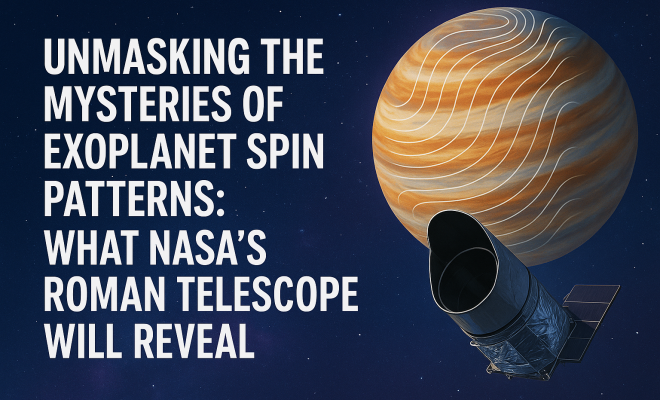
“`html
Introduction: The Allure of Exoplanet Spin Patterns
For astronomers and space enthusiasts alike, the search for exoplanets continues to ignite curiosity and fuel imagination. Recent research has revealed astounding exoplanet spin patterns that challenge our understanding of how these alien worlds behave. Coupled with the imminent launch of NASA’s Roman Telescope, which aims to scrutinize 100 million stars for new planets, this era may very well be on the brink of groundbreaking discoveries. But what does this mean for our understanding of the universe and our place within it?
Understanding Exoplanets: What Are They?
Exoplanets, or extrasolar planets, are celestial bodies that orbit stars outside our solar system. Since the first confirmed detection in the 1990s, thousands of exoplanets have been identified, each presenting a unique set of characteristics. They vary widely in size, composition, and distance from their parent stars. Some orbit closely, while others are located in the habitable zone, the sweet spot where conditions might allow for liquid water and, potentially, life.
But what truly sets these planets apart is their spin – or rotation – patterns. The way a planet spins can greatly influence its climate, atmospheric conditions, and even its potential to support life. Thus, understanding exoplanet spin patterns can provide invaluable insights into the nature of these distant worlds.
The Surprising Findings: Spin Patterns of Exoplanets
Recent studies have highlighted a surprising trend among exoplanets: many appear to exhibit unexpected spin orientations. This has confounded scientists who assumed the spins of planets would be more uniform, similar to those within our own solar system. Instead, researchers have found a variety of orientations, with some exoplanets spinning in a direction that is counter to their orbital path.
This discovery raises essential questions: Why are these planets spinning in such peculiar ways? What factors are influencing their spins? The answers may lie in the complex interplay of gravitational forces, collisions with other celestial bodies, or the history of the planetary system itself. For example, a close encounter with another planet or star could alter a planet’s rotational axis, leading to the unusual spin patterns observed.
NASA’s Roman Telescope: A New Era of Discovery
As we grapple with these new findings, attention turns to NASA’s upcoming Roman Telescope, set to revolutionize our understanding of the cosmos. Named after the pioneering astronomer Nancy Grace Roman, this mission is designed to survey tens of millions of stars in search of new exoplanets. By utilizing advanced imaging techniques and wide-field capabilities, the Roman Telescope will enable astronomers to study the spin patterns of exoplanets like never before.
The telescope’s primary goal is to identify planets within habitable zones — regions around stars where conditions may be suitable for life. By analyzing the light from these distant worlds, scientists hope to learn about their compositions, atmospheres, and, of course, their spin patterns. This ambitious mission is set to launch in the coming years, promising an unprecedented influx of data and discoveries.
The Science Behind Exoplanet Spin Patterns
Understanding exoplanet spin patterns requires a grasp of various scientific principles. The spin of a planet is influenced by factors such as its mass, distance from its star, and the gravitational interactions it experiences. For example, planets that are closer to their stars are subjected to stronger gravitational forces, which can affect their rotation and axial tilt.
Furthermore, scientists utilize computer simulations to model these interactions. By simulating the dynamics of planetary formations and collisions, researchers can better understand how the spins of these distant worlds could have evolved over time. This theoretical framework is crucial in interpreting the observational data we gather from telescopes like Roman.
Comparative Analysis: Our Solar System vs. Exoplanets
To appreciate the significance of the observed exoplanet spin patterns, it helps to compare these findings with the planets in our solar system. For instance, Earth spins on its axis at a stable tilt of about 23 degrees, which gives us our seasons. Meanwhile, gas giants like Jupiter exhibit a more rapid rotation, completing a spin in just under ten hours. (See: Understanding exoplanets and their characteristics.)
In contrast, some exoplanets exhibit spins that are retrograde, meaning they rotate in the opposite direction of their orbit around their star. This phenomenon is particularly interesting because it suggests a tumultuous history involving significant gravitational interactions or collisions. The stark differences between our solar system and the exoplanetary systems we observe challenge our assumptions and deepen our understanding of planetary formation.
Implications for Life Beyond Earth
The implications of studying exoplanet spin patterns extend far beyond academic curiosity; they touch on one of humanity’s most profound questions — are we alone in the universe? The conditions induced by a planet’s rotation can significantly affect its climate and habitability.
For instance, a planet with a slow rotation might experience extreme temperature variations between day and night, while a planet with a rapid spin could sustain a relatively stable climate. These factors could influence the potential for life to develop and thrive. By understanding the spin patterns of exoplanets, scientists can better assess their habitability and prioritize which planets to study further.
The FOMO Effect: Why You Should Care Now
The excitement surrounding exoplanet spin patterns and the Roman Telescope isn’t just for scientists; it resonates with everyone. This is a moment in history where we stand on the brink of discovery. The sense of urgency and curiosity—what else is out there?—is palpable. As data from the Roman Telescope begins to flow in, it will offer a front-row seat to the unfolding narrative of the universe.
For those interested in science or the cosmos, following these developments isn’t just a hobby; it’s an invitation to witness history. The prospect of uncovering new worlds and understanding their dynamics will undoubtedly dominate headlines in the coming years, and being informed allows you to engage in these discussions actively.
The Role of Technology in Exoplanet Discovery
The advances in technology have been nothing short of revolutionary when it comes to spotting exoplanets and measuring their spin patterns. Telescopes have evolved enormously, transitioning from ground-based observatories to sophisticated space telescopes equipped with high-powered sensors capable of detecting minute changes in light intensity.
Techniques like the transit method, where astronomers observe the dimming of a star as a planet passes in front of it, and radial velocity measurements, which detect the wobbles in a star caused by a planet’s gravitational pull, are crucial for identifying exoplanets. With the addition of the Roman Telescope’s capabilities, the future looks incredibly promising for discovering new worlds and understanding their characteristics.
Understanding the Dynamics of Spin Patterns
To get deeper into exoplanet spin patterns, it’s essential to grasp the underlying dynamics that result in these unique rotational behaviors. The interaction of a planet’s formation environment plays a significant role in determining its spin. For example, the initial angular momentum from the cloud of gas and dust from which a planet formed can influence its spin rate. Studies show that planets forming in denser environments may experience more frequent and powerful collisions, leading to varied results in spin alignment.
Another factor influencing spin patterns is tidal locking. This occurs when a planet’s rotation slows down over time due to gravitational forces exerted by its star, eventually leading to one side of the planet always facing the star. Many exoplanets, particularly those in close orbit around their stars, exhibit this behavior, impacting their climate and potential habitability.
Case Studies: Notable Exoplanets and Their Spins
Several exoplanets have attracted attention due to their unusual spin patterns. Take, for instance, WASP-121b, a gas giant that orbits extremely close to its star, leading to intense temperatures and tidal forces that drastically affect its rotation. Observations suggest it has a significantly altered axial tilt, which may be a result of prolonged tidal interactions.
Another intriguing case is the super-Earth LHS 3844b, which shows a remarkably rapid rotation period of just 11 hours. This rapid spin could contribute to a unique weather system, potentially influencing the planet’s ability to retain an atmosphere. Understanding these case studies helps paint a broader picture of how different factors contribute to the variety of spin patterns we observe.
Expert Perspectives on Exoplanet Spin Patterns
Experts in astrophysics are increasingly emphasizing the importance of exoplanet spin patterns in understanding the characteristics of these distant worlds. Dr. Sarah H. Matthews, a prominent astrophysicist, states, “The intricate dynamics of spin patterns reveal not just how a planet formed but also its current climate conditions. This knowledge can guide us in the quest for habitable worlds.” Her perspective underscores the need for a multi-faceted approach when studying exoplanets. (See: NASA's Roman Telescope mission details.)
Additionally, Dr. Mark T. Jennings highlights the role of spin in planetary evolution: “Examining the spin patterns of exoplanets can shed light on their geological activity and atmospheric stability. A stable spin is often indicative of a planet’s ability to support life, making this area of research incredibly vital.” Both experts agree that advancing our understanding of these patterns is crucial for future discoveries.
Current and Future Missions: What’s Next?
As we look to the future, several missions beyond the Roman Telescope promise to enhance our understanding of exoplanet spin patterns. The European Space Agency’s PLATO mission aims to study the characteristics of exoplanets with a focus on their sizes and masses, which are critical for determining their densities and compositions.
The James Webb Space Telescope, already operational, is set to provide unprecedented imaging and spectroscopic data, allowing researchers to analyze the atmospheres of various exoplanets and infer details about their spins. These missions will undoubtedly contribute to a more comprehensive understanding of planetary systems, leading to new insights into how spin patterns evolve over time.
FAQ: Your Questions About Exoplanet Spin Patterns Answered
What exactly are exoplanet spin patterns?
Exoplanet spin patterns refer to the rotational behaviors of planets outside our solar system, including their rotation speed, axial tilt, and orientation relative to their orbital path. Understanding these patterns is essential for assessing a planet’s climate and potential habitability.
How do scientists measure exoplanet spin patterns?
Scientists utilize various methods, including observing changes in light as a planet transits in front of its star and analyzing gravitational effects on the star itself. Advanced imaging techniques and simulations also play a crucial role in understanding these spin patterns.
Can exoplanet spin patterns indicate the presence of life?
While spin patterns alone do not confirm life, they can provide insights into a planet’s climate and atmospheric stability, essential factors for habitability. A stable rotation is generally more conducive to supporting life as we know it.
What are some examples of exoplanets with unusual spin patterns?
WASP-121b and LHS 3844b are two notable examples. WASP-121b exhibits significant tidal locking due to its proximity to its star, while LHS 3844b has a rapid rotation period that could influence its atmospheric conditions.
How does the Roman Telescope contribute to the study of exoplanet spin patterns?
The Roman Telescope is set to survey vast numbers of stars for new exoplanets, using advanced imaging and wide-field capabilities to gather data that can help analyze planetary spin patterns in ways never before possible.
Looking Ahead: The Future of Exoplanet Research
The future of exoplanet research is bright, particularly as we prepare for new data from the Roman Telescope and other upcoming missions. With an ever-expanding catalogue of exoplanets and the surprising spin patterns emerging from recent studies, scientists are entering a new frontier of cosmic understanding.
As we learn more about these alien worlds, it will be essential to continuously refine our theories and models. The combination of observational data and theoretical frameworks will allow researchers to draw more accurate conclusions about how these planets form, evolve, and potentially support life. (See: Research on exoplanets and their spin patterns.)
The Broader Implications of Exoplanet Spin Patterns
Examining exoplanet spin patterns also opens up fascinating discussions about the formation and evolution of planetary systems. The diversity of spin patterns challenges current models of planetary formation and suggests that our understanding of how planets interact within their systems is incomplete. For example, the presence of binary star systems, where two stars orbit each other, can complicate the gravitational influences on nearby planets, potentially leading to unusual spin orientations.
Additionally, the interplay between a planet’s magnetic field and its spin can also be a crucial factor in determining its atmospheric retention. Planets with strong magnetic fields that are aligned with their spins may be more capable of holding onto their atmospheres, which is vital for habitability. Conversely, a misaligned magnetic field could lead to atmospheric stripping by stellar winds, reducing the chances for life.
Comparing the Spin Patterns of Different Exoplanets
A closer examination of diverse exoplanets shows a remarkable range of spin patterns and behaviors. Some exoplanets, like Proxima Centauri b, are thought to be tidally locked, meaning they have one side always facing their star. This phenomenon can lead to extreme differences in temperature and climate, with one hemisphere perpetually bathed in sunlight while the other is shrouded in darkness.
On the other hand, there are planets like HD 189733b, which rotates rapidly and has been shown to have intense weather systems, including winds reaching up to 8,700 kilometers per hour (about 5,400 miles per hour). Such high-speed rotation can contribute to dynamic weather patterns that are vastly different from what we experience on Earth. These comparisons allow scientists to theorize about the underlying mechanics that drive their unique spin behaviors.
In Summary: The Quest for Understanding Exoplanet Spin Patterns
The study of exoplanet spin patterns is more than just a quest for knowledge about distant worlds; it has significant implications for our understanding of planetary formation, evolution, and the potential for life beyond Earth. As we await the data that the Roman Telescope and other upcoming missions will provide, it’s clear that each new discovery will offer insights into the complex dynamics that govern these celestial bodies.
As our understanding deepens, we may find ourselves not only answering the age-old question of whether we are alone in the universe but also learning more about the processes that led to the formation of our own solar system. The journey through the cosmos continues, and with it, the mysteries of exoplanets unfold in exciting and unexpected ways.
Conclusion: The Cosmic Journey Continues
Our quest to understand exoplanet spin patterns and the myriad worlds beyond our solar system is just beginning. As we anticipate the groundbreaking discoveries that will emerge from the Roman Telescope and other missions, it’s worth reflecting on how these insights could alter our perception of life beyond Earth. With each new planet we discover and each spin pattern we analyze, we move one step closer to answering the age-old question: Are we alone in the universe?
“`
Trending Now
Frequently Asked Questions
What are exoplanets and why are they important?
Exoplanets, or extrasolar planets, are celestial bodies that orbit stars outside our solar system. They are important because they help us understand planetary systems, the potential for life beyond Earth, and the diversity of planetary environments in the universe.
How does the spin of an exoplanet affect its climate?
The spin of an exoplanet influences its climate and atmospheric conditions. A planet's rotation can determine temperature variations, weather patterns, and even the potential for sustaining liquid water, all of which are crucial for the possibility of life.
What surprising trends have been found in exoplanet spin patterns?
Recent studies have revealed that many exoplanets exhibit unexpected spin orientations, with some spinning counter to their orbital path. This challenges previous assumptions about uniform spin patterns and raises questions about the formation and evolution of these distant worlds.
What role will NASA's Roman Telescope play in exoplanet research?
NASA's Roman Telescope will enhance our understanding of exoplanets by scrutinizing 100 million stars to identify new planets and analyze their spin patterns. This mission is expected to lead to groundbreaking discoveries in our comprehension of the universe.
Why is the study of exoplanet spin patterns significant?
Studying exoplanet spin patterns is significant because it provides insights into the dynamics of these distant worlds. Understanding their rotation can reveal information about climate, atmospheric conditions, and the potential for habitability, thus expanding our knowledge of life in the universe.
Have you experienced this yourself? We’d love to hear your story in the comments.