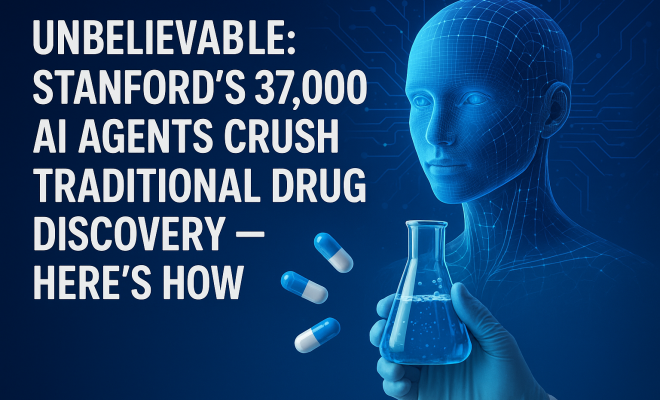
Unbelievable: Stanford’s 37,000 AI Agents Crush Traditional Drug Discovery — Here’s How
When you think about drug discovery, what comes to mind? Maybe a lone scientist poring over microscopes, or a team in a sterile lab meticulously synthesizing compounds, right? For decades, that’s largely been the picture. It’s a slow, incredibly expensive, and often heartbreaking process, with a staggering 90% of drugs failing in clinical trials. Think about that for a moment: nine out of ten promising treatments never make it to the patients who desperately need them. That’s not just a statistic; it’s a monumental challenge that has left countless diseases without adequate solutions.
But what if I told you that a team at Stanford University has essentially built a ‘virtual biotech company’ powered by 37,000 AI agents, and it’s already showing signs of completely rewriting the rules of drug development? This isn’t science fiction; it’s happening right now, and it’s published in the prestigious journal Science. This groundbreaking system isn’t just an incremental improvement; it’s a paradigm shift in how we approach one of humanity’s most complex problems. It forces us to ask critical questions about the future of medicine and the stark contrast between AI drug discovery platforms vs traditional methods. Let’s dig into what makes this so revolutionary.
1. The Staggering Failure Rate of Traditional Drug Discovery: A Persistent Problem
Let’s face it, the current pharmaceutical R&D pipeline is, for lack of a better word, inefficient. It’s a grueling marathon that can take 10 to 15 years and cost billions of dollars for a single drug to go from concept to market. And, as I mentioned, the odds are stacked against success from the very beginning. This 90% failure rate in clinical trials isn’t just a financial hit for pharmaceutical companies; it represents missed opportunities to save lives and alleviate suffering.
Why is it so high? Part of the problem lies in the sheer complexity of human biology. We’re talking about intricate cellular pathways, unpredictable drug interactions, and the subtle ways diseases manifest in different individuals. Traditional methods rely heavily on trial and error, educated guesses, and a relatively limited ability to predict how a compound will behave in a living system. This often leads to drugs that look promising in a petri dish but fail when tested in humans, whether due to lack of efficacy, unexpected toxicity, or simply not targeting the right biological mechanism effectively. This is precisely where the promise of AI drug discovery platforms vs traditional methods becomes so compelling.
2. Stanford’s Virtual Biotech Company: A Digital Army of Innovation
Imagine a pharmaceutical company where every single employee is an AI. That’s essentially what Stanford has created. This isn’t just one super-smart AI; it’s a decentralized network of 37,000 specialized AI agents, each with a specific role, much like departments in a real company. You have AI agents acting as researchers, others as chemists, some as clinical trial specialists, and even some as project managers, all collaborating and communicating to advance drug candidates.
This distributed intelligence is a key differentiator. Instead of a single bottleneck, you have thousands of agents working in parallel, sharing information, and optimizing their individual tasks. They’re not just crunching numbers; they’re learning, adapting, and making decisions based on vast datasets, mimicking the complex, iterative process of human R&D but at an unimaginable scale and speed. This collective intelligence is designed to tackle problems that are simply too vast and complex for human teams alone, offering a truly novel approach to drug discovery.
3. Mimicking Human Collaboration: AI Teams for Drug Development
One of the most fascinating aspects of Stanford’s system is how it emulates human collaboration. These 37,000 AI agents aren’t just independent robots; they communicate, share insights, and build upon each other’s findings. For example, one set of AI agents might analyze existing scientific literature to identify promising drug targets for a specific disease. Once a target is identified, another group of AI agents might then take over, designing novel molecular compounds that could potentially interact with that target.
This isn’t just about automation; it’s about intelligent, dynamic collaboration. The system can even simulate aspects of clinical trials, predicting how a drug might perform and identifying potential pitfalls long before human trials begin. This level of integrated, iterative design and testing is something traditional methods struggle to achieve with comparable speed and data breadth. It highlights a core advantage when we compare AI drug discovery platforms vs traditional methods: the ability to process and synthesize information on an unprecedented scale.
4. Beyond Trial and Error: Predictive Power in Target Identification
A major bottleneck in traditional drug discovery is identifying the right biological targets. You can have a brilliant drug, but if it’s hitting the wrong target, it’s useless. This is where Stanford’s AI truly shines. The system doesn’t just randomly test compounds; it actively identifies drug targets with a higher probability of clinical trial success. How does it do this? By analyzing vast amounts of data – genomic information, protein structures, disease pathways, existing drug data, and even failed clinical trial results – to find patterns and make highly informed predictions.
Think about it: instead of scientists spending years hypothesizing and then empirically testing targets, the AI can sift through terabytes of data in a fraction of the time, pinpointing the most promising avenues. This isn’t just about efficiency; it’s about increasing the likelihood of success from the very first step. It shifts the paradigm from reactive experimentation to proactive, data-driven prediction, a critical improvement in the efficiency of AI drug discovery platforms vs traditional methods.
5. A Real-World Success Story: Validating AI’s Potential
Perhaps the most compelling evidence of this system’s power is its independent proposal for a lung cancer treatment. The AI, without human intervention, identified a potential therapeutic approach for lung cancer. What’s truly remarkable is that this specific approach was later validated by a major pharmaceutical company through its own independent research. This isn’t just a theoretical exercise; it’s a concrete demonstration of the AI’s ability to generate actionable, clinically relevant insights. (See: 90% of drugs fail in clinical trials.)
This success story is a huge deal because it moves AI drug discovery from the realm of academic interest to tangible, real-world impact. It proves that these AI agents aren’t just good at simulating; they’re good at innovating and discovering. For anyone skeptical about the practical application of AI in such a complex field, this validation offers powerful reassurance that this technology is not only promising but already delivering results.
6. Accelerating Cures for Devastating Diseases: The Emotional Impact
Let’s not forget the human element here. Diseases like cancer, Alzheimer’s, and countless rare genetic disorders continue to devastate families globally. The current pace of drug discovery means that effective treatments often arrive too late for many. The promise of this Stanford system isn’t just about scientific advancement; it’s about hope. For more context, see study whether technology helps or hurts.
Imagine cutting years off the development timeline for a new cancer drug, or finding a treatment for a currently incurable neurological condition. That’s the emotional core of why this research is so impactful and why it’s going viral. It taps into our deepest desire for medical advancements, for cures, and for a future where debilitating diseases are no longer a death sentence. The potential to accelerate cures represents a monumental leap forward for humanity, fundamentally changing the discussion around AI drug discovery platforms vs traditional methods.
7. Monetization Potential and Industry Disruption: A Lucrative Frontier
Beyond the scientific and humanitarian aspects, the commercial implications of this technology are enormous. We’re talking about a lucrative intersection of medical/healthcare, pharmaceutical, and B2B SaaS/software niches. Pharmaceutical companies spend billions on R&D, and any technology that can significantly reduce costs, accelerate timelines, and increase success rates will be in incredibly high demand.
This development is poised to drive commercial searches for ‘AI drug discovery platforms,’ ‘biotech investment opportunities,’ and ‘future of pharmaceutical R&D.’ Virtual biotech companies powered by AI could license their discoveries, partner with established pharma giants, or even develop their own drugs. The efficiency gains alone could lead to an explosion of new therapies, creating immense value and completely disrupting the traditional pharmaceutical business model. It’s an economic tidal wave waiting to happen.
8. Challenges and Ethical Considerations: A Balanced Perspective
Of course, no groundbreaking technology comes without its challenges. While the potential is immense, we must also consider the limitations and ethical implications. Data quality is paramount; if the AI is trained on biased or incomplete data, its outputs will reflect those flaws. There’s also the question of ‘explainability’ – understanding *why* the AI made a particular decision. In drug development, where human lives are at stake, having a clear understanding of the reasoning behind a drug’s design is critical.
Then there are the ethical considerations. Who is ultimately responsible if an AI-designed drug has unforeseen side effects? How do we ensure equitable access to these rapidly developed therapies? These aren’t easy questions, and they’ll require careful thought and robust regulatory frameworks as AI drug discovery platforms vs traditional methods become more prevalent. It’s not enough to simply innovate; we must innovate responsibly.
9. The Future of Pharmaceutical R&D: A Hybrid Approach?
So, does this mean human scientists are out of a job? Absolutely not. While AI is incredibly powerful, it’s a tool, albeit a sophisticated one. The future of pharmaceutical R&D will likely be a hybrid approach, where AI and human intelligence work in tandem. AI can handle the data-intensive tasks, identify patterns, and propose novel solutions at a scale impossible for humans. Human scientists, in turn, can focus on validating AI findings, designing complex experiments, interpreting nuanced results, and bringing the critical creativity, intuition, and ethical judgment that AI currently lacks.
The synergy between these two forces could unlock unprecedented potential. AI can augment human capabilities, allowing researchers to tackle more complex problems and bring life-saving drugs to market faster. This isn’t about replacing; it’s about empowering. The comparison of AI drug discovery platforms vs traditional methods isn’t a zero-sum game; it’s about evolving towards a more effective and humane future for medicine.
10. Beyond Stanford: The Broader Landscape of AI in Biotech
It’s important to recognize that Stanford’s breakthrough, while spectacular, is part of a larger trend. Many other companies and academic institutions are also leveraging AI for drug discovery, albeit perhaps not with such a massive, multi-agent system. From companies like Recursion Pharmaceuticals using AI to map cellular biology, to Insilico Medicine applying deep learning to identify novel targets and molecules, the field is buzzing with innovation.
What Stanford’s work does, however, is push the boundaries of scale and autonomy. It demonstrates the profound impact of a truly integrated AI system mimicking the entire R&D pipeline. This isn’t just an AI assisting a scientist; it’s an AI *acting* as a biotech company. This level of comprehensive, autonomous operation sets a new benchmark for what AI drug discovery platforms can achieve compared to traditional methods. It signals a future where the virtual lab might be just as important, if not more so, than the physical one.
11. The Mechanics of AI Drug Discovery: How it Works
To really appreciate the difference between AI drug discovery platforms vs traditional methods, it’s worth taking a peek under the hood of how these AI systems actually operate. It’s not magic, but it’s certainly cutting-edge computer science. At its core, AI in drug discovery relies on machine learning algorithms, particularly deep learning. These algorithms are fed massive datasets – think chemical compound libraries, genomic sequences, patient health records, scientific papers, and even images of cells and tissues.
The process usually starts with target identification. AI analyzes vast biological data to pinpoint specific genes, proteins, or pathways that are implicated in a disease. Traditional methods might involve years of biological research and experimentation to find these. Then comes compound generation and optimization. Instead of chemists manually synthesizing and testing thousands of molecules, AI can design novel compounds from scratch, predicting their properties and how they might interact with the identified target. It can screen billions of virtual compounds in a fraction of the time it would take human researchers to test a few thousand in a lab. Think about how much faster that is! (See: challenges in drug discovery process.)
Next, the AI moves to predicting efficacy and toxicity. Before a single molecule is synthesized in a lab or tested in an animal, AI models can simulate how a compound might behave in the human body. This includes predicting potential side effects, absorption rates, and how effectively it will bind to its target. This drastically reduces the number of compounds that need to be physically tested, saving immense time and resources. Finally, AI can even assist in clinical trial design and patient selection, optimizing trial parameters and identifying patient groups most likely to respond to a particular drug, which can significantly improve trial success rates.
12. The Economic Imperative: Why Pharma is Embracing AI
The pharmaceutical industry isn’t just dabbling in AI because it’s cool; there’s a serious economic imperative driving this adoption. The cost of bringing a new drug to market has soared, often exceeding $2 billion when factoring in the cost of all the failed projects. This astronomical cost, coupled with the long development timelines and high failure rates we discussed earlier, makes R&D a high-risk, high-reward gamble. For more context, see revolutionizing parenting.
AI offers a path to de-risk this process and improve the return on investment. By accelerating target identification, optimizing compound design, and improving the prediction of clinical success, AI can drastically cut down both the time and monetary investment required for drug development. This isn’t just about saving money; it’s about freeing up capital that can be reinvested into more research, tackling even more complex diseases. It also means potentially bringing more drugs to market, increasing revenue streams for pharmaceutical companies. The competitive landscape is shifting, and companies that don’t embrace AI risk being left behind, unable to keep pace with the efficiency and innovation of their AI-powered counterparts.
13. Expert Perspectives: What Leaders in the Field Are Saying
It’s not just academics at Stanford touting the potential of AI. Industry leaders and venture capitalists are equally enthusiastic. CEOs of major pharmaceutical companies are openly discussing their investments in AI and machine learning divisions. For instance, companies like AstraZeneca and GSK have formed strategic partnerships with AI firms to leverage their capabilities in drug discovery. Experts often highlight that AI isn’t just a tool for hypothesis generation; it’s a tool for hypothesis *validation* and *optimization* at a scale previously unimaginable.
Many believe that the true power of AI lies in its ability to uncover hidden correlations and patterns in vast, complex biological datasets that human minds simply cannot process. As one prominent biotech CEO put it, “AI allows us to move beyond intuition-driven science to data-driven discovery, where every decision is backed by insights derived from billions of data points.” This shift in methodology is what truly differentiates AI drug discovery platforms vs traditional methods, making the latter seem increasingly archaic.
14. Case Study: Insilico Medicine’s AI-Discovered Drug
While the Stanford example is incredibly compelling, it’s not the only one. Insilico Medicine, a Hong Kong-based company, made headlines by using its AI platform to discover a novel drug candidate for idiopathic pulmonary fibrosis (IPF), a chronic and ultimately fatal lung disease. What’s remarkable is the speed: their AI identified a novel target and generated a new molecule in just 18 months, which traditionally would have taken years. Even more impressive, this AI-designed drug entered human clinical trials, marking a significant milestone.
This isn’t just proof of concept; it’s a real-world demonstration of AI moving a drug from discovery to human testing at an unprecedented pace. It showcases how AI can tackle complex diseases where traditional approaches have struggled to find effective treatments. This success story isn’t an isolated incident; it’s a harbinger of what’s to come, reinforcing the narrative that AI drug discovery platforms vs traditional methods are not just different, but fundamentally more efficient and potentially more successful.
15. The Regulatory Landscape: Adapting to AI-Driven Innovation
As AI drug discovery accelerates, regulatory bodies like the FDA in the US and the EMA in Europe are grappling with how to adapt their frameworks. Traditional drug approval processes are designed for human-led R&D, with clear steps for preclinical testing, clinical trials (Phases 1, 2, and 3), and post-market surveillance. The integration of AI introduces new questions: How do you validate an AI’s output? What level of ‘explainability’ is required for AI-generated drug designs? How do we ensure the robustness and reproducibility of AI-driven predictions?
Regulators are working to establish new guidelines that can accommodate AI-driven innovation while maintaining the highest standards of safety and efficacy. This will likely involve a collaborative approach between industry, academia, and regulatory agencies to define best practices for AI model validation, data governance, and ethical considerations. The goal isn’t to impede innovation but to ensure that these powerful new tools are used responsibly and safely to benefit patients. It’s a critical aspect of the ongoing evolution when discussing AI drug discovery platforms vs traditional methods.
Frequently Asked Questions About AI Drug Discovery
Q1: What exactly is AI drug discovery?
AI drug discovery uses artificial intelligence and machine learning algorithms to analyze vast amounts of biological, chemical, and medical data. The goal is to identify potential drug targets, design new drug molecules, predict their effectiveness and safety, and optimize the entire drug development process, making it faster, cheaper, and more successful than traditional methods. For more context, see revolutionizing mental health resources. (See: FDA drug approval process overview.)
Q2: How does AI compare to traditional drug discovery methods in terms of speed and cost?
AI drug discovery platforms are significantly faster and potentially much more cost-effective. Traditional methods can take 10-15 years and cost billions, with a high failure rate. AI can identify targets and design molecules in months, screen billions of compounds virtually, and reduce the need for expensive, time-consuming lab experiments and animal testing, thereby accelerating timelines and lowering overall costs.
Q3: Can AI entirely replace human scientists in drug discovery?
No, not entirely. While AI can automate data-intensive tasks, identify patterns, and propose solutions at an unprecedented scale, human scientists remain crucial. They provide the creative intuition, design complex experiments, interpret nuanced results, validate AI findings, and bring essential ethical judgment that AI currently lacks. The future is likely a hybrid model where AI augments human capabilities.
Q4: What are the main advantages of AI in drug discovery?
The key advantages include significantly reduced timelines, lower development costs, higher success rates (by predicting efficacy and toxicity more accurately), the ability to analyze vast and complex datasets, and the potential to discover novel therapies for diseases where traditional methods have struggled. It moves from trial-and-error to data-driven prediction.
Q5: What are the biggest challenges facing AI drug discovery?
Challenges include ensuring high-quality, unbiased training data; the ‘explainability’ problem (understanding *why* an AI made a particular decision); ethical concerns regarding responsibility and equitable access; and the need for robust regulatory frameworks to govern AI-designed drugs. Data security and privacy are also significant considerations.
Q6: Are there any AI-discovered drugs already in clinical trials or on the market?
Yes. While it’s still an emerging field, several AI-discovered drug candidates have entered human clinical trials. A notable example is Insilico Medicine’s drug for idiopathic pulmonary fibrosis. This shows the practical application and tangible progress being made in the field.
Q7: How will AI drug discovery impact patients?
The most significant impact on patients will be the acceleration of new, effective treatments for a wider range of diseases. This means life-saving drugs could reach patients years sooner, and therapies for currently untreatable conditions might become a reality. It offers immense hope for those suffering from debilitating illnesses.
Q8: What kind of data does AI use in drug discovery?
AI platforms utilize a diverse range of data, including genomic and proteomic sequences, chemical compound libraries, patient electronic health records, scientific literature, clinical trial data (both successful and failed), molecular structures, and even imaging data from cells and tissues. The more diverse and comprehensive the data, the better the AI’s learning capabilities.
The development at Stanford is nothing short of revolutionary. It’s a clear signal that the era of AI-driven drug discovery is not just coming; it’s here. The implications for medicine, for business, and for humanity are profound. We’re witnessing the dawn of a new age where the agonizingly slow and often futile process of finding new cures could be transformed into a streamlined, intelligent, and far more successful endeavor. It’s an exciting, slightly daunting, but ultimately hopeful vision for the future of health.
Trending Now
Frequently Asked Questions
How do AI agents improve drug discovery?
AI agents streamline the drug discovery process by analyzing vast datasets, predicting molecular interactions, and identifying potential drug candidates much faster than traditional methods. Stanford's system, powered by 37,000 AI agents, showcases how machine learning can significantly reduce time and costs associated with developing new medications.
What is the failure rate of traditional drug discovery?
The failure rate of traditional drug discovery is staggering, with about 90% of drugs failing in clinical trials. This high rate underscores the inefficiencies and complexities involved in the current pharmaceutical research and development pipeline, which can take up to 15 years and cost billions for a single drug.
What are the benefits of AI in pharmaceuticals?
AI offers numerous benefits in pharmaceuticals, including enhanced speed and efficiency in drug discovery, the ability to analyze large datasets for insights, and improved predictive accuracy for clinical trial outcomes. This technology represents a significant shift from traditional methods, potentially leading to more successful treatments reaching patients.
How does Stanford's AI drug discovery system work?
Stanford's AI drug discovery system operates like a virtual biotech company, utilizing 37,000 AI agents that collaborate to analyze biological data, predict drug interactions, and optimize compounds. This innovative approach allows for more efficient identification of viable drug candidates, addressing the limitations of traditional drug development.
What challenges does traditional drug discovery face?
Traditional drug discovery is plagued by challenges such as high costs, lengthy timelines, and a high failure rate in clinical trials. The complexity of human biology complicates the process, resulting in missed opportunities to develop effective treatments for various diseases, which AI technology aims to mitigate.
What's your take on this? Share your thoughts in the comments below — we read every one.