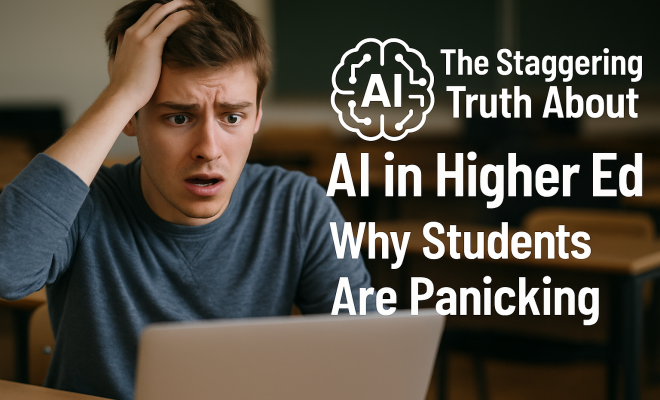
The Staggering Truth About AI in Higher Ed: Why Students Are Panicking
Let’s be honest: the world of higher education is always playing catch-up, isn’t it? We talk a big game about innovation and preparing students for the future, but often, by the time we implement something, the future has already moved on. This isn’t a new phenomenon, but with the rapid ascent of artificial intelligence, that gap feels less like a lag and more like a chasm. A recent global survey from the Digital Education Council in 2026 really brought this home, highlighting a truly significant disconnect in how ready our universities, and more specifically our faculty, are for the AI revolution. It’s not just about teaching students *about* AI anymore; it’s about fundamentally rethinking how we teach *with* AI, and that’s where the real AI integration challenges and opportunities in higher education lie.
As someone who’s spent years in the academic trenches – from K-12 classrooms to university dean’s offices – I’ve seen firsthand how challenging it can be to shift the pedagogical ship. But the stakes with AI are different. This isn’t just another tech tool; it’s a paradigm shift. The survey data is pretty stark: while a good chunk of faculty, 64% globally, have gone through some AI literacy training, students aren’t exactly feeling confident. Only 29% of students worldwide believe their instructors are truly equipped to guide them on using AI effectively. If you’re in the US or Canada, that number plummets to a dismal 17%. That’s not just a statistic; it’s a flashing red light for student anxiety, with 41% globally (and a whopping 50% in the APAC region) worrying that AI will actually shrink job opportunities in their chosen field by the time they graduate. This isn’t just about grades; it’s about livelihoods, and frankly, it’s a problem we in higher education can’t afford to ignore.
1. The Faculty Preparedness Paradox: Training vs. Confidence
It’s a classic case of quantity versus quality, isn’t it? The Digital Education Council’s survey proudly states that 64% of faculty globally have participated in some form of AI literacy training. On the surface, that sounds pretty good. We’re investing in professional development, getting faculty up to speed, and trying to stay relevant. But here’s the rub: those training sessions might be ticking a box, but they aren’t necessarily translating into real-world confidence or, more importantly, student perception of competence.
Think about it: what does ‘AI literacy training’ actually entail? Is it a single webinar? A weekend workshop? Or a deeply embedded, ongoing professional learning community focused on pedagogical integration? The survey suggests it’s often the former, or at least not robust enough. The fact that only 29% of students globally, and a mere 17% in North America, feel their instructors are well-equipped to guide them on AI use speaks volumes. It tells me that faculty might know *what* AI is, but they don’t necessarily know *how* to effectively weave it into their curriculum, assess student work with it, or, crucially, prepare students for a world where AI is ubiquitous. This disconnect is one of the most pressing AI integration challenges and opportunities in higher education.
2. Student Anxiety and the Future of Work: An Existential Crisis?
This is where it gets really personal for our students. Forget the theoretical debates about AI ethics for a moment; our students are looking at their future careers, and many are seeing a storm cloud on the horizon. The survey reveals a heartbreaking statistic: 41% of students globally are worried that AI will reduce job opportunities in their field by the time they graduate. In the Asia-Pacific region, that number jumps to a staggering 50%. Half of our students in a major global region are genuinely concerned about their employability because of AI. That’s not just anxiety; that’s an existential crisis for many.
This isn’t just a vague fear either. They’re seeing the headlines, witnessing the rapid advancements, and perhaps even experiencing AI tools firsthand that can automate tasks traditionally done by entry-level professionals. They’re asking: ‘If AI can do X, Y, and Z, what’s left for me?’ This puts an immense pressure on higher education to not just teach subjects, but to also provide clear pathways and assurances that their degrees are still valuable. We need to move beyond simply acknowledging AI’s existence and actively demonstrate how students can leverage it, rather than be replaced by it.
3. The Curricular Catch-Up Game: Degrees Aren’t Enough
Universities, bless their hearts, are trying. The report notes that institutions are rapidly integrating AI into curricula and offering more AI-related graduate degrees. You see new master’s programs in AI, specializations in data science with an AI focus, and even undergraduate courses touching on machine learning. This is, without a doubt, a positive step. It shows an awareness of the changing landscape and an effort to adapt.
However, simply adding ‘AI’ to a course title or creating a new degree isn’t a magic bullet. The core issue isn’t just about producing AI specialists; it’s about ensuring *all* graduates, regardless of their major, understand how AI will impact their chosen profession. A history major needs to know how AI can analyze historical data, an art student needs to understand AI in creative tools, and a business student needs to grasp AI’s role in market analysis. The pace of faculty adaptation and effective pedagogical integration is lagging behind the speed at which AI is being superficially added to course catalogs. This creates a critical gap in truly preparing students for an AI-transformed workforce, making it a key aspect of the AI integration challenges and opportunities in higher education.
4. Overcoming Resistance: The Human Element of AI Adoption
Let’s be frank: change is hard, especially in academia. There’s a certain comfort in established methods, tried-and-true syllabi, and familiar assessment strategies. Introducing AI into this mix isn’t just about learning new software; it’s about challenging deeply ingrained pedagogical philosophies. Some faculty might view AI as a threat to academic integrity, a tool for cheating, or simply another burden on already overloaded schedules. This resistance isn’t necessarily malicious; it often stems from a lack of understanding, fear of the unknown, or genuine concerns about maintaining educational quality. (See: AI's impact on education.)
To overcome this, we need more than just mandatory training sessions. We need to foster a culture of experimentation, provide robust support systems, and highlight success stories. Faculty need to see practical, tangible benefits for themselves and their students. They need mentors who are successfully integrating AI, opportunities to collaborate on new approaches, and reassurance that their concerns are being heard and addressed. Ignoring this human element of resistance is a surefire way to ensure AI integration remains superficial and ineffective. For more context, see The Startling Truth About AI Tutors and Student Grades Revealed.
5. Ethical Quandaries and Responsible AI Use: More Than Just Code
Beyond the practicalities of integration, there’s a massive ethical dimension to AI that higher education *must* address head-on. This isn’t just about preventing plagiarism; it’s about teaching students to be responsible digital citizens in an AI-powered world. We’re talking about algorithmic bias, data privacy, the potential for misinformation, and the societal impact of increasingly autonomous systems. If faculty aren’t adequately prepared to discuss these complex issues, how can we expect our students to navigate them ethically?
This means moving beyond technical training to incorporate critical thinking, philosophy, and social sciences into AI discussions. We need to equip students to question the outputs of AI, understand its limitations, and recognize its inherent biases. This requires faculty to not only be AI literate but also ethically literate in the context of AI. It’s a huge ask, but an absolutely crucial one for preparing thoughtful, responsible graduates.
6. Leveraging AI for Personalized Learning: A Golden Opportunity
Despite the challenges, the opportunities presented by AI integration in higher education are truly transformative. One of the most exciting prospects is personalized learning. Imagine AI-powered tutors, like my own Entelechy app, that can adapt to individual student needs, identify learning gaps, and provide tailored feedback in real-time. This isn’t science fiction; it’s here, and it has the potential to revolutionize how students learn.
For faculty, this could mean less time on repetitive grading or basic instruction and more time on complex problem-solving, deep discussions, and mentorship. AI can help automate administrative tasks, analyze student performance data to flag struggling learners, and even suggest resources based on individual learning styles. If we embrace these tools thoughtfully, we can move away from a one-size-fits-all model of education and truly cater to the diverse needs of our student body. This is where the ‘opportunities’ part of the AI integration challenges and opportunities in higher education really shines.
7. AI-Powered Research and Innovation: Accelerating Discovery
Higher education isn’t just about teaching; it’s about pushing the boundaries of knowledge through research. And here, AI offers truly mind-blowing potential. From analyzing vast datasets in scientific research to generating new hypotheses, AI can accelerate discovery across almost every discipline. Think about drug discovery, climate modeling, or even humanities research involving massive textual archives – AI can process and identify patterns at speeds and scales impossible for humans alone.
Universities that embrace AI in their research infrastructure will become hubs of innovation, attracting top talent and securing significant funding. This requires investing in powerful computing resources, training researchers in AI methodologies, and fostering interdisciplinary collaboration. It’s about empowering our faculty and students to tackle the world’s most complex problems with a powerful new ally, fundamentally redefining the scope of academic inquiry.
8. Redefining Assessment and Skill Development: Beyond Rote Memorization
One of the most profound shifts AI demands is a re-evaluation of how we assess student learning. If AI can write essays, solve complex equations, or generate code, what does it mean to test traditional skills? We can no longer solely focus on rote memorization or tasks easily replicated by AI. Instead, we must pivot towards assessing higher-order thinking, critical evaluation, creativity, problem-solving, and the ability to effectively *collaborate* with AI tools.
This means developing new assessment strategies that challenge students to use AI responsibly, critically analyze its outputs, and apply human judgment where AI falls short. It also means focusing on skills that are uniquely human – emotional intelligence, ethical reasoning, complex communication, and strategic thinking. By doing so, we don’t just prepare students for an AI-transformed workforce; we equip them to lead it. This is perhaps the most significant long-term opportunity within the AI integration challenges and opportunities in higher education. (See: Youth Risk Behavior Survey data.)
9. Infrastructure and Resource Allocation: The Digital Divide Within
We often talk about the digital divide between institutions, but AI introduces a new layer of complexity: the digital divide *within* institutions. Implementing AI effectively isn’t just about buying software; it demands robust computing infrastructure, high-speed internet, dedicated IT support, and access to specialized hardware like GPUs for intensive AI tasks. Many universities, especially those with tighter budgets, struggle to provide this foundational support. It’s not enough to say “use AI” if the campus Wi-Fi can barely stream a video, or if faculty don’t have access to powerful enough machines to run AI applications or even experiment with them.
This challenge extends to staffing as well. Who manages the AI platforms? Who troubleshoots issues? Who trains new faculty members as AI tools evolve? Without sufficient investment in the underlying technological infrastructure and the human capital to maintain it, AI integration will remain a piecemeal, inequitable effort. This uneven playing field means some students will gain invaluable AI experience, while others will be left behind, exacerbating existing disparities. For more context, see 8 Potent Alternatives to AI Tutors That Will Skyrocket Student Engagement.
10. Data Governance and Privacy: A Minefield of Regulations
AI thrives on data, but using student data in an AI context opens up a complex web of ethical and legal considerations. How do we ensure student privacy when AI systems are analyzing learning patterns, personalizing content, or even providing mental health support? Regulations like GDPR, FERPA in the US, and similar laws globally place strict limits on how educational institutions can collect, store, and use personal data. Integrating AI means navigating these waters carefully, ensuring transparency with students about data usage, and implementing robust security measures to prevent breaches.
Beyond legal compliance, there’s the moral imperative to protect students. We need clear policies on data anonymization, consent, and the ethical use of AI-derived insights. This requires a collaborative effort between IT, legal, faculty, and administrative leadership to establish guidelines that foster innovation without compromising trust or privacy. Ignoring this aspect could lead to significant reputational damage and, more importantly, betray the trust of our students.
11. Fostering an AI-Ready Culture: Beyond the Classroom
Successfully integrating AI isn’t just about what happens in the lecture hall; it’s about cultivating an AI-ready culture across the entire university ecosystem. This means encouraging administrative staff to use AI for efficiency gains, like automating scheduling or HR processes. It means empowering student support services to leverage AI for early intervention or personalized advising. It also means establishing centers of excellence for AI research and application, creating interdisciplinary labs where faculty and students from different fields can collaborate on AI projects.
A true AI-ready culture is one where experimentation is encouraged, failures are seen as learning opportunities, and continuous professional development in AI is the norm, not the exception. It’s about leadership modeling AI adoption and celebrating innovative uses. Without this holistic approach, AI risks remaining siloed in specific departments or as a novelty rather than a fundamental driver of institutional advancement.
12. Global Collaboration and Best Practices: Learning from Each Other
The challenges and opportunities of AI in higher education aren’t unique to any single institution or country. This is a global phenomenon. Therefore, fostering international collaboration is crucial. Universities need to actively share best practices, research findings, and successful integration strategies. Platforms for dialogue, joint research initiatives, and faculty exchange programs focused on AI pedagogy can accelerate progress for everyone.
Imagine a global consortium of universities dedicated to developing open-source AI tools for education, or a shared repository of ethically vetted AI lesson plans. This kind of collaborative spirit can help institutions avoid reinventing the wheel, learn from each other’s mistakes, and collectively shape a more equitable and effective future for AI in higher education. We’re all in this together, and by working collaboratively, we can overcome challenges much faster and unlock opportunities more broadly. For more context, see 8 Critical Steps Graduates Must Take Now to Survive the AI Job Apocalypse. (See: Harvard University's research on AI.)
Frequently Asked Questions About AI Integration in Higher Education
Q1: What are the primary concerns faculty have about integrating AI into their teaching?
Faculty often worry about several things. First, there’s the fear of the unknown – many feel they lack the necessary training and understanding to effectively use AI tools themselves, let alone teach students how to use them. Second, academic integrity is a huge concern; the rise of AI tools like ChatGPT has made plagiarism detection more complex, leading to anxiety about how to fairly assess student work. Third, there’s the added workload. Learning new tools and redesigning courses takes time, and many faculty already feel stretched thin. Finally, some faculty are skeptical about AI’s true educational value, viewing it as a gimmick rather than a substantive pedagogical tool.
Q2: How can universities effectively address student anxiety about AI impacting future job prospects?
Universities need to proactively demonstrate how AI will augment, not just replace, human roles. This means embedding AI literacy across *all* curricula, not just STEM fields, showing how AI will be used in humanities, arts, business, and social sciences. We need to focus on teaching students critical AI skills like prompt engineering, ethical AI use, data interpretation, and the ability to collaborate with AI. Career services departments should partner with industry to highlight emerging job roles that require AI proficiency and showcase success stories of graduates leveraging AI. Ultimately, it’s about shifting the narrative from fear to empowerment.
Q3: What role do ethical considerations play in AI integration, beyond just plagiarism?
Ethical considerations extend far beyond preventing cheating. We’re talking about algorithmic bias, where AI systems can perpetuate and even amplify societal inequalities if not carefully designed and monitored. There are significant concerns about data privacy and security, especially when AI tools collect and analyze sensitive student information. We also need to address issues of transparency and explainability – understanding *how* an AI makes its recommendations or decisions. Then there’s the broader societal impact: the potential for deepfakes, misinformation, and the erosion of critical thinking if students blindly trust AI outputs. Higher education must equip students to be critical, ethical users and developers of AI, not just passive consumers.
Q4: How can personalized learning be achieved through AI without losing the human touch of education?
AI for personalized learning isn’t about replacing instructors; it’s about augmenting their capabilities. Imagine AI handling the repetitive tasks – grading quizzes, identifying common student misconceptions, or recommending supplementary materials. This frees up instructors to focus on high-impact activities: deep discussions, complex problem-solving, one-on-one mentorship, and fostering creativity. AI can provide data-driven insights to help instructors understand individual student needs better, allowing them to intervene effectively and tailor their human interactions. The goal is a synergistic relationship where AI handles the heavy lifting of individualization, allowing educators to provide richer, more meaningful human connections.
Q5: What are some practical steps universities can take to overcome faculty resistance to AI adoption?
Overcoming resistance requires a multi-faceted approach. First, provide accessible, relevant, and ongoing professional development that focuses on practical applications and pedagogical benefits, not just technical jargon. Second, create communities of practice where faculty can share experiences, troubleshoot problems, and celebrate successes. Third, offer incentives, such as grants for AI-integrated course redesign or recognition for innovative AI use. Fourth, provide robust technical support and instructional design assistance. Finally, leadership must clearly articulate the vision for AI, model its responsible use, and create a supportive environment where experimentation is encouraged and perceived risks are mitigated.
The Digital Education Council’s 2026 survey paints a picture that’s both concerning and, if we’re willing to rise to the occasion, incredibly hopeful. The anxiety among students is real, and the gap in faculty preparedness is undeniable. But this isn’t a death knell for higher education; it’s a wake-up call. We have an urgent, critical mission to bridge this gap, not just by adding more AI courses, but by fundamentally transforming how we teach, how we learn, and how we prepare our graduates for a world that’s changing at an exponential pace. The future of higher education, and the future job prospects of our students, depend on our ability to navigate these AI integration challenges and opportunities with vision and courage.
Trending Now
Frequently Asked Questions
Why are students panicking about AI in higher education?
Students are concerned that their instructors lack the necessary skills to guide them in effectively using AI. With only 29% of students globally feeling confident in their faculty's AI expertise, many fear that AI could negatively impact their job prospects after graduation.
How prepared are faculty for the integration of AI in higher education?
While 64% of faculty worldwide have received some AI literacy training, there is a significant gap in student confidence. Many students believe that their instructors are not fully equipped to teach them how to leverage AI effectively in their studies.
What are the main challenges of AI integration in higher education?
The primary challenges include shifting pedagogical approaches to incorporate AI effectively and ensuring that faculty are not only trained but also confident in using AI tools. This adjustment is crucial for preparing students for an AI-driven job market.
How does AI affect job opportunities for students?
A significant portion of students, particularly 50% in the APAC region, worry that AI will reduce job opportunities in their fields. This anxiety stems from a lack of confidence in their education and the perceived readiness of their institutions to prepare them for an AI-influenced workforce.
What does the Digital Education Council survey reveal about AI in education?
The survey highlights a disconnect between faculty preparedness and student confidence regarding AI. It shows that while many educators have received training, students remain anxious about their readiness to navigate an increasingly AI-driven job market.
What's your take on this? Share your thoughts in the comments below — we read every one.