Play’s Power: Boost Executive Function in Young Children
“`html
When you think about children at play, you might envision carefree laughter, creative make-believe, and endless energy. But what if I told you that this playful time is far more than just entertainment? Recent research highlights a profound connection between executive function and play in children, revealing that these playful experiences are crucial for developing essential cognitive skills. In this article, we’ll explore the intricate relationship between play and executive function, shedding light on how parents and educators can harness this knowledge for the benefit of young learners.
Understanding Executive Function: What Is It?
Before delving into the role of play, it’s essential to define executive function. Often described as the brain’s “air traffic control system,” executive function encompasses a set of cognitive processes that help individuals manage their thoughts, actions, and emotions. These skills include:
- Working memory: The ability to hold and manipulate information in the mind.
- Inhibitory control: The capacity to suppress impulses and distractions.
- Cognitive flexibility: The ability to adapt to new situations and switch between tasks.
These components work together to facilitate problem-solving, planning, and decision-making, all of which are critical for academic success and everyday functioning.
The Science Behind Play and Executive Function Development
Numerous studies have demonstrated that play is not merely a way for children to unwind; it is a powerful catalyst for developing executive function. Research published in the journal Child Development indicates that children who engage in various types of play, particularly imaginative and social play, exhibit stronger executive function skills.
For instance, a study conducted by researchers from the University of Pennsylvania found that children who participated in structured play activities showed significant improvements in working memory and inhibitory control compared to those who didn’t. This suggests that play provides a unique context for practicing and enhancing executive function skills.
The Types of Play That Matter
Not all play is created equal when it comes to fostering executive function. Different types of play can influence the development of these skills in distinct ways:
1. Imaginative Play
Imaginative play, or pretend play, encourages children to take on roles and create scenarios. This type of play allows for the exploration of social norms, negotiation, and emotional regulation. When children engage in role-playing, they practice cognitive flexibility, as they must adjust their thoughts and behaviors based on the characters they embody.
2. Structured Play
Structured activities, such as team sports or board games, require children to follow rules, take turns, and strategize. These activities promote inhibitory control and working memory as children must remember rules and anticipate the actions of others. A study from the University of California, Berkeley, found that children who regularly participated in structured play activities maintained higher levels of executive function compared to their peers.
3. Physical Play
Physical play, which includes outdoor activities and sports, promotes not only physical health but cognitive development as well. Active play has been linked to improved attention and self-regulation skills. Engaging in physical activities allows children to release pent-up energy and fosters a sense of achievement, which contributes positively to their overall executive function.
The Impact of Social Play
Social interaction during play is integral to developing executive function skills. Playgrounds, for instance, offer children a platform to communicate, collaborate, and negotiate with peers. In these playful interactions, children encounter conflict and must find resolution strategies, which enhances their problem-solving abilities.
Additionally, researchers from the University of Chicago found that children who engage in cooperative play show higher levels of cognitive flexibility than those who play alone. This underlines the importance of social dynamics in play, as they frequently require children to adapt their thinking and actions based on feedback from their playmates.
Challenges and Barriers to Play
Despite the undeniable benefits of play, many children today face obstacles that limit their playtime. Factors such as increased academic pressure, structured schedules, and screen time can hinder opportunities for unstructured play. This is concerning, as a reduction in playtime may negatively impact the development of executive function skills. (See: Executive function and play research.)
For instance, a report from the American Academy of Pediatrics emphasizes that children need at least an hour of unstructured play each day to foster healthy cognitive and emotional development. However, with rising academic demands, many schools prioritize structured learning over play, potentially stunting children’s executive function growth.
How Parents and Educators Can Foster Play
Given the critical role of play in developing executive function, what can parents and educators do to promote it? Here are some actionable strategies:
1. Encourage Unstructured Play
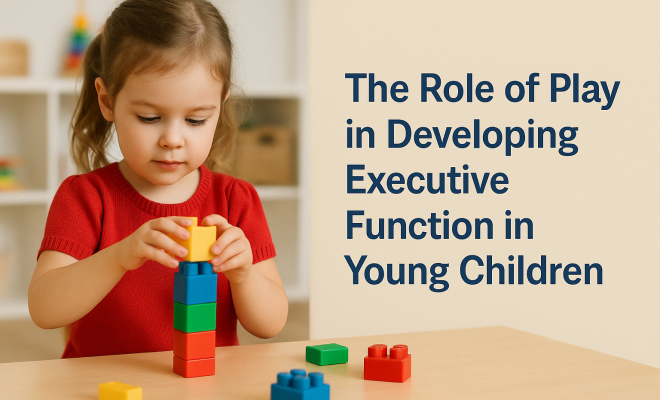
Allow children the freedom to explore their interests through unstructured play. Whether it’s building with blocks, drawing, or engaging in outdoor activities, giving children time to play without specific objectives encourages creativity and decision-making.
2. Introduce Structured Play Activities
Incorporate structured play activities, like board games or organized sports, to provide opportunities for children to practice rule-following, strategizing, and working collaboratively with others.
3. Limit Screen Time
While technology can certainly offer educational benefits, excessive screen time can detract from opportunities for interactive play. Set limits on screen usage to ensure children have ample time for physical and imaginative play.
4. Model Positive Play Behavior
Engage in play with your children, whether it’s through role-playing games or sports. Modeling positive interactions helps them learn how to navigate social situations and manage their emotions effectively.
The Role of Play in Academic Readiness
As educational systems increasingly focus on standardized testing and academic performance, the importance of play in academic readiness can sometimes be overlooked. However, skills nurtured through play—like problem-solving, attention regulation, and cognitive flexibility—are invaluable for successful learning.
A study published in the journal Developmental Psychology found a strong correlation between play-based learning and academic achievement. Children who engaged in play-centric educational experiences exhibited improved literacy and numeracy skills, highlighting the need for schools to integrate play into their curriculum.
Current Relevance: The Pandemic’s Impact on Play
The COVID-19 pandemic dramatically altered the landscape of play. Lockdowns, social distancing measures, and remote learning created a perfect storm that limited children’s access to traditional play settings. Research indicates that this has had varying impacts on children’s executive function abilities, with many experiencing heightened levels of anxiety and diminished social skills.
Parents and educators alike must acknowledge this shift and actively seek ways to reintegrate play into children’s lives. Creating safe, engaging environments where children can interact and explore freely is essential for rebuilding their executive function skills that may have been affected during the pandemic.
Final Thoughts: Investing in Play for Lifelong Skills
The connection between executive function and play in children is clear: play is not just a leisure activity but a vital component of healthy cognitive and emotional development. By prioritizing play, both at home and in educational settings, we can equip children with the executive function skills they need to thrive academically and socially.
As parents and educators, it’s our responsibility to advocate for play, recognizing its power to shape young minds. Let’s ensure that the laughter and creativity of playtime continue to be an integral part of every child’s journey toward becoming a well-rounded individual.
The Long-Term Benefits of Play on Executive Function
Understanding how play influences executive function isn’t just crucial for early childhood; it also has lasting impacts throughout childhood and into adolescence. Research suggests that children who engage in rich play experiences often demonstrate enhanced emotional regulation, social skills, and problem-solving capabilities well into their teenage years.
A longitudinal study published in the journal Child Development tracked children from preschool through high school. The findings indicated that those who had regular opportunities for play, especially imaginative and cooperative play, scored higher on measures of executive function during adolescence. This reinforces the idea that the skills developed during play are foundational and continue to benefit children as they grow.
Statistics on Play and Executive Function
Data from various research studies highlight the importance of play in developing executive function:
- According to a study by the National Institute for Play, children who engage in at least 60 minutes of daily play show a 20% increase in cognitive flexibility compared to those with less playtime.
- Research reveals that children who participate in structured play have 30% better working memory than those who do not.
- One study found that children who engage in cooperative play are 25% more likely to exhibit strong inhibitory control skills.
Expert Perspectives on Executive Function and Play
Experts in child development emphasize the critical role of play in fostering executive function. Dr. Adele Diamond, a renowned developmental psychologist, explains, “Play allows children to practice complex skills in real-life contexts. It’s through play that they learn to manage their thoughts, emotions, and actions, which are essential components of executive function.”
Similarly, Dr. Stuart Brown, founder of the National Institute for Play, states, “Play is not an option. It is a necessity for healthy human development. We cannot overlook its importance in building the cognitive skills children need to succeed in life.”
Common Misconceptions About Play
Even with the clear benefits of play, there are still misconceptions that can hinder its integration into children’s lives. Let’s address some of these myths:
Myth 1: Play is Just for Fun
Many adults view play as a frivolous activity. In reality, play is a serious learning process. It’s the way children learn to navigate their environment and develop important skills.
Myth 2: Playtime Can Be Sacrificed for Academics
Some believe that more time spent on academics means less time for play. However, research contradicts this, showing that play enhances learning and academic performance.
Myth 3: All Play is Beneficial
Not all play promotes executive function. Passive activities, such as watching television or playing video games, do not typically engage the same cognitive processes as active, imaginative play does.
FAQs About Executive Function and Play in Children
1. What age is best for encouraging play to enhance executive function?
It’s beneficial to encourage play from infancy through adolescence. Each stage of development has different types of play that can bolster executive function skills.
2. How can I tell if my child’s executive function skills are developing?
Signs of developing executive function can include improved attention spans, better impulse control, and enhanced problem-solving abilities. Observing how children manage tasks and social interactions can provide insight into their executive function development.
3. Are there specific games that promote executive function?
Yes! Games that require strategy, memory, and social interaction, such as chess, checkers, and team sports, are excellent for enhancing executive function.
4. How much playtime is recommended for children?
The American Academy of Pediatrics recommends at least one hour of unstructured play each day for children to support their cognitive, social, and emotional development.
5. What can I do if my child resists play?
Start by introducing play in short, manageable segments. Incorporate their interests, and gradually increase playtime. Encourage friends to join as social interaction can motivate participation.
6. Can structured activities replace unstructured play?
While structured activities can foster executive function, they should not replace unstructured play. Both types provide unique benefits and should be balanced in a child’s routine.
7. How does play relate to emotional development?
Play is crucial for emotional development as it provides children with opportunities to express feelings, understand empathy, and manage their emotions in social situations.
New Findings in Executive Function and Play Research
Recent studies are consistently uncovering new insights into how play influences executive function development. For example, a 2022 study published in Frontiers in Psychology examined the effects of outdoor play on executive function in preschoolers. The researchers found that children who participated in nature-based play showed significantly better attention regulation and working memory than those who engaged in indoor play. This underscores the potential benefits of diverse play environments.
Comparing Structured Play Versus Unstructured Play
While both structured and unstructured play have their merits, the debate continues regarding which type is more beneficial for developing executive function skills. Structured play, such as organized sports or games with rules, often targets specific skills like teamwork and rule-following, providing a clear framework for children to practice self-regulation.
On the other hand, unstructured play promotes creativity and independence, allowing children to explore and navigate their interests freely. A study published in Early Childhood Research Quarterly found that children who engage in more unstructured play demonstrate greater cognitive flexibility, which is a critical component of executive function. The ideal approach might involve a blend of both types of play to support various aspects of cognitive development.
Strategies for Integrating Play into Daily Routines
Incorporating play into children’s daily routines doesn’t have to be a chore. Here are some creative strategies:
- Family Play Nights: Designate one night a week for family games, whether board games, outdoor sports, or arts and crafts. This builds connections and enhances executive function skills through shared experiences.
- Make Chores Fun: Turn household chores into a game. Create a treasure hunt for cleaning supplies or time challenges to make these tasks more engaging.
- Play-Based Learning Activities: Integrate play into learning. For example, use role-play to teach history or math concepts through storytelling and imagination.
- Encourage Group Playdates: Arrange for playdates that encourage group interaction, as social play is vital for developing interpersonal skills and cognitive flexibility.
The Role of Educators in Facilitating Play
Educators play a crucial role in facilitating play within schools. They can create an environment that nurtures play by incorporating play-based learning into the curriculum. This includes setting up learning stations where children can engage in collaborative projects or self-directed exploration. By valuing and prioritizing play, educators can help children strengthen their executive function skills while also boosting their enthusiasm for learning.
Additionally, professional development opportunities for teachers can emphasize the importance of play in early childhood education, equipping them with the tools and strategies to foster a playful learning environment.
Conclusion: A Call to Action for Parents and Educators
It’s vital to recognize the integral role of play in nurturing both executive function and overall child development. As a society, we must advocate for children’s right to play, ensuring they have ample opportunities for both structured and unstructured play experiences. The benefits are profound—play prepares children for the complexities of life, equipping them with the cognitive tools they need to navigate their futures successfully. Let’s champion play as an essential element of childhood, creating environments that support continuous exploration, learning, and joy.
“`
Trending Now
Frequently Asked Questions
What is executive function in young children?
Executive function refers to a set of cognitive processes that help children manage their thoughts, actions, and emotions. It includes skills like working memory, inhibitory control, and cognitive flexibility, which are crucial for problem-solving, planning, and decision-making.
How does play influence executive function development?
Play significantly impacts executive function development by providing children with opportunities to engage in imaginative and social activities. Research shows that various types of play enhance skills like working memory and cognitive flexibility, leading to improved cognitive abilities.
What types of play are best for developing executive function?
Imaginative play and structured play activities are particularly effective in developing executive function in young children. These types of play encourage problem-solving, collaboration, and adaptability, which are key components of cognitive development.
Can play help with children's academic success?
Yes, engaging in play has been linked to better academic performance. By fostering executive function skills such as working memory and inhibitory control, play prepares children for the demands of school and enhances their overall learning capabilities.
How can parents support executive function development through play?
Parents can support executive function development by providing diverse play experiences that encourage creativity, problem-solving, and social interaction. Activities like role-playing, games that require strategy, and cooperative play can all enhance these critical cognitive skills.
What did we miss? Let us know in the comments and join the conversation.