Boost Cognitive Skills: Elementary Conservation Tasks
“`html
Understanding how children think and learn is a cornerstone of effective education. One significant area of focus in cognitive development is the concept of conservation. Conservation tasks are activities designed to assess a child’s understanding of quantity, volume, and number, regardless of their appearance. By engaging elementary school students in conservation activities, educators can play a vital role in their cognitive development, laying the groundwork for advanced reasoning and problem-solving skills.
What Are Conservation Tasks?
Conservation tasks were first introduced by developmental psychologist Jean Piaget in the 20th century. These tasks examine a child’s ability to recognize that certain properties of objects remain constant, even when their form or appearance changes. For instance, if two equal amounts of liquid are poured into differently shaped containers, a child who has achieved conservation will understand that both containers still hold the same volume, despite their different shapes.
Typically, conservation tasks are categorized into several types: conservation of number, mass, volume, and area. Each type assesses a child’s cognitive abilities at various developmental stages. While Piaget’s work laid the foundation, further research has refined our understanding of how children grasp these concepts and the most effective ways to teach them.
The Importance of Conservation in Cognitive Development
Engaging in elementary school conservation activities is essential for fostering critical thinking and problem-solving skills. Children who grasp conservation concepts are better equipped to handle mathematical tasks and scientific reasoning. Cognitive development plays a pivotal role in how children interact with their environment and understand the world around them.
For example, mastering conservation of number helps children with basic arithmetic, laying the groundwork for future mathematical skills. In contrast, failing to understand these concepts may hinder children’s academic progress, as they struggle to relate quantities and numbers effectively. Thus, teaching conservation is not just an academic exercise; it’s a fundamental building block for future learning.
Stages of Cognitive Development
According to Piaget, cognitive development unfolds through four stages: sensory-motor, preoperational, concrete operational, and formal operational. Conservation tasks are most relevant during the concrete operational stage, which typically occurs between the ages of 7 and 11. During this period, children begin to think logically about concrete events and understand the concept of conservation.
However, it is crucial to note that not all children reach these stages at the same age. Variability in cognitive development can be influenced by factors such as culture, education, and individual experiences. Therefore, educators must be mindful of these differences when designing conservation activities for their classrooms.
Types of Conservation Tasks
Within the realm of elementary school conservation activities, several types of tasks can be employed to assess different aspects of conservation. Below are some common examples:
- Conservation of Number: This task typically involves presenting children with two rows of objects (e.g., buttons or coins) and asking whether they have the same number of items. Children might initially say one row has more if they are spaced further apart, but they eventually learn that the number remains constant.
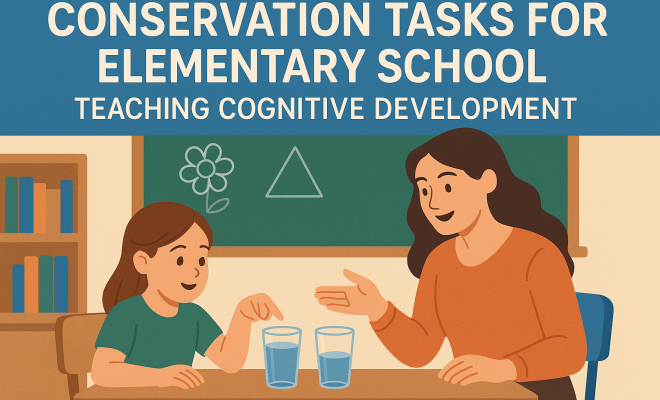
- Conservation of Volume: In this task, two containers of equal volume are filled with liquid. When the liquid from one container is poured into a taller, narrower container, younger children may believe the taller container holds more liquid, while older children recognize that the volume remains the same.
- Conservation of Mass: Similar to volume, this task involves showing children two equal lumps of clay. When one lump is flattened or shaped differently, younger children might think it has changed in mass, whereas older children understand it remains constant.
- Conservation of Area: This can be demonstrated using two identical squares of paper. If one square is cut into smaller pieces and rearranged to form a different shape, younger children might think it covers less area, while older children grasp that the area remains unchanged.
Effective Strategies for Implementing Conservation Activities
When it comes to elementary school conservation activities, incorporating engaging, hands-on learning experiences can significantly enhance understanding. Here are several strategies educators can employ:
- Use Real-World Objects: Incorporating everyday items such as blocks, coins, or food can make conservation tasks more relatable and engaging for students. Children are more likely to understand concepts when they can see and manipulate physical objects.
- Encourage Group Work: Collaborative activities not only foster social skills but also allow students to discuss their reasoning and challenge each other’s understanding. Group discussions can lead to deeper insights and clearer understandings of conservation concepts.
- Integrate Technology: Utilizing educational apps and online platforms can offer interactive conservation tasks that appeal to tech-savvy students. Gamifying the learning experience makes it more enjoyable while still educational.
- Scaffold Learning: Start with simpler tasks before moving on to more complex ones. This gradual increase in challenge allows students to build confidence and ensures they grasp each foundational concept before progressing.
Challenges in Teaching Conservation Tasks
While teaching conservation tasks is essential, educators often face challenges. One significant hurdle is the developmental variability among students. Because children develop at different rates, some may grasp conservation concepts earlier than others. This can lead to frustration for both students and teachers. (See: Conservation in psychology.)
Additionally, misconceptions can arise during conservation tasks. For instance, students may initially rely on visual cues rather than logical reasoning. Teachers must be prepared to address these misconceptions through guided questioning and reinforcement of logical thinking.
Finally, the pressure of standardized testing can detract from hands-on learning experiences. Educators might feel compelled to prioritize rote memorization over exploration, which can hinder the cognitive development that conservation tasks can offer. Striking a balance between meeting educational standards and providing enriching experiences is crucial.
Real-World Applications of Conservation Understanding
Understanding conservation concepts goes beyond academic success; it has real-world implications. Children equipped with conservation skills are better prepared to tackle everyday problems, whether they’re calculating how much juice is left in a carton or determining how to share snacks equally among friends.
Moreover, conservation tasks lay the groundwork for more advanced mathematical concepts, such as fractions and geometry. When children comprehend conservation, they can approach more complex topics with confidence and understanding, leading to greater overall success in school.
Additionally, in an age where environmental awareness is critical, understanding conservation can extend to ecological concepts. Educating students about resource conservation—such as water, energy, and materials—can promote a sense of stewardship for the planet, encouraging them to think critically about their impact on the environment.
The Role of Parents and Communities
While educators play a vital role in teaching conservation tasks, parents and communities also have a part to play. Engaging children in discussions about conservation at home can reinforce what they learn in school. Simple activities—like measuring ingredients for a recipe or discussing the sizes of items during shopping—provide practical applications of conservation concepts.
Community programs and workshops can also support learning. Environmental groups, libraries, and local organizations often offer resources—such as nature walks or science fairs—that align with conservation tasks. Collaboration between schools and communities can create a more enriching educational experience for children.
Incorporating Nature into Conservation Activities
Bringing conservation tasks outdoors provides an excellent opportunity for experiential learning. Nature-based conservation activities can be particularly powerful, allowing children to explore and understand concepts in a real-world context. For example, a classroom might engage students in measuring the height of trees, estimating the volume of water in a pond, or counting the number of leaves on different plants. These activities not only reinforce conservation principles but also connect students to their environment.
Schools can organize field trips to local parks, nature reserves, or botanical gardens, where students can observe conservation principles in action. Activities could include simple experiments like measuring the growth of plants under different environmental conditions, which demonstrate conservation of mass and volume in a tangible way.
Examples of Successful Conservation Programs
Many schools have successfully implemented conservation activities into their curriculum. For instance, the Eco-Schools Program encourages schools to focus on sustainable practices while integrating educational activities focused on the environment. Through Eco-Schools, students participate in projects that not only teach conservation but also empower them to take action regarding environmental issues. This program has fostered a generation of environmentally-conscious students who understand the importance of conservation from a young age.
Another great example is the Garden-Based Learning initiative. Schools partner with local organizations to create gardens on school grounds, where students engage in planting, caring for, and observing their growth. These gardens serve as a living laboratory for teaching conservation concepts related to plants, ecosystems, and the food cycle. Students can measure plant growth, calculate area for planting, and discuss the environmental impact of gardening practices. (See: Child cognitive development resources.)
Statistics on Conservation Education
Recent studies highlight the effectiveness of conservation education in schools. According to a survey conducted by the National Science Teachers Association, 73% of teachers reported a noticeable increase in student engagement when hands-on conservation activities were included in their lessons. Furthermore, children who participated in conservation programs showed a 30% improvement in understanding basic environmental concepts compared to those who did not.
Another important statistic comes from a report by the Environmental Protection Agency, which found that students who engage in environmental education programs are more likely to develop sustainable habits and attitudes. Over 80% of students involved in such programs reported a commitment to recycling and energy conservation practices at home.
FAQs about Elementary School Conservation Activities
What age group is best suited for conservation activities?
Conservation activities can be tailored for a range of ages, but they are especially effective for elementary school students aged 6 to 11, during their concrete operational stage of cognitive development.
How can I assess if my child understands conservation concepts?
Engage your child in discussions about everyday situations that involve conservation, such as sharing snacks or measuring liquids. Use questions that prompt them to explain their reasoning, and observe if they can articulate that the quantity remains the same despite changes in appearance.
Are conservation activities only for science classes?
While they are often associated with science, conservation activities can be integrated into math, art, and even social studies. For instance, art projects can involve measuring materials, while social studies can include discussions about resource management.
Can technology enhance conservation learning?
Absolutely! Many educational apps and online games focus on environmental science and conservation principles, making learning interactive and engaging for tech-savvy students. Additionally, virtual field trips can expose students to conservation concepts without leaving the classroom.
How can parents support conservation learning at home?
Parents can support conservation learning by engaging children in everyday activities that require measurement, counting, and logical reasoning. Discussing conservation topics during family outings or projects can further reinforce these concepts outside of school.
New Approaches to Conservation Education
As the understanding of conservation tasks evolves, educators are exploring new methodologies to engage students more effectively. One such approach is project-based learning (PBL), where students undertake projects that require them to apply conservation concepts in real-life situations. For example, students might plan a school garden, requiring them to measure plots, calculate soil volume, and consider plant placement based on area conservation principles. This not only enhances their grasp of conservation but also promotes teamwork and responsibility.
Another innovative approach is integrating conservation tasks into storytelling. Teachers can use narratives that involve characters dealing with conservation dilemmas, prompting students to think critically about the decisions being made. For example, a story about a character trying to save water during a drought could lead to discussions on conservation of volume and how it applies to everyday life. This method engages students’ imagination while reinforcing important concepts.
Community Involvement in Conservation Activities
Community involvement can significantly enrich conservation education. Schools can collaborate with local environmental organizations to host workshops or educational events focused on sustainability. For instance, a local recycling center might hold a session where students learn about waste management and participate in sorting recyclable materials. Such programs not only enhance understanding but also empower students to become active participants in their communities.
Additionally, schools could establish partnerships with local farms or botanical gardens, providing students with hands-on experiences in conservation and agriculture. These partnerships can offer field trips and real-life applications of conservation tasks, such as understanding the conservation of mass through soil measurements or exploring plant growth rates.
The Global Perspective on Conservation Education
Looking beyond local efforts, conservation education is becoming a global phenomenon. Various international programs focus on teaching children about conservation practices and environmental stewardship. For instance, the United Nations Educational, Scientific and Cultural Organization (UNESCO) promotes education for sustainable development globally, emphasizing the importance of conservation from a young age.
Many countries have also integrated conservation tasks into their national curriculums, recognizing the need for future generations to be environmentally literate. Countries like Finland and Sweden lead by example, with their education systems prioritizing outdoor learning and environmental studies. Their models can serve as inspiration for educators worldwide, proving that conservation education can indeed be a fundamental part of a child’s learning experience.
Statistics Supporting Global Conservation Education Initiatives
Recent surveys from organizations like UNESCO show that countries with comprehensive conservation education programs report higher levels of environmental awareness among students. Approximately 65% of students in countries with integrated conservation curriculums expressed a commitment to sustainability initiatives in their communities. Furthermore, studies indicate that eco-conscious habits developed during childhood often persist into adulthood, as evidenced by the 55% of adults who participated in conservation programs during their school years actively engaging in environmentally friendly practices today.
Conclusion: The Future of Conservation Activities in Education
As we move forward in education, the importance of incorporating elementary school conservation activities into curricula cannot be overstated. These tasks not only enhance cognitive development but also prepare children for real-world problem-solving and critical thinking. By fostering an understanding of conservation, educators empower students to navigate the complexities of their environment and make informed decisions.
In a rapidly changing world, equipping children with the skills to think critically about quantity, volume, and conservation extends beyond academic success. It shapes environmentally conscious citizens ready to engage with and protect their world. By embracing these activities, schools can cultivate a generation that values learning, reasoning, and responsible stewardship of the planet.
“`
Trending Now
Frequently Asked Questions
What are conservation tasks in cognitive development?
Conservation tasks are activities designed to assess a child's understanding that certain properties of objects, such as quantity and volume, remain constant despite changes in their appearance. These tasks, introduced by Jean Piaget, help evaluate cognitive abilities at various developmental stages.
Why are conservation tasks important for children?
Conservation tasks are crucial for fostering critical thinking and problem-solving skills in children. Understanding these concepts helps them excel in mathematical tasks and scientific reasoning, which are essential for their overall cognitive development and interaction with the world.
How do conservation tasks relate to Piaget's theory?
Conservation tasks are a key element of Jean Piaget's theory of cognitive development. They illustrate how children progress through stages of understanding, specifically their ability to recognize that certain properties remain unchanged despite changes in form or appearance.
What types of conservation tasks are there?
Conservation tasks are typically categorized into four types: conservation of number, mass, volume, and area. Each type assesses different aspects of a child's cognitive development and their ability to understand constancy in various contexts.
How can teachers implement conservation tasks in the classroom?
Teachers can implement conservation tasks by engaging students in hands-on activities that involve comparing quantities, volumes, or areas using different shapes and containers. These interactive tasks encourage critical thinking and help students develop a deeper understanding of mathematical concepts.
Agree or disagree? Drop a comment and tell us what you think.