Bloom’s Taxonomy Question Stems: Guide to Higher-Order Thinking
“`html
In the modern educational landscape, fostering higher-order thinking skills is more crucial than ever. Teachers are constantly seeking effective strategies to engage students and stimulate critical thinking. One of the most effective tools for achieving this is Bloom’s Taxonomy, particularly its question stems. These question stems serve as prompts that can guide students through a range of cognitive processes, from basic recall to complex analysis and evaluation. With the right application, Bloom’s Taxonomy Question Stems can transform classrooms across various subjects, enhancing student learning and comprehension.
1. Understanding Bloom’s Taxonomy
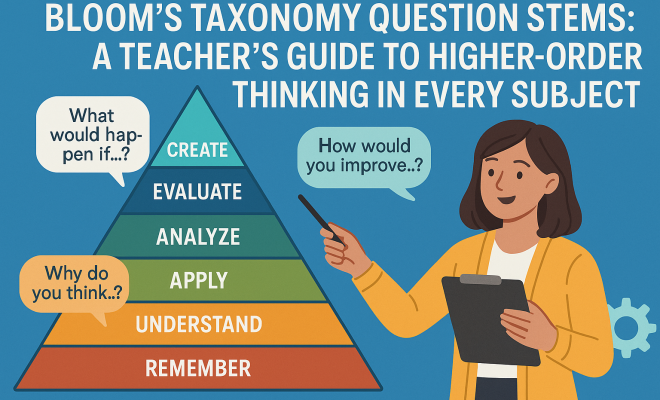
Bloom’s Taxonomy was developed in 1956 by a committee of educators led by Benjamin Bloom. The framework categorizes educational objectives into a hierarchy, originally consisting of six levels: Knowledge, Comprehension, Application, Analysis, Synthesis, and Evaluation. Over the decades, this taxonomy has been revised to reflect a more dynamic approach to learning, culminating in the revised version by Anderson and Krathwohl in 2001. Now, the levels are Remembering, Understanding, Applying, Analyzing, Evaluating, and Creating.
This hierarchical model emphasizes the importance of moving beyond rote memorization to encourage deeper learning. Each level represents a different type of cognitive process, promoting a progression from lower to higher-order thinking skills. By understanding this taxonomy, educators can craft effective lesson plans that challenge students and promote academic growth.
2. The Role of Question Stems in Education
Question stems are phrases or prompts that can guide students toward higher-order thinking by framing inquiries that require more than just factual recall. Instead of asking students to simply name the capitals of countries or list the steps in a scientific process, effective question stems prompt students to analyze, interpret, or evaluate information. For example, rather than asking, “What is the capital of France?”, a teacher might ask, “How does the geography of France influence its capital?” This not only engages students but also encourages them to think critically.
In every subject area, question stems can be tailored to fit specific content needs and learning goals. This adaptability makes them a powerful tool in any educator’s toolkit. The use of well-crafted question stems can stimulate rich discussions, foster collaborative learning environments, and enhance comprehension and retention of material.
3. Creating Effective Question Stems
To create effective Bloom’s Taxonomy question stems, educators should start by identifying the level of understanding they want to achieve in their students. Each level of Bloom’s taxonomy corresponds to specific action verbs that can guide the formulation of questions. For instance, if the objective is to analyze, educators might use stems such as, “What are the underlying causes of…?” or “How would you compare and contrast…?”
Here are some examples of question stems categorized by the different levels of Bloom’s Taxonomy:
- Remembering: What is…? List the…? Define…
- Understanding: Explain why…? Describe the significance of…?
- Applying: How would you use…? What examples can you find…?
- Analyzing: What is the relationship between…? How can you categorize…?
- Evaluating: What criteria would you use to assess…? How would you justify…?
- Creating: Can you design a…? How would you improve…?
4. Incorporating Question Stems Across Subjects
One of the greatest strengths of Bloom’s Taxonomy Question Stems is their versatility. They can be adapted for use in various subjects, including mathematics, science, literature, and social studies. In a science class, for instance, a teacher might frame a question like, “What would be the impact on the ecosystem if…?” This not only encourages students to apply their knowledge but also to analyze hypothetical situations.
In literature, question stems can be equally powerful. A prompt like, “How would the story change if the main character made a different choice?” encourages creative thinking as well as comprehension. By applying these question stems across subjects, educators can promote a holistic understanding of content while encouraging critical thinking and problem-solving skills.
5. Enhancing Classroom Discussions
Classroom discussions can often stagnate with surface-level questions. Bloom’s Taxonomy Question Stems can invigorate these discussions and encourage deeper engagement. When students are prompted with thought-provoking questions, they are more likely to explore concepts in greater depth, leading to richer dialogue and collaboration among peers. Rather than simply responding with a ‘yes’ or ‘no’, students can delve into the “why” and “how” of a topic. (See: Bloom's Taxonomy overview.)
For instance, instead of asking students if they liked a character in a novel, a teacher might ask, “What actions did the character take that influenced your view of them?” This not only requires students to reflect on their personal opinions but also to support their responses with textual evidence.
6. Assessment and Evaluation
Effective assessment is critical in education, and Bloom’s Taxonomy Question Stems can enhance both formative and summative assessments. By incorporating these question stems into tests and quizzes, educators can assess students’ understanding at various cognitive levels. Instead of relying solely on multiple choice or true/false questions, assessments can include open-ended questions that require analysis or evaluation.
For example, a history teacher might ask, “Evaluate the impact of the Industrial Revolution on modern society.” This not only assesses students’ knowledge of historical facts but also their ability to synthesize information and form well-supported arguments. Such assessments help teachers gauge student understanding and identify areas needing reinforcement.
7. Professional Development and Training
Incorporating Bloom’s Taxonomy Question Stems into teaching practices requires professional development and training. Educational leaders and administrators should provide support and resources for teachers to effectively implement these strategies in their classrooms. Workshops, ongoing training sessions, and collaborative planning opportunities can empower educators to craft meaningful question stems that align with their curriculum goals.
Furthermore, teachers should be encouraged to share their experiences and strategies in using question stems, fostering a culture of continuous learning and adaptation. Through collaboration, educators can refine their approaches and enhance their effectiveness in promoting higher-order thinking among students.
8. Real-World Applications and Impacts
Beyond the classroom, the ability to think critically and apply knowledge is essential in real-world scenarios. Employers across industries seek individuals who can analyze problems, evaluate solutions, and create innovative ideas. By employing Bloom’s Taxonomy Question Stems in education, teachers are not only preparing students for academic success but also equipping them with the skills necessary for future careers.
Furthermore, as students become adept at higher-order thinking, they learn to approach challenges with a problem-solving mindset. This capacity for critical thinking can lead to greater civic engagement and informed decision-making in their communities, ultimately benefiting society as a whole.
9. Final Thoughts on Bloom’s Taxonomy Question Stems
Incorporating Bloom’s Taxonomy Question Stems into educational practices represents a transformative approach to teaching and learning. By encouraging higher-order thinking, educators can create dynamic, engaging, and meaningful learning experiences. The versatility of question stems allows them to be used across various subjects, enhancing classroom discussions, assessments, and student engagement. As education continues to evolve, the integration of these question stems will remain vital in empowering students to become critical thinkers and lifelong learners.
10. Examples of Bloom’s Taxonomy Question Stems in Action
To better illustrate the effectiveness of Bloom’s Taxonomy Question Stems, let’s explore some practical examples across different educational contexts. In a high school science class, a teacher might introduce a unit on ecosystems. Instead of asking students to define what an ecosystem is, they could pose the question, “What factors contribute to the health of an ecosystem?” This question encourages students to not only recall information but also synthesize their understanding of various elements interacting within an ecosystem.
In a mathematics setting, a teacher might ask, “How would you approach solving this problem differently if you were given additional constraints?” This type of question stimulates critical thinking and encourages students to explore different methods of problem-solving, which is essential for developing mathematical reasoning skills. (See: U.S. Department of Education on teaching strategies.)
In literature classes, students could be asked, “What themes are present in this novel, and how do they reflect the historical context in which it was written?” This encourages students to analyze the text critically and relate it to broader societal issues, further enhancing their comprehension and analytical skills.
11. Statistics on the Effectiveness of Higher-Order Thinking
Research has shown that teaching methods that promote higher-order thinking significantly improve student engagement and comprehension. A study published in the Journal of Educational Psychology found that students exposed to higher-order questioning techniques scored on average 30% higher on assessments than their peers who received traditional instruction. Furthermore, a meta-analysis of 100 studies indicated that students who engage in higher-order thinking tasks are more likely to retain information long-term and apply their knowledge in novel situations.
These statistics underscore the importance of incorporating Bloom’s Taxonomy Question Stems into teaching practices. Educators can create a more effective learning environment by focusing on questions that stimulate higher-order thinking, thus preparing students for real-world challenges.
12. Expert Perspectives on Bloom’s Taxonomy
Education experts emphasize the importance of Bloom’s Taxonomy in modern pedagogy. Dr. Patricia Kuhl, a cognitive scientist at the University of Washington, states, “Teaching students to think critically is crucial for their success in an increasingly complex world. Bloom’s Taxonomy provides educators with a framework to structure learning experiences that cultivate critical thinking skills.”
Similarly, Dr. John Hattie, a renowned educational researcher, highlights the effectiveness of visible learning through structured questioning. He notes, “When teachers use question stems based on Bloom’s Taxonomy, they are not just assessing knowledge; they are inviting students into a dialogue that promotes deeper understanding and learning.” These insights from experts reinforce the framework’s relevance in contemporary education.
13. Creating a Question Stem Toolkit
For teachers looking to implement Bloom’s Taxonomy Question Stems in their classrooms, developing a question stem toolkit can be a valuable resource. This toolkit could include examples of question stems for each level of Bloom’s Taxonomy, categorized by subject area. Additionally, teachers might include strategies for using these stems in different instructional contexts, such as group discussions, individual assignments, or assessments.
Examples of question stems can be printed and displayed in classrooms or shared digitally among educators. This collaborative approach helps create a shared language of inquiry among teachers, fostering a community that values critical thinking and engaged learning.
14. FAQ: Bloom’s Taxonomy Question Stems
What are Bloom’s Taxonomy Question Stems?
Bloom’s Taxonomy Question Stems are prompts that educators use to facilitate higher-order thinking in students. They guide inquiry at various cognitive levels, from basic recall of facts to complex evaluation and creation of new ideas.
Why are question stems important in education?
Question stems encourage deeper thinking and understanding, helping students move beyond memorization to analyze, evaluate, and create. This promotes critical thinking skills essential for academic success and real-world applications. (See: Harvard's resources on Bloom's Taxonomy.)
How can I create my own question stems?
To create effective question stems, consider the objective you want to achieve. Use action verbs corresponding to Bloom’s levels, and frame your questions to encourage analysis, synthesis, or evaluation.
Can question stems be used in all subject areas?
Absolutely! Bloom’s Taxonomy Question Stems are versatile and can be adapted for any subject, including mathematics, science, literature, and social studies, enhancing critical thinking and comprehension across the curriculum.
How can I assess the effectiveness of question stems in my teaching?
Evaluate student responses to the questions you pose. Are they engaging in deeper analysis and critical thinking? Look at assessment scores and student engagement in discussions to gauge effectiveness.
Where can I find more resources on Bloom’s Taxonomy?
Many educational websites, professional development resources, and instructional guides offer information on Bloom’s Taxonomy and sample question stems. Consider exploring online platforms, educational journals, and workshops focused on critical thinking in education.
15. Strategies for Implementing Question Stems
Implementing Bloom’s Taxonomy Question Stems can be a game changer for educators. Here are some effective strategies to seamlessly integrate them into your teaching:
- Start Small: Introduce question stems gradually. Begin with one subject or lesson plan, and once comfortable, expand to others. This helps in becoming more familiar with the types of questions that elicit higher-order thinking.
- Modeling: Demonstrate how to use question stems in class discussions. Show students how to formulate their own questions and encourage them to respond to peers using these stems during group work.
- Peer Collaboration: Foster collaboration by having students create question stems together. This can be particularly effective in group projects or literature circles, where they analyze texts collectively.
- Feedback Loop: After using question stems, gather feedback from students about which questions they found engaging or challenging. This can help refine future questions and better meet students’ needs.
- Reflection: Encourage students to reflect on their learning and the thought processes that led them to their answers. This not only reinforces their understanding but also highlights the value of the question stems used.
16. Challenges in Using Bloom’s Taxonomy Question Stems
While Bloom’s Taxonomy Question Stems offer numerous benefits, teachers may also face challenges in their implementation. Here are some common hurdles and ways to address them:
- Time Constraints: Developing higher-order questions can be time-consuming. To combat this, teachers can create a bank of question stems in advance that can be reused across multiple lessons.
- Student Resistance: Some students may be accustomed to traditional rote learning. Gradually introduce question stems and provide support as students become familiar with higher-order thinking tasks.
- Assessing Responses: Evaluating open-ended responses can be challenging. Develop clear rubrics that outline expectations for higher-order thinking skills, so students know what is required in their answers.
- Balancing Depth and Breadth: It’s important to strike a balance between covering content and encouraging deeper analysis. Integrate question stems into existing content rather than replacing it entirely.
17. Future Trends in Higher-Order Thinking Education
The landscape of education is continually evolving, and with advances in technology and pedagogy, the emphasis on higher-order thinking is likely to grow. Here are some emerging trends related to Bloom’s Taxonomy and question stems:
- Digital Learning Tools: The rise of digital platforms allows for interactive question stems that can adapt to student responses in real-time, providing immediate feedback and fostering engagement.
- Project-Based Learning (PBL): More educators are adopting PBL approaches that naturally integrate higher-order thinking. Question stems can help guide the projects, prompting students to explore, analyze, and evaluate their findings.
- Interdisciplinary Learning: As education becomes more integrated, question stems will facilitate connections between subjects, helping students apply knowledge across various domains.
- Personalized Learning: Tailoring question stems to individual learning styles and needs can make higher-order thinking more accessible, allowing for differentiation in the classroom.
“`
Trending Now
Frequently Asked Questions
What is Bloom's Taxonomy?
Bloom's Taxonomy is a framework developed in 1956 by educators led by Benjamin Bloom, categorizing educational objectives into a hierarchy of cognitive processes. It includes levels such as Remembering, Understanding, Applying, Analyzing, Evaluating, and Creating, promoting deeper learning beyond rote memorization.
How can question stems enhance student learning?
Question stems are prompts that encourage higher-order thinking by requiring students to analyze, interpret, or evaluate information. Instead of simple recall, they guide students to engage in deeper cognitive processes, enhancing comprehension and critical thinking skills.
What are some examples of higher-order thinking questions?
Examples of higher-order thinking questions include prompts like 'How would you evaluate the effectiveness of…?' or 'What are the implications of…?' These types of questions encourage students to analyze and synthesize information rather than just recall facts.
Why is higher-order thinking important in education?
Higher-order thinking is crucial in education as it fosters critical thinking, problem-solving, and analytical skills. These skills are essential for students to navigate complex situations and apply their knowledge effectively in real-world contexts.
How has Bloom's Taxonomy been revised?
Bloom's Taxonomy was revised in 2001 by Anderson and Krathwohl, shifting from the original six levels to a more dynamic model with levels: Remembering, Understanding, Applying, Analyzing, Evaluating, and Creating, reflecting contemporary educational practices.
Agree or disagree? Drop a comment and tell us what you think.