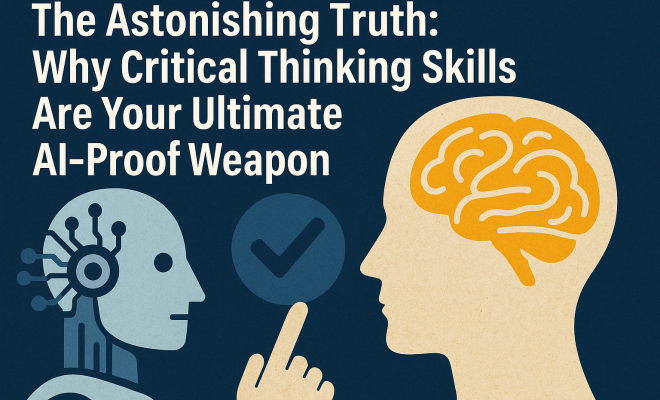
The Astonishing Truth: Why Critical Thinking Skills Are Your Ultimate AI-Proof Weapon
“`html
We’ve all heard the whispers, haven’t we? The fear that artificial intelligence is coming for our jobs, ready to automate away everything from data entry to even creative pursuits. It’s a narrative that’s dominated headlines and late-night conversations. But what if I told you the real story is far more nuanced, even surprisingly optimistic for those willing to adapt? A groundbreaking report from the World Economic Forum just dropped, and it’s turning the conventional wisdom on its head, revealing that while AI is indeed transforming the workplace, it’s simultaneously creating an unprecedented demand for a very human set of abilities. The study, which polled over 10,000 employers across the globe, points to a dramatic shift: certain ‘AI-proof’ skills, particularly critical thinking skills and emotional intelligence, are now considered gold, becoming the most valuable assets for anyone looking to secure their future employment.
This isn’t just another dry academic paper; it’s a call to action that’s already gone viral, sparking massive engagement on social media. People are sharing personal stories, seeking advice, and scrambling to understand what this means for their careers. It’s a powerful counter-narrative to the widespread anxiety about AI job displacement, offering a hopeful, yet urgent, message about professional development. The message is clear: while machines can handle routine tasks with dizzying efficiency, the human element—our capacity for deep thought, nuanced understanding, and genuine connection—is becoming more indispensable than ever. So, if you’re wondering how to navigate this brave new world, let’s dive into the skills that will not only keep you relevant but help you thrive.
1. Critical Thinking Skills: The Ultimate AI Antidote
If there’s one skill that stands head and shoulders above the rest in the new economy, it’s critical thinking. The World Economic Forum’s report didn’t mince words: employers are crying out for individuals who can analyze complex information, evaluate arguments, and form reasoned judgments. Think about it: AI can process mountains of data in seconds, but it can’t truly question its own assumptions, identify biases in its training data, or understand the subtle, often contradictory, human factors at play in a decision. That’s where you come in.
Developing strong critical thinking skills means moving beyond simply accepting information at face value. It involves actively asking ‘why?’ and ‘how?’ and ‘what if?’ It means being able to dissect a problem into its core components, identify relevant and irrelevant information, and construct logical arguments. For instance, an AI might generate a brilliant marketing campaign based on past data, but it takes a human with critical thinking to anticipate an unforeseen cultural backlash, question the ethical implications of the messaging, or pivot strategy based on a qualitative understanding of consumer sentiment that algorithms simply can’t grasp. This isn’t just about problem-solving; it’s about problem-finding and ensuring the solutions are robust, ethical, and truly effective in a messy human world.
2. Emotional Intelligence: Connecting in a Disconnected World
Next up on the ‘AI-proof’ list is emotional intelligence (EQ), and for good reason. As AI automates more transactional aspects of work, the demand for human interaction that’s genuinely empathetic, persuasive, and collaborative skyrockets. The report highlights that understanding and managing one’s own emotions, and recognizing and influencing the emotions of others, is now a premium skill. Machines don’t have feelings, can’t read between the lines of a tense negotiation, or offer genuine comfort to a struggling colleague. These are uniquely human strengths.
Think about leadership, sales, customer service, or team collaboration. In all these areas, success hinges on the ability to build rapport, de-escalate conflicts, motivate others, and truly understand unspoken needs. An AI can process customer queries, but it can’t offer the genuine empathy that turns a frustrated customer into a loyal advocate. It can analyze team performance metrics, but it can’t sense underlying tension or inspire a group to push through a challenging project. Emotional intelligence is about navigating the complex social dynamics that are inherent in any human endeavor, making it irreplaceable in a world increasingly reliant on technology.
3. Complex Problem-Solving: Beyond the Obvious Solutions
While AI excels at solving well-defined problems with clear parameters, it struggles when the problem itself is ill-defined, ambiguous, or requires a truly novel approach. This is where complex problem-solving abilities become invaluable. The World Economic Forum’s findings underscore that employers need people who can tackle issues that don’t have a ready-made solution in a database or a predictable algorithmic path. These are the ‘wicked problems’ that defy easy categorization and often involve multiple interdependent factors.
Consider a global supply chain disruption, a sudden shift in market dynamics, or an unforeseen ethical dilemma arising from new technology. An AI might offer data points or projections, but it takes a human brain to synthesize disparate information, identify root causes that aren’t immediately obvious, and devise creative, adaptive strategies. This often involves blending logical reasoning with intuition, collaborating across diverse teams, and being comfortable with ambiguity. It’s about not just finding answers, but knowing how to ask the right questions when the path forward isn’t clear, a skill deeply intertwined with critical thinking skills.
4. Creativity and Innovation: The Spark of Originality
Yes, AI can generate art, music, and text. But true creativity, the kind that pushes boundaries, conceives entirely new paradigms, or creates something truly original from scratch, remains firmly in the human domain. The report emphasizes that the ability to think outside the box, to connect seemingly unrelated ideas, and to innovate new solutions or products is more sought-after than ever. AI tools are fantastic at augmenting human creativity, acting as powerful assistants, but they don’t possess the inherent curiosity, the drive to express, or the capacity for genuine serendipitous discovery that defines human ingenuity. (See: CDC on Emotional Intelligence.)
This isn’t just about artistic endeavors. Creativity is vital in business strategy, product development, marketing, and even process improvement. It’s about seeing new opportunities, designing better systems, or finding novel ways to engage customers. When everyone has access to similar AI tools, the differentiator becomes the human mind that can envision something truly unique and compelling, leveraging those tools rather than being replaced by them. It’s about bringing a fresh perspective that AI, by its very nature of being trained on existing data, simply cannot replicate. For more context, see AI Glasses Cheating Threatens Exams.
5. Leadership and Social Influence: Guiding the Human Element
Effective leadership and the ability to influence others are inherently human skills that AI cannot replicate. The World Economic Forum’s survey results clearly show that organizations are prioritizing individuals who can inspire, motivate, and guide teams through change. This goes far beyond mere management of tasks; it involves building trust, fostering a positive culture, mediating disputes, and empowering individuals to reach their full potential. These are the soft skills that make hard objectives achievable.
Think about a leader who needs to articulate a compelling vision, negotiate a complex deal, or rally a demoralized team. These scenarios demand charisma, empathy, and a deep understanding of human psychology—qualities that are fundamental to social influence. While AI can analyze team performance or suggest communication strategies, it can’t deliver a stirring speech, build genuine camaraderie, or navigate the delicate balance of power dynamics in a boardroom. Leadership is about human connection and direction, making it another crucial ‘AI-proof’ ability that relies heavily on critical thinking skills and emotional intelligence.
6. Service Orientation: Prioritizing Human Needs
In a world increasingly driven by efficiency and automation, the ability to genuinely help and serve others stands out. The report identifies service orientation as a key skill, emphasizing a proactive approach to understanding and meeting the needs of clients, customers, and colleagues. This isn’t just about following a script or processing a request; it’s about anticipating issues, going the extra mile, and building relationships based on trust and genuine care. AI can automate many aspects of service delivery, but it can’t replicate the human touch that makes a difference.
Consider a healthcare professional, a financial advisor, or even a retail assistant. The truly invaluable individuals in these roles are those who listen intently, show genuine concern, and tailor solutions to unique circumstances. They demonstrate empathy, patience, and a deep desire to solve problems for others, often before those problems are even fully articulated. This human-centric approach to service creates loyalty and satisfaction in ways that algorithms, no matter how sophisticated, simply cannot. It’s about making people feel truly seen and heard, something that requires a nuanced understanding of human behavior.
7. Judgment and Decision-Making: The Wisdom Factor
While AI can provide data-driven recommendations, the ultimate responsibility for making high-stakes decisions, particularly those with ethical, social, or long-term strategic implications, rests with humans. The World Economic Forum highlights judgment and decision-making as a critical skill, emphasizing the ability to weigh complex factors, assess risks, and make sound choices even in the face of uncertainty and incomplete information. This is where experience, intuition, and a strong moral compass come into play, all underpinned by robust critical thinking skills.
Imagine a CEO deciding whether to launch a controversial product, a judge presiding over a complex legal case, or a doctor making a life-or-death diagnosis. While AI can offer probabilities and insights, the final decision requires human wisdom, accountability, and the ability to grapple with trade-offs that extend beyond pure data optimization. It’s about understanding the ripple effects of a decision, not just on immediate outcomes but on people, culture, and long-term reputation. This human capacity for nuanced judgment, especially in ethically ambiguous situations, is paramount.
8. Systems Analysis and Evaluation: Understanding the Big Picture
As our world becomes more interconnected and complex, the ability to understand how different parts of a system interact and influence each other is incredibly valuable. The report points to systems analysis and evaluation as a crucial ‘AI-proof’ skill. This involves not just understanding individual components but seeing the entire ecosystem, identifying bottlenecks, anticipating unintended consequences, and figuring out how to optimize the whole. While AI can model systems, it takes human insight to truly evaluate their effectiveness in real-world contexts and propose meaningful improvements.
Think about managing a large organization, designing urban infrastructure, or even implementing a new technology platform. A systems analyst needs to grasp the interplay of technology, human behavior, regulatory frameworks, and economic forces. They can identify leverage points, predict how a change in one area will affect others, and devise holistic solutions that avoid simply patching symptoms. This requires a high degree of abstract reasoning, pattern recognition, and the ability to think in terms of interconnectedness—all facets of advanced critical thinking skills applied to a broader scope.
The Great Reskilling: Your Path Forward
The message from the World Economic Forum is clear: the future of work isn’t about competing with AI; it’s about complementing it. The skills that make us uniquely human—our capacity for deep thought, empathy, creativity, and nuanced judgment—are not just surviving the rise of AI, they’re becoming more valuable than ever. This dramatic shift highlights a significant skills gap, meaning there’s an urgent need for individuals and educational institutions to adapt. The good news is, these ‘AI-proof’ skills aren’t innate; they can be developed and honed through conscious effort and dedicated practice. (See: AP News on AI and Job Skills.)
So, what does this mean for you? It’s a powerful invitation to invest in yourself. Look for online courses, professional development programs, and certifications that focus on strengthening your critical thinking skills, emotional intelligence, and complex problem-solving abilities. Seek out opportunities in your current role or through volunteer work that challenge you to lead, innovate, and serve. The viral nature of this report on social media isn’t just about fear; it’s about a collective realization that the future belongs to those who embrace their humanity. By focusing on these indispensable human-centric skills, you won’t just ‘AI-proof’ your career; you’ll unlock a more fulfilling and impactful professional journey. For more context, see This Crucial Shift in Teen Social Media Use Is Fueling an Anxiety Epidemic.
Deep Dive: The Nuances of Critical Thinking Skills
Let’s really dig into what makes critical thinking skills so uniquely human and why AI can’t quite replicate them. It’s not just about logical deduction, although that’s certainly a part of it. True critical thinking involves a blend of cognitive abilities that allow us to navigate ambiguity and uncertainty, something AI struggles with. For example, consider the ability to identify implicit assumptions. AI models operate on the data they’re fed. If that data contains biases or unstated assumptions, the AI will perpetuate them without question. A human with strong critical thinking skills, on the other hand, can step back and ask: “What beliefs or values are embedded in this data? What might we be taking for granted here?” This meta-cognitive ability—thinking about our thinking—is a cornerstone of critical thought.
Another crucial element is the capacity for ethical reasoning. AI can be programmed with ethical guidelines, but it can’t grapple with moral dilemmas in the same way a human can. When faced with a situation where two ‘good’ outcomes conflict, or where a decision impacts human dignity in a way that isn’t quantifiable, critical thinking allows us to weigh the qualitative, often subjective, factors. It’s about understanding the human impact beyond metrics. This isn’t just about following rules; it’s about the deep, often uncomfortable, process of moral deliberation, which is inherently tied to our humanity. This makes critical thinking skills not just valuable, but essential for responsible innovation and leadership in the AI age.
The Impact of AI on Skill Development: A Comparison
It’s easy to view AI as a competitor, but a more productive perspective is to see it as a powerful co-pilot. AI can actually enhance our ability to develop these critical human skills, rather than replace them. For instance, AI tools can automate the gathering and initial analysis of vast datasets, freeing up human minds to focus on the higher-level critical thinking: interpreting patterns, identifying anomalies, and formulating strategic questions. Instead of spending hours crunching numbers, you can spend that time debating the implications of those numbers, considering alternative hypotheses, and challenging the underlying assumptions.
Think about a legal professional. AI can review thousands of legal documents in minutes, flagging relevant precedents. But it takes a human lawyer, armed with critical thinking skills, to interpret the nuances of those precedents, understand how they apply to a unique case, argue their relevance persuasively, and navigate the complex human dynamics of a courtroom. Similarly, in education, AI can personalize learning paths and offer immediate feedback on foundational knowledge. This allows educators to dedicate more time to fostering critical discussion, encouraging creative problem-solving, and developing students’ emotional intelligence through interpersonal engagement. So, AI isn’t just creating a need for these skills; it’s also providing tools that can help us cultivate them more effectively by offloading the mundane.
Expert Perspectives: What Leaders Are Saying
Beyond the World Economic Forum report, prominent figures across industries are echoing the sentiment about the growing importance of human-centric skills. Satya Nadella, CEO of Microsoft, often speaks about the need for “empathy, creativity, and judgment” as core human capabilities that will define the future workforce. He emphasizes that while AI can amplify human ingenuity, it cannot replace the uniquely human ability to connect, understand, and create new value. Similarly, leaders in the education sector, like Andreas Schleicher, Director for Education and Skills at the OECD, highlight the urgency of reorienting educational systems to prioritize critical thinking skills, collaboration, and socio-emotional learning over rote memorization.
Venture capitalists are also increasingly looking for these qualities in startup founders. They know that a brilliant technical idea can fail without a leader who possesses strong emotional intelligence to build and motivate a team, critical thinking skills to adapt to market shifts, and creativity to pivot when necessary. The consensus forming across diverse sectors is clear: the future belongs to those who can master the art of being human in an increasingly technological world. It’s a powerful testament to the enduring value of our innate abilities.
Practical Strategies for Cultivating Critical Thinking Skills
So, you’re convinced that critical thinking skills are crucial, but how do you actually get better at them? It’s not just something you’re born with; it’s a muscle you can train. Here are some actionable strategies: For more context, see Education Department Sends Student Loan Borrowers 'Final Notices'.
- Practice Active Questioning: Don’t just accept information. Ask “Why is this true?” “How do we know?” “What evidence supports this?” “What are the counter-arguments?” Do this with news articles, work reports, and even casual conversations.
- Seek Diverse Perspectives: Actively engage with people who hold different viewpoints than your own. Try to understand their reasoning, even if you disagree. This helps you identify your own biases and broaden your understanding of complex issues.
- Analyze Assumptions: Every argument or decision rests on certain assumptions. Practice identifying these. Ask yourself: “What has to be true for this statement/plan to work?” “Are these assumptions valid?”
- Deconstruct Problems: When faced with a complex problem, break it down into smaller, manageable parts. What are the core elements? How do they relate to each other? This makes the problem less daunting and easier to analyze systematically.
- Evaluate Evidence: Not all evidence is equal. Learn to distinguish between credible sources and unreliable ones. Understand the difference between correlation and causation. Question the methodology behind data collection.
- Engage in Socratic Dialogue: Find a trusted colleague or friend and discuss a complex topic, challenging each other’s ideas with questions. This simulates real-world critical analysis.
- Reflect and Journal: After making a decision or analyzing a situation, take time to reflect on your thought process. What went well? What could you have done differently? What biases might have influenced you?
Frequently Asked Questions About AI, Work, and Human Skills
Q1: Will AI really take all our jobs?
No, not all jobs. The World Economic Forum report and many other studies suggest that AI will automate routine, repetitive tasks, but it will simultaneously create new jobs and increase demand for uniquely human skills like critical thinking, creativity, and emotional intelligence. The future is more about job transformation and augmentation than outright replacement.
Q2: How quickly do I need to develop these ‘AI-proof’ skills?
The shift is already happening, so the sooner you start, the better. Continuous learning is key in today’s rapidly evolving job market. Think of it as an ongoing journey rather than a one-time fix.
Q3: Are these skills only for high-level positions?
Absolutely not. While leadership roles certainly demand these skills, they are becoming crucial at every level of an organization. From customer service to data analysis, the ability to think critically, solve complex problems, and engage empathetically is highly valued in all sectors.
Q4: Can AI help me learn these human skills?
Yes, indirectly! AI tools can free up your time by automating mundane tasks, allowing you to focus on developing these higher-order skills. AI can also provide personalized learning resources, simulate scenarios for practice, and give you feedback on certain aspects of communication or problem-solving, acting as a valuable learning assistant.
Q5: What if I’m not naturally creative or empathetic? Can I still develop these skills?
Yes, definitely. While some people might have a natural inclination, these skills are not fixed traits; they are developed through practice, conscious effort, and exposure to different experiences. Like any muscle, the more you exercise your critical thinking, emotional intelligence, and creativity, the stronger they become.
Q6: Should I focus on technical skills or human skills?
The ideal approach is a blend of both. Technical skills get you in the door, but human skills—especially critical thinking skills—help you stand out, adapt, and lead. The most valuable professionals will be those who can effectively leverage technology while bringing uniquely human insights and capabilities to the table.
“`
Trending Now
Frequently Asked Questions
What are critical thinking skills and why are they important?
Critical thinking skills involve the ability to analyze information, evaluate evidence, and make reasoned decisions. They are crucial in today's job market as they enable individuals to solve complex problems and adapt to changing circumstances, making them highly sought after by employers amidst the rise of AI.
How does AI impact job security?
AI is transforming the workplace by automating routine tasks, which raises concerns about job security. However, it simultaneously increases demand for 'AI-proof' skills like critical thinking and emotional intelligence, which are essential for roles that require human judgment and creativity.
What skills are considered 'AI-proof'?
According to the World Economic Forum, 'AI-proof' skills include critical thinking, emotional intelligence, creativity, and complex problem-solving. These skills are invaluable as they complement AI capabilities and ensure individuals remain relevant in an evolving job landscape.
Why is emotional intelligence important in the workplace?
Emotional intelligence is vital in the workplace as it enhances interpersonal relationships, fosters teamwork, and improves communication. As AI takes over more technical tasks, the ability to connect with others and understand emotions becomes increasingly essential for job success.
How can I improve my critical thinking skills?
Improving critical thinking skills can be achieved through practice and education. Engage in activities that challenge your reasoning, such as puzzles and debates, seek diverse perspectives, and reflect on your decision-making processes to enhance your analytical abilities.
What's your take on this? Share your thoughts in the comments below — we read every one.