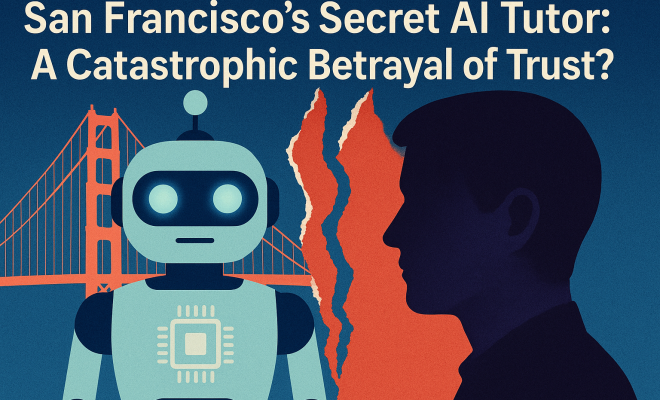
San Francisco’s Secret AI Tutor: A Catastrophic Betrayal of Trust?
“`html
Imagine sending your child off to elementary school, trusting that the learning environment is transparent and that you’re kept in the loop about significant changes to their education. Now, imagine discovering, not from the school, but through a news report or a whispered conversation, that an artificial intelligence program has been quietly integrated into their daily lessons, acting as a personal reading tutor. This isn’t a dystopian novel; it’s the unsettling reality that recently unfolded for countless parents in the San Francisco Unified School District (SFUSD).
The revelation that an AI reading tutor, named Amira, was deployed for K-5 students without parents’ explicit knowledge or consent has ignited a firestorm of controversy. This isn’t just about a new piece of software; it’s about trust, transparency, data privacy, and the very essence of what we believe education should be. The incident has quickly gone viral, sparking urgent questions about the ethical tightrope school districts are walking as they adopt powerful new technologies, especially an AI tutor in classrooms. It forces us all to confront the potential long-term impacts on our children’s development and the crucial role of human connection in learning.
The Shocking Rollout: How Amira Slipped Under the Radar
The story of Amira’s unannounced arrival in San Francisco classrooms is a case study in how not to introduce new technology into sensitive environments like elementary schools. For many parents, the first they heard of Amira was not through an email, a PTA meeting, or a school newsletter, but through external reporting. This lack of direct communication created an immediate sense of betrayal. Parents felt blindsided, as if a significant educational decision had been made behind their backs, impacting their children directly.
Amira, developed by Amira Learning, is designed to listen to children read aloud, identify struggles, and provide real-time feedback. On the surface, the idea of personalized reading assistance sounds appealing. Who wouldn’t want their child to receive tailored support, especially in a foundational skill like reading? However, the problem wasn’t necessarily the technology itself, but the clandestine manner of its implementation. This wasn’t a minor curriculum adjustment; it was the introduction of an AI tutor in classrooms that would interact intimately with young children, collecting data on their speech patterns, reading fluency, and potentially even their emotional responses to learning challenges. For such a significant shift, transparency should have been paramount.
Parental Outcry: A Breach of Trust and Autonomy
The swift and vocal parental backlash wasn’t just about privacy; it was deeply rooted in a feeling of disempowerment. Parents are, by definition, their children’s primary advocates. They expect to be informed about the tools and methods used in their child’s education, particularly when those tools involve sophisticated artificial intelligence. The SFUSD’s failure to communicate effectively stripped parents of their ability to make informed decisions, ask questions, or voice concerns before the technology was already in place.
One parent, Sarah Chen, whose child attends a San Francisco elementary school, articulated the sentiment shared by many: “It’s not just about what the AI does; it’s about the principle. We trust the school with our children’s education and well-being. To find out they’ve put an AI in front of them, recording their voices, without telling us, feels like a fundamental breach of that trust.” This sentiment highlights the broader issue of parental autonomy in educational choices. When schools adopt technologies that fundamentally alter the learning experience and data collection practices, parents have a right to be part of that conversation.
Data Privacy in the Digital Classroom: A Looming Concern
Perhaps the most immediate and profound concern stemming from the Amira controversy is student data privacy. An AI tutor in classrooms, especially one that processes speech and assesses learning, collects a vast amount of potentially sensitive information. This includes recordings of children’s voices, their reading errors, their progress over time, and even unique vocal biomarkers. The question isn’t just what data is being collected, but how it’s stored, who has access to it, and for how long.
In an era where data breaches are commonplace and personal information is a valuable commodity, parents are understandably wary. What are the district’s agreements with Amira Learning? Is the data anonymized? Could this data ever be used for purposes beyond educational assessment, or shared with third parties? These aren’t hypothetical anxieties; they are legitimate questions that demand clear, actionable answers. Without robust safeguards and transparent policies, the promise of personalized learning can quickly turn into a privacy nightmare, potentially exposing children to unforeseen risks in the digital landscape.
Algorithmic Bias: The Unseen Influence of AI
Another critical ethical concern, often overlooked by non-experts, is the potential for algorithmic bias. AI models are only as good as the data they’re trained on. If the training data for an AI tutor in classrooms like Amira isn’t diverse and representative of all student populations – including different accents, dialects, and learning styles – the AI could inadvertently disadvantage certain groups of children. For example, an AI trained predominantly on standard American English might struggle to accurately assess a child with a regional accent or for whom English is a second language, leading to misdiagnoses of reading difficulties or unfair evaluations.
Dr. Ruha Benjamin, a professor of African American Studies at Princeton University and author of ‘Race After Technology,’ often speaks about the dangers of “discriminatory design” in AI. She argues that biases can be baked into algorithms from the outset, reflecting and amplifying existing societal inequalities. In an educational context, this could mean an AI tutor inadvertently perpetuates disparities, providing less effective support to students from marginalized communities, or even labeling them inaccurately. This isn’t about malicious intent, but about the inherent limitations and potential blind spots of even well-intentioned algorithms. Ensuring equity in AI education requires rigorous testing, diverse training data, and continuous auditing for bias. (See: CDC on children's health behaviors.)
The Diminishing Role of Human Interaction in Learning
While an AI tutor in classrooms can offer individualized practice, it cannot replicate the nuanced, empathetic, and multi-faceted interaction of a human teacher. Learning isn’t just about data points and correct answers; it’s about social-emotional development, building relationships, critical thinking, and receiving encouragement from a person who understands the complexities of childhood.
Consider the difference between an AI identifying a reading error and a human teacher doing so. A human teacher might notice a child’s frustration, offer a word of encouragement, ask about their day, or adapt their teaching style on the fly based on non-verbal cues. An AI, no matter how sophisticated, lacks this emotional intelligence and contextual understanding. Over-reliance on AI for foundational learning could potentially diminish opportunities for children to develop crucial social skills, build rapport with educators, and experience the invaluable human element of mentorship and guidance. It’s a delicate balance: AI as a tool to support, not replace, the irreplaceable role of human educators. For more context, see Dramatic Bill Gives Parents Power Over Billions in Education Funds.
Beyond San Francisco: A National Debate on AI in Education
The San Francisco incident is not an isolated event; it’s a microcosm of a larger, national, and even global debate about the ethical integration of AI into education. School districts across the country are grappling with similar questions as they explore AI tools for everything from personalized learning paths to automated grading. The Amira controversy serves as a stark warning: the rush to adopt new technologies, especially without adequate stakeholder engagement and transparent policies, can have serious repercussions.
This widespread adoption of AI in education, often driven by the promise of efficiency and individualized instruction, creates a critical need for new regulatory frameworks, ethical guidelines, and open dialogue. We need to ask ourselves: What are the non-negotiable ethical red lines when it comes to AI interacting with children? How do we ensure that technology serves to augment human learning, rather than inadvertently diminishing it or creating new forms of inequity? These are questions that demand collective answers from educators, parents, policymakers, and technologists alike.
Establishing a Framework for Ethical AI Adoption in Schools
To avoid future controversies like the Amira rollout, school districts need to establish clear, comprehensive frameworks for evaluating and implementing AI tools. This framework should be built on principles of transparency, equity, privacy, and accountability. It’s not enough to simply purchase software; there needs to be a thoughtful, deliberative process.
- Transparency First: Any significant technological change, especially one involving an AI tutor in classrooms, must be communicated clearly and proactively to parents, teachers, and students. This includes explaining what the AI does, why it’s being used, and what data it collects.
- Parental Consent and Opt-Out: For tools that collect sensitive student data, explicit parental consent should be a baseline. Parents should also have a clear option to opt their children out of using specific AI programs without penalty.
- Robust Data Privacy Policies: Districts must have ironclad contracts with AI vendors detailing data ownership, storage, access, and deletion policies. Independent audits of these policies should be regular.
- Bias Auditing and Equity Checks: Before deployment, AI tools should undergo rigorous testing for algorithmic bias to ensure they perform equitably across all student demographics. Continuous monitoring is also essential.
- Teacher Training and Involvement: Educators need comprehensive training on how to effectively use AI tools and understand their limitations. Teachers should also be key stakeholders in the decision-making process for AI adoption.
- Prioritizing Human Connection: AI should always be seen as a supplementary tool, not a replacement for human educators. Policies should emphasize how AI enhances, rather than diminishes, human interaction and social-emotional learning opportunities.
The Path Forward: Rebuilding Trust and Fostering Dialogue
The fallout from the Amira situation is a wake-up call. It highlights the urgent need for school districts to prioritize open communication and collaborative decision-making when it comes to integrating advanced technologies like an AI tutor in classrooms. Rebuilding trust will require more than just apologies; it will demand genuine engagement with parent communities, transparent reviews of existing AI deployments, and a commitment to co-creating future policies.
This isn’t about rejecting innovation. AI has tremendous potential to personalize learning, support struggling students, and free up teachers for more high-level instruction. But that potential can only be realized if it’s introduced thoughtfully, ethically, and with the full understanding and consent of the communities it serves. The San Francisco controversy isn’t just a local issue; it’s a blueprint for what to avoid and a powerful reminder that in education, especially where children are concerned, trust and transparency are non-negotiable.
The Economic Ripple Effect: Opportunities and Challenges
Beyond the immediate ethical and pedagogical concerns, this incident also underscores the significant economic implications surrounding AI in education. The market for educational technology, particularly AI-driven solutions, is booming. Companies like Amira Learning are vying for lucrative contracts with school districts, promising efficiency and improved outcomes. This competitive landscape, however, places a greater onus on districts to perform rigorous due diligence and not simply be swayed by slick marketing.
For parents and privacy advocates, the controversy opens avenues for legal services focusing on education law and data privacy litigation. Questions about parental rights, data ownership, and potential violations of privacy regulations will undoubtedly lead to increased demand for legal expertise. On the other side, competing educational software providers and cybersecurity firms see an opportunity to differentiate themselves by offering more transparent, privacy-centric, and ethically designed AI solutions. The incident serves as a clear signal that the “move fast and break things” mentality has no place in child education, creating a demand for more responsible, accountable B2B SaaS solutions in the ed-tech space. This heightened scrutiny will ultimately force the entire industry to evolve, hopefully towards more ethical and transparent practices, which benefits everyone.
The Role of Government and Policy in AI Education
The Amira incident really highlights a gap in how quickly technology moves compared to how quickly policy and regulation can keep up. School districts often find themselves in a tricky spot, trying to implement innovative tools while operating within existing, sometimes outdated, legal frameworks. This isn’t just a local problem for SFUSD; it’s a call for federal and state governments to step in and provide clearer guidance.
Think about the Family Educational Rights and Privacy Act (FERPA). It’s a cornerstone of student data privacy, but it was written long before AI tutors in classrooms were even a concept. How do its provisions apply when an AI collects voice recordings, analyzes emotional responses, and potentially creates new data profiles on students? Policymakers need to update these laws or create new ones specifically tailored to AI in education. This could involve setting national standards for data anonymization, mandating independent audits of AI algorithms for bias, and establishing clear lines of accountability for data breaches. Without this kind of top-down structure, individual districts will continue to struggle, leading to inconsistent practices and ongoing trust issues with parents. It’s a huge undertaking, but it’s absolutely necessary if we want to harness AI’s potential safely and fairly. (See: AP News on education technology privacy.)
Expert Perspectives: What Educators and Child Psychologists Say
When an AI tutor in classrooms becomes a topic of debate, it’s crucial to hear from the people who spend their lives understanding child development and pedagogy. Many educators, while open to technology, stress that an AI can only ever be a tool, not a substitute for human connection. Dr. Maria Montessori’s philosophy, for instance, emphasizes hands-on learning and the teacher’s role in observing and guiding the child’s natural curiosity. An AI, even a sophisticated one, can’t replicate that nuanced observation or the personalized, empathetic response a human provides when a child struggles or excels.
Child psychologists often raise concerns about the potential impact on social-emotional learning. Young children learn about empathy, communication, and resilience through interacting with other humans – their teachers, peers, and parents. If an AI takes over a significant portion of their one-on-one learning, what are they missing out on? Are they developing the same capacity for human connection? There are also questions about the psychological effects of being constantly evaluated by an algorithm. Does it foster a growth mindset, or does it create a sense of pressure to perform for a non-human entity? These are complex questions, and the consensus among many experts leans towards a cautious, supplementary role for AI, always ensuring that human interaction remains at the core of a child’s educational experience. For more context, see Massive Data Breach Exposes Millions of California Student Records.
The Parent Perspective: A Deeper Dive into Concerns
The parental outcry in San Francisco wasn’t just about privacy; it was multifaceted. For some, the concern was about the potential “dehumanization” of education. They worry that replacing human interaction with an AI could make learning feel sterile or transactional, especially for young children who thrive on connection. Parents often choose schools based on the quality of teachers and the community feel, and introducing an AI tutor in classrooms without their input felt like a shift away from those values.
Other parents voiced concerns about equity. What if the AI performs better for certain demographics? What if children from lower-income households, who might already have less access to technology at home, are disproportionately affected by potential biases or technical glitches? There’s also the fundamental question of choice: parents want to be able to choose the educational path for their children. If an AI is mandatory, it removes that choice. The emotional element is significant too – the feeling of being disrespected or sidelined in decisions about their child’s future. It wasn’t just about the technology, it was about feeling heard and valued as a partner in their child’s education.
Specific Examples of AI in Classrooms (Good and Bad)
While the Amira case highlights the pitfalls, it’s worth noting that AI in education isn’t inherently bad. There are numerous examples where an AI tutor in classrooms, or other AI tools, are used effectively and ethically. For instance, some AI tools help teachers identify students who might be falling behind in math by analyzing their performance patterns, allowing teachers to intervene early. These tools don’t replace the teacher; they augment their ability to catch issues sooner.
Another positive example is AI-powered language learning apps that provide personalized practice and feedback, especially useful for adult learners or older students. They can offer unlimited repetition and adapt to individual pace, which can be hard for a single teacher to provide for an entire class. However, the line is often crossed when the AI becomes a primary instructor for young children without human oversight, or when data collection practices are opaque. The difference often lies in whether the AI is a supportive assistant to the teacher and student, or if it’s positioned as a stand-alone educational authority. The key is thoughtful integration, where human educators remain in control and fully informed.
The Future of Learning: Blended Models and AI’s Place
Looking ahead, it’s clear that AI will continue to play a role in education. The goal shouldn’t be to ban it, but to integrate it wisely. The most promising future models for an AI tutor in classrooms likely involve a blended approach. This means leveraging AI for its strengths – personalized practice, immediate feedback on specific skills, and data analysis to inform instruction – while preserving and enhancing the irreplaceable human elements of teaching.
Imagine a classroom where an AI helps students practice their reading fluency, freeing up the teacher to work one-on-one with students on comprehension, critical thinking, or creative writing. Or an AI that flags common misconceptions in a math class, allowing the teacher to address those specific issues with the whole group or small groups. In this blended future, teachers become facilitators and mentors, using AI as a powerful assistant to personalize learning at scale. The emphasis shifts from AI replacing teachers to AI empowering teachers to do what they do best: inspire, connect, and guide students through the complexities of learning and life. This future, however, depends entirely on transparent, ethical, and collaborative implementation, making sure that trust remains at the heart of the educational process.
Frequently Asked Questions About AI Tutors in Classrooms
Q1: What exactly is an AI tutor in classrooms?
An AI tutor in classrooms is a software program designed to provide personalized educational support to students using artificial intelligence. This can involve listening to students read, identifying errors, offering real-time feedback, adapting lessons to individual learning paces, or even answering questions. It’s meant to supplement, not replace, human teachers. For more context, see Shocking: AI Glasses Cheating Threatens Exams. (See: NY Times on AI in education.)
Q2: Why are schools interested in using AI tutors?
Schools are often drawn to AI tutors for their potential to personalize learning at scale, address learning gaps, provide immediate feedback, and free up teachers’ time for more complex instructional tasks. With large class sizes, AI can offer individualized attention that a single teacher might struggle to provide for every student.
Q3: What are the main concerns parents have about AI tutors like Amira?
Parents’ primary concerns often revolve around data privacy (what data is collected, how it’s stored, who has access), lack of transparency in implementation (not being informed or asked for consent), potential for algorithmic bias (AI performing differently for various student groups), and the diminishing role of human interaction in their child’s learning and social-emotional development.
Q4: How does an AI tutor collect data, and what kind of data is it?
AI tutors that interact verbally, like Amira, typically collect voice recordings, analyze speech patterns, track reading fluency, identify errors, and monitor progress over time. Some might also track eye movements or emotional responses. This data helps the AI adapt its teaching, but it also raises significant privacy questions about sensitive personal information.
Q5: Can an AI tutor replace a human teacher?
No, most experts agree that an AI tutor cannot replace a human teacher. While AI can excel at delivering personalized practice and immediate feedback on specific skills, it lacks the emotional intelligence, empathy, contextual understanding, and ability to foster social-emotional development that a human teacher provides. AI is best viewed as a powerful tool to support and augment human teaching, not to stand in for it.
Q6: What is algorithmic bias in the context of an AI tutor?
Algorithmic bias occurs when an AI’s performance or recommendations are unfairly skewed towards or against certain groups of students due to biases in its training data. For example, an AI reading tutor trained predominantly on one accent might struggle to accurately assess a child with a different accent, potentially leading to misdiagnosis of their reading abilities.
Q7: What can parents do if they are concerned about AI use in their child’s school?
Parents can start by asking their school district for clear, written policies on AI use, data privacy, and parental consent. They can attend PTA meetings, join parent advocacy groups, or contact school board members. If a school doesn’t have such policies, parents can advocate for their development, ensuring transparency and an opt-out option for sensitive AI tools.
Q8: What should school districts do to ethically implement AI in classrooms?
School districts should prioritize transparency, obtaining explicit parental consent, establishing robust data privacy policies with vendors, conducting thorough bias audits of AI tools, providing comprehensive teacher training, and always emphasizing that AI is a supplementary tool that enhances human connection, rather than replacing it. Open dialogue with all stakeholders is crucial.
“`
Trending Now
- this guide on amp up your lessons with a cross-curricular project about music
- our breakdown of this crucial shift in teen social media use is fueling an anxiety epidemic
- this guide on jaw-dropping: this is why your canadian paycheck feels worthless now
- Massive Data Breach Exposes Millions of…
Frequently Asked Questions
What is the controversy surrounding the AI tutor Amira in San Francisco?
The controversy stems from the San Francisco Unified School District's deployment of the AI reading tutor Amira without informing parents. Many felt blindsided by the decision, raising concerns about trust, transparency, and data privacy in education.
How does the AI tutor Amira work?
Amira is designed to listen to children read aloud, identify their struggles, and provide real-time feedback. Its intent is to enhance reading skills, but the lack of parental consent has sparked significant debate over its implementation.
Why did parents feel betrayed by the introduction of Amira?
Parents felt betrayed because they learned about Amira's integration into the classroom not from the school, but through news reports. This lack of communication made them feel that a crucial educational decision was made without their knowledge.
What are the implications of using AI in elementary education?
The use of AI in elementary education raises questions about ethical practices, data privacy, and the importance of human connection in learning. This incident highlights the need for transparency and parental involvement in educational technology decisions.
What can parents do if they are concerned about AI in schools?
Parents concerned about AI in schools should engage with school officials, attend PTA meetings, and advocate for transparency and communication regarding new technologies. Active involvement can help ensure that their voices are heard in educational decisions.
Agree or disagree? Drop a comment and tell us what you think.