Outrageous: Teachers Pay Teachers’ AI Ban Sparks Seller Rebellion!
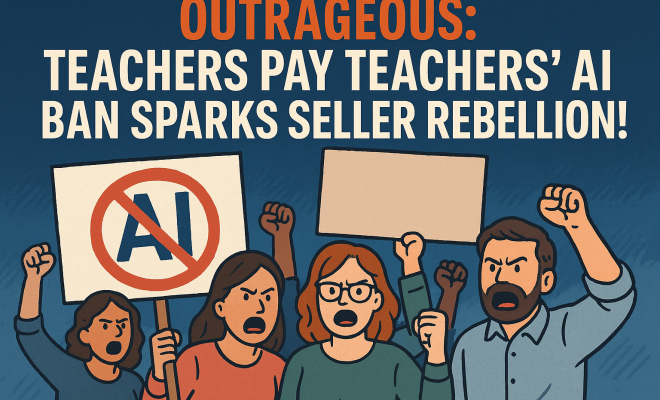
When a platform as ubiquitous in the educational landscape as Teachers Pay Teachers (TPT) makes a significant policy shift, it sends ripples. But when that shift involves banning an emergent technology like artificial intelligence, and it sparks a full-blown rebellion from its seller community, well, you know you’ve hit a nerve. The recent announcement of a comprehensive Teachers Pay Teachers AI ban has ignited a firestorm, revealing deep divisions among educators, content creators, and the platform itself about the future of instructional materials.
For years, TPT has been the go-to digital marketplace for millions of teachers seeking everything from elaborate lesson plans to quick worksheets. It’s a place where educators can share their creativity, supplement their income, and save precious planning time. The platform’s success is built on the premise of teacher-created, teacher-approved content. So, when reports began to surface about a new phenomenon dubbed ‘AI slop’ – low-quality, error-ridden materials generated by algorithms rather than human insight – it posed a fundamental challenge to TPT’s core identity. The ensuing Teachers Pay Teachers AI ban isn’t just a policy update; it’s a declaration in an ongoing battle for the soul of educational content.
1. The Rise of ‘AI Slop’ and the Impetus for Change: Why TPT Felt Cornered
Let’s be blunt: AI-generated content can be terrible. While large language models (LLMs) like ChatGPT have made impressive strides, they’re not infallible, especially when tasked with creating nuanced educational materials. The term ‘AI slop’ perfectly captures the essence of this problem: content that looks plausible at first glance but quickly reveals itself to be generic, inaccurate, culturally insensitive, or simply poorly written. We’re talking about worksheets with factual errors, lesson plans that lack pedagogical depth, or activities that don’t quite make sense.
Sellers on TPT, who often pour hours into crafting high-quality, engaging resources, started noticing a flood of these low-effort, AI-generated products. Imagine spending weeks perfecting a unit on ancient Egypt, only to see a competitor upload a similar-looking, but ultimately superficial, resource generated by AI in minutes. This wasn’t just unfair; it threatened to dilute the overall quality of the marketplace. TPT’s reputation hinges on the trust educators place in its resources, and ‘AI slop’ was eroding that trust, forcing the platform to address the elephant in the digital classroom.
2. The Official Teachers Pay Teachers AI Ban: What Does it Actually Mean?
The core of the new policy is straightforward: AI-generated content is no longer permitted on Teachers Pay Teachers. This isn’t just about text; it extends to AI-generated images, illustrations, and any other component of a resource that was created primarily by an algorithm rather than human effort. The platform has stated its intention to implement detection mechanisms, though the specifics of these tools remain somewhat opaque, adding to the anxiety of sellers.
It’s crucial to understand that this isn’t a ban on AI as a tool in the creative process. Many sellers use AI responsibly, for example, to brainstorm ideas, proofread their own human-written text, or generate initial drafts that are then heavily edited and refined by a human. The ban targets content where AI is the primary author, where the ‘human touch’ is largely absent. This distinction, however, has proven difficult to articulate and even harder to enforce, leading to much of the current confusion and frustration among the TPT community.
3. Seller Backlash and the Online Petition: A Community Divided
You can practically hear the collective groan from thousands of TPT sellers. The announcement of the Teachers Pay Teachers AI ban didn’t land with a quiet thud; it landed like a bombshell. Almost immediately, an online petition emerged, garnering significant signatures and expressing widespread discontent. Many sellers feel blindsided, arguing that the policy is overly broad, stifles innovation, and unfairly penalizes those who responsibly integrate AI into their workflow.
The core of their argument is often about efficiency and evolution. Teachers are already overworked and underpaid. If AI can help streamline the creation of certain components – say, generating a quick quiz on a specific topic that a human then meticulously reviews and adapts – why shouldn’t they use it? They view AI as a powerful assistant, not a replacement for their expertise. The petition highlights a perceived lack of consultation from TPT, suggesting that the platform imposed a blanket ban without fully understanding the diverse ways its sellers were already leveraging AI to create better, more efficient resources.
4. The Broader Debate: AI in Education: Efficiency vs. Integrity
The Teachers Pay Teachers AI ban isn’t happening in a vacuum; it’s a microcosm of a much larger, global debate about the role of AI in education. On one side, you have proponents who champion AI as a revolutionary tool for personalization, efficiency, and access. Imagine AI tailoring learning materials to individual student needs, grading assignments, or even generating unique practice problems on the fly. For many educators, the promise of AI to reduce administrative burden and free up time for genuine teaching is incredibly appealing.
However, the skeptics raise legitimate concerns about academic integrity, the potential for algorithmic bias, and the erosion of critical thinking skills. If students rely too heavily on AI for assignments, are they truly learning? If teachers use AI extensively for lesson planning, are they sacrificing pedagogical depth for convenience? The TPT situation underscores this tension: how do we harness the power of AI without compromising the quality, integrity, and human element that are so vital to effective education? (See: Overview of artificial intelligence.)
5. Navigating the Gray Areas: AI-Assisted vs. AI-Generated
This is where the rubber meets the road, and where much of the confusion around the Teachers Pay Teachers AI ban lies. There’s a fundamental difference between content that is ‘AI-assisted’ and content that is ‘AI-generated.’ An AI-assisted resource might involve a teacher using ChatGPT to brainstorm five creative ways to introduce a new history unit, then taking those ideas and developing a full, human-crafted lesson plan. Or perhaps they use an AI image generator to create a unique graphic, which they then heavily edit and integrate into their human-designed worksheet.
An AI-generated resource, in contrast, would be a teacher simply prompting an LLM to ‘create a 5th-grade math worksheet on fractions’ and uploading the output directly to TPT with minimal or no human intervention. The challenge for TPT, and indeed for any platform grappling with AI, is to create clear guidelines and robust detection methods that can reliably distinguish between these two scenarios. Without that clarity, innocent sellers who use AI as a tool might find themselves penalized alongside those who are truly just uploading ‘AI slop.’ For more context, see AI Governance Certifications in EdTech.
6. The Monetization Angle: Why This Matters for the ‘Edu-preneur’
Let’s not forget the business side of things. Teachers Pay Teachers is a massive marketplace, generating substantial income for many educators. For some, it’s a side hustle; for others, it’s a full-time business. The Teachers Pay Teachers AI ban directly impacts their ability to create and sell resources. If they’ve invested time and money into learning AI tools to streamline their content creation, a blanket ban feels like a sudden invalidation of their efforts and a threat to their livelihood.
This situation also creates a ripple effect in the broader ‘edu-preneur’ ecosystem. Companies developing AI detection software for educators see a new market opening up. Developers of ‘original classroom content’ tools might see increased demand. And the debate itself highlights the commercial potential within online education, software, and B2B SaaS, as platforms scramble to adapt to this rapidly changing technological landscape while maintaining quality and trust.
7. The Quest for AI Detection Software and Its Limitations
TPT’s decision to ban AI-generated content implicitly means they’ll need effective AI detection software. But here’s the kicker: AI detection is notoriously difficult and often imperfect. These tools analyze linguistic patterns, sentence structures, and other markers to determine the likelihood that content was AI-generated. However, they frequently produce false positives, flagging human-written text as AI, and false negatives, missing AI-generated content that has been lightly edited.
Imagine a teacher, painstakingly crafting a resource, only to have TPT’s AI detector mistakenly flag it, leading to a potential ban or content removal. This is a real fear for many sellers. The technology simply isn’t foolproof, and relying heavily on it for policy enforcement can create a minefield of unintended consequences, eroding trust between the platform and its most valuable asset: its human creators.
8. Maintaining Quality and Academic Integrity in a Post-AI World
Ultimately, TPT’s move is an attempt to safeguard the quality and academic integrity of its marketplace. The platform’s success is predicated on the idea that teachers are sharing their best, most thoughtful work. If the site becomes flooded with low-quality, AI-generated resources, it loses its value proposition. Students deserve high-quality, accurate, and pedagogically sound materials, and teachers deserve resources they can trust.
The challenge, however, isn’t just about banning AI; it’s about fostering a culture where quality is paramount, regardless of the tools used. This might involve more robust review processes, clearer guidelines for human authorship, and perhaps even distinguishing between ‘AI-assisted’ and ‘human-created’ categories rather than a blanket ban. The goal should be to elevate educational quality, not to stifle the responsible use of innovative tools.
9. What’s Next for TPT and Its Community?
The Teachers Pay Teachers AI ban is far from settled. The online petition and the vocal backlash indicate that this is an ongoing conversation, not a closed case. TPT faces the unenviable task of balancing innovation with quality control, and appeasing a diverse community of sellers with vastly different perspectives on AI. Will they adjust their policy, offering more nuanced guidelines that differentiate between AI-assisted and AI-generated content? Will they invest in more transparent and accurate detection methods?
One thing is clear: the future of educational content creation will inevitably involve AI. The question isn’t if, but how. TPT, as a leader in this space, has an opportunity to help define those ‘hows’ in a way that truly serves educators and students, rather than alienating its most valuable contributors. The resolution of this controversy will set a precedent for other educational platforms grappling with the same complex issues, and we’ll all be watching to see how this crucial chapter unfolds.
10. The Economic Impact on Teacher Entrepreneurs
Beyond the philosophical arguments, the Teachers Pay Teachers AI ban carries significant economic weight for the thousands of teacher-entrepreneurs who rely on the platform. Many sellers have invested heavily in understanding and utilizing AI tools to enhance their product offerings. This includes subscribing to premium AI services, taking courses on prompt engineering, or even hiring virtual assistants trained in AI content generation. A sudden, sweeping ban can feel like pulling the rug out from under their business models, rendering these investments moot and forcing a costly pivot.
Consider the competitive landscape too. For a seller operating a full-time TPT store, efficiency is key. If a competitor can ethically leverage AI to generate high-quality drafts or brainstorm innovative ideas in a fraction of the time, they gain a significant advantage. The ban, in its current form, could inadvertently disadvantage sellers who previously embraced AI as a legitimate productivity booster, potentially stifling the growth of smaller, independent teacher-businesses who need every edge they can get to compete with larger, more established stores. (See: Impact of technology on education.)
11. Ethical Considerations and Algorithmic Bias in Educational Content
While the focus often lands on ‘AI slop,’ there’s a deeper ethical layer to AI-generated educational materials: algorithmic bias. AI models are trained on vast datasets, and if those datasets reflect societal biases (gender, race, socioeconomic status, etc.), the AI’s output can perpetuate or even amplify those biases. This is a particularly sensitive issue in education, where equity and inclusivity are paramount.
For example, an AI generating a history lesson might inadvertently overemphasize certain perspectives while marginalizing others. An AI creating math word problems might consistently portray characters from specific demographics, reinforcing stereotypes. Human educators, through their training and experience, are typically attuned to these nuances and strive for balanced, inclusive content. The concern with uncurated AI output is that it lacks this critical human judgment, potentially disseminating biased materials to impressionable students. TPT’s ban, from this perspective, could be seen as a preventative measure against the unintentional spread of such biases, ensuring that the human gatekeepers of educational content remain central to its creation. For more context, see Path to an AI Governance Lead in EdTech.
12. The Role of Community Engagement and Platform Transparency
A significant point of contention for TPT sellers is the perceived lack of transparency and community engagement leading up to the ban. Many feel the policy was handed down rather than developed collaboratively. In an era where online platforms often thrive on active user communities, alienating a core segment of sellers can be detrimental. Open dialogues, feedback sessions, or even pilot programs could have softened the blow and perhaps led to a more nuanced policy that better reflects the diverse ways educators use AI.
Platforms like TPT operate on a symbiotic relationship with their creators. Sellers provide the content that attracts buyers, and the platform provides the infrastructure and audience. When trust in this relationship erodes due to unilateral policy changes, it can lead to disengagement, a search for alternative platforms, or even a decrease in the quality of content submitted by disgruntled creators. Moving forward, TPT might need to re-evaluate its approach to community communication, perhaps establishing a seller advisory board or holding regular forums to discuss evolving technological challenges and policy implications.
13. Comparison with Other Content Platforms and Their AI Policies
TPT isn’t alone in grappling with AI-generated content. Other major content platforms have adopted varying stances, offering a useful comparative lens. For instance, some stock image sites initially had a blanket ban on AI-generated art but have since introduced categories specifically for AI art, often with clear labeling requirements. Writing platforms like Medium or Substack largely allow AI-assisted content but emphasize the importance of human editing and disclosure.
The key differentiator for TPT is the unique nature of educational materials. Unlike a blog post or a piece of digital art, an educational resource directly impacts student learning. Errors, biases, or a lack of pedagogical depth can have tangible, negative consequences. This higher stakes environment likely informs TPT’s more stringent approach compared to platforms focused on entertainment or general information. However, the experiences of these other platforms might still offer lessons in how to evolve a policy from a blanket ban to a more nuanced framework that incorporates disclosure, quality control, and distinct categorization.
14. The Future of Teacher Professional Development and AI Literacy
Regardless of TPT’s final stance, the Teachers Pay Teachers AI ban highlights a critical need for professional development in AI literacy for educators. Teachers need to understand not just how to use AI tools, but also their limitations, ethical implications, and how to critically evaluate AI-generated content. This includes being able to spot ‘AI slop,’ understand potential biases, and discern when human expertise is indispensable.
If platforms like TPT are to eventually re-introduce AI-assisted content with stricter guidelines, a well-informed seller base will be crucial. This involves training on effective prompt engineering, robust editing practices, and understanding the legal and ethical boundaries of AI use. The conversation should shift from simply banning AI to empowering educators to be intelligent consumers and responsible creators of AI-augmented educational resources, ensuring they remain at the forefront of pedagogical innovation.
Frequently Asked Questions About the Teachers Pay Teachers AI Ban
What exactly is the Teachers Pay Teachers AI ban?
The Teachers Pay Teachers AI ban is a policy implemented by the platform that prohibits the uploading of content created primarily by artificial intelligence. This includes text, images, and other components where an AI model was the main author, not just an assistant to a human creator.
Why did TPT implement this ban?
TPT implemented the ban primarily to combat “AI slop” – low-quality, inaccurate, or generic educational materials generated by AI. The platform aims to maintain the high quality and academic integrity of its marketplace, which is built on the trust educators place in teacher-created resources. For more context, see AI Ethics Officer Salary Insights. (See: AI's role in education today.)
Does this mean I can’t use AI at all if I’m a TPT seller?
Not necessarily. The ban targets content where AI is the primary author. Many sellers use AI responsibly as a tool to assist their creative process – for brainstorming ideas, proofreading human-written text, or generating initial drafts that are then heavily edited and refined by a human. The distinction lies in whether the “human touch” is largely absent or if the human remains the primary author and curator.
What’s the difference between “AI-assisted” and “AI-generated” content?
AI-assisted content means a human creator used AI tools to help with certain tasks (like brainstorming or quick drafting), but the final product is substantially edited, refined, and authored by the human. AI-generated content is largely created by an AI with minimal or no human intervention, essentially uploading raw AI output.
How will TPT detect AI-generated content?
TPT has stated its intention to implement detection mechanisms, but the specifics of these tools are not fully transparent. AI detection software typically analyzes linguistic patterns and other markers. However, these tools are known to be imperfect, sometimes flagging human-written content as AI or missing lightly edited AI output.
What was the reaction from the TPT seller community?
The reaction was largely negative, with many sellers expressing frustration and launching an online petition. Sellers argue the ban is too broad, stifles innovation, and unfairly penalizes those who use AI responsibly to enhance efficiency and quality. They also felt there was a lack of consultation from TPT before the policy was announced.
Does the ban apply to AI-generated images as well?
Yes, the ban extends to AI-generated images, illustrations, and any other visual components of a resource if they were created primarily by an algorithm rather than human effort.
What are the broader implications of this ban for AI in education?
The TPT ban reflects a larger debate about AI’s role in education, balancing the potential for efficiency and personalization against concerns about academic integrity, algorithmic bias, and the erosion of critical thinking. It highlights the challenge of harnessing AI’s power without compromising the quality and human element crucial to effective learning.
Could TPT change its policy in the future?
It’s possible. The significant backlash and ongoing discussions suggest that TPT might need to re-evaluate or refine its policy to offer more nuanced guidelines, potentially differentiating between AI-assisted and AI-generated content, and investing in more transparent detection methods. The situation is still evolving.
Trending Now
Frequently Asked Questions
Why did Teachers Pay Teachers ban AI-generated content?
Teachers Pay Teachers (TPT) banned AI-generated content due to concerns over 'AI slop,' which refers to low-quality, inaccurate materials produced by algorithms. This decision aims to protect the integrity of educational resources and ensure that content remains teacher-created and reliable.
What is 'AI slop' in educational content?
'AI slop' is a term used to describe low-quality educational materials generated by artificial intelligence. These resources often contain factual errors, lack depth, and may not be culturally sensitive, undermining the quality that educators expect from platforms like TPT.
How has the TPT community reacted to the AI ban?
The ban on AI-generated content has sparked a rebellion among TPT sellers, revealing deep divisions within the community. Many sellers are concerned about the implications for creativity and income, while others support the move to maintain high standards for educational materials.
What impact does the AI ban have on TPT sellers?
The AI ban impacts TPT sellers by limiting the types of content they can create and sell. Sellers who rely on AI tools for efficiency may find their options restricted, while those who focus on original, high-quality materials may see increased demand for their work.
What are the implications of TPT's policy change for educational content?
TPT's policy change to ban AI-generated content highlights a broader debate about the future of educational resources. It emphasizes the importance of maintaining high-quality, teacher-approved materials and raises questions about the role of technology in education.
Agree or disagree? Drop a comment and tell us what you think.