Milky Way’s True Edge Revealed: A Stellar Geography Breakthrough
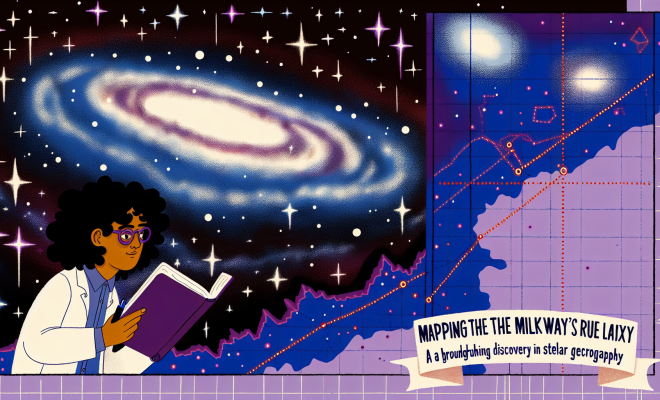
The Milky Way galaxy, a vast and intricate structure comprising billions of stars, has long fascinated astronomers and stargazers alike. Recent research has unveiled a groundbreaking revelation about the galaxy’s true boundaries, providing a clearer understanding of its structure and evolution. According to new findings, the Milky Way’s edge extends between 35,000 to 40,000 light-years from its center, a distance defined not by the formation of new stars, but rather by a population of older stars that drift beyond this boundary.
Understanding the Galactic Structure
The Milky Way is not just a collection of stars; it is a dynamic system that has been evolving for billions of years. The galaxy is shaped by various processes, including star formation, interactions with other galaxies, and the gravitational forces that govern celestial bodies. Understanding the structure of the Milky Way, especially its outer regions, is crucial for astrophysicists who aim to comprehend the formation and evolution of galaxies in the universe.
The Role of Stellar Age Mapping
Central to this recent discovery is the technique of stellar age mapping. This method involves analyzing the ages of stars to discern patterns that reveal information about their formation and movement. By studying the ages and distributions of stars, astronomers can identify where star formation has occurred and where it has ceased. This technique has allowed researchers to determine that beyond the Milky Way’s conventional edge, there exists a region characterized by a significant decline in star formation activity.
Defining the True Edge of the Milky Way
At approximately 35,000 to 40,000 light-years from the galactic center, astronomers have identified a stark transition in the Milky Way’s structure. Within this boundary, star formation is vibrant, with young stars actively being born from the galaxy’s dense molecular clouds. However, as one moves outward, the situation changes dramatically. The new findings indicate that beyond this delineation, the region is populated primarily by older stars that have drifted outward from the galaxy’s core, forming a distinct U-shaped pattern.
Implications of the Discovery
This discovery has profound implications for our understanding of the Milky Way’s structure and its stellar nursery. The identification of the true edge helps resolve long-standing questions about where star formation is actively taking place and where it has effectively ceased. This boundary marks the limit of the Milky Way’s stellar nursery, the region where conditions are favorable for star birth.
Connections to Galactic Evolution
Understanding the true edge of the Milky Way also sheds light on the galaxy’s evolution over time. As stars are born and evolve, they contribute to the chemical enrichment of the galaxy and influence the formation of subsequent generations of stars. The presence of older stars beyond the new boundary indicates a history of stellar migration and the gravitational forces that have shaped the galaxy’s evolution.
Research Methods and Findings
The researchers utilized a combination of observational data and sophisticated modeling techniques to arrive at their conclusions. By analyzing data from various observatories and space missions, they were able to construct a detailed map of stellar ages and distributions within the Milky Way. This process involved extensive data collection and analysis, including:
- Cataloging Stars: Gathering data on the ages, distances, and compositions of stars throughout the Milky Way.
- Mapping Stellar Ages: Using advanced algorithms to analyze the ages of stars and create a comprehensive map of the galaxy’s stellar population.
- Modeling Galactic Dynamics: Employing simulations to understand how stars move within the galaxy and how they interact with one another.
Challenges in Stellar Age Determination
Determining the age of stars is a complex task that poses several challenges. Factors such as stellar evolution, chemical composition, and distance from Earth can complicate age estimates. However, advancements in technology and techniques have improved the accuracy of these measurements, allowing astronomers to construct a more reliable picture of the Milky Way’s stellar population.
Conclusion: A New Perspective on the Milky Way
The identification of the Milky Way’s true edge at 35,000 to 40,000 light-years from the center marks a significant milestone in our understanding of galactic structure. This research not only clarifies the extent of the galaxy’s stellar nursery but also enhances our comprehension of the dynamics that govern the formation and evolution of stars.
As astronomers continue to explore the cosmos, each new discovery adds a layer of complexity and excitement to our understanding of the universe. This revelation about the Milky Way’s boundaries serves as a reminder of the vastness of space and the intricate processes that shape the galaxies around us. With further exploration and research, the mysteries of the Milky Way and beyond will continue to unfold, inviting future generations to look up at the stars with wonder and curiosity.