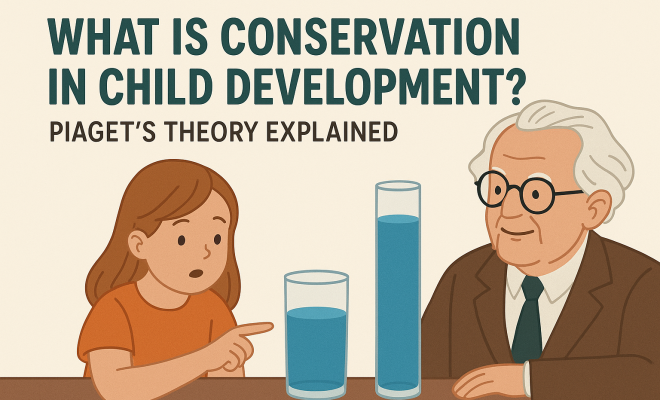
What Is Conservation in Child Development? Piaget’s Theory Explained
“`html
The concept of conservation in child development is pivotal in understanding how children perceive and interact with the world around them. Developed by the Swiss psychologist Jean Piaget, conservation refers to a child’s ability to recognize that certain properties of objects, such as volume, mass, or number, remain the same despite changes in the objects’ form or arrangement. This foundational theory has shaped educational practices and developmental psychology, providing insights into how children learn and grow cognitively.
Understanding Piaget’s Stages of Cognitive Development
To grasp the concept of conservation thoroughly, it’s crucial to understand Jean Piaget’s broader theory of cognitive development, which he organized into four distinct stages:
- Sensorimotor Stage (Birth to 2 years): At this stage, infants learn through sensory experiences and manipulating objects. Their understanding of the world is predominantly physical.
- Preoperational Stage (2 to 7 years): Children start to use language and engage in symbolic play but lack logical reasoning and are egocentric, meaning they have difficulty seeing things from perspectives other than their own.
- Concrete Operational Stage (7 to 11 years): During this phase, children begin to think logically about concrete events. This is also when they start to grasp the concept of conservation.
- Formal Operational Stage (12 years and up): Abstract reasoning emerges, allowing for more complex thought processes.
The Concept of Conservation in Detail
Conservation is specifically assessed during the concrete operational stage. Piaget identified several types of conservation, including:
- Conservation of Number: Understanding that the quantity of items remains the same despite changes in arrangement or appearance.
- Conservation of Volume: Recognizing that liquid volumes remain constant even when poured into different-shaped containers.
- Conservation of Mass: Grasping that the mass of an object remains unchanged when its shape is altered.
To illustrate these concepts, consider a simple experiment that Piaget used to demonstrate conservation of number. If two rows of coins are presented to a child—one with coins spread out and another with coins closely placed—children in the preoperational stage might claim that the spread-out row has more coins. However, those in the concrete operational stage will recognize that both rows contain the same number of coins despite their different arrangements.
Why Conservation Matters in Child Development
Understanding conservation is vital for several reasons:
- Foundation for Logical Thinking: Mastery of conservation is a building block for more advanced cognitive processes. It lays the groundwork for logical reasoning and critical thinking skills.
- Educational Implications: Recognizing where a child stands in terms of conservation can help educators tailor their teaching methods to better fit developmental stages, ensuring more effective learning strategies.
- Social and Emotional Development: A child’s ability to understand concepts like conservation often correlates with emotional maturity, as they begin to recognize stability and consistency in their environment.
Practical Applications of Conservation in Education
Teachers and parents can use the principles of conservation in child development to create engaging learning environments. Here are some practical applications:
- Hands-On Activities: Engage children with tangible objects like blocks, playdough, or water to illustrate conservation principles. For instance, pour water from a short, wide glass into a tall, narrow one and ask them if the amount of water has changed.
- Interactive Games: Use games that require counting and number manipulation, such as sorting and classifying items, to promote understanding of conservation of number.
- Encouraging Dialogue: Encourage children to explain their reasoning when making judgments about quantity and volume. This not only reinforces their understanding but also develops their verbal skills and ability to articulate thoughts.
Challenges in Understanding Conservation
Despite its importance, not all children achieve conservation at the same rate. Several factors can influence a child’s grasp of these concepts: (See: Jean Piaget's contributions to psychology.)
- Cognitive Readiness: Each child develops at their own pace. Factors like maturity, environmental stimuli, and educational opportunities can affect cognitive readiness.
- Individual Differences: Children come with unique backgrounds, experiences, and inherent capabilities that can impact their understanding of conservation.
- Cultural Influences: Cultural contexts can shape how children learn and understand mathematical concepts, including conservation. Some cultures emphasize different strategies for counting and measuring, leading to variations in conservation skills.
Current Relevance of Conservation in Child Development
In today’s educational landscape, the application of conservation principles remains relevant. With the move towards more child-centered and constructivist approaches in education, understanding how children develop conservation skills can help educators implement better teaching strategies. Here are a few key areas where conservation is particularly relevant:
- STEM Education: Science, Technology, Engineering, and Mathematics (STEM) education often requires a solid grasp of conservation concepts. Students must understand measurements, volume, and quantity to succeed in these fields.
- Social-Emotional Learning (SEL): As children learn about conservation, they also develop skills in problem-solving and emotional regulation, as they begin to understand the stability of their environment.
- Technology Integration: Modern technology, including educational apps and online resources, can enhance learning experiences related to conservation through interactive simulations and virtual experiments.
Expert Perspectives on Conservation in Child Development
Educational psychologists and child development experts emphasize the ongoing importance of conservation skills. Dr. Linda Smith, a developmental psychologist, notes that “conservation tasks are not simply tests of knowledge but rather indicators of cognitive development. They help us understand how children make sense of their world.”
Furthermore, educators like Dr. Robert Marzano stress that “teaching children about conservation is not just about imparting knowledge; it’s about helping them develop a framework for reasoning and problem-solving that will serve them throughout their lives.”
Encouraging Conservation Skills at Home
Parents can play an essential role in helping children develop conservation skills through everyday activities. Here are a few strategies to consider:
- Cooking Together: Involve your child in cooking, where they can measure ingredients, compare quantities, and understand volume through practical experience.
- Gardening: Planting and caring for a garden can help children understand growth, volume, and mass as they measure and observe changes over time.
- Play-Based Learning: Incorporate educational games that encourage counting, sorting, and measuring, facilitating natural discussions about conservation.
Practical Activities to Foster Conservation Skills
In addition to the strategies mentioned, there are specific activities that can further encourage conservation skills:
- Art Projects: Use materials like clay or dough to create objects of varying shapes and sizes. Ask your child to compare the weight or volume of different shapes, reinforcing the idea that size doesn’t always equal mass or volume.
- Nature Walks: Take a walk in nature and collect different objects. Discuss their properties—how many stones or leaves you picked up, or compare the sizes of different rocks while discussing whether their weight is the same.
- Board Games: Play board games that involve counting spaces or resources. Games like “Monopoly” or “Chutes and Ladders” can help children apply their understanding of numbers in a fun and engaging way.
Statistics on Conservation Understanding
Research indicates that children’s understanding of conservation can vary significantly based on several factors, including age and educational background. For example, studies show that children typically begin to exhibit an understanding of conservation concepts around the age of 5 or 6, with 70% demonstrating conservation of number by age 7. However, only about 30% understand conservation of mass until they reach age 8 or 9. These statistics highlight the gradual nature of cognitive development and the importance of tailored educational practices.
Common Misconceptions About Conservation
There are several misconceptions about conservation in child development that may lead to misunderstandings in educational settings:
- Timing of Mastery: Some parents and educators may believe that all children should master conservation at the same age. In reality, the development of these skills can vary widely among children.
- Overemphasis on Formal Education: While formal education plays a role, children also acquire conservation skills through play and everyday interactions. It’s crucial to recognize that learning occurs in diverse environments.
- Assuming Understanding from Correct Answers: Just because a child can answer a conservation question correctly doesn’t mean they fully understand the underlying concepts. It’s important to encourage children to explain their thought processes.
FAQ: Understanding Conservation in Child Development
What is conservation in child development?
Conservation in child development is the understanding that certain properties of objects, such as volume, mass, and number, remain the same despite changes in the object’s appearance or arrangement. (See: Research on cognitive development stages.)
At what age do children typically develop conservation skills?
Children generally begin to grasp conservation concepts around the age of 5 or 6, but the full understanding of various types of conservation may not be evident until they reach 7 to 11 years old.
How can parents support their child’s understanding of conservation?
Parents can support their child’s understanding of conservation through hands-on activities like cooking, gardening, and play-based learning, which encourage exploration of quantities, measurements, and comparisons.
Why is conservation important for cognitive development?
Conservation is vital for cognitive development because it lays the groundwork for logical reasoning and critical thinking skills, allowing children to understand and interact with the world more effectively.
Can cultural differences impact conservation skills?
Yes, cultural contexts can influence how children learn and understand mathematical concepts, including conservation. Different cultures may emphasize unique strategies for counting and measuring, leading to variations in children’s conservation skills.
The Lasting Impact of Understanding Conservation
Understanding conservation in child development is not just an academic exercise; it’s a crucial aspect of nurturing well-rounded individuals. By recognizing and applying the principles of conservation, we empower children to think critically and develop strong cognitive skills that will serve them throughout their lives. As educators and parents, fostering an environment where conservation concepts can flourish will pave the way for a generation of learners capable of tackling complex challenges with confidence.
Additional Insights into Conservation in Child Development
Going deeper into the implications of conservation, it’s essential to consider how these cognitive skills interact with social learning. Children’s understanding of conservation can influence their interactions with peers. For instance, when children play games that involve sharing resources, their grasp of conservation can affect how they negotiate and cooperate with others. This aspect of social learning ties back to emotional intelligence, as children who understand conservation are often better at managing their expectations and frustrations when sharing or competing.
Longitudinal Studies on Conservation Skills
Longitudinal studies tracking children from early childhood through adolescence reveal that mastery of conservation concepts correlates with later academic success. For example, research has shown that children who demonstrate a strong understanding of conservation by age 8 often perform better in mathematics by the time they reach middle school. These findings suggest that early interventions focusing on conservation skills could lead to improved outcomes in more complex subjects later on.
Comparative Analysis: Conservation Skills Across Cultures
When looking at conservation skills from a comparative perspective, it becomes evident that cultural practices can shape how children learn these concepts. For example, children in cultures that emphasize cooperative group activities may develop conservation skills differently than those in more individualistic societies. In communal settings, children often engage in activities that require them to measure and distribute resources among peers, potentially fostering a deeper understanding of conservation.
Expert Recommendations for Enhancing Conservation Skills
Experts recommend several strategies for educators and parents to enhance conservation skills in children. Dr. Sarah Lee, a child development expert, suggests integrating conservation tasks into everyday activities. “Simple actions like sorting laundry by color or size can help children practice their conservation skills without them even realizing it,” she says. Additionally, Dr. James Carter emphasizes the importance of storytelling in teaching conservation concepts. By using narratives that involve different quantities and transformations, children can contextualize and internalize the idea of conservation more effectively.
Common Classroom Activities to Promote Conservation
In the classroom, teachers can implement creative activities that promote conservation skills. For instance:
- Measurement Stations: Set up stations where children can measure various objects using different tools (e.g., rulers, measuring cups). This hands-on approach reinforces the concept of volume and length as they understand that different containers or objects can hold the same amount.
- Fraction Games: Use pizza or pie charts to teach children about fractions and conservation of number. By cutting up a pizza, children can see how the number of slices remains the same, regardless of how they are arranged on a plate.
- Water Play Activities: Engage children in water play with containers of various shapes and sizes. Ask them to predict and then verify whether the same amount of water fits in each container.
Further Reading and Resources
For those interested in exploring conservation in child development further, several resources can provide additional insight:
- Books: Look for books like “The Child’s World of Mathematics” by David W. Kamii, which delve into how children understand numbers and conservation.
- Online Courses: Platforms like Coursera and EdX offer courses on child development and cognitive psychology that cover Piaget’s theories and more.
- Parenting Blogs: Websites such as “Parenting Science” provide research-backed articles on child development topics, including conservation.
Conclusion on Conservation’s Role in Child Development
The journey of understanding conservation in child development is one that intertwines cognitive growth with practical experience. By integrating conservation principles into daily activities and educational practices, we not only enhance children’s cognitive abilities but also equip them with essential skills for their futures. Whether through play, structured learning, or cultural practices, fostering an awareness of conservation prepares children to navigate the complexities of the world around them.
“`
Trending Now
Frequently Asked Questions
What is the concept of conservation in child development?
Conservation in child development refers to a child's ability to understand that certain properties of objects, such as volume, mass, or number, remain unchanged despite changes in their form or arrangement. This concept is crucial in cognitive development and is primarily observed during the concrete operational stage, as described by Jean Piaget.
How does Piaget's theory explain conservation?
Piaget's theory posits that conservation develops during the concrete operational stage, typically between the ages of 7 and 11. At this stage, children begin to think logically about concrete events, allowing them to grasp the idea that certain properties remain constant despite physical changes.
What are Piaget's stages of cognitive development?
Piaget's stages of cognitive development include the Sensorimotor Stage (birth to 2 years), Preoperational Stage (2 to 7 years), Concrete Operational Stage (7 to 11 years), and Formal Operational Stage (12 years and up). Each stage represents different ways children understand and interact with the world.
What types of conservation did Piaget identify?
Piaget identified several types of conservation: Conservation of Number, which is the understanding that quantity remains the same despite rearrangement; Conservation of Volume, recognizing that liquid volumes stay constant when transferred to different containers; and others related to mass and area.
Why is conservation important in child development?
Conservation is important in child development as it indicates a child's ability to think logically and understand the permanence of certain properties despite changes. This skill is fundamental for cognitive growth and influences educational practices, helping educators tailor learning experiences to children's developmental stages.
What did we miss? Let us know in the comments and join the conversation.