Astronomers Unveil Potential ‘Superkilonova’: A New Cosmic Phenomenon
Introduction
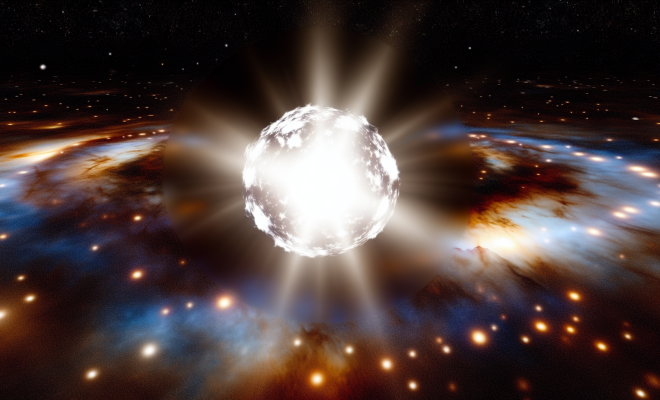
In a groundbreaking discovery, astronomers have identified a potential new type of cosmic explosion dubbed a ‘superkilonova’. This phenomenon, which could reshape our understanding of stellar explosions, was observed through a unique event known as AT2025ulz. The event has been characterized by a double explosion—a neutron star collision hidden within the remnants of a supernova. This discovery not only adds a new chapter to the narrative of cosmic events but also raises intriguing questions about the nature of such astronomical occurrences.
The Discovery of AT2025ulz
AT2025ulz was first detected through the observation of gravitational waves, which are ripples in the fabric of space-time caused by massive cosmic events. The initial detection was followed by the observation of a rapid, fading red glow, a signature closely resembling that of a kilonova—an event typically associated with the merging of neutron stars that forge heavy elements like gold and uranium.
The team of researchers, led by Anna Kasliwal, an astronomer at the California Institute of Technology, unearthed this unusual cosmic phenomenon after analyzing data from various observatories. The peculiar timing of the explosion, occurring mere hours after a supernova, complicated the interpretation of the event and suggested a more complex scenario than previously understood.
Understanding Kilonovae and Supernovae
Before delving deeper into the implications of the superkilonova, it is essential to understand the two primary types of stellar explosions: kilonovae and supernovae.
- Kilonovae: These events occur when two neutron stars orbit each other and eventually collide. The collision results in a massive release of energy, creating heavy elements through rapid neutron capture processes. Kilonovae are typically characterized by their short duration and specific light curves.
- Supernovae: These explosions mark the death of massive stars, resulting in either the gravitational collapse of the core or the runaway nuclear fusion of a white dwarf star. Supernovae are among the most luminous events in the universe, outshining entire galaxies.
The Characteristics of the Superkilonova
The findings from AT2025ulz present characteristics that diverge from those of traditional kilonovae and supernovae. One of the most striking aspects is the mismatch between the expected signatures of these explosions and what was observed. The gravitational-wave data suggested that the event involved the merger of unusually small neutron stars, each less than one solar mass. This characteristic raises questions about the formation and evolution of such neutron stars, which are typically expected to be more massive.
The Role of Gravitational Waves
Gravitational waves play a pivotal role in understanding cosmic events, acting as a form of cosmic messenger that delivers information about cataclysmic occurrences in the universe. The detection of gravitational waves from AT2025ulz provided the first clue that something extraordinary was unfolding. The event’s waveforms indicated a collision, hinting at a neutron star merger, which is traditionally associated with the formation of kilonovae.
However, the gravitational wave signals associated with AT2025ulz did not conform to the patterns established by previous observations. This anomaly suggested that the neutron stars involved in the event were smaller than expected, challenging existing models of neutron star formation.
The Fading Red Glow
After the initial gravitational wave detection, the team observed a fast-fading red glow emanating from the event site. This glow is a crucial aspect of kilonovae, which typically exhibit a blue or red color depending on the composition of the ejected material. The rapid fading of the glow in AT2025ulz indicated that the event was likely unique, further complicating interpretations of its nature.
The rapid decline in brightness suggested that the energy release was not only intense but also rapidly dissipated, which is a characteristic of both kilonovae and supernovae. However, the timing of the glow’s appearance, occurring shortly after the supernova, raised questions about its origin.
Implications for Cosmic Understanding
The discovery of AT2025ulz and the potential existence of superkilonovae carries several implications for astrophysics and our understanding of the universe:
- New Models of Neutron Star Formation: The existence of smaller neutron stars challenges current theories regarding their formation and evolution. Astronomers may need to refine existing models to account for the formation pathways that could lead to such low-mass neutron stars.
- Insights into Element Formation: Kilonovae are known for their role in producing heavy elements. The study of superkilonovae could provide additional insights into the processes that create elements like gold and uranium, potentially reshaping our understanding of nucleosynthesis in the universe.
- Expanding the Catalog of Cosmic Explosions: If confirmed, superkilonovae would represent a new category of cosmic events, expanding our knowledge of the universe’s explosive phenomena and their diverse characteristics.
The Path Forward: Confirmation and Future Research
While the discovery of AT2025ulz is a significant milestone, astronomers caution that further studies are necessary to confirm the existence of superkilonovae. The complexities presented by this event require additional observations and analyses to unravel the details of the explosions and the nature of the neutron stars involved.
Future research will likely focus on:
- Observational Campaigns: Continuous monitoring of the event site and similar regions in the universe will be crucial for gathering more data. Astronomers will utilize advanced telescopes and observatories to capture the light curves and spectra of potential superkilonovae.
- Theoretical Modeling: Astrophysicists will also need to develop new theoretical models to explain the observed phenomena. This includes simulations of neutron star mergers and the resultant explosions, which will help clarify the conditions necessary for superkilonovae to occur.
- Collaborative Efforts: The collaboration between gravitational wave observatories, such as LIGO and Virgo, and electromagnetic observatories will be essential for a comprehensive understanding of these cosmic events. Coordinated efforts will enhance the ability to detect and analyze superkilonovae.
Conclusion
The potential discovery of a new class of cosmic explosions—superkilonovae—marks a significant advancement in the field of astronomy. The observations associated with AT2025ulz challenge existing paradigms and open up new avenues for research into the life cycles of stars, the formation of heavy elements, and the dynamics of neutron stars. As astronomers continue to investigate this mysterious event, the universe may reveal even more secrets hidden within its vast expanse.
With each new discovery, our understanding of the cosmos evolves, illustrating the profound complexity and beauty of the universe we inhabit. The journey of exploration is far from over, and the revelations surrounding superkilonovae could lead to transformative insights into the very fabric of reality itself.