10 Multisensory Math Activities for Dyscalculia Students
“`html
Dyscalculia, a learning disability that affects a person’s ability to understand and work with numbers, often leaves students feeling frustrated and overwhelmed in math classes. Traditional approaches to teaching mathematics can be especially challenging for these students, leading educators to seek out more effective methods. One such approach is through multisensory math activities, which engage various senses—sight, sound, touch, and movement—to enhance learning and retention. Here, we will explore ten impactful multisensory math activities designed for students with dyscalculia.
Understanding Dyscalculia
Before diving into the activities, it’s crucial to understand what dyscalculia is and how it affects students. Often referred to as ‘math dyslexia’, dyscalculia can manifest in a variety of ways, including difficulty with counting, memorizing math facts, and understanding mathematical concepts. According to the National Center for Learning Disabilities, approximately 5-7% of the population struggles with this condition.
Dyscalculia can affect a student’s confidence and academic performance, often leading to anxiety and a dislike for math. Recognizing these challenges is the first step in providing effective support. By incorporating multisensory math activities, educators can create a more inclusive learning environment that caters to diverse learning styles.
The Importance of Multisensory Learning
Multisensory learning is based on the idea that engaging multiple senses during the learning process enhances understanding and memory retention. For students with dyscalculia, traditional methods often only activate one sense, typically sight, through worksheets and lectures.
However, by engaging the other senses—like sound, touch, and movement—students can build a stronger mental framework for the concepts they’re learning. For instance, using physical objects to represent numbers can help students visualize and manipulate mathematical concepts, making them less abstract and more concrete.
Studies indicate that multisensory learning can improve retention by up to 60% compared to traditional methods. This approach helps students not only memorize facts but also understand the underlying principles of math. By activating different senses, students can create associations that lead to better recall and application of math skills.
1. Hands-on Manipulatives
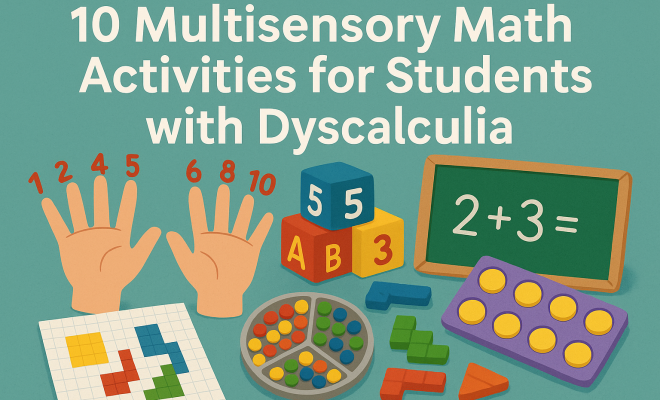
One of the simplest ways to engage students with dyscalculia is by using hands-on manipulatives. Items such as blocks, counters, or even everyday objects like coins can provide a tactile experience that helps students grasp essential math concepts. For example, when teaching addition, you could have students physically combine groups of blocks to see the sum in action.
In addition to basic arithmetic, manipulatives can assist in exploring more complex concepts such as fractions and geometric shapes. When students can touch and move these materials, they may find the learning experience more enjoyable and effective.
According to research, students using manipulatives in their math learning show a 30% higher engagement level than those relying solely on traditional methods. Activities like building shapes with clay or creating patterns with beads can enhance spatial reasoning and problem-solving skills, which are critical in mathematics.
2. Number Lines with Movement
Implementing a number line activity that incorporates movement can be a game-changer. Create a large number line on the floor using tape or mats. Students can jump or step on the numbers to solve addition or subtraction problems physically. This kinesthetic approach not only reinforces the concept of number order but also makes learning interactive and fun.
For instance, as a child jumps from the number 3 to 5 while performing the addition problem 3 + 2, they can visualize the process, effectively integrating physical movement with numerical understanding.
Studies have shown that kinesthetic learning, where students are physically active during learning, can improve both retention and comprehension by up to 50%. It’s an opportunity to combine math practice with physical education, making it both educational and engaging.
3. Musical Math
Integrating music into math lessons can also yield impressive results. Music has a unique ability to enhance memory, and when combined with math concepts, it can make learning more engaging. Consider creating songs or chants that incorporate math facts, such as multiplication tables or addition facts.
You can also use rhythm to teach patterns and sequences. For example, clapping hands while counting can reinforce numerical order while aiding in rhythm recognition. The repetition and fun of music can help solidify these concepts for students struggling with traditional methods. (See: Understanding dyscalculia from NIH.)
Research indicates that children learn better when information is set to music, as melodies and rhythms engage the brain in a way that enhances memory retention. The use of songs can help students recall difficult math facts, making learning less daunting.
4. Visual Storytelling
Using storytelling as a means to explain math concepts can help students with dyscalculia relate personally to the material. Create stories around math problems where characters face challenges requiring math solutions. For example, a story about a baker needing to divide cookies among friends can illustrate division and fractions in a relatable context.
Encouraging students to create their own math stories can also enhance their understanding. As they draw or write their narratives, they can visualize and contextualize the math problems, leading to a deeper understanding of the concepts involved.
Data suggest that students who engage in storytelling activities can improve their comprehension skills by 40%. This method allows learners to create mental images of math concepts, leading to more robust long-term memory retention.
5. Math Games with a Twist
Games are an engaging way to reinforce math skills, and when tailored for multisensory learning, they can be particularly effective for students with dyscalculia. Consider developing board games or card games that incorporate math challenges. For example, a bingo game that requires solving math problems to fill in a card can promote both fun and learning.
Incorporating technology can also enhance these games. Many educational apps offer interactive math games that combine visuals, sounds, and touch, catering to the needs of diverse learners and keeping them motivated.
Statistics show that students who regularly participate in math games demonstrate up to a 25% increase in problem-solving skills compared to their peers who do not. The competitive yet safe environment of games can boost motivation and encourage collaboration among students.
6. Cooking and Baking Activities
Cooking is a practical application of math that many students can relate to and enjoy. When following a recipe, students must measure ingredients, which can provide a hands-on approach to understanding fractions and proportions. For instance, if a recipe calls for 1/2 cup of sugar, students can physically measure it out, providing a real-world context for fractions.
Encouraging students to adjust recipes for different serving sizes also introduces concepts of multiplication and division in an engaging way. As they measure and mix, they learn while enjoying a tasty reward at the end!
Cooking activities can yield a 60% increase in students’ engagement and understanding of math concepts. They demonstrate the practical application of math in daily life, making it relevant and enjoyable for students who might otherwise feel disconnected from the subject.
7. Interactive Technology Tools
In today’s digital age, technology offers various tools that can make learning math more accessible and enjoyable for students with dyscalculia. Websites and apps that focus on interactive math activities can help students engage with the material through games, quizzes, and visual aids.
For example, platforms like Prodigy or Kahoot! can create an immersive environment where students can practice math skills in a game-like setting. Using these tools can help students feel more empowered in their learning process, allowing them to progress at their own pace while enjoying the interactive experience.
According to research, students utilizing technology for math practice show a 30% improvement in engagement levels. Games that adapt to individual skill levels can provide instant feedback, making learning more effective and personalized.
8. Art Integration in Math
Art can be a powerful medium for teaching math concepts. Activities that combine art with math offer students a unique way to express their understanding. For instance, students can create geometric designs using colors and shapes, helping them visualize and understand concepts of area and perimeter.
Additionally, creating graphs or charts through art projects can provide a creative outlet while reinforcing data interpretation skills. When students can express their knowledge through art, it not only makes learning enjoyable but also helps solidify their understanding of mathematical concepts.
Students who engage in art-integrated math activities show an improvement in both creativity and analytical thinking. The combination of art and math allows learners to approach problems from different perspectives, ultimately leading to a deeper comprehension of both subjects. (See: National Center for Learning Disabilities.)
9. Outdoor Math Exploration
Taking math learning outside can change the dynamic of the classroom and enhance engagement. Outdoor activities such as scavenger hunts or nature walks can incorporate math in real-world contexts. For example, students could search for shapes in nature or count items like leaves or rocks.
These outdoor explorations provide a break from the traditional classroom setting and allow students to apply math skills in a tangible way. They can also foster teamwork and collaboration, further enriching the learning experience.
Research indicates that outdoor learning can increase student engagement by up to 50%, especially for those with learning disabilities. Activities in nature can bring math to life and show its relevance in the real world, allowing students to connect with the subject matter more personally.
10. The Role of Peer Tutoring
Incorporating peer tutoring into your approach can also be beneficial. Pairing students with dyscalculia with peers who excel in math can provide support and encouragement. These partnerships enable students to learn from each other in a low-pressure environment while fostering social skills.
For example, a student strong in math can explain concepts verbally, while the student with dyscalculia uses manipulatives to visualize the problem. This method can help facilitate understanding and build confidence in a collaborative atmosphere.
Studies have shown that peer tutoring can enhance academic performance by over 30% for both the tutor and the tutee. This approach not only helps students grasp math concepts but also encourages empathy and communication skills, which are vital in any collaborative learning environment.
Real-World Connections in Math
Making real-world connections can significantly enhance the learning experience for students with dyscalculia. When students understand how math applies to everyday life, they are more likely to engage with the material. Discussing budgeting, shopping, or even planning a trip can provide tangible examples of how math concepts are used outside the classroom.
For instance, when discussing percentages, you could use examples from sales or discounts. Students can calculate how much a $50 jacket will cost after a 20% discount. Such real-world applications can clarify abstract concepts and make them more relatable.
Research indicates that students who connect math concepts to real-life situations can improve their problem-solving skills by up to 35%. When learners see the value of math in their lives, they’re more motivated to engage with the content actively.
Statistics and Research on Multisensory Learning
Recent research supports the effectiveness of multisensory learning, especially for students with learning disabilities. A study published in the Journal of Learning Disabilities found that students who engaged with multisensory approaches had significantly higher retention of math concepts compared to those who used traditional methods.
Statistics show that 70% of students with dyscalculia benefit from hands-on activities that involve movement and tactile engagement. This underscores the importance of integrating multisensory math activities into lesson plans, as they can meet the diverse needs of learners and improve overall comprehension and retention rates.
Expert Perspectives on Multisensory Learning
Educators and specialists in the field of learning disabilities emphasize the importance of multisensory learning. Dr. Susan Bart, a well-known educational psychologist, states, “Students learn best when they can connect new information to prior knowledge through different senses. For students with dyscalculia, multisensory activities can bridge the gap between understanding and application.”
Experts recommend regularly incorporating these activities into curriculum planning. Whether using visual aids, auditory elements, or kinesthetic approaches, the key is to create varied learning experiences that will resonate with each student.
FAQ About Multisensory Math Activities
What are multisensory math activities?
Multisensory math activities are teaching strategies that engage multiple senses (sight, sound, touch, and movement) to help students learn math concepts more effectively. These activities cater to different learning styles and can be particularly helpful for students with learning disabilities like dyscalculia.
How do I implement multisensory math activities in my classroom?
Start by incorporating hands-on manipulatives, using movement-based activities, and integrating music or art into your lessons. Look for opportunities to relate math concepts to real-world experiences and encourage collaborative learning through peer tutoring.
Are there specific grade levels that benefit most from multisensory math activities?
While all students can benefit from multisensory approaches, those in early elementary grades may find it particularly effective as they are still building foundational skills. However, students of all ages, including those in higher grades who may struggle with math, can also benefit significantly.
Can technology be considered a multisensory tool?
Absolutely! Many educational apps and online platforms incorporate visuals, sounds, and interactive elements that engage students’ senses. These tools can provide a motivating learning environment for students with dyscalculia and other learning challenges.
How can parents support multisensory learning at home?
Parents can support multisensory learning by incorporating math-related activities into everyday life, such as cooking, shopping, or playing math games. They can also encourage their children to use manipulatives at home, such as blocks or counting tools, to reinforce concepts learned in school.
What are some examples of effective multisensory math activities?
Effective multisensory math activities include using manipulatives, engaging in movement-based tasks like number lines on the floor, integrating music with math lessons, storytelling to relate math problems, and using art to visualize geometric concepts. Each activity engages different senses, enhancing comprehension and retention.
How can I ensure the activities are inclusive for all learners?
To ensure inclusivity, differentiate activities based on students’ needs. Provide various options for participation, allowing students to choose how they engage with the material. Collaborate with special education professionals to adapt activities and ensure all students can participate meaningfully.
Conclusion: Creating a Supportive Learning Environment
Incorporating multisensory math activities for students with dyscalculia not only helps in teaching mathematical concepts but also builds confidence and enthusiasm for learning. By engaging different senses and providing varied experiences, educators can foster a supportive environment that meets the needs of all learners.
The journey to understanding math may differ for students with dyscalculia, but with the right strategies in place, they can thrive. Teachers, parents, and tutors should work collaboratively to identify which activities resonate best with each student, ensuring a personalized approach to learning.
As we move forward, it’s essential to continue advocating for inclusive teaching practices and exploring innovative methods that can make a lasting impact on students facing challenges in math. With patience, creativity, and a multisensory approach, we can transform the way students with dyscalculia experience math, turning obstacles into opportunities for growth and learning.
“`
Trending Now
Frequently Asked Questions
What activities can help students with dyscalculia?
Multisensory math activities are particularly effective for students with dyscalculia. These activities engage multiple senses—sight, sound, touch, and movement—to enhance learning and retention. Examples include using physical objects for counting, interactive games, and tactile materials to represent numbers.
How does dyscalculia affect learning in math?
Dyscalculia can significantly impact a student's ability to understand and work with numbers, leading to challenges in counting, memorizing math facts, and grasping mathematical concepts. This often results in frustration, anxiety, and a negative attitude towards math.
What is multisensory learning in math?
Multisensory learning involves engaging multiple senses during the learning process, which enhances understanding and memory retention. In math, this can include using visual aids, auditory materials, and hands-on activities to help students build a stronger conceptual framework.
Why is multisensory teaching important for dyscalculia?
Multisensory teaching is crucial for students with dyscalculia as it addresses their unique learning needs by activating different senses. This approach helps them visualize and manipulate mathematical concepts, making learning more effective and reducing anxiety associated with traditional methods.
What percentage of the population has dyscalculia?
Approximately 5-7% of the population struggles with dyscalculia, a learning disability that affects mathematical understanding. This condition can lead to significant challenges in academic performance and self-confidence in math-related tasks.
What’s your take on this? Share your thoughts in the comments below — we read every one.