Unraveling the Universe: The Groundbreaking ‘HyperMillennium’ Simulation
Introduction
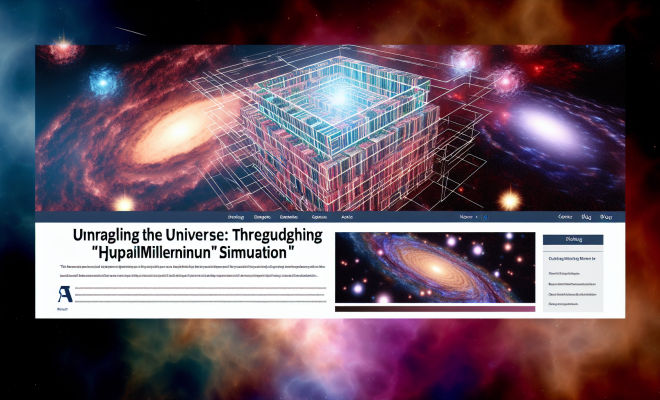
In a remarkable leap forward for cosmology, a Chinese-led international research team has unveiled the largest-ever cosmological simulation, aptly named ‘HyperMillennium’. This ambitious project represents a significant advancement in our understanding of the universe, offering researchers a tool of unprecedented scale and detail to explore the cosmic evolution of galaxies and other structures over billions of years.
The Scale of ‘HyperMillennium’
The ‘HyperMillennium’ simulation spans an astonishing volume of space, covering a cubic region with a side length of 12 billion light-years. To put this into perspective, this scale allows scientists to investigate the universe at a level of detail that was previously unattainable. The simulation involves the computation of 4.2 trillion virtual dark matter particles, marking a significant increase in the number of particles utilized in cosmological simulations.
The Importance of Dark Matter
Dark matter, which makes up approximately 27% of the universe’s mass-energy content, plays a crucial role in the formation and evolution of cosmic structures. Its gravitational influence is responsible for the clustering of galaxies and the formation of galaxy clusters. The sheer number of virtual dark matter particles in the ‘HyperMillennium’ simulation allows researchers to more accurately model the dynamics of dark matter and its interaction with visible matter.
Recreating Cosmic History
Using advanced N-body numerical simulation techniques, the researchers successfully recreated the evolution of large-scale structures in the universe over a timeline of 10 billion years. This approach allows scientists to essentially ‘rewind time’ and observe how galaxies, galaxy clusters, and various cosmic features formed from the aftermath of the Big Bang.
The Methodology Behind the Simulation
The methodology employed in the ‘HyperMillennium’ simulation involves complex algorithms that calculate the gravitational interactions between particles over vast distances. By simulating the universe in this way, researchers can analyze the processes that led to the formation of the cosmic web—a vast network of filaments and voids that characterize the large-scale structure of the universe.
Insights into Cosmic Evolution
The insights gained from the ‘HyperMillennium’ simulation are expected to be transformative for the field of cosmology. By providing a more comprehensive understanding of how structures in the universe evolved, this simulation opens new avenues for research. It allows scientists to test various cosmological theories and models against the simulated data, enhancing our comprehension of phenomena such as dark energy, galaxy formation, and the overall evolution of the universe.
Collaborative Efforts in Cosmology
This groundbreaking project is a testament to the collaborative spirit of the global scientific community. The team involved in the ‘HyperMillennium’ simulation includes researchers from various institutions around the world, highlighting the importance of international collaboration in scientific advancement. The pooling of resources, expertise, and diverse perspectives has played a crucial role in the success of this ambitious simulation.
Future Directions
The release of the ‘HyperMillennium’ simulation is just the beginning. Researchers are eager to explore the vast amounts of data generated by this simulation, using it to refine existing models and propose new hypotheses. The implications of this research extend beyond mere curiosity; understanding the universe’s structure and evolution can also have practical applications in fields such as astrophysics, astronomy, and even technology.
Applications in Astrophysics and Beyond
- Galaxy Formation: By studying the simulated data, scientists can gain insights into the processes that govern galaxy formation and evolution.
- Dark Energy Research: The simulation provides a platform to test theories about dark energy, which is believed to drive the accelerated expansion of the universe.
- Technological Innovations: The computational techniques and algorithms developed for the simulation may have applications in other areas of technology, including data analysis and modeling.
Conclusion
The launch of the ‘HyperMillennium’ simulation marks a significant milestone in the field of cosmology. By enabling researchers to explore the universe in unprecedented detail, this simulation not only enhances our understanding of cosmic evolution but also paves the way for future discoveries. As scientists continue to analyze the data generated by this groundbreaking project, we can expect to see new insights that challenge our current understanding of the universe and its mysteries.
Looking Ahead
As we look to the future, the knowledge gained from the ‘HyperMillennium’ simulation will undoubtedly inspire a new generation of cosmologists and astrophysicists. The quest to unravel the complexities of the universe continues, and with tools like ‘HyperMillennium’, we are better equipped than ever to uncover the secrets that lie beyond our planet.