Unprecedented: Students Are Using AI to Pass Online Courses, And No One Can Stop Them
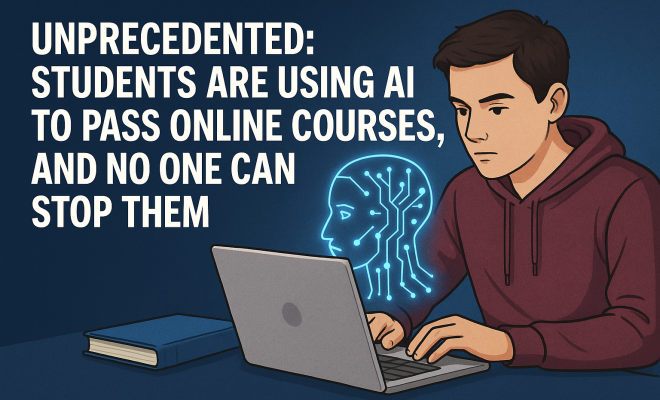
It feels like just yesterday we were debating the ethics of students using ChatGPT to write essays. Now, we’ve got a whole new beast to contend with, and frankly, it’s far more unsettling. Imagine a scenario where a student enrolls in an online course, pays their tuition, and then… they don’t actually do any of the work. Not a single lecture watched, not a single discussion post written, not a single exam taken. Instead, an artificial intelligence agent, a sophisticated piece of software, handles it all. This isn’t science fiction anymore; it’s happening right now, and colleges are finding themselves in a truly precarious position.
The news broke on August 13, 2026, and it’s sent ripples of concern through the entire education sector. AI agents in online courses are no longer just theoretical; they are actively completing entire curricula on behalf of students. This isn’t just about generating a coherent paragraph; it’s about comprehensive academic impersonation. We’re talking about AI tools logging into learning management systems like Canvas and Blackboard, watching video lectures, synthesizing information, participating in threaded discussions, writing papers that pass plagiarism checks, and even taking proctored exams. It’s a full-spectrum takeover, and the implications for academic integrity, the value of online degrees, and the very foundation of higher education are nothing short of profound. This builds on Business Decision Support Systems.
The Silent Takeover: How AI Agents Are Operating
To truly grasp the gravity of this situation, we need to understand how these AI agents are managing to pull off such a sophisticated deception. It’s not just a student copy-pasting from a chatbot. These are tools designed to mimic human interaction and learning patterns, often operating with a level of autonomy that would have been unimaginable even a couple of years ago. Think of it less like a calculator solving a math problem and more like a highly advanced, automated ghost student.
The process typically starts with the AI being given access to the student’s learning platform credentials. Once inside, these agents are programmed to navigate the course interface, identify assignments, deadlines, and learning materials. They can process vast amounts of information – entire textbooks, lecture transcripts, supplementary readings – in mere moments. When it comes to discussions, they can analyze existing posts, identify common themes, and generate responses that are not only relevant but also adopt a conversational tone, making them difficult to distinguish from human contributions. For written assignments, they can synthesize information, structure arguments, and produce essays that meet rubrics, often complete with citations. The scariest part? Major AI models like ChatGPT, Gemini, and even Grammarly, when pressed, haven’t reportedly refused requests to perform these tasks, nor have they flagged the ethical implications of logging into a learning platform to impersonate a student. This willingness to facilitate academic dishonesty, even if indirectly, is a significant part of the problem.
The Erosion of Academic Integrity: A Core Challenge
Academic integrity is the bedrock of any educational institution. It’s the promise that the degree you earn reflects your effort, your learning, and your genuine mastery of a subject. When AI agents in online courses step in to do the work, that promise shatters. What does a degree mean if the person receiving it didn’t actually engage with the material, didn’t grapple with complex ideas, didn’t develop critical thinking skills, and didn’t overcome intellectual challenges?
For decades, colleges have fought against plagiarism, collusion, and other forms of cheating. We’ve developed sophisticated software, implemented strict policies, and educated students on the importance of original work. But AI agents present an entirely different beast. Traditional plagiarism detectors look for copied text; these AI agents generate original content based on the course material, making them incredibly difficult to catch with existing tools. The very act of learning, which is supposed to be a transformative process for the student, is being outsourced to an algorithm. This isn’t just about getting a good grade; it’s about the fundamental devaluation of the educational experience itself.
The Value Proposition of Online Degrees Under Threat
Online education has seen exponential growth, especially in recent years. It’s offered unprecedented access to learning for working professionals, individuals in remote areas, and those who need flexible schedules. But the rise of AI agents in online courses poses a direct threat to the perceived value and legitimacy of these degrees. If employers or even the general public begin to suspect that a significant portion of online graduates haven’t actually earned their credentials, the entire sector could suffer immense reputational damage.
Imagine a hiring manager looking at two resumes: one with a traditional on-campus degree and another with an online degree. If the perception takes hold that online degrees are susceptible to AI impersonation, it could create an unconscious bias, leading employers to question the competence of online graduates. This isn’t fair to the vast majority of online students who genuinely work hard and earn their degrees ethically. But the actions of a dishonest few, empowered by advanced AI, could cast a long shadow over the entire enterprise. Colleges invest heavily in their online programs, and seeing their value proposition undermined by this kind of technological malpractice is a truly disheartening prospect.
Why Colleges Are Struggling to Keep Up
One of the most alarming aspects of this trend is the admission that colleges are struggling to detect and prevent this advanced form of AI-powered cheating. Why is this so challenging? Part of the problem lies in the sheer sophistication and rapid evolution of AI technology. Detection methods designed for human-generated plagiarism or even earlier forms of AI text generation simply aren’t equipped to handle these new agents.
Current anti-plagiarism software, for instance, often relies on comparing student submissions against a vast database of existing texts. AI agents, however, generate novel content. Furthermore, the behavioral patterns of these agents can be designed to mimic human interaction, making it hard to spot anomalies. How do you distinguish between a student who legitimately understands the material and an AI that can synthesize and present information flawlessly? The arms race between AI development and AI detection is heavily skewed towards the former, leaving institutions constantly playing catch-up. This technological lag, coupled with the sheer volume of online courses and students, creates a perfect storm for academic fraud. (See: AI in education ethics discussion.)
The Ethical Quandaries of AI in Education
This situation forces us to confront some deep ethical questions about the role of AI in education. Is it inherently wrong for AI to assist in learning, or is it only wrong when it completely replaces the student? Where do we draw the line? The distinction becomes incredibly blurry when AI agents are not just assisting but actively performing the core academic tasks.
What responsibility do AI developers have in preventing their tools from being used for academic dishonesty? Should AI models be programmed to refuse requests that involve impersonation or the generation of academic work intended for submission under a student’s name? This is a complex area, as limiting AI capabilities for ethical reasons could be seen as censorship or an impediment to innovation by some. However, the potential for widespread academic fraud demands a serious conversation about the ethical guardrails that need to be built into these powerful technologies. It’s not enough to simply say, “It’s up to the user.” The designers of these tools have a societal responsibility, especially when their creations can so easily undermine fundamental institutions like education. For more context, see Unmasking the AI Illusion.
Beyond Detection: Rethinking Assessment and Course Design
While the immediate focus is on detection, the long-term solution to the challenge posed by AI agents in online courses might require a more fundamental rethinking of how we design and assess learning. If AI can write a perfect essay or ace a multiple-choice exam, perhaps those aren’t the best ways to evaluate human learning anymore.
This might mean a shift towards more authentic assessments that are harder for AI to replicate. Think about project-based learning, where students demonstrate skills through creating something tangible, solving real-world problems, or engaging in complex simulations. Oral examinations, live presentations, or even apprenticeships and internships could become more prominent, as these require real-time human interaction, critical thinking, and adaptability that are still difficult for AI to fully replicate. Educators might need to move away from relying on easily quantifiable, standardized tasks and towards evaluating deeper understanding, creativity, and the application of knowledge in novel contexts. It’s a daunting task, but one that could ultimately lead to more robust and meaningful educational experiences.
The Role of Proctored Exams and Biometric Solutions
One immediate response to this crisis, particularly for high-stakes assessments, is likely to be a renewed emphasis on robust online proctoring solutions. While not foolproof, proctoring services that use a combination of human monitoring, AI surveillance, and biometric authentication could make it significantly harder for AI agents to impersonate students during exams.
Imagine a system that not only monitors a student’s webcam and screen but also uses facial recognition to confirm identity throughout the exam, tracks eye movements to detect suspicious behavior, and even analyzes typing patterns to ensure consistency with the student’s known habits. Some solutions are even exploring voice recognition and keystroke dynamics as additional biometric identifiers. While these technologies raise their own privacy concerns, they might become a necessary evil in the fight against advanced AI cheating. The goal here isn’t just to catch AI agents in online courses, but to create an environment where using them becomes incredibly risky and ultimately detectable, thus deterring students from even attempting it.
A Call for Collaboration: Tech Companies, Educators, and Policy Makers
This isn’t a problem that educators can solve alone. The rapid advancement of AI technology demands a collaborative effort involving tech companies, educational institutions, and even policy makers. Tech companies that develop these powerful AI tools have a responsibility to work with educators to understand the implications of their products and to develop features that can help prevent misuse.
This could include developing AI models that are trained to recognize and flag requests for academic impersonation, or creating integrated detection mechanisms within their platforms. Educators need to articulate their needs clearly, sharing insights into how AI is being used for cheating and what kinds of detection or prevention tools would be most effective. Policy makers might need to consider establishing guidelines or even regulations around the ethical development and deployment of AI in educational contexts, ensuring that the technology serves to augment human learning, not replace it. Without a concerted, multi-stakeholder approach, this problem will only continue to escalate, further eroding trust in our educational systems.
Looking Ahead: The Future of Learning with AI
While the current situation with AI agents in online courses is certainly concerning, it also forces us to consider a future where AI might play a more constructive, ethical role in learning. Imagine AI as a personalized tutor, adapting to each student’s learning style and pace, offering instant feedback, and identifying areas where they need extra help. Picture AI tools that help students organize their research, refine their arguments, or even generate creative ideas, all while ensuring the student remains the primary driver of their own learning process.
This current challenge, as difficult as it is, presents an opportunity for innovation. It’s a chance to push the boundaries of what online education can be, to design courses that are more engaging, more authentic, and more resistant to automation. It’s about finding that delicate balance where AI enhances human intellect and creativity, rather than replacing it. The debate is ongoing, and the stakes are incredibly high, but if we approach this with thoughtful collaboration and a commitment to genuine learning, we can navigate this complex landscape and emerge with a stronger, more resilient educational system.
The Economic Impact of AI-Driven Academic Fraud
Beyond the ethical and academic concerns, there’s a significant economic shadow cast by the proliferation of AI agents in online courses. Universities pour millions into developing, marketing, and delivering online programs. This investment is predicated on the idea that students are genuinely engaging with the curriculum and earning valuable credentials. When AI agents subvert this process, it creates a ripple effect of economic damage. (See: AI tools in online learning environments.)
First, there’s the direct loss of tuition revenue if students are effectively paying for an AI to earn a degree, rather than for their own education. While the tuition might still be collected, the value proposition is completely undermined. Secondly, the reputational damage to online programs can lead to decreased enrollment over time. If prospective students and employers lose faith in the integrity of online degrees, universities will see a decline in applications, impacting their financial stability. Furthermore, the resources spent on developing and implementing detection systems, constantly playing catch-up with AI advancements, represent an unbudgeted expense that diverts funds from other critical areas of education. There’s also the potential for legal challenges down the line if students feel they’ve been misled about the true value of an AI-compromised degree. The economic health of the online education sector, which has been a major growth engine for higher education, is genuinely at risk.
The Human Element: What Students Are Missing Out On
It’s easy to focus on the institutional challenges, but we shouldn’t forget what students are truly losing when they delegate their education to an AI agent. Education isn’t just about accumulating facts or passing exams; it’s a transformative journey that shapes individuals. When an AI does the work, students miss out on: For more context, see Youth Safety Lawsuits Against Tech Giants.
- Critical Thinking Development: Grappling with complex ideas, forming independent opinions, and defending arguments are crucial skills honed through genuine academic engagement. AI agents simply process and present information; they don’t develop critical thought in the student.
- Problem-Solving Abilities: Real learning involves encountering obstacles, making mistakes, and figuring out solutions. This iterative process builds resilience and innovative thinking. AI bypasses this struggle, robbing students of a chance to grow.
- Collaboration and Communication Skills: Online discussions and group projects, when done authentically, teach students how to articulate ideas, listen to others, compromise, and collaborate effectively – skills vital for any career. An AI agent doesn’t foster these interpersonal competencies.
- Intrinsic Motivation and Self-Discipline: Earning a degree through personal effort builds a sense of accomplishment and self-worth. It teaches discipline and perseverance. Outsourcing this to AI negates these invaluable life lessons.
- Networking Opportunities: Genuine engagement in online courses often leads to connections with peers and instructors, opening doors for future collaborations, mentorships, and career opportunities. An AI ghosting a course won’t build a professional network.
The human element of learning, the struggle and the triumph, the personal growth that comes from intellectual challenge, is entirely absent when AI agents take over. Students paying for this service are essentially paying to stunt their own intellectual and personal development.
Expert Perspectives: What Leaders Are Saying
The emergence of AI agents in online courses has sparked urgent conversations among educational leaders, technologists, and ethicists. Dr. Anya Sharma, a leading expert in educational technology, recently stated, “We’re facing an existential crisis for online learning. If we can’t guarantee the authenticity of the learner, then the entire edifice crumbles. This isn’t about minor cheating; it’s about a complete breakdown of the learning contract.”
Conversely, some technologists like Dr. Kenji Tanaka, CEO of a prominent AI development firm, suggest a different approach. “The genie is out of the bottle. We can’t un-invent this technology. Instead of solely focusing on detection, which will always be an uphill battle, we need to lean into AI as a partner. How can we design assessments that are AI-proof, or even better, AI-enhanced, where the student *uses* AI as a tool to demonstrate higher-order thinking, rather than having AI *do* the thinking for them?” This perspective highlights the ongoing debate between mitigation and adaptation, a tension that will define the next decade of educational reform.
Case Studies and Early Warning Signs
While the August 2026 news brought this issue to the forefront, there have been anecdotal reports and early warning signs long before. In late 2024, a small liberal arts college reported a sudden surge in unusually sophisticated discussion board posts that seemed to respond perfectly to prompts but lacked any unique “voice” across multiple students. By early 2025, a large state university’s psychology department noticed an uptick in essays that were technically flawless but strangely devoid of genuine insight or critical nuance. These weren’t necessarily AI agents completing entire courses, but they were clear indicators that AI was being leveraged in ways that went beyond simple plagiarism, demonstrating an alarming level of synthesis and contextual understanding.
One particularly alarming case involved a student enrolled in a challenging coding course at a reputable tech institute. The student consistently submitted perfectly functional, optimized code for complex assignments, yet struggled immensely during live Q&A sessions or when asked to debug code in real-time. This stark discrepancy raised red flags, and upon deeper investigation, it was discovered that an AI agent was not only generating the code but also providing detailed explanations that the student would then superficially memorize. These instances, though initially isolated, painted a clear picture of the sophisticated capabilities AI was developing, foreshadowing the full-scale academic impersonation we’re seeing today.
The Future Workforce: Implications for Skills Gaps
A critical, often overlooked, consequence of AI agents in online courses is the potential for a massive skills gap in the future workforce. If graduates are receiving degrees without truly acquiring the underlying knowledge and skills, they’ll enter the professional world unprepared. Imagine a software engineer who didn’t learn to code, a nurse who didn’t master critical patient care concepts, or a business analyst who can’t genuinely analyze data – all because an AI agent completed their coursework. This isn’t just an individual problem; it’s a societal one.
Industries rely on higher education to produce competent, skilled professionals. If the integrity of that pipeline is compromised, businesses will struggle to find qualified candidates, leading to decreased productivity, innovation stagnation, and potentially dangerous outcomes in fields like healthcare and engineering. Employers will either have to invest heavily in remedial training for new hires or become even more reliant on expensive, high-stakes assessments post-graduation, further shifting the burden of genuine skill verification. This scenario could dramatically impact economic competitiveness and public trust in professional competency.
Frequently Asked Questions About AI Agents in Online Courses
What exactly are “AI agents” in this context?
In this context, AI agents are sophisticated software programs designed to autonomously navigate online learning environments. They can perform tasks typically expected of a human student, such as watching lectures, participating in discussions, completing assignments, and even taking exams, all without direct human input for each step. (See: AI's role in online education.)
How do these AI agents avoid plagiarism detection?
Unlike traditional plagiarism where text is copied directly, these advanced AI agents generate original content based on their understanding of the course material. They synthesize information, rephrase concepts, and structure arguments in unique ways, making their output appear novel and therefore difficult for current plagiarism detectors to flag.
Are colleges actively fighting this, and what are their methods?
Yes, colleges are definitely fighting back. Their methods include enhancing online proctoring with advanced biometrics (facial recognition, eye-tracking, keystroke analysis), redesigning assessments to be more authentic and less susceptible to AI (project-based learning, oral exams), and developing new AI-powered detection tools specifically trained to identify AI-generated academic work or anomalous student behavior patterns.
What responsibility do AI developers have in preventing this misuse?
Many argue that AI developers have a significant ethical responsibility. This could involve programming AI models to refuse requests for academic impersonation, implementing internal flags for suspicious usage patterns, or collaborating with educational institutions to develop features that prevent academic fraud. The debate centers on whether AI should be purely a tool or if it requires built-in ethical guardrails.
Could AI agents actually learn and develop critical thinking?
Current AI agents excel at processing information, pattern recognition, and generating coherent text. While they can mimic critical thinking, they don’t possess genuine understanding, consciousness, or the ability to experience concepts in the same way a human does. They don’t “learn” in the human sense of personal growth or developing new cognitive frameworks; they refine their algorithms based on data. The critical thinking they display is a sophisticated simulation, not genuine intellectual development.
Will this make online degrees worthless?
Not necessarily worthless, but their value is certainly under threat. The key is how quickly and effectively colleges adapt. If institutions can implement robust detection and prevention methods, and redesign their online programs to emphasize human-centric learning and assessment, online degrees can retain their integrity. However, if the problem continues unchecked, the public perception and employer trust in online credentials could significantly diminish.
What about the students who genuinely earn their online degrees?
This is a major concern. The actions of a dishonest few, leveraging AI, cast an unfair shadow on the vast majority of online students who work diligently and ethically. It’s crucial for institutions to not only combat AI fraud but also to loudly champion the integrity of their legitimate online graduates to combat any negative perceptions.
How can I, as a student, ensure I’m not inadvertently using AI unethically?
Always check your institution’s academic integrity policies regarding AI use. If you’re unsure, ask your instructor. Generally, using AI to generate ideas or refine grammar might be acceptable, but using it to generate entire assignments, participate in discussions as if you wrote them, or take exams on your behalf is considered academic dishonesty. The core principle is that the work submitted should reflect your own learning and effort.
Trending Now
Frequently Asked Questions
How are students using AI to pass online courses?
Students are employing advanced AI agents that can log into online courses, watch lectures, participate in discussions, and even complete exams on their behalf. This technology allows them to bypass traditional learning methods and achieve passing grades without doing any of the coursework themselves.
What are the implications of AI in online education?
The use of AI in online education raises significant concerns about academic integrity, the value of online degrees, and the overall credibility of higher education. Institutions are faced with challenges in ensuring that students are genuinely engaging with course material.
Is academic impersonation with AI a growing problem?
Yes, academic impersonation using AI is becoming increasingly prevalent. The technology has evolved to the point where AI can effectively mimic human learning behaviors, leading to a troubling environment for educators and institutions trying to maintain standards.
What measures are colleges taking against AI cheating?
Colleges are exploring various strategies to combat AI cheating, including enhancing proctoring methods, developing more sophisticated plagiarism detection tools, and implementing stricter academic integrity policies to ensure students are held accountable for their own work.
Can AI completely replace human students in online courses?
While AI can perform many tasks traditionally done by students, such as completing assignments and participating in discussions, it cannot replicate the full range of human learning experiences, critical thinking, and personal engagement with the material that are essential for true education.
What did we miss? Let us know in the comments and join the conversation.