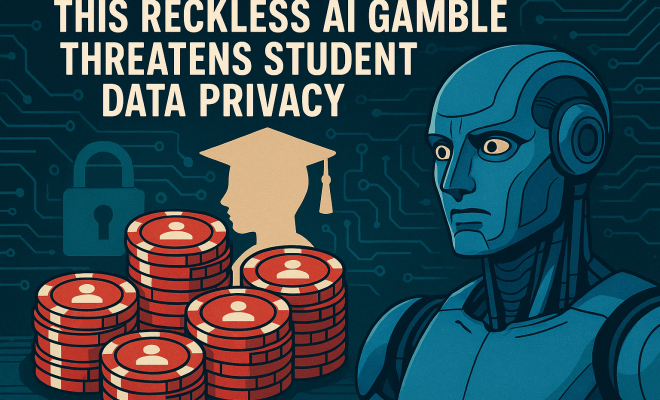
This Reckless AI Gamble Threatens Student Data Privacy
“`html
You’ve seen it, haven’t you? Artificial intelligence, once a futuristic whisper, is now shouting from every classroom. From personalized learning algorithms to AI-powered tutoring and administrative tools, these technologies are rapidly becoming fixtures in K-12 education. And honestly, who can blame schools for being eager? The promises are enticing: tailored education, reduced teacher workload, and unprecedented insights into student progress. But here’s the kicker, the part that keeps many of us up at night: as schools race to integrate these shiny new tools, a critical, often overlooked question looms large: what about student data privacy?
It’s not just a theoretical concern. We’re talking about the personal information of millions of children – their grades, their learning styles, their behavioral patterns, even their biometric data in some cases. This isn’t just a list of names and addresses; it’s a digital footprint of their entire educational journey, a footprint that AI systems gobble up to learn, adapt, and operate. The speed at which AI has permeated our schools has, frankly, outpaced our ability to establish robust guardrails, leaving a gaping void where clear policies and ironclad protections for student data privacy should be. This isn’t just about compliance; it’s about trust, ethics, and safeguarding the most vulnerable members of our society.
The AI Gold Rush in Education: A Double-Edged Sword
Let’s be real: AI offers incredible potential to revolutionize education. Imagine a student struggling with algebra, and an AI tutor can identify the precise conceptual gap, offering targeted exercises and explanations until understanding clicks. Or consider an AI system that helps teachers differentiate instruction for a classroom of diverse learners, freeing up valuable time for more direct student interaction. These aren’t pipe dreams; they’re already happening in various forms. Companies are pouring billions into developing educational AI, and schools, often under immense pressure to innovate and improve outcomes, are eager adopters.
However, this rapid adoption comes with significant caveats. Many of these AI tools are developed by third-party vendors, and their business models often rely on collecting vast amounts of data. This data, once collected, can be stored in cloud servers, processed by complex algorithms, and, in some cases, even used to ‘train’ the AI models themselves. This is where the red flags start waving. Without clear contracts and stringent oversight, schools might inadvertently grant these vendors broad permissions to student data, permissions that could extend beyond the immediate educational purpose. It’s a classic case of innovation running ahead of regulation, leaving a precarious landscape for student data privacy.
Recent Incidents Sound the Alarm on Student Data Privacy
It’s easy to dismiss these concerns as hypothetical until you see them manifest in real-world incidents. Take, for instance, the unsettling breach that impacted Canvas, a widely used learning management system. While the specifics of the breach and its impact on student data were a significant concern, it served as a stark reminder of the inherent vulnerabilities in even the most established educational technology platforms. These systems, holding a treasure trove of student information, become prime targets for malicious actors. When a system as ubiquitous as Canvas can face a breach, it forces every school district to reconsider its reliance on third-party vendors and the robustness of their security protocols. See also protecting student privacy.
Then there’s the more nuanced, but equally troubling, situation involving chatbot vendor AllHere. Allegations surfaced regarding how the company might have used student data, raising questions about the scope of data collection, its intended use, and whether those uses aligned with parental and school expectations. These kinds of incidents aren’t just about data falling into the wrong hands; they’re about data being used in ways that parents never consented to, or that could have long-term implications for students. They underscore a fundamental tension: AI thrives on data, but our children’s data demands the highest level of protection. Each incident, whether a direct breach or an alleged misuse, chips away at public trust and amplifies the urgent need for a more proactive approach to student data privacy.
States Step Up: Mandating AI Policies for K-12
The good news is that some legislative bodies are starting to catch up. States are no longer waiting for federal guidance; they’re taking the initiative. Ohio, for example, is at the forefront, now mandating that school districts develop and implement comprehensive AI policies. This isn’t just a suggestion; it’s a requirement. What does this mean in practice? It means districts can’t just adopt an AI tool because it looks cool; they have to think critically about its implications. They must consider how student data will be collected, stored, used, and protected. They need to establish clear guidelines for teachers, students, and parents regarding AI’s role in the classroom.
This mandate is a crucial step because it shifts the responsibility from individual educators, who may lack the expertise, to the district level, where dedicated resources and legal counsel can be brought to bear. It forces a systemic conversation about the ethical deployment of AI and the paramount importance of student data privacy. We’re moving beyond a reactive stance – addressing problems after they arise – to a proactive one, attempting to build a framework that anticipates and mitigates risks before they become headline news. Other states are watching Ohio closely, and it’s highly probable that we’ll see similar mandates spread across the country as the integration of AI in education continues its relentless march.
California’s Bold Move: Restricting Data Use for AI Model Training
While Ohio focuses on district-level policy, California is targeting a specific, highly contentious aspect of AI’s data appetite: the use of student data for training AI models. The state is proposing groundbreaking legislation that would significantly restrict this practice. Why is this such a big deal? Because the ‘training’ of AI models is where much of the value extraction from data occurs. When an AI model is trained on student data, that data isn’t just being used for a specific application; it’s being incorporated into the very ‘brain’ of the AI, influencing its future behavior and capabilities. This ‘training data’ can become a permanent part of the model, raising profound questions about ownership, consent, and long-term implications. (See: student data privacy guidelines.)
Imagine a scenario where an AI model trained on student essays inadvertently learns to identify certain demographic markers or learning disabilities, and then that model is sold to other entities. Or consider the potential for bias: if an AI is trained on data reflecting existing educational inequalities, it could perpetuate or even exacerbate those biases. California’s proposed legislation recognizes this profound ethical dilemma. By restricting the use of student data for AI model training, the state aims to draw a clear line in the sand, asserting that children’s educational data is not a free-for-all resource for tech companies to hone their algorithms. It’s a powerful statement about the sanctity of student data privacy and a potential game-changer for how ed-tech companies operate.
The Parental Uproar: Why This Topic Has Gone Viral
You don’t have to be a tech guru to understand why parents are profoundly concerned about student data privacy. This isn’t some niche, academic debate. It’s hitting home for millions. The widespread adoption of AI in schools, coupled with a string of high-profile data breaches and privacy controversies, has ignited a firestorm of parental anxiety. Parents are asking legitimate questions: Who has access to my child’s learning profile? What happens if this data is hacked? Could my child’s future opportunities be influenced by an AI algorithm’s assessment? These aren’t hypothetical fears; they are grounded in a very real understanding of the digital world and its potential for exploitation.
Social media amplifies these concerns, turning individual anxieties into collective movements. A single news report about a data breach can go viral, sparking thousands of conversations and demanding action from school boards and legislators. Parents, often feeling powerless against large tech companies and complex school systems, are finding their voice and demanding accountability. They understand that their children’s data is more than just data; it’s a window into their lives, their development, and their vulnerabilities. This emotional connection, combined with a growing awareness of data’s commercial value, ensures that student data privacy will remain a deeply personal and politically charged issue for years to come.
Ethical Quagmires: Beyond Just Data Security
While data security is paramount, the ethical implications of AI in learning environments extend far beyond preventing breaches. We’re talking about fundamental questions that touch on fairness, autonomy, and the very nature of learning. For instance, what happens when an AI algorithm, designed to ‘optimize’ learning, inadvertently narrows a student’s curriculum based on perceived strengths, preventing them from exploring other areas? Could AI-driven assessments create a new form of digital tracking, labeling students based on predictive analytics rather than their individual potential?
Consider the issue of bias. AI models are only as unbiased as the data they are trained on. If historical data reflects societal biases – for example, certain groups being underrepresented in advanced placement courses – an AI system could perpetuate or even amplify these inequalities. This isn’t just a technical glitch; it’s a deeply embedded ethical challenge that requires careful consideration and ongoing auditing. Schools, in their enthusiasm for innovation, must not lose sight of these broader ethical landscapes. They have a moral obligation to ensure that AI serves all students equitably and does not inadvertently create new forms of digital discrimination.
The Economic Imperative: Monetization and Market Opportunities
It might seem counterintuitive, but the very problems surrounding student data privacy are creating significant economic opportunities. The intense focus on safeguarding children’s data is fueling a booming market in cybersecurity, legal services specializing in privacy law, and secure educational software. Think about it: every school district scrambling to comply with new state mandates needs robust cybersecurity solutions to protect its systems. This translates into a high-CPC (cost-per-click) niche for cybersecurity firms offering everything from penetration testing to data encryption services.
Then there’s the legal angle. With evolving regulations like Ohio’s new AI policy and California’s proposed restrictions, schools and ed-tech vendors alike are desperate for expert legal counsel to navigate this complex landscape. Privacy law consultants and firms are seeing a surge in demand, advising on compliance, contract negotiations, and risk mitigation. Finally, the market is ripe for educational software that explicitly prioritizes privacy. Parents and schools are actively searching for ‘privacy-focused learning platforms’ or ‘secure ed-tech solutions.’ This creates a lucrative niche for developers who can build trust by demonstrating transparent data practices and robust security. In essence, the challenge of student data privacy is driving innovation and investment in solutions that promise greater safety and accountability, turning a problem into a powerful economic engine.
The Global Landscape: International Perspectives on Student Data Privacy
Student data privacy isn’t just a U.S. concern; it’s a global challenge. Different countries are grappling with the same questions, though their regulatory approaches and cultural norms often lead to varied solutions. For instance, the European Union, with its stringent General Data Protection Regulation (GDPR), sets a high bar for data protection, including for children. GDPR emphasizes consent, the right to be forgotten, and data minimization, often requiring explicit parental consent for processing children’s data in educational settings. This has a ripple effect on global ed-tech companies, pushing them to adopt higher privacy standards if they want to operate in the EU market.
Contrast this with some Asian countries, where the focus might lean more towards national security or efficient data utilization for educational advancement, potentially with less emphasis on individual privacy rights. Canada’s Personal Information Protection and Electronic Documents Act (PIPEDA) also offers protections, requiring organizations to obtain consent for the collection, use, and disclosure of personal information. Understanding these international variations highlights the complexity of the issue. A company developing an AI education tool needs to be mindful of a patchwork of regulations if it aims for global adoption, often leading to a lowest-common-denominator approach or, ideally, a design that incorporates the highest privacy standards from the outset. This global dialogue enriches our understanding and pushes for more comprehensive solutions across the board.
The Role of Data Minimization and Anonymization
One of the most powerful strategies in protecting student data privacy, often underscored in privacy-by-design principles, is data minimization. This concept is simple yet profoundly effective: only collect the absolute minimum amount of data necessary to achieve the stated educational purpose. If an AI tool can function perfectly well with a student’s anonymized performance data rather than their full name, date of birth, and home address, then only the anonymized data should be collected. (See: AI and education privacy concerns.)
Anonymization techniques are crucial here. This involves stripping identifying information from datasets so that individual students cannot be identified. Pseudonymization, a related technique, replaces direct identifiers with artificial identifiers, allowing for re-identification under strict controls if absolutely necessary. The challenge, of course, is that with enough data points, even “anonymized” data can sometimes be re-identified, especially with advanced AI techniques. Therefore, schools and vendors must employ robust anonymization practices and regularly audit them to ensure effectiveness. Embracing data minimization and sophisticated anonymization should be a core tenet of any AI policy in education, reducing the attack surface for breaches and limiting the potential for misuse right from the start.
Emerging Technologies and Future Challenges
The landscape of student data privacy isn’t static; it’s constantly evolving with new technological advancements. Think about the rise of biometric data collection in schools, such as facial recognition for attendance or fingerprint scanners for lunch purchases. While proponents argue for efficiency and security, these technologies introduce entirely new categories of sensitive data with profound privacy implications. What happens if a biometric database is breached? Could this data be used to track students outside of school or be cross-referenced with other databases?
Beyond biometrics, consider the future impact of quantum computing on encryption. Current encryption methods that protect student data could potentially be broken by quantum computers, necessitating a shift to “quantum-safe” encryption algorithms. The Internet of Things (IoT) in classrooms, with smart boards, smart sensors, and wearables, also generates a constant stream of data, much of which could be linked back to individual students. Staying ahead of these emerging technologies, anticipating their privacy challenges, and building in protections at the design phase will be critical. It means that districts, educators, and parents need to engage in continuous learning and adaptation to safeguard student data in a rapidly changing tech environment. This builds on AI ethics in education.
A Deep Dive into FERPA and COPPA in the AI Era
In the United States, two foundational laws, the Family Educational Rights and Privacy Act (FERPA) and the Children’s Online Privacy Protection Act (COPPA), provide the existing legal framework for student data privacy. However, the rise of AI presents unique challenges to their application. FERPA, enacted in 1974, primarily protects the privacy of student education records and grants parents certain rights regarding their children’s records. Schools must generally obtain written parental consent before disclosing personally identifiable information from education records.
COPPA, on the other hand, applies to online services directed at children under 13 and requires parental consent for the collection of personal information. The problem is, neither law was designed with sophisticated AI systems in mind. For FERPA, the definition of “education records” can be debated when AI tools generate new forms of analytical data or predictive insights. For COPPA, the sheer volume and continuous nature of data collection by AI tools, often embedded in platforms used by both under-13 and over-13 students, complicates consent mechanisms. Schools often act as the “agent” of parents under FERPA, consenting to terms of service for ed-tech vendors. But does this broad consent truly cover the nuanced data processing involved in AI model training? This legal gray area is exactly what states like California are trying to address with new legislation, seeking to clarify and strengthen protections beyond the original intent of these decades-old laws.
Actionable Advice for Parents and Schools
So, what can we actually do about all this? For parents, the first step is to be informed and engaged. Don’t be afraid to ask your child’s school tough questions. Inquire about their AI policies, which specific AI tools they use, and how they protect student data. Ask to see their vendor contracts if possible, and understand how your child’s data is being collected, used, and stored. Many schools have a designated data privacy officer or IT director; reach out to them. Join parent-teacher associations and advocate for strong student data privacy policies at the district level. Your voice matters more than you think.
For schools, the path forward involves a multi-pronged approach. First, establish clear, comprehensive AI usage policies that explicitly address student data privacy, going beyond mere compliance with state mandates. This means defining acceptable uses of AI, outlining data governance protocols, and ensuring transparency with parents. Second, conduct thorough due diligence on all third-party AI vendors. Don’t just look at features; scrutinize their data privacy policies, security certifications, and contractual obligations regarding student data. Negotiate for strong data ownership clauses and limitations on how vendors can use student information. Third, invest in ongoing staff training. Educators need to understand the nuances of AI, its ethical implications, and best practices for protecting student data. Finally, foster an open dialogue with parents and the community. Transparency builds trust, and trust is essential for the successful and ethical integration of AI in education. This isn’t a sprint; it’s a marathon, and sustained vigilance is key to protecting our children’s digital futures. We covered FERPA checklist for AI tutors in more detail.
FAQ: Student Data Privacy in the AI Era
What exactly is “student data privacy”?
Student data privacy refers to the protection of personally identifiable information (PII) collected from students in educational settings. This includes grades, attendance, disciplinary records, learning styles, disabilities, and even biometric data. In the AI era, it also encompasses data generated through interactions with AI tools, like usage patterns, responses, and AI-driven assessments. It’s about ensuring this data is collected, stored, used, and shared responsibly, ethically, and securely, typically requiring consent and strict controls to prevent unauthorized access or misuse. (See: AI ethics and privacy in education.)
How does AI specifically impact student data privacy?
AI impacts student data privacy by requiring vast amounts of data to function and improve. When AI systems are used in schools, they constantly collect information about student interactions, performance, and behavior. This data is often sent to third-party vendors for processing and, crucially, for ‘training’ their AI models. The privacy risks arise from: 1) the sheer volume of data collected; 2) the potential for this data to be used for purposes beyond direct education (e.g., commercial profiling); 3) the vulnerability of vendor systems to breaches; and 4) the ethical dilemmas of AI bias or algorithmic decision-making based on sensitive student data.
What laws currently protect student data privacy in the U.S.?
In the U.S., the primary federal laws are the Family Educational Rights and Privacy Act (FERPA) and the Children’s Online Privacy Protection Act (COPPA). FERPA protects the privacy of student education records and gives parents rights to access and control those records. COPPA regulates online collection of personal information from children under 13. Many states, like Ohio and California, are also enacting their own laws and policies to address the specific challenges posed by AI, often building upon or extending the protections offered by federal statutes.
What should parents do to protect their child’s data?
Parents should be proactive! Start by asking your child’s school about their AI usage policies and which specific AI tools they use. Inquire about the school’s contracts with third-party vendors, specifically asking how student data is collected, stored, and used. Understand your rights under FERPA regarding your child’s education records. Advocate for strong privacy policies at school board meetings and through parent-teacher associations. Most importantly, stay informed about new technologies and privacy concerns, and maintain an open dialogue with your school administrators.
What responsibility do schools have in this scenario?
Schools have a significant responsibility. They need to: 1) develop clear, comprehensive AI usage policies that prioritize student data privacy; 2) conduct thorough due diligence on all ed-tech vendors, scrutinizing their privacy policies and security measures; 3) negotiate strong contracts that limit vendor data use and ensure data ownership remains with the school/parents; 4) provide ongoing training for staff on AI ethics and data privacy best practices; and 5) maintain transparent communication with parents about how student data is used and protected. Essentially, schools are the frontline guardians of student data in the AI age.
Can AI models truly be ‘unbiased’ if trained on existing student data?
Achieving complete ‘unbiasedness’ is incredibly difficult, if not impossible, because AI models learn from the data they’re fed, and historical data often reflects existing societal biases. If an AI is trained on educational data that shows disparities in access, performance, or opportunities for certain demographic groups, the AI could inadvertently perpetuate or even amplify those biases. Schools and developers must actively work to mitigate bias by using diverse datasets, implementing fairness algorithms, and regularly auditing AI outputs for discriminatory patterns. It requires constant vigilance and ethical consideration.
The rapid integration of AI into our children’s classrooms presents a fascinating paradox. It holds the promise of unprecedented educational advancements, yet simultaneously exposes them to significant, evolving risks. The incidents at Canvas and the allegations against AllHere are not isolated anomalies; they are bellwethers, signaling the urgent need for a more considered, ethical, and legally robust approach to student data privacy. As states like Ohio and California push for mandatory policies and restrictive legislation, it’s clear that the conversation is shifting from ‘if’ we should protect student data to ‘how’ we can do it effectively in an AI-driven world. This isn’t just about avoiding legal repercussions; it’s about upholding a fundamental societal responsibility to safeguard our children’s privacy and ensure their digital well-being as they navigate an increasingly complex technological landscape.
“`
Trending Now
- 5 Genius Ideas From Real Teachers About Balancing Life, Work, and Pursuing a Master’s Degree
- this guide on your smart home is a goldmine for hackers: 10 disturbing truths you need to know
- read the full story
- this guide on crypto hack losses passed $1b in h1 2026, blockaid reports
- Urgent: This Overlooked Vulnerability Is Putting Your Drinking Water at Risk
Frequently Asked Questions
What are the risks of AI in education?
The integration of AI in education poses significant risks to student data privacy. Personal information, including grades and behavioral patterns, can be compromised if robust protections are not established. As schools adopt these technologies, the speed of implementation often outpaces the development of necessary policies to safeguard sensitive data.
How does AI affect student privacy?
AI systems collect extensive data on students, including their learning styles and even biometric information. This creates a digital footprint that, if not properly protected, can lead to privacy violations and misuse of personal information, raising ethical concerns about how student data is handled.
What measures can schools take to protect student data?
Schools can implement strict data governance policies, conduct regular audits, and ensure compliance with privacy regulations. Additionally, training staff on data protection and choosing AI tools that prioritize student privacy can help mitigate risks associated with data breaches and misuse.
What are the benefits of AI in education?
AI has the potential to revolutionize education by offering personalized learning experiences and helping teachers differentiate instruction. For example, AI tutors can identify specific gaps in a student's understanding and provide tailored exercises, ultimately enhancing the learning process.
Why is student data privacy important?
Student data privacy is crucial because it protects the personal information of vulnerable individuals—children. Ensuring that this data is secure fosters trust in educational institutions and prevents potential exploitation or harm that could arise from data breaches or misuse.
What did we miss? Let us know in the comments and join the conversation.