This Crucial Flaw in AI Detection Tools Is Wrecking Student Lives
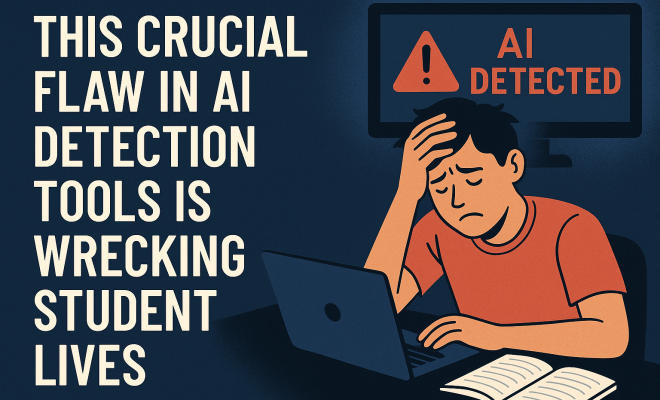
Imagine pouring your heart and soul into an essay, painstakingly crafting every sentence, only to be accused of cheating by a soulless algorithm. Now, imagine that accusation carries the weight of academic suspension, visa revocation, and a potentially shattered future. This isn’t a dystopian novel; it’s the unsettling reality for a growing number of students, particularly international students and non-native English speakers, who are finding themselves caught in the crosshairs of supposedly sophisticated AI detection tools. The promise of these AI detection tools cheating has been to uphold academic integrity in an age where AI-generated text is increasingly accessible. But a closer look reveals a deeply troubling flaw: these tools are disproportionately flagging non-native English speakers, often with devastating consequences.
The controversy isn’t just a minor technical glitch; it strikes at the very core of fairness and equity in education. As institutions worldwide grapple with the rise of tools like ChatGPT, the knee-jerk reaction has been to deploy AI detection software as a digital sentry. Companies like Turnitin, a long-standing fixture in academic plagiarism detection, have pivoted to offer AI detection capabilities, claiming impressive accuracy rates. Yet, independent studies and anecdotal evidence paint a far more concerning picture. We’re talking about false positives, not in the single digits, but at rates that should make every educator and administrator pause. This isn’t just about a bad grade; it’s about a student’s entire academic and personal trajectory being jeopardized by a piece of software that can’t tell the difference between genuine effort and synthetic text. The emotional toll is immense, the questions of fairness are paramount, and the broader debate on academic integrity in the age of AI is reaching a fever pitch. Related reading: scaling your pipeline.
The Rise of AI Detection Tools and the Rush to Adopt
The academic world found itself in a bit of a panic when generative AI tools like ChatGPT burst onto the scene. Suddenly, the specter of students effortlessly churning out essays, research papers, and even complex code with minimal effort loomed large. The temptation to simply copy and paste, or to have an AI do the heavy lifting, became a genuine concern for educators. In response, a market for AI detection tools cheating quickly emerged, promising to be the digital guardians of academic honesty. Companies that had already established themselves in plagiarism detection, most notably Turnitin, were quick to integrate AI detection capabilities into their existing platforms, or launch new, dedicated services. Their marketing often emphasized high accuracy rates, positioning these tools as essential weapons in the battle against AI-assisted academic dishonesty.
Educational institutions, feeling the pressure to adapt and maintain academic standards, often embraced these tools with open arms. After all, who wouldn’t want a technological solution to a seemingly intractable problem? The narrative was compelling: AI creates the problem, and AI provides the solution. Many schools quickly implemented policies requiring students to submit assignments through these detectors, sometimes even making the use of such tools a condition for grading. The intention, undoubtedly, was good – to protect the integrity of degrees and ensure a level playing field. However, as is often the case with rapidly deployed technology, the real-world implications and unforeseen biases began to surface, particularly for vulnerable student populations.
The Alarming Bias Against Non-Native English Speakers
Here’s where the story takes a troubling turn. Reports and studies have started to reveal a significant, often devastating, bias embedded within these AI detection tools. The primary victims? Non-native English speakers and international students. These students, who are already navigating the challenges of studying in a foreign language and often a new culture, are being disproportionately flagged for AI-generated writing. Think about that for a moment: the very act of writing in a language that isn’t your first, with its inherent grammatical nuances, stylistic choices, and vocabulary variations, is somehow being interpreted by these algorithms as a sign of artificiality.
Why is this happening? One prevailing theory suggests that the training data used to develop these AI detection models might be heavily biased towards certain linguistic patterns and writing styles common among native English speakers. When a student’s writing deviates from these ‘expected’ patterns – perhaps due to slightly less idiomatic phrasing, a more formal tone, or grammatical structures influenced by their native language – the algorithm misinterprets it as being un-human, or AI-generated. It’s a classic case of algorithmic bias, where a tool designed to identify one thing (AI text) ends up penalizing another (linguistic diversity and genuine human effort from a different linguistic background). This isn’t just a minor statistical anomaly; it’s a systemic issue that threatens to undermine the trust between students and institutions, and disproportionately harms those who are already at a disadvantage.
False Positives: A Real-World Catastrophe
The consequences of these false positives are far from trivial. For a student accused of using AI to write an essay, the immediate fallout can be academic penalties ranging from a failing grade on an assignment to suspension or even expulsion from their program. But for international students, the stakes are often astronomically higher. An accusation of academic dishonesty can lead to the revocation of their student visa, forcing them to leave the country and abandon their educational dreams. This isn’t just a setback; it’s a life-altering event that can derail careers, create immense financial burdens, and cause profound psychological distress. (free SAT practice tools)
Consider the case of a student from, say, South Korea, meticulously crafting a thesis over months, only to have a tool like Turnitin flag it as 90% AI-generated. The student knows they wrote every word, but proving it against an algorithm’s ‘judgment’ can feel like an impossible battle. They might be subjected to grueling interviews, asked to explain their writing process in minute detail, or even forced to rewrite sections under supervised conditions – all while grappling with the anxiety of a potential academic and immigration nightmare. The emotional impact is immense, with students reporting feelings of despair, anger, and a profound sense of injustice. It’s a stark reminder that behind every data point and every algorithm, there are real human lives and futures at stake. (See: AI detection tools in education.)
The Scrutiny of Accuracy Claims: Turnitin Under Fire
Companies like Turnitin have been at the forefront of this new wave of AI detection, often promoting their tools with confidence. Turnitin, for instance, initially claimed an accuracy rate of over 98% for its AI writing detection feature. These are impressive numbers, the kind that would naturally reassure educators looking for reliable solutions. However, these claims have come under increasing scrutiny as independent researchers and academic institutions conduct their own tests.
What they’re finding often contradicts the companies’ assertions. Studies have shown that when these tools are tested on a diverse range of writing samples, especially those from non-native English speakers or those with unconventional writing styles, the rate of false positives can skyrocket. For example, some analyses have found false positive rates significantly higher than the claimed 2%, reaching concerning levels that make their widespread, high-stakes application deeply problematic. This discrepancy between advertised accuracy and real-world performance is a critical point of contention, leading many to question the ethical implications of deploying such unproven technology in sensitive academic environments. If a tool cannot reliably distinguish between human and AI-generated text, especially when linguistic diversity is a factor, its utility and fairness become seriously compromised.
Beyond the Algorithm: The Human Element of Academic Integrity
The reliance on AI detection tools cheating also risks overshadowing the crucial human element in assessing academic integrity. When an algorithm flags a student’s work, it often creates an immediate presumption of guilt, shifting the burden of proof onto the student. This can bypass the nuanced understanding that a human instructor brings to the table – an instructor who knows their students’ writing styles, their progress, and their individual challenges.
Effective academic integrity policies have always relied on a combination of clear expectations, preventative education, and thoughtful assessment by educators. A professor familiar with a student’s previous work might immediately recognize a flagged essay as consistent with their style, even if it exhibits characteristics that an algorithm misinterprets. Conversely, a human might spot genuine plagiarism or AI use that a tool misses because they understand the context of the assignment and the student’s learning journey. By over-relying on automated tools, institutions risk losing this crucial human judgment, turning academic assessment into a cold, mechanical process devoid of empathy and individual consideration. We need to remember that academic integrity is not just about catching cheaters; it’s about fostering an environment of trust, learning, and genuine intellectual effort.
The Broader Debate: AI, Education, and the Future of Learning
This controversy extends far beyond the immediate plight of international students. It forces us to confront fundamental questions about the role of AI in education, the nature of academic integrity in the digital age, and how we prepare students for a world where AI tools are ubiquitous. Should we ban AI tools outright, or should we teach students how to use them responsibly and ethically? How do we design assignments that are ‘AI-proof’ or, perhaps more accurately, ‘AI-integrated’ in a meaningful way?
Some educators argue that instead of fighting AI, we should be embracing it as a learning tool, much like we embraced calculators or word processors. The challenge then becomes teaching students critical thinking, source evaluation, and how to effectively leverage AI as an assistant, not a replacement for their own intellect. This shift in pedagogical approach requires a re-evaluation of assessment methods, moving away from simple essay assignments that are easily gamed by AI, towards projects that demand originality, critical analysis, and real-world problem-solving – tasks that even advanced AI struggles with without significant human input and direction. The goal shouldn’t be to create a generation of students who fear AI, but rather one that can master it responsibly.
Legal and Ethical Ramifications: Student Rights and Institutional Responsibilities
The use of AI detection tools cheating also raises significant legal and ethical questions. When a student is falsely accused, what recourse do they have? What are the responsibilities of educational institutions to ensure due process and fair hearings? The potential for wrongful accusations to impact a student’s academic record, immigration status, and future career prospects is immense, making these not just academic issues, but serious matters of civil rights and justice.
Students facing academic dishonesty charges often find themselves in a precarious position, needing to navigate complex institutional procedures, prove their innocence against algorithmic ‘evidence,’ and sometimes even seek legal counsel. This situation highlights the urgent need for clear, transparent policies regarding the use of AI detection tools, including robust appeals processes, a commitment to human review, and a recognition that algorithmic outputs are not infallible. Institutions have a moral and ethical obligation to protect their students, and that includes protecting them from potentially biased and inaccurate technology. There’s also a growing market for legal services specializing in academic dishonesty cases, a clear indicator of how serious these accusations have become. (See: academic integrity in education.)
Moving Forward: Towards Fairer Assessment in the AI Era
So, where do we go from here? The solution isn’t to abandon technology entirely, but to approach it with critical awareness and a commitment to equity. First, there’s a clear need for greater transparency from AI detection tool developers. They must be open about their training data, their algorithms’ limitations, and their real-world accuracy rates across diverse populations. Independent audits and rigorous testing are essential to validate their claims.
Second, educational institutions must adopt a cautious and human-centered approach. This means viewing AI detection tool flags as just one piece of evidence, never the sole basis for an accusation. A human instructor should always conduct a thorough review, considering the student’s history, their linguistic background, and the specific context of the assignment. Implementing clear guidelines for how these tools are used, ensuring robust appeals processes, and providing support for students who are falsely accused are absolutely crucial. Furthermore, investing in professional development for educators to understand AI’s capabilities and limitations, and to design assignments that foster genuine learning and critical thinking, will be far more effective in upholding academic integrity than relying blindly on algorithms. The future of education in the AI era demands not just technological solutions, but thoughtful, ethical, and human-centric approaches.
The Psychological Impact on Accused Students
Beyond the immediate academic and legal ramifications, we can’t ignore the severe psychological toll these false accusations take on students. Imagine the stress of facing an accusation that could upend your life, especially when you know you’re innocent. Students report experiencing overwhelming anxiety, depression, and a profound sense of injustice. For international students, this pressure is compounded by cultural differences, language barriers, and the fear of jeopardizing their immigration status. They might feel isolated, struggling to communicate their defense effectively, and questioning their place in an academic system that seems to distrust them inherently. This isn’t just about a potential bad grade; it’s about a fundamental assault on a student’s self-worth and trust in the educational process. The emotional scars from such an experience can linger long after the academic issue is resolved, impacting their mental health and future academic engagement.
Comparing AI Detection Tools: A Landscape of Uncertainty
It’s important to recognize that Turnitin isn’t the only player in this game. The market for AI detection tools is crowded, with various companies offering their own solutions, each with different methodologies and claimed accuracy rates. You’ve got tools like GPTZero, Copyleaks, Originality.ai, and others. Each one uses slightly different algorithms, often focusing on metrics like perplexity (how “surprised” a language model is by a sequence of words) and burstiness (the variation in sentence length and structure). The problem is, there’s no universally accepted standard for what constitutes “AI-generated,” and these tools often contradict each other. One tool might flag a piece of writing as 90% AI-generated, while another says it’s 100% human. This inconsistency creates a chaotic and unreliable landscape for educators and students alike. It begs the question: if the “experts” can’t agree, how can we expect students to navigate these murky waters, or institutions to make fair judgments based on such disparate results? See also enhancing mental health support.
This lack of standardization and the proprietary nature of these algorithms mean that educators are often deploying black-box solutions without fully understanding their limitations. It’s a Wild West scenario where institutions are expected to trust tools that haven’t undergone rigorous, public, third-party validation, especially across diverse linguistic populations. This situation highlights the urgent need for a more unified approach to AI detection, or perhaps a collective acknowledgment that current technology simply isn’t robust enough for high-stakes academic decisions.
Expert Perspectives: What Researchers and Educators are Saying
The academic community itself is deeply divided and vocal about these issues. Many researchers in natural language processing and AI ethics have expressed serious reservations about the current state of AI detection technology. Dr. Deb Roy from MIT, for example, has highlighted the inherent difficulty in distinguishing between human and AI-generated text, particularly as AI models become more sophisticated. He and others point out that AI models are trained on vast amounts of human-generated text, meaning their output often mimics human writing patterns so closely that even advanced detectors struggle. Furthermore, the concept of “AI-generated” is fluid; if a student uses AI to brainstorm ideas or refine grammar, where do we draw the line? Is that “cheating”?
Educators, on the front lines, are grappling with the practicalities. Some are advocating for a complete moratorium on AI detection tools, arguing that the risk of false positives is too high and the damage to student trust too great. Others are pushing for a pedagogical shift, redesigning assignments to make AI less effective or to even incorporate AI as a legitimate tool, requiring students to document their AI usage. The consensus among many thought leaders is that a purely punitive approach, relying solely on imperfect detection technology, is unsustainable and counterproductive. Instead, the focus needs to shift towards educating students about responsible AI use and fostering a culture of academic integrity that transcends technological shortcuts.
FAQ: Addressing Common Questions about AI Detection Tools Cheating
Let’s tackle some frequently asked questions about AI detection tools and their impact on academic integrity. (See: Harvard University research on education.)
Q1: How do AI detection tools actually work?
Most AI detection tools analyze text for patterns often associated with large language models (LLMs). They look for things like low “perplexity” (meaning the text is predictable, like a computer wrote it), high “burstiness” (lack of variation in sentence length and structure, as human writing tends to be more varied), specific vocabulary choices, and grammatical structures. They compare the submitted text against patterns learned from vast datasets of both human-written and AI-generated content. The idea is to spot the subtle, or sometimes not-so-subtle, tells that distinguish machine output from human creativity.
Q2: Can I trick AI detection tools?
While there are various “humanizing” tools and techniques claimed to help bypass AI detectors, relying on them is risky. These methods often involve paraphrasing, adding errors, or altering sentence structure. However, AI detection technology is constantly evolving, and these “tricks” might not work reliably. More importantly, attempting to bypass detection tools can be seen as an act of academic dishonesty in itself, potentially leading to even more severe consequences than simply admitting AI use if it’s against policy. The safest approach is to understand your institution’s policies and submit genuinely human-written work.
Q3: What should I do if my work is falsely flagged by an AI detection tool?
First, don’t panic. Gather all evidence of your writing process, such as drafts, research notes, outlines, and timestamps of your work. If possible, show your instructor earlier versions of your assignment. Request a meeting with your instructor and be prepared to explain your writing process in detail. Ask for clarification on the specific parts of your text that were flagged. Most importantly, understand your institution’s academic appeals process and be ready to utilize it. If you’re an international student, seek advice from your international student office or academic advisor, as they can help navigate the unique challenges you face.
Q4: Are there any universities that have stopped using AI detection tools?
Yes, some universities and educators have either paused their use of AI detection tools or adopted extremely cautious approaches due to concerns about accuracy and bias. Institutions are constantly re-evaluating their policies as the technology evolves and more data becomes available. Some have moved away from using them for punitive measures, instead using them as a diagnostic tool for discussion with students, or focusing on redesigning assignments to be less susceptible to AI generation. The landscape is fluid, so it’s always best to check your specific institution’s current policies.
Q5: How can educators adapt their assignments to the age of AI?
Educators can adapt by designing assignments that emphasize critical thinking, personal reflection, real-world application, and unique perspectives that AI struggles to replicate. This could include oral presentations, project-based learning, assignments that require up-to-the-minute information, local context, or personal experiences. Requiring students to document their research process, provide bibliographies with annotations, or include reflection on their learning journey can also help. The goal is to shift from assessing recall of information (which AI excels at) to assessing higher-order thinking, creativity, and authentic engagement with the material.
Trending Now
Frequently Asked Questions
What are the flaws in AI detection tools for students?
AI detection tools often disproportionately flag non-native English speakers, leading to false accusations of cheating. This flaw can result in severe consequences, such as academic suspension or visa revocation, jeopardizing students' futures.
How do AI detection tools impact non-native English speakers?
Non-native English speakers are particularly vulnerable to being incorrectly flagged by AI detection tools. These tools may misinterpret their writing style, leading to unfair academic penalties and emotional distress.
What are the consequences of false positives in AI detection?
False positives in AI detection can result in serious repercussions for students, including loss of academic credibility, suspension, and lasting damage to their educational and personal lives.
Why are universities using AI detection tools?
Universities are using AI detection tools to uphold academic integrity amid concerns about AI-generated text. However, the rush to adopt these tools has raised significant concerns about fairness and accuracy.
Are AI detection tools effective in identifying cheating?
While companies like Turnitin claim high accuracy rates, independent studies suggest that these tools frequently produce false positives, undermining their effectiveness and raising questions about their reliability in maintaining academic integrity.
Agree or disagree? Drop a comment and tell us what you think.