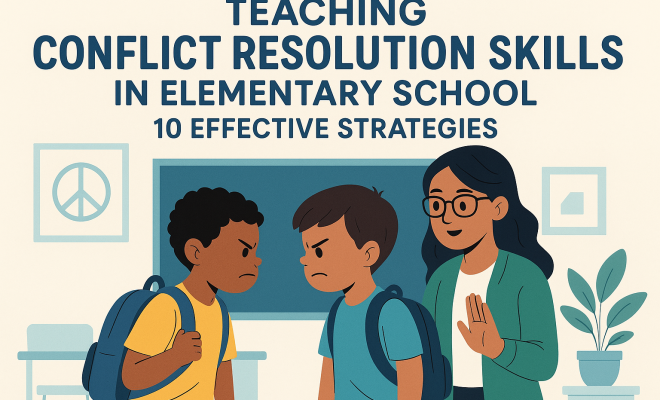
10 Effective Strategies for Teaching Conflict Resolution in Elementary School
“`html
In a world filled with diverse opinions and backgrounds, teaching conflict resolution skills in elementary school is essential for fostering a peaceful and cooperative environment. These skills not only help children navigate disputes with their peers but also prepare them for the complexities of adult interactions. Educators, parents, and community leaders all play a crucial role in instilling these skills at an early age. Below, we explore ten effective strategies that can be implemented in elementary classrooms to help students become adept at resolving conflicts.
Understanding Conflict Resolution
Before diving into specific strategies, it’s vital to understand what conflict resolution entails. Conflict resolution involves recognizing disagreements and finding effective ways to address them. This skill set includes emotional intelligence, communication, negotiation, and problem-solving abilities. For young children, who may not yet have the vocabulary or experience to articulate their feelings, learning conflict resolution can feel daunting. However, equipping them with these tools fosters a sense of agency, enabling them to handle disputes independently.
1. Create a Safe Environment
One of the foundational elements of teaching conflict resolution skills is ensuring that students feel safe expressing themselves. This involves creating a classroom atmosphere where all opinions are valued and respected. Teachers can set clear rules that promote kindness and discourage bullying or derogatory remarks. Regularly reinforcing these guidelines establishes a culture of trust. When students know they won’t be judged for their feelings or viewpoints, they’re more likely to engage in constructive conflict resolution.
2. Use Role-Playing Activities
Role-playing can be a powerful tool for teaching conflict resolution. By stepping into the shoes of someone experiencing a conflict, students can gain empathy and a better understanding of different perspectives. For example, teachers can stage scenarios where two characters disagree about a toy or game. Students can take turns acting out both sides of the conflict and practicing various resolution strategies. This hands-on approach not only makes the learning process engaging but also allows students to experiment with language and negotiate outcomes in a safe space.
3. Teach Emotional Literacy
To resolve conflicts effectively, students need to identify and articulate their emotions. Teaching emotional literacy involves helping young learners recognize what they’re feeling and why. Activities such as feeling charts, where students can point to or write down their emotions, can be beneficial. Discussing feelings openly during class meetings can also create awareness among peers. Understanding emotions allows children to communicate their needs better, paving the way for more productive conflict resolution.
4. Introduce the “I-Message” Technique
The “I-Message” technique is a communication strategy that encourages individuals to express their feelings without blaming others. It typically follows a formula: “I feel [emotion] when [situation] because [reason], and I would like [solution].” For instance, a student might say, “I feel sad when you don’t share the ball because I wanted to play too, and I would like us to take turns.” Teaching this technique helps students articulate their feelings in a non-confrontational way, facilitating a more constructive dialogue.
5. Implement Peer Mediation Programs
Peer mediation involves training selected students to help their classmates resolve conflicts. This approach not only provides an immediate method for conflict resolution but also empowers students, making them feel responsible for their school environment. A peer mediator listens to both sides, helps clarify issues, and guides students toward a mutually agreeable solution. Training sessions can equip mediators with essential skills, such as active listening, neutrality, and problem-solving techniques, fostering a culture of conflict resolution within the school.
6. Promote Active Listening Skills
Active listening is a critical skill for resolving conflicts. It involves fully concentrating, understanding, and responding to what the other person is saying. Teachers can model active listening during conversations, demonstrating how to maintain eye contact, nod in agreement, and rephrase what the speaker has said. You can also create activities where students practice listening to their peers and summarizing their points. By fostering active listening, students learn to value each other’s perspectives, which is essential for effective conflict resolution. (See: Mental health resources for youth.)
7. Encourage Problem-Solving Strategies
When conflicts arise, students often need guidance in brainstorming solutions. Teaching them a structured problem-solving approach can be invaluable. One popular method is the “S.T.A.R.” strategy, which stands for Stop, Think, Act, and Review. First, students should stop and calm down during a conflict. Next, they think about the situation and consider possible solutions. Then, they act by trying one of the solutions and finally review the outcome to see if it resolved the issue. This strategy not only helps them to resolve conflicts but also encourages critical thinking.
8. Highlight the Importance of Compromise
Compromise is at the heart of effective conflict resolution. Teaching students the value of give-and-take can help them navigate disputes more smoothly. Activities might include group projects where students must divide tasks and negotiate roles, or scenarios where they need to find a solution that satisfies both parties. By illustrating the benefits of compromise, such as stronger friendships and teamwork, students can learn that finding middle ground is often more rewarding than winning an argument.
9. Integrate Conflict Resolution into the Curriculum
Integrating conflict resolution into subjects like social studies, literature, or even mathematics can enhance its relevance. For instance, during discussions about historical events, teachers can explore how conflicts were resolved and the implications of those resolutions. In literature, characters’ conflicts can provide rich discussions about emotions, motivations, and resolutions. By weaving conflict resolution skills into various subjects, educators can reinforce the principles across multiple contexts, making it a seamless part of the learning experience.
The Current Relevance of Conflict Resolution Skills
In today’s increasingly polarized environment, teaching conflict resolution skills in elementary school is more vital than ever. With rising instances of bullying, social media conflicts, and divisive public discourse, equipping children with the ability to navigate disagreements can lead to healthier interactions throughout their lives. Furthermore, these skills contribute to a more harmonious school environment, fostering empathy, cooperation, and respect among peers. As we prepare future generations for the challenges ahead, the emphasis on conflict resolution cannot be overstated.
Building a Strong Foundation: The Role of Educators
Educators play a crucial role in instilling conflict resolution skills in young students. Their approach to conflict management sets the tone for how students perceive and handle disagreements. Teachers who model conflict resolution in their interactions with students and colleagues create a powerful example for students to emulate. By demonstrating patience, understanding, and effective communication, teachers can foster an environment where conflict resolution skills are not just taught but practiced daily.
The Role of Parents and Guardians
Parents and guardians are partners in the development of conflict resolution skills. Encouraging discussions about conflicts at home can reinforce what children learn in school. Simple family discussions about daily conflicts can serve as an opportunity for children to practice their skills. Asking open-ended questions such as “How did that make you feel?” or “What could you have done differently?” can help children reflect on their actions and think critically about conflict resolution. This collaborative effort between parents and schools creates a consistent message about the importance of these skills.
Statistics on Conflict Resolution
Understanding the broader impact of conflict resolution education can be supported by statistics. Research shows that conflict resolution programs can decrease school violence by up to 50% in some settings. Furthermore, schools that implement comprehensive social-emotional learning (SEL) programs, which often include conflict resolution components, report improved academic performance and student behavior. For instance, a study by the Collaborative for Academic, Social, and Emotional Learning (CASEL) indicates that students receiving SEL instruction showed an 11 percentile-point gain in academic achievement compared to their peers who did not receive such instruction.
Real-Life Examples of Conflict Resolution Skills in Action
Real-life examples can illustrate the importance of conflict resolution skills. Consider a scenario where two students want to play the same game during recess, leading to an argument. A teacher trained in conflict resolution steps in, guiding the students to express their feelings using the “I-Message” technique. By encouraging them to communicate openly, the teacher helps them identify a solution that allows both to play together. This not only resolves the immediate conflict but also teaches valuable lessons about empathy and collaboration.
Expert Perspectives on Conflict Resolution
Experts in child development emphasize the importance of teaching conflict resolution skills early. Dr. Laura Markham, a clinical psychologist and founder of Aha! Parenting, states that children equipped with conflict resolution skills are more likely to develop healthier relationships throughout their lives. According to her, “When children learn to resolve conflicts peacefully, they build the foundation for their future interactions, whether in friendships, workplaces, or personal relationships.” Her insights underline the necessity of integrating these teachings into elementary education.
FAQ: Common Questions About Conflict Resolution Skills in Elementary School
Why are conflict resolution skills important for elementary students?
Conflict resolution skills are essential because they help students manage disagreements effectively, fostering healthier relationships and a more peaceful school environment. These skills are critical for emotional and social development, teaching children how to communicate their feelings and work collaboratively towards solutions.
At what age should children start learning conflict resolution skills?
Children can begin learning conflict resolution skills as early as preschool. Simple concepts like sharing, taking turns, and expressing feelings can lay the groundwork for more complex skills as they grow older. The techniques taught can evolve in complexity with the child’s development.
How can schools measure the effectiveness of their conflict resolution programs?
Schools can measure the effectiveness of conflict resolution programs through surveys assessing student behavior, instances of conflict, and overall school climate. Additionally, academic performance and student engagement metrics can provide insight into the broader impact of these programs.
Can conflict resolution skills be taught at home?
Absolutely! Parents can teach conflict resolution skills at home by modeling effective communication, discussing conflicts openly, and encouraging children to express their feelings. Role-playing potential conflict scenarios at home can also provide practical experience in resolving disagreements.
What role does emotional intelligence play in conflict resolution?
Emotional intelligence is critical in conflict resolution as it allows individuals to understand and manage their own emotions while empathizing with others. Higher emotional intelligence can lead to better communication, increased empathy, and improved conflict resolution outcomes.
What are some fun activities to teach children conflict resolution skills?
There are numerous engaging activities that can help children learn conflict resolution skills. Consider using storytelling sessions where children create their own stories involving conflicts and resolutions. Another fun activity is the “Conflict Resolution Art Project,” where students draw or create crafts that represent a conflict and a peaceful resolution. These creative outlets allow children to express their understanding of conflict resolution in a tangible way.
How do cultural differences affect conflict resolution approaches?
Cultural differences can significantly influence how conflicts are perceived and resolved. In some cultures, direct confrontation may be avoided, favoring indirect communication or mediation by a third party. Teaching children to appreciate and understand these differences can enhance their conflict resolution skills, preparing them to navigate diverse environments effectively.
How can technology be utilized to teach conflict resolution skills?
Technology can play a role in enhancing conflict resolution education. Online simulations and games can create scenarios where students practice resolving conflicts in virtual settings. Additionally, educational apps can facilitate discussions about emotions and conflict resolution strategies. Using technology can engage students and provide a modern approach to learning these essential skills.
Creating a School-Wide Culture of Conflict Resolution
To maximize the impact of conflict resolution education, it’s essential to create a school-wide culture that prioritizes these skills. This can begin with staff training that equips all educators with conflict resolution techniques to model and implement in their classrooms. Schools can also organize workshops for parents and guardians to ensure a collective effort in reinforcing these skills at home. Creating a shared language around conflict resolution fosters unity and consistency in messaging, making the educational experience more effective.
Long-Term Benefits of Conflict Resolution Skills
Teaching conflict resolution skills in elementary school has long-term benefits that extend beyond the classroom. Children who learn these skills are better equipped to handle challenges in their personal and professional lives as they grow older. Research suggests that individuals with strong conflict resolution skills tend to have healthier relationships, improved mental health, and even greater career success. By investing time in teaching these skills at a young age, educators are laying the foundation for a more harmonious future.
Conclusion
Teaching conflict resolution skills in elementary school isn’t just about resolving disagreements; it’s about building a foundation for lifelong relationships and effective communication. By integrating these ten strategies into the classroom, educators can empower students to handle conflicts constructively and compassionately. The skills they learn now will serve them well throughout their lives, allowing them to engage with the world in meaningful ways.
“`
Trending Now
Frequently Asked Questions
What are conflict resolution skills for kids?
Conflict resolution skills for kids involve the ability to recognize disagreements and find effective ways to address them. These skills include emotional intelligence, communication, negotiation, and problem-solving, which are essential for navigating disputes with peers and preparing for adult interactions.
How can teachers promote conflict resolution in the classroom?
Teachers can promote conflict resolution by creating a safe environment where students feel respected and valued. Implementing clear rules against bullying, encouraging open dialogue, and using role-playing activities can help students learn to express their feelings and resolve conflicts constructively.
Why is teaching conflict resolution important in elementary school?
Teaching conflict resolution in elementary school is crucial as it helps children develop essential life skills such as empathy, communication, and problem-solving. These skills not only aid in resolving disputes with peers but also prepare them for more complex interactions in adulthood.
What activities can help teach conflict resolution skills?
Activities such as role-playing, group discussions, and conflict resolution games can effectively teach students how to handle disagreements. These interactive methods allow children to practice empathy, negotiation, and problem-solving in a safe and supportive environment.
How can parents support conflict resolution skills at home?
Parents can support conflict resolution skills by encouraging open communication and active listening at home. Discussing conflicts openly, modeling respectful behavior, and guiding children through problem-solving processes can reinforce the skills learned in school.
What’s your take on this? Share your thoughts in the comments below — we read every one.