AI-Powered Holographic System Revolutionizes 3D Data Storage
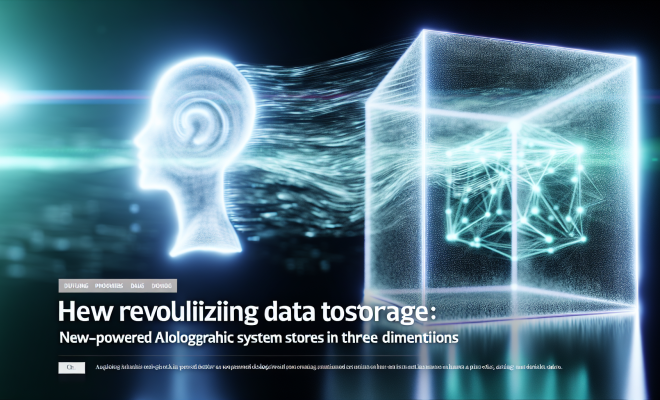
In a groundbreaking development, researchers have unveiled a new data storage technology that utilizes light to encode vast amounts of information in three dimensions. This innovative AI-powered holographic storage system leverages complex properties of light—specifically amplitude, phase, and polarization—to dramatically enhance data storage capacity and retrieval efficiency.
Understanding Holographic Data Storage
Traditionally, data storage methods have relied on two-dimensional surfaces, such as magnetic disks or optical discs. However, the new approach allows data to be stored throughout a medium rather than just on its surface. By manipulating light at multiple levels, this multidimensional storage technique opens the door to storing significantly larger datasets in a compact format.
Key Innovations in the Research
The research, published in the journal Optica, represents a significant leap forward in the field of data storage technology. By employing an advanced holographic technique, the team effectively encodes data throughout a material. This method enhances the amount of information that can be stored, enabling a higher density of data compared to conventional methods.
- Amplitude: Refers to the intensity of the light wave, allowing variations in brightness to convey different data values.
- Phase: Involves the position of the light wave in its cycle, providing another dimension for data encoding.
- Polarization: The orientation of light waves can be manipulated to represent additional data layers.
By combining these three properties, researchers have created a robust system capable of storing an unprecedented amount of information within a relatively small physical space.
AI-Assisted Data Retrieval
One of the standout features of this new holographic storage system is its integration with artificial intelligence. The use of AI facilitates the reconstruction of light patterns, significantly simplifying the data retrieval process. This capability not only enhances the speed at which data can be accessed but also improves accuracy in retrieving stored information.
The combination of multidimensional storage and AI assistance means that users can expect a more efficient data retrieval experience, potentially reducing the time and resources required to access large datasets.
Potential Applications and Benefits
The implications of this technology extend far beyond improved data storage. According to the research team, the multidimensional holographic data storage system could lead to several transformative applications:
- Smaller Data Centers: As data storage capacity increases, the physical size of data centers could be significantly reduced, leading to cost savings and streamlined operations.
- Efficient Large-Scale Archival Storage: Organizations with massive archival needs, such as libraries and research institutions, could leverage this technology for more efficient storage solutions.
- Enhanced Data Processing and Transmission Efficiency: The ability to store and retrieve data more effectively could lead to faster processing speeds and reduced latency in data transmission.
- Safer Data Transmission: The system’s reliance on light for data storage and transmission could enhance security, making it more difficult for unauthorized access.
- Optical Encryption: Holographic storage methods could pave the way for new forms of optical encryption, adding an extra layer of security to sensitive data.
- Advanced Imaging Applications: This technology could also find applications in fields such as medical imaging, where high-capacity storage for large image files is essential.
The Future of Data Storage
As our world becomes increasingly data-driven, the demand for innovative storage solutions continues to grow. The development of this AI-powered holographic storage system symbolizes a significant step forward in meeting that demand. With the ability to store data in three dimensions and the assistance of artificial intelligence, the possibilities for enhancing data storage capabilities are vast.
Looking ahead, researchers are optimistic about the potential to refine this technology further. As advancements continue, we may see a new era of data storage that not only meets the needs of modern society but also shapes the future of information technology.
Conclusion
The discovery of a new AI-powered holographic storage system marks a pivotal moment in data storage technology. By harnessing the properties of light and integrating artificial intelligence for data retrieval, researchers have set the stage for a future where data storage is not only more efficient but also more secure and adaptable. As this technology evolves, it promises to revolutionize how we manage and interact with data in our increasingly digital world.