NASA Confirms Two Asteroids Approaching Earth in 2026
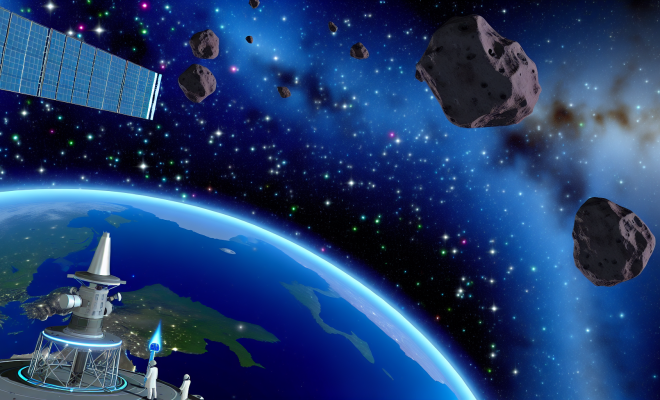
On March 17, 2026, NASA confirmed that two asteroids will make close approaches to Earth, capturing the attention of both scientists and space enthusiasts alike. While these celestial bodies, designated as 2015 VO142 and 2026 EZ2, posed no immediate threat to our planet, their close encounters serve as a reminder of the ongoing efforts to monitor near-Earth objects (NEOs) and enhance planetary defense strategies.
Understanding the Asteroids
The first of the two asteroids, 2015 VO142, measures approximately 18 feet (5.5 meters) in diameter. To put this into perspective, it is roughly the size of a small car. This asteroid made its closest approach to Earth at a distance of 649,000 miles (1.05 million kilometers), which is significantly beyond the orbit of the Moon.
The second asteroid, 2026 EZ2, is much larger, measuring about 170 feet (52 meters) across, comparable in size to a commercial airplane. It passed at a distance of 2,340,000 miles (3.77 million kilometers) from Earth. Although these distances are vast in cosmic terms, the approaches of these asteroids are closely monitored to ensure that any potential threats are identified and mitigated well in advance.
The Importance of Monitoring NEOs
The tracking of near-Earth objects like 2015 VO142 and 2026 EZ2 is crucial for several reasons:
- Planetary Defense: As the number of known NEOs increases, so too does the need for effective strategies to protect Earth from potential impacts.
- Scientific Research: Understanding the composition and trajectories of asteroids helps scientists learn more about the formation of our solar system.
- Public Awareness: Increased awareness of NEOs promotes interest in space science and can lead to greater public support for funding space exploration initiatives.
How NASA Tracks Asteroids
NASA employs a variety of high-precision instruments to track and monitor asteroids and other celestial objects. These tools include ground-based telescopes and space-based observatories that provide critical data for astronomers and planetary defense teams.
When an asteroid is detected, scientists analyze its orbit and trajectory to determine the likelihood of it impacting Earth. This process involves complex calculations and simulations that take into account gravitational interactions with other celestial bodies, as well as the asteroid’s physical characteristics.
In the case of 2015 VO142 and 2026 EZ2, extensive tracking confirmed that both asteroids were on safe trajectories, allowing researchers to focus on refining their models and strategies to better prepare for potential future threats.
The Future of Planetary Defense
While the close approaches of 2015 VO142 and 2026 EZ2 did not pose any danger, they highlight the importance of ongoing efforts in planetary defense. NASA, along with international space agencies and observatories, is continuously working to enhance its capabilities for detecting and tracking NEOs.
One of the initiatives currently under development is the Double Asteroid Redirection Test (DART), which aims to test our ability to change the trajectory of an asteroid through kinetic impact. By intentionally crashing a spacecraft into an asteroid, scientists hope to gather data on how much force is needed to alter its path, providing valuable insights for future planetary defense strategies.
Engaging the Public in Space Science
As we continue to explore our solar system and understand the dynamics of celestial bodies, public engagement remains essential. NASA and other organizations are encouraging people to learn more about asteroids and their potential impact on Earth.
Educational programs and outreach initiatives aim to inform the public about the importance of tracking NEOs, as well as the technological advancements being made in the field of space science. By fostering a greater understanding of these topics, we can inspire the next generation of scientists and engineers to take an interest in planetary defense and space exploration.
Conclusion
While the recent close approaches of asteroids 2015 VO142 and 2026 EZ2 did not pose any threat to Earth, they serve as a reminder of the importance of monitoring our cosmic neighborhood. Ongoing research and technological advancements will continue to enhance our ability to protect the planet from potential asteroid impacts, ensuring a safer future for all.