How to Teach Phonemic Awareness to Struggling First Graders
“`html
Teaching phonemic awareness is a foundational skill necessary for young children, particularly first graders who may be struggling with reading and language development. Phonemic awareness refers to the ability to recognize and manipulate individual sounds (phonemes) in spoken words. This skill is crucial because it directly impacts a child’s ability to decode words, which is essential for reading proficiency. In this article, we’ll explore effective strategies for teaching phonemic awareness, backed by research and practical insights, ensuring that educators and parents can support struggling learners.
1. The Importance of Phonemic Awareness
Understanding phonemic awareness is vital for first graders as it lays the groundwork for their literacy skills. Studies show that children with strong phonemic awareness are more likely to succeed in reading, as they can break down words into individual sounds. A lack of this awareness can lead to difficulties in both reading and spelling, often causing frustration and a decline in academic confidence.
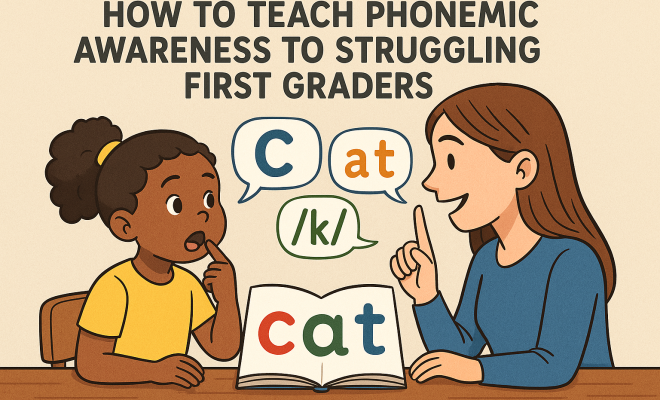
Children who struggle with phonemic awareness may have a hard time blending sounds to form words or segmenting words into their component sounds. For instance, a child might know how to say the word “cat” but may not understand that it consists of three distinct sounds: /k/, /æ/, and /t/. This misunderstanding can hinder their ability to read unfamiliar words, making it crucial for educators to identify and address these challenges early on.
2. Identifying Struggling Learners
Recognizing which students are having difficulty with phonemic awareness is the first step in targeted teaching. Teachers can use various assessment tools, such as phoneme segmentation tests or sound blending assessments, to identify gaps in students’ skills. Observational assessments in the classroom, where teachers note students’ ability to manipulate sounds during reading activities, can also provide insight.
It’s essential to gather data not just at the beginning of the school year but consistently throughout. Regular check-ins can help track progress and identify when a child may need additional support or intervention. Early identification enables educators to tailor their instruction to meet individual student needs, ensuring that struggling learners receive the help they require.
3. Creating an Engaging Learning Environment
Effective teaching of phonemic awareness requires a supportive and engaging environment. Educators can create a phonemic-friendly classroom by incorporating various resources, such as phonics games, sound charts, and interactive whiteboards. Using songs and rhymes can also make learning more enjoyable and memorable for young children.
Group activities, where students work together to identify and manipulate sounds, foster a sense of community and collaboration. For example, using a phoneme hopscotch game, where children jump on letters while saying the corresponding sounds, can turn an ordinary lesson into a fun and stimulating experience. Engaging children through play not only helps in retaining phonemic skills but also enhances their overall enthusiasm for learning.
4. Effective Teaching Strategies
When teaching phonemic awareness, a multi-sensory approach often yields the best results. This involves using visual, auditory, and kinesthetic methods to reinforce learning. For instance, educators can incorporate letter cards, sound boxes, and manipulatives so that children can physically interact with language components.
Some effective strategies include:
- Sound Isolation: Teach students to recognize individual sounds by asking them to identify the first, middle, and last sounds in words. This can be practiced with familiar words like “dog” or “sun”.
- Sound Blending: Help students practice blending sounds together to form words. For example, say the sounds /b/, /a/, and /t/ slowly, and ask them what word these sounds form.
- Sound Segmentation: Encourage children to break down words into individual sounds, which is critical for spelling. Use simple words initially, gradually increasing complexity as they gain confidence.
5. Incorporating Technology
In today’s digital age, technology can enhance the teaching of phonemic awareness. Various educational apps and online resources offer interactive phonemic games that can motivate and engage students. For example, apps that allow children to match sounds to letters or practice sound blending can reinforce skills outside of the traditional classroom. (See: Importance of phonemic awareness in literacy.)
However, while integrating technology, it’s important to balance screen time with hands-on activities. Technology should serve as a supplement to traditional phonemic awareness instruction, rather than a replacement. Teachers should choose tools that align with their learning objectives and provide opportunities for students to practice skills in diverse formats.
6. Parental Involvement
Parents play an essential role in supporting their children’s phonemic awareness development. Educators can empower parents by providing resources and strategies they can use at home. Simple activities, such as reading aloud to their children, playing rhyming games, or singing songs, can significantly enhance phonemic awareness.
Furthermore, workshops can be held to equip parents with knowledge about phonemic awareness and reading strategies. When parents understand the importance of phonemic skills and how to help their children, it creates a partnership that significantly benefits the child’s literacy development.
7. Using Literature in Teaching
Children’s literature can be a wonderful tool for teaching phonemic awareness. Books that contain rhymes, alliteration, and sound patterns engage children’s ears to the sounds of language. Reading these types of books aloud helps children become attuned to the phonetic features of words.
Teachers can select books that emphasize specific phonemes or sound patterns and use them as a springboard for phonemic activities. For instance, after reading a book, teachers can ask students to identify sounds or play sound-based games related to the story. This not only reinforces phonemic skills but also enhances comprehension and enjoyment of reading.
8. Assessing Progress
Regular assessment of phonemic awareness skills is crucial to ensure that teaching methods are effective. Educators should implement both formal and informal assessments to monitor student progress. Formal assessments, such as the Dynamic Indicators of Basic Early Literacy Skills (DIBELS), provide structured measurements of phonemic skills.
At the same time, informal assessments, such as teacher observations and student self-assessments, can provide valuable insights into a child’s understanding and application of phonemic awareness. By analyzing assessment data, educators can adjust instruction and intervention strategies to better meet students’ needs.
9. Building Confidence Through Success
As first graders practice and develop their phonemic awareness skills, it’s vital to celebrate their successes, no matter how small. Building confidence in their abilities can motivate students to engage more actively in learning. Teachers can create a positive reinforcement system, rewarding progress with praise or incentives.
Encouraging a growth mindset is critical. Students need to understand that developing phonemic awareness is a process that takes time and effort. By fostering an environment where errors are seen as opportunities to learn, educators can help diminish anxiety around reading, making it a more enjoyable experience for struggling learners.
10. Advanced Phonemic Awareness Activities
Once students have grasped the basics of phonemic awareness, it’s beneficial to introduce more advanced activities that can challenge them further. These activities can help solidify their understanding and extend their skills. Here are a few examples:
- Phoneme Manipulation: Teach students to add, delete, or substitute phonemes to create new words. For example, ask students, “What word do you get if you take the /s/ away from ‘sand’?”
- Interactive Storytelling: Use stories that prompt students to make sound-based predictions. As they listen, encourage them to guess what sounds they will hear next or identify parts of the story that rhyme.
- Phonemic Awareness Centers: Set up learning stations where students can engage in varied phonemic activities. One center could focus on sound sorting with pictures, while another might involve using puppets to enact phoneme games.
11. Statistics and Research on Phonemic Awareness
Research underscores the significance of phonemic awareness in literacy development. According to the National Reading Panel, children who receive systematic phonemic awareness instruction perform significantly better in reading than those who do not receive such instruction. A landmark study showed that phonemic awareness is one of the strongest predictors of a child’s future reading success, with 70% of struggling readers in the third grade lacking phonemic awareness skills. (See: Understanding early literacy skills.)
Additionally, a 2020 study published in the journal “Reading Research Quarterly” found that early phonemic awareness instruction had a long-term positive effect on reading comprehension, with students continuing to show improved skills four years after intervention. These statistics highlight the necessity for educators to prioritize phonemic awareness in their curriculums, particularly for at-risk students.
12. Expert Perspectives on Teaching Phonemic Awareness
Experts in early childhood education emphasize the importance of phonemic awareness. Dr. Louisa Moats, a prominent literacy researcher, states, “Phonemic awareness is not just a skill; it’s the foundation that supports all other aspects of reading and writing.” Her research suggests that effective phonemic awareness instruction should be explicit and systematic, allowing children to develop a strong understanding of how sounds work in language.
Furthermore, Dr. Timothy Shanahan, a leading literacy advocate, advocates for integrating phonemic awareness with phonics instruction. He explains, “Children need to understand not only the sounds but also how those sounds correspond to letters. This dual approach helps solidify their reading skills.” His insights remind educators to combine various strategies to achieve the best outcomes for students.
13. Comparing Phonemic Awareness with Other Literacy Skills
Phonemic awareness is often discussed alongside phonics, vocabulary, and comprehension, but it’s crucial to understand how it fits into the broader literacy landscape. Phonemic awareness specifically focuses on the sounds in spoken language, while phonics connects these sounds to written language. Both skills are essential, but they serve different purposes in the reading development process. Here’s how they compare:
- Phonemic Awareness: Deals with the auditory recognition and manipulation of sounds.
- Phonics: Involves linking sounds to their corresponding letters and understanding how these sounds form words when written.
- Vocabulary: Focuses on the understanding and use of words and their meanings, which is crucial for comprehension.
- Comprehension: The ability to understand and interpret what is read; it builds on phonemic awareness, phonics, and vocabulary.
Understanding these components and how they interact can help educators design more effective literacy programs that holistically address student needs.
14. Frequently Asked Questions
What age should phonemic awareness instruction begin?
Phonemic awareness instruction can begin as early as preschool. Preschoolers can engage in activities that promote sound recognition, such as songs and rhymes, laying the groundwork for more formal instruction in kindergarten and first grade.
How long should phonemic awareness activities last?
Short, focused activities of about 10-15 minutes are effective. Young children have shorter attention spans, so brief sessions can maintain engagement while providing consistent practice.
Can phonemic awareness be taught to older students?
Yes, older students who struggle with reading can benefit from phonemic awareness instruction. Tailored lessons that address their specific challenges can help improve their reading skills, regardless of their age.
What resources are available for teaching phonemic awareness?
Numerous resources are available, including phonemic awareness workbooks, online games, and educational apps. Websites like Reading Rockets and Teach Your Monster to Read offer engaging materials for teachers and parents alike.
Is phonemic awareness the same as phonological awareness?
While they are related, phonemic awareness is a subset of phonological awareness. Phonological awareness encompasses a range of skills, including recognizing larger sound units like syllables and rhymes, while phonemic awareness focuses specifically on individual sounds.
How can I assess a child’s phonemic awareness skills?
Assessing phonemic awareness can be done through informal methods like observing a child during reading activities or formal assessments like phoneme segmentation tests. Regular progress monitoring can also help identify areas of need.
15. Advanced Techniques for Teaching Phonemic Awareness
As students become more adept at recognizing and manipulating sounds, educators can introduce more sophisticated techniques to deepen their understanding and application of phonemic awareness. These advanced techniques not only reinforce existing skills but also challenge students to think critically about language. Here are some suggestions:
- Rhyming Games: Create games where students come up with words that rhyme with a given word, enhancing their ability to hear and produce similar sounds. This can include using props like a rhyming hat filled with objects that rhyme with the word you give.
- Phoneme Substitution Activities: Challenge students to change one sound in a word to form a new word. For example, changing the /c/ in “cat” to /h/ to make “hat.” This activity helps them understand how changing sounds changes meanings.
- Sound Sorts: Utilize visual aids and sorting activities where children categorize pictures based on the initial, medial, or final sounds. This can be done with physical objects or digital resources, fostering engagement through visual learning.
16. Integrating Phonemic Awareness Across the Curriculum
Integrating phonemic awareness skills across different subject areas can further enhance students’ learning experiences. For instance, incorporating phonemic activities into math lessons, such as counting syllables in geometry vocabulary, can create connections between subjects and reinforce learning. Here are some ideas:
- Science Vocabulary: Use science lessons to introduce new vocabulary while emphasizing phonemic awareness. For instance, when discussing plants, focus on words like “stem,” “leaf,” and “root,” prompting students to break these words into sounds.
- Social Studies: While discussing historical figures or events, engage students in phonemic activities by having them identify the sounds in relevant terms or names, deepening their understanding while practicing phonemic skills.
- Art Integration: Incorporate phonemic awareness into art projects where children create collages or drawings that represent words they are learning. They can say the words aloud and break them down into sounds as they create their artwork.
17. Building a Community of Readers
Creating a culture of reading where phonemic awareness is celebrated can have lasting effects on students’ attitudes toward literacy. Schools can host events like read-a-thons, where children can showcase their reading skills and share what they’ve learned about phonemes. Additionally, forming partnerships with local libraries can expose students to an array of literature and phonemic activities outside the classroom. Consider these community-building strategies:
- Book Fairs and Reading Events: Organize book fairs where students can explore new texts that highlight phonemic elements. Invite parents to participate, reinforcing the importance of reading at home.
- Phonemic Awareness Workshops: Host workshops for parents and community members to learn how to support phonemic awareness at home, creating a consistent message around early literacy development.
- Peer Reading Programs: Pair older students with younger ones to read together, allowing them to model phonemic awareness strategies and foster a love for reading across age groups.
18. Challenges in Teaching Phonemic Awareness
While teaching phonemic awareness is essential, there are challenges that educators may face. Some students may have difficulty with auditory discrimination, making it harder for them to hear and manipulate sounds. Others may struggle due to language barriers or learning disabilities. Here are some strategies to address these challenges:
- Individualized Instruction: Tailor instruction to meet the unique needs of each student, providing additional support and resources where necessary. This could involve one-on-one sessions focusing on specific phonemic skills.
- Multi-Language Resources: For students who speak multiple languages, provide phonemic awareness resources in their home language alongside English to strengthen their understanding of sounds in both languages.
- Collaborative Learning: Encourage cooperative learning where students can work in pairs or small groups, allowing those who have mastered certain skills to help peers who are struggling, fostering a supportive learning environment.
19. Success Stories: Real-Life Applications
Many schools and educators have seen transformative results by prioritizing phonemic awareness in their teaching strategies. For instance, a school district in California reported a 30% increase in reading proficiency scores among first graders after implementing a phonemic awareness program that included regular assessments and personalized instruction. Similarly, a literacy-focused non-profit organization shared success stories of students who, after receiving targeted phonemic awareness instruction, went from struggling readers to confident individuals who excelled in their literacy skills. These success stories highlight the impact of effective phonemic awareness teaching and how it can reshape a child’s educational journey.
20. Conclusion
Teaching phonemic awareness is essential for helping young children develop strong reading skills. By understanding the importance of this foundational skill, recognizing struggling learners, creating engaging environments, and applying effective strategies, educators and parents can foster a love for reading in children. The journey of teaching phonemic awareness is one of patience and creativity, but the reward of seeing children succeed is invaluable.
“`
Trending Now
Frequently Asked Questions
What is phonemic awareness and why is it important?
Phonemic awareness is the ability to recognize and manipulate individual sounds (phonemes) in spoken words. It is crucial for first graders as it directly impacts their ability to decode words, which is essential for reading proficiency. Strong phonemic awareness skills help children succeed in reading and spelling.
How can I tell if my child is struggling with phonemic awareness?
You can identify struggles in phonemic awareness by observing if your child has difficulty blending sounds to form words or segmenting words into individual sounds. Additionally, using phoneme segmentation tests or sound blending assessments can help pinpoint specific gaps in their skills.
What are effective strategies for teaching phonemic awareness?
Effective strategies include using games that focus on sound manipulation, incorporating songs and rhymes, and engaging in activities that emphasize phoneme segmentation and blending. Regular practice and positive reinforcement can also help struggling learners improve their phonemic awareness.
Why do some children have difficulty with phonemic awareness?
Some children may struggle with phonemic awareness due to a lack of exposure to language or phonics activities. Others might have underlying learning challenges that make it difficult for them to recognize and manipulate sounds, which can hinder their reading and spelling abilities.
How can teachers support students with phonemic awareness difficulties?
Teachers can support struggling students by using targeted assessments to identify specific challenges and implementing structured phonemic awareness activities in the classroom. Providing individualized instruction and using engaging, hands-on learning strategies can help these learners develop their skills.
What did we miss? Let us know in the comments and join the conversation.