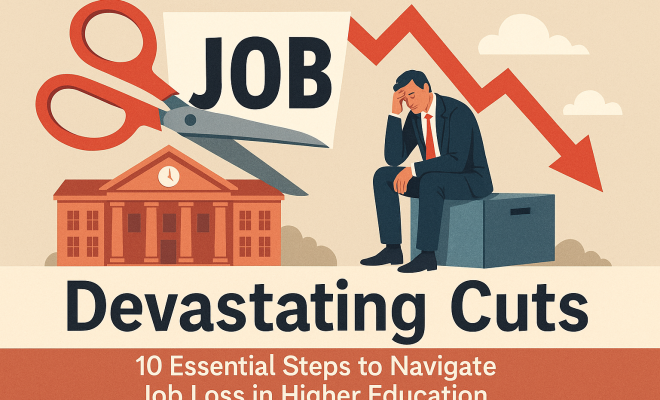
Devastating Cuts: 10 Essential Steps to Navigate Job Loss in Higher Education
It’s a tough time to be an educator, isn’t it? The ivory tower, once a symbol of stability and intellectual pursuit, now often feels more like a house of cards. We’re seeing budget deficits that make your head spin, enrollment numbers plummeting, and state funding drying up faster than a forgotten chalkboard eraser. Take Kansas State University’s College of Arts and Sciences, for instance. They’re staring down a whopping $2.6 million budget hole, which means cuts, and sadly, likely faculty terminations, are on the horizon for the next three fiscal years. You can imagine the scene at their recent town hall on September 10, 2026 – a lot of understandable anger and heartache. Faculty members are rightly asking, ‘How does this strengthen the university?’
And it’s not just K-State. This isn’t an isolated incident; it’s a national trend. Reports from September 18, 2026, show Michigan’s public universities grappling with similar issues, contemplating widespread job losses among their 97,000 faculty and staff. The ripple effect on local economies is going to be significant, and the human cost? Immeasurable. If you’re a faculty member, or really, anyone working in higher education, you’re probably feeling that knot in your stomach, wondering what the future holds. That’s why understanding how to navigate job loss in higher education isn’t just a good idea; it’s absolutely critical. It’s about taking control in an increasingly uncertain landscape, and that’s precisely what we’re going to dive into.
1. Acknowledge and Process Your Emotions: Don’t Suppress the Grief
Losing a job, especially one you’ve dedicated years, if not decades, of your life to, isn’t just a financial setback; it’s an emotional earthquake. For academics, our work often intertwines deeply with our identity. We’re not just professors; we’re researchers, mentors, and shapers of young minds. When that identity is threatened or stripped away, it can trigger a powerful cocktail of emotions: anger, fear, sadness, betrayal, and even a sense of failure. It’s crucial to give yourself permission to feel these emotions rather than trying to push them down or intellectualize them away. Suppressing grief only prolongs the healing process.
Think about it: at that K-State town hall, the emotional outcry wasn’t just about salaries; it was about the disruption of careers, the loss of purpose, and the shattering of expectations. Give yourself space to mourn what you’re losing – the routine, the colleagues, the students, the intellectual environment. Talk to trusted friends, family, or a therapist. Journaling can also be incredibly therapeutic. This initial phase of emotional processing is not a sign of weakness; it’s a vital step in building resilience and preparing yourself for the practical challenges ahead. You can’t effectively plan for the future if you’re drowning in unprocessed past emotions.
2. Conduct a Thorough Financial Audit: Know Your Numbers Cold
Once you’ve begun to process the initial shock, the very next practical step is to get an unvarnished look at your financial situation. This isn’t the time for guesswork; you need hard numbers. Sit down and meticulously list all your income sources, including your current salary, any side gigs, or spousal income. Then, create an equally detailed list of all your monthly expenses: mortgage/rent, utilities, student loan payments, car payments, insurance, groceries, subscriptions, and even those smaller, often overlooked discretionary spending items like dining out or entertainment. Be brutally honest.
The goal here is to determine your ‘burn rate’ – how much money you absolutely need to cover essential expenses each month. Once you have this figure, look at your savings, severance package (if applicable), and any other liquid assets. How many months can you sustain your current lifestyle without a primary income? This exercise will give you a realistic timeline and help you identify areas where you might need to cut back immediately. Knowledge is power, and in this case, financial clarity is your first line of defense against panic when you’re facing something like how to navigate job loss in higher education.
3. Understand Your Severance and Benefits Package: Read the Fine Print
If job loss becomes a reality, your institution will likely offer a severance package. Do not, under any circumstances, sign anything without thoroughly understanding every clause. This is where a legal professional specializing in employment law can be invaluable. They can review the terms, ensure fairness, and potentially negotiate for better conditions on your behalf. What’s included? How many weeks or months of pay? Will health insurance continue, and for how long? What about retirement contributions or any accrued vacation/sick leave payouts?
Beyond severance, consider your benefits. What happens to your health insurance? Can you elect COBRA, and what will that cost? What about life insurance, disability insurance, or any tuition benefits for dependents? Understanding these details is critical for financial planning and making informed decisions about your family’s well-being. Don’t let the emotional weight of the situation cloud your judgment; approach this step with a clear head and professional guidance if needed. This is your livelihood, and you deserve every penny and benefit you’re entitled to.
4. Network Strategically and Discreetly: Leverage Your Connections
One of the greatest assets academics possess is their network. You’ve attended conferences, collaborated on research, served on committees, and mentored students. Now is the time to activate those connections, but do so strategically and, initially, discreetly. Begin by reaching out to trusted colleagues, former mentors, or even successful former students. Explain your situation (without oversharing or sounding desperate) and inquire about potential opportunities or advice. They might know about openings you wouldn’t find on job boards, or they might be able to connect you with others who can help. (See: Associated Press news on education funding.)
Update your LinkedIn profile, ensuring it highlights your accomplishments and skills in a way that’s accessible to a broader audience, not just fellow academics. Attend virtual and in-person professional events. Remember, networking isn’t just about asking for a job; it’s about building relationships, sharing insights, and demonstrating your value. A strong network can be your lifeline when you’re trying to figure out how to navigate job loss in higher education, opening doors you might not even know existed.
5. Update Your CV and Craft a Compelling Resume: Tailor Your Narrative
Your academic CV is a comprehensive record of your scholarly achievements, publications, and teaching experience. It’s fantastic for tenure reviews and grant applications, but it’s often far too detailed and jargon-laden for the broader job market. You need to create a separate, concise resume that translates your academic skills into transferable professional competencies. Think about the skills you’ve honed: research, data analysis, project management (managing a lab or a course), communication, critical thinking, problem-solving, curriculum development, and mentorship. For more context, see Colorado's Bold Move to Save Teachers.
Each bullet point on your resume should start with an action verb and quantify your achievements whenever possible. Instead of just saying ‘Taught courses,’ say ‘Designed and delivered engaging undergraduate courses to over 500 students, consistently achieving student evaluation scores 15% above department average.’ Tailor your resume and cover letter for each specific job application, highlighting the skills most relevant to that role. This reframing is crucial whether you’re looking for another academic position or transitioning into industry, and it’s a vital part of learning how to navigate job loss in higher education successfully.
6. Explore Alternative Career Paths and Skill Translation: Beyond the Academy
One of the most challenging but potentially rewarding aspects of job loss in higher education is the opportunity to re-evaluate your career trajectory. While another faculty position might be your first preference, the reality of budget cuts means those opportunities are shrinking. This is the moment to think expansively. What non-academic roles align with your skills and passions? Many academics successfully transition into fields like instructional design, corporate training, data analysis, policy research, consulting, technical writing, editing, or even entrepreneurship.
Consider what specific problems you’ve solved in your academic career and how those solutions can be applied in other sectors. If you’ve managed a research grant, you have project management experience. If you’ve written extensively, you’re a skilled communicator. If you’ve taught complex subjects, you’re an expert at simplifying information. Look into online courses, certifications, or workshops that can help you acquire new skills or formalize existing ones to make you more attractive to non-academic employers. This proactive exploration can transform a setback into a springboard for an exciting new direction.
7. Seek Professional Development and Reskilling Opportunities: Stay Relevant
The job market, both within and outside academia, is constantly evolving. If you find yourself in a position of unemployment or underemployment, it’s an opportune time to invest in your professional development and acquire new, in-demand skills. Many universities, ironically, offer excellent continuing education programs, and there are countless online platforms like Coursera, edX, and LinkedIn Learning that provide certifications in areas like data science, project management, digital marketing, or specific software proficiency.
Think about what skills are currently highly valued in the sectors you’re targeting. For example, if you’re eyeing corporate training, a certification in adult learning principles or instructional design software could be a huge advantage. If you’re looking at data analysis roles, brushing up on Python or R, or getting a certification in a specific analytics platform, would be beneficial. Staying current and demonstrating a willingness to learn new things makes you a more attractive candidate, showing potential employers that you’re adaptable and forward-thinking, which is key when you’re trying to figure out how to navigate job loss in higher education.
8. Prioritize Self-Care and Mental Well-being: The Marathon, Not a Sprint
The stress of job loss can be immense, impacting not just your finances but your mental and physical health. It’s a marathon, not a sprint, and you need to protect your well-being throughout the process. Make sure you’re getting enough sleep, eating nutritious meals, and incorporating regular physical activity into your routine. These aren’t luxuries; they’re necessities for maintaining clarity of mind and emotional stability.
Beyond the basics, actively seek out support systems. This could be a support group for professionals in transition, regular check-ins with friends and family, or professional counseling. Don’t hesitate to lean on these resources. The psychological toll of unemployment, especially after a long, stable career, can be significant. Prioritizing self-care isn’t selfish; it’s a strategic move that ensures you have the energy and resilience to pursue new opportunities effectively. Remember, you can’t pour from an empty cup, and you’ll need all your strength to successfully navigate job loss in higher education.
9. Consider Interim or Contract Work: Bridge the Gap
While you’re searching for your next long-term role, don’t overlook the value of interim, contract, or freelance work. This can serve multiple purposes: it provides a much-needed income stream, keeps your skills sharp, and prevents significant gaps on your resume. Many universities utilize adjunct faculty or temporary project managers, and there are numerous opportunities for academics to consult, write, or teach online. (See: BBC coverage of higher education challenges.)
Think about your specialized knowledge. Could you offer consulting services to businesses or non-profits in your field? Could you tutor students online? Could you take on freelance writing or editing assignments? These interim roles might not be your ultimate goal, but they can be invaluable for maintaining financial stability and professional momentum during a challenging transition period. Plus, sometimes these temporary gigs can even lead to full-time opportunities or new career directions you hadn’t considered.
10. Maintain a Positive and Proactive Mindset: Control What You Can
Perhaps the most challenging, yet crucial, step is to maintain a positive and proactive mindset. It’s easy to fall into despair when faced with widespread budget cuts and the uncertainty of your future, as we’re seeing at institutions like K-State and across Michigan. However, dwelling on what you can’t control only saps your energy and hinders your progress. Focus instead on what you *can* control: your attitude, your effort, and your actions. For more context, see This Crucial Program Could End the Teacher Housing Crisis.
Set small, achievable goals each day related to your job search, professional development, or networking. Celebrate these small victories. Reframe setbacks as learning opportunities. Understand that job searching is often a numbers game, and rejection isn’t a reflection of your worth. Cultivate a sense of gratitude for your past experiences and the skills you’ve gained. A proactive mindset, combined with the practical steps outlined here, will empower you to not just survive but truly thrive as you navigate job loss in higher education and forge a new, fulfilling path.
11. The Shifting Landscape: Why Higher Ed is in Turmoil
It’s important to understand the broader forces at play when we talk about how to navigate job loss in higher education. The current instability isn’t just a blip; it’s a symptom of deeper systemic issues. One major factor is declining enrollment. Fewer high school graduates, coupled with a growing skepticism about the value proposition of a traditional four-year degree and its skyrocketing costs, means fewer students are knocking on university doors. This directly impacts tuition revenue, which for many institutions, is their lifeblood.
Then there’s the state funding issue. For decades, public universities have seen their state appropriations shrink, forcing them to become more reliant on tuition and private donations. When the economy falters, or state priorities shift, higher education often bears the brunt of budget cuts. Add to this the increasing competition from online programs, community colleges, and alternative credential providers, and you have a perfect storm. Institutions are often forced to make painful decisions, which unfortunately, often involve reducing faculty and staff to balance the books. This isn’t a reflection of your individual worth, but rather the harsh reality of a changing economic model.
12. Leveraging Your Academic Background for Non-Traditional Roles
Many academics, especially those with advanced degrees, often feel pigeonholed into traditional professorial roles. However, your academic training has equipped you with a unique and highly valuable skill set that’s often overlooked outside the ivory tower. Think about it: a Ph.D. is essentially a very long, complex project management exercise. You conceived a research question, secured resources, conducted extensive data collection and analysis, managed timelines, and then communicated your findings to a diverse audience. These are all skills highly sought after in various industries.
Consider the private sector. Companies in tech, pharmaceuticals, finance, and even non-profits are always looking for individuals with strong research capabilities, critical thinking skills, and the ability to synthesize complex information. Your expertise in a niche subject could make you an invaluable subject matter expert for a consulting firm, a think tank, or a content creation company. Don’t underestimate the power of your academic rigor and intellectual curiosity; these are traits that can make you stand out in competitive job markets, especially when you can articulate them in a business-friendly language on your resume and in interviews.
13. Building Your Personal Brand: Beyond the Institution
When you’re deeply embedded in an institution, it’s easy for your professional identity to become intertwined with its brand. However, when facing job loss, it’s crucial to cultivate your own personal brand that exists independently of any university affiliation. This means actively showcasing your expertise, values, and unique contributions to your field, or to new fields you’re targeting.
Start a professional blog, contribute articles to industry publications, or engage actively on platforms like LinkedIn and Twitter, sharing insights and participating in discussions relevant to your expertise. Consider creating a personal website that serves as a portfolio of your work, whether it’s publications, teaching philosophy, or projects you’ve managed. Your personal brand is your professional reputation, and it can open doors that institutional affiliations alone might not. It demonstrates initiative, thought leadership, and a proactive approach to your career, which are all highly attractive qualities to potential employers both inside and outside academia. For more context, see Dramatic: Colorado's Bold Program Could Save Its Schools From Collapse. (See: New York Times education section.)
The landscape of higher education is undeniably shifting, and for many, that shift means profound career uncertainty. But uncertainty doesn’t have to equate to helplessness. By taking deliberate, thoughtful steps – from processing emotions to strategically networking and reskilling – you can equip yourself to face these challenges head-on. It’s about recognizing your inherent value, translating your incredible academic skills for a broader market, and understanding that your expertise is needed, perhaps just in a different setting. The future may look different than you imagined, but it’s still yours to shape.
Frequently Asked Questions About Navigating Job Loss in Higher Education
Q1: I’ve been in academia my entire career. How do I even begin to look for jobs outside of higher education?
This is a really common concern. The first step is to recognize that your academic skills are highly transferable. You’re a researcher, a project manager, a communicator, and often a mentor and leader. Start by identifying the core competencies you’ve developed – data analysis, critical thinking, grant writing, public speaking, curriculum design, problem-solving, and so on. Then, research industries or roles where these skills are valued. Fields like instructional design, corporate training, data science, market research, policy analysis, technical writing, consulting, and non-profit management are often good fits. Look for online resources and communities (like the “Beyond the Professoriate” or “Versatile PhD” initiatives) that specialize in helping academics transition to non-academic careers. They often provide frameworks for translating your CV into a resume and for understanding corporate hiring processes.
Q2: How important is networking when looking for a new job, especially outside academia?
Networking is absolutely critical, both inside and outside of academia. In fact, it’s often cited as the most effective way to find new opportunities. Many jobs are filled through referrals or connections before they’re ever publicly advertised. Start with your existing network: former students, colleagues from conferences, collaborators, and even friends and family. Informational interviews are incredibly valuable – these are low-pressure conversations where you learn about someone’s career path and industry, not directly ask for a job. For non-academic roles, LinkedIn is your best friend. Optimize your profile to highlight transferable skills, join industry-specific groups, and connect with people in roles or companies that interest you. The goal isn’t just to find job openings, but to gather intelligence, understand different career paths, and build relationships that could lead to opportunities down the line.
Q3: What if I don’t have experience with specific software or tools required for non-academic jobs?
Don’t let that deter you! Many companies understand that smart, adaptable individuals can quickly learn new tools. This is where professional development and reskilling come in. Identify the key software or platforms commonly used in your target industry (e.g., project management software like Asana or Trello, data analysis tools like Python or R, CRM systems like Salesforce, or instructional design software). Then, proactively seek out online courses (Coursera, edX, LinkedIn Learning, Udemy), certifications, or workshops to gain proficiency. Even self-teaching and completing personal projects can demonstrate your initiative and ability to learn. Highlight these efforts on your resume and in interviews, emphasizing your quick learning ability and enthusiasm for new challenges.
Q4: Should I disclose that I was laid off from my previous academic position?
Honesty is usually the best policy, but how you frame it matters. You don’t need to dwell on the negative aspects or express bitterness. Instead, focus on the broader trends in higher education (like budget cuts or shifting institutional priorities) that led to the decision, rather than personal shortcomings. Frame it as an opportunity for new growth, to explore different career paths, or to apply your skills in a new environment. For example, you could say, “Due to university-wide restructuring and budget realignments, my position was eliminated. This has given me the chance to explore opportunities where I can apply my [mention specific skills] to [mention target industry/role].” This approach is professional, transparent, and proactive.
Q5: How can I manage the psychological impact of job loss and maintain motivation during a long job search?
Job loss is incredibly stressful, and it’s normal to experience emotional highs and lows. Prioritize self-care: maintain a routine, get enough sleep, eat well, and exercise. Connect with your support network – friends, family, or a therapist – to process your emotions. Break down your job search into small, manageable daily tasks to avoid feeling overwhelmed. Celebrate small victories, like updating your LinkedIn profile or sending out an application. Rejection is a part of the job search process, and it’s rarely personal; try not to let it define your self-worth. Consider joining a support group for job seekers or professionals in transition. Maintaining a positive and resilient mindset is crucial for navigating this challenging period successfully.
Trending Now
Frequently Asked Questions
What should I do if I lose my job in higher education?
If you lose your job in higher education, it's essential to first acknowledge and process your emotions. Understand that job loss is not just a financial setback but also an identity challenge. Seek support from colleagues, explore job opportunities, and consider professional development to enhance your skills.
How can I cope with job loss as an educator?
Coping with job loss as an educator involves recognizing the emotional impact and allowing yourself to grieve. Connect with peers for support, reassess your career goals, and explore alternative roles in education or related fields. Maintaining a positive outlook and being proactive can aid your recovery.
What are the common reasons for job cuts in higher education?
Common reasons for job cuts in higher education include budget deficits, declining enrollment numbers, and reduced state funding. Many institutions are facing financial pressures that lead to difficult decisions, including faculty terminations and program reductions.
How can I prepare for potential job loss in academia?
To prepare for potential job loss in academia, stay informed about your institution's financial health, enhance your professional skills, and network with colleagues. Consider creating a financial plan to manage potential income loss and explore alternative career paths in education or other sectors.
What impact does job loss in higher education have on local economies?
Job loss in higher education can have a significant impact on local economies, as it often leads to reduced spending by affected faculty and staff. This can affect local businesses and services, creating a ripple effect that extends beyond the university community.
What's your take on this? Share your thoughts in the comments below — we read every one.