Cosmic Awakening: Supermassive Black Hole Erupts After 100 Million Years
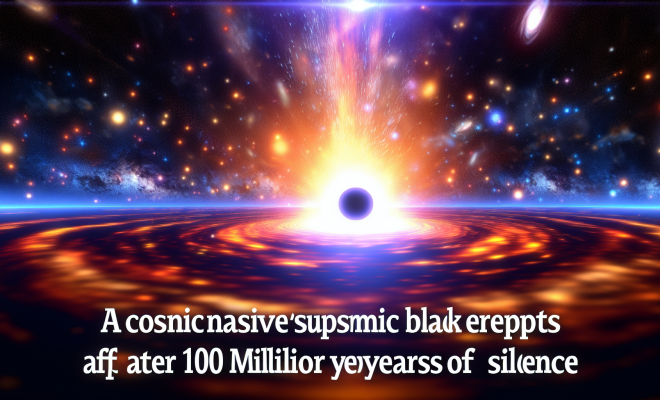
In a remarkable astronomical event, a supermassive black hole located in the galaxy J1007+3540 has been observed to awaken after a staggering 100 million years of dormancy. This rare phenomenon, likened to a cosmic volcano, has captivated the attention of astronomers and astrophysicists worldwide. Led by Shobha Kumari from Midnapore City College, this study sheds light on the dynamics of active galactic nuclei (AGN) and the intricate interactions between black holes and their surrounding environments.
The Awakening of J1007+3540
The black hole in question, found in the distant galaxy J1007+3540, has recently erupted with powerful jets that extend nearly one million light-years into space. This eruption marks an important chapter in the history of the galaxy, as it transitions from a period of inactivity to one of significant astrophysical activity. The phenomenon was identified as a rare episodic AGN event, characterized by the sudden resumption of jet activity.
Characteristics of the Eruption
The eruption consists of a bright inner jet surrounded by older, fading plasma. This plasma has been stretched and shaped by the extreme hot gas pressure present in the galaxy cluster. The dual nature of the jets—the bright inner core and the fainter outer layer—provides valuable insight into the mechanisms that drive black hole activity and the surrounding cosmic environment.
What Are Active Galactic Nuclei?
Active galactic nuclei are regions at the center of some galaxies that emit immense amounts of energy, often outshining the entire galaxy. This energy is produced by material falling into the supermassive black hole at the center, which releases gravitational energy as it accelerates and heats up. AGNs can exhibit various forms of activity, including radio jets, X-ray emissions, and optical light, depending on their orientation and the surrounding medium.
Significance of the Discovery
This discovery is significant for several reasons:
- Understanding Galactic Evolution: The observation of J1007+3540’s awakening provides a unique opportunity to study the lifecycle of supermassive black holes and their influence on galaxy formation and evolution.
- Insights into Jet Dynamics: The interaction between the newly formed jets and the older plasma offers insights into how black holes can influence their environments over vast timescales.
- Implications for Future Research: This event could pave the way for further studies on similar phenomena, helping astronomers to better understand the population of dormant black holes in the universe.
The Research Team
The research was conducted by a team of astronomers, including Dr. Sabyasachi Pal, Dr. Surajit Paul, and Dr. Marek Jamrozy, who collaborated with Kumari to analyze data from various observational platforms. Their findings contribute to the growing body of knowledge regarding the behavior of supermassive black holes and their jets, particularly in relation to the environment of galaxy clusters.
Methodology
The team utilized advanced telescopic data and simulations to track the activity of the black hole over time. By examining the light emitted from the jets and the surrounding plasma, they were able to deduce the age of the jets and their relationship with the galaxy cluster’s hot gas. This multi-faceted approach allowed them to construct a clearer picture of the dynamics at play.
Cosmic Volcanoes and Their Impact
The analogy of a cosmic volcano is particularly fitting for this phenomenon. Just as a volcano can erupt after a prolonged period of inactivity, releasing ash and lava, the black hole in J1007+3540 has unleashed jets of energy and plasma that can influence the surrounding cosmic landscape. These jets can heat up the intergalactic medium, trigger star formation, and even affect the growth of other galaxies.
The Future of Black Hole Research
The awakening of J1007+3540 is a reminder of the dynamic nature of the universe. As astronomers continue to refine their techniques and gather more data, the field of black hole research is poised for further breakthroughs. Future observations may uncover more dormant supermassive black holes that could similarly awaken, providing additional opportunities to study the complex interactions between black holes and their host galaxies.
Conclusion
The eruption of the supermassive black hole in galaxy J1007+3540 is a fascinating development that enhances our understanding of cosmic phenomena. As researchers like Kumari and her team delve deeper into these mysteries, we can anticipate exciting new revelations about the life cycles of black holes and their significant role in shaping the universe as we know it.