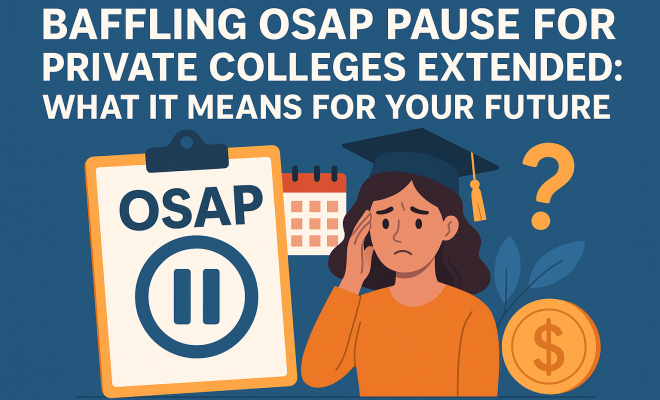
Baffling OSAP Pause for Private Colleges Extended: What It Means for Your Future
If you’re a student in Ontario, or perhaps considering post-secondary education in the province, you’ve probably heard about OSAP – the Ontario Student Assistance Program. It’s a lifeline for thousands, helping cover tuition, books, and living expenses. So, when the provincial government decided to hit the brakes on OSAP payments to students attending private post-secondary institutions, it sent ripples of anxiety across the educational landscape. Now, that initial pause, which began last fall, has been officially extended until at least the new year. This isn’t just a bureaucratic footnote; it’s a significant development that could reshape how many Ontarians access career-focused education, and it raises some serious questions about the future of private colleges.
The core issue here, according to the provincial government, is a deep concern over potential misuse of student aid. They’re not just tweaking a few rules; they’re launching a full-scale investigation into how OSAP funds are being managed and utilized within the private career college sector. This isn’t a minor audit; it suggests a systemic problem that the province feels compelled to address with a firm hand. For students who rely on this funding, it’s a bewildering and often frustrating situation. Imagine planning your education, making financial commitments, and then suddenly having a major part of your funding stream put on hold. It creates an enormous amount of uncertainty, and frankly, it feels a bit unfair to those who are genuinely pursuing their education.
The Genesis of the OSAP Pause Private Colleges Decision
To really understand the current situation, we need to rewind a bit. The initial decision to pause OSAP funding for private career colleges wasn’t made on a whim. It stemmed from a growing concern within government circles regarding the rapid expansion of these institutions and, more critically, the skyrocketing amount of OSAP funding flowing into them. While private colleges often fill crucial gaps in the labor market by offering specialized, career-focused programs that public institutions might not, their oversight has historically been less stringent. This created an environment ripe for potential exploitation, both by some unscrupulous institutions and, in some cases, by individuals claiming funds without genuine educational intent.
The government’s internal review, which led to the initial pause, highlighted several red flags. These included a disproportionate increase in OSAP applications for certain private programs, questions about the quality and accreditation of some courses, and concerns about whether students were truly receiving value for the significant public investment being made. It’s a tricky balance, isn’t it? On one hand, you want to foster innovation and allow diverse educational pathways. On the other, you have a responsibility to protect taxpayer money and ensure that student aid is being used effectively to genuinely improve lives and the provincial economy.
The extension of the OSAP pause private colleges are experiencing now signals that the initial concerns were not easily dismissed. It suggests the government found enough evidence or enough lingering questions to warrant a more thorough, prolonged investigation rather than a quick fix. This isn’t just about a few bad apples; it implies a broader need for systemic reform in how private post-secondary institutions operate within the OSAP framework. For students caught in the middle, it’s a difficult pill to swallow, as their educational plans are now on hold while the adults in the room sort out the rules.
Proposed Reforms: What’s on the Table?
The extension of the OSAP pause isn’t just about stopping payments; it’s a prelude to significant proposed reforms aimed at tightening the reins on private institutions. These aren’t minor tweaks; they represent a fundamental shift in how the province intends to regulate and fund these colleges. For anyone involved in this sector – students, administrators, and even potential employers – understanding these proposals is absolutely critical. They could redefine the landscape of career education in Ontario for years to come.
One of the most talked-about proposals is the implementation of enrollment caps for OSAP-funded programs at private colleges. This is a direct response to concerns about unchecked growth and potential over-enrollment in programs that might not lead to viable employment. Imagine a situation where a private college rapidly expands a program, attracting hundreds of OSAP-funded students, only for those graduates to find a saturated job market. Enrollment caps aim to prevent this by linking program size more closely to labor market demand and the institution’s capacity to deliver quality education. It’s a move towards a more sustainable and responsible use of public funds.
Another significant reform targets predominantly online-only courses. The province is looking to exclude these from OSAP eligibility, or at least significantly restrict their funding. While online learning has its merits, especially for flexibility, there’s a clear apprehension that some online-only programs at private institutions might lack the rigor, student support, or practical components necessary for genuine skill development. This isn’t a blanket condemnation of online education, but rather a focused effort to ensure that OSAP supports programs with demonstrable educational value and accountability. It’s about ensuring students aren’t just paying for a digital certificate but acquiring tangible skills.
Finally, and perhaps most crucially, the government is pushing for stronger student identity and eligibility verification. This gets to the heart of the alleged misuse of funds. There have been whispers, and more, of individuals enrolling in programs without genuine intent, or even instances of identity fraud to access OSAP money. By strengthening verification processes, the province hopes to weed out fraudulent applications and ensure that OSAP funds reach only those legitimate students who truly need and deserve them. This could mean more rigorous application processes, stricter documentation requirements, and possibly even in-person verification steps. It’s a necessary evil, perhaps, but one aimed at safeguarding the integrity of the entire system. (See: Ontario Student Assistance Program overview.)
The Immediate Fallout for Students
While the government’s intentions behind the OSAP pause private colleges are experiencing might be well-meaning, the immediate impact on students is nothing short of distressing. For many, this isn’t just about a delay; it’s about a complete derailment of their educational and career plans. When you’re banking on government funding to cover your tuition and living expenses, having that funding suddenly withdrawn or put on hold creates an urgent, often terrifying, financial void.
Think about it: students have already committed to programs, signed up for classes, and in many cases, made significant life changes around their educational pursuits. They might have left jobs, moved to a new city, or taken on other financial obligations based on the expectation of OSAP support. Now, they’re facing tuition bills with no clear way to pay them. This isn’t just a minor inconvenience; it’s a crisis for many. Some students might be forced to drop out of their programs entirely, losing not only their investment but also valuable time and progress towards their career goals. For more context, see Unprecedented Student Loan Forgiveness Plan Could Erase Millions in Debt.
Beyond tuition, there’s the broader issue of enrollment decisions. Prospective students who were eyeing private career colleges, specifically because of the OSAP option, are now in a state of limbo. Do they wait? Do they pivot to a public college or university, which might not offer the specialized program they wanted? Or do they abandon their educational aspirations altogether for now? This uncertainty has a chilling effect on enrollment, potentially leaving many aspiring professionals feeling abandoned by the system they hoped would support them.
Moreover, the psychological toll shouldn’t be underestimated. The stress of financial insecurity, coupled with the frustration of having your plans upended, can be immense. Students are left feeling vulnerable, questioning their choices, and wondering if their educational dreams are still viable. It’s a tough spot to be in, and while the province works to fix what it perceives as systemic issues, the human cost of this pause is very real for thousands of individuals.
Financial Viability of Private Career Colleges
The OSAP pause private colleges are facing isn’t just a headache for students; it poses a significant existential threat to many private post-secondary institutions themselves. Unlike public colleges and universities, which receive substantial direct government funding, private career colleges often rely heavily on tuition fees, and a large portion of those fees typically come directly or indirectly from OSAP. When that tap is suddenly turned off, or even just significantly restricted, it creates an immediate and severe cash flow problem.
Imagine running a business where a major customer suddenly stops paying, or tells you they’ll only pay a fraction of what they used to, with no clear timeline for resolution. That’s essentially the position many private colleges find themselves in. They have operating costs – salaries for instructors and staff, facility rents, equipment maintenance, accreditation fees, and marketing expenses – all of which continue regardless of OSAP funding. Without a steady stream of tuition revenue, these institutions will struggle to meet their financial obligations. We could see layoffs, program cancellations, or even outright closures for some of the smaller or less financially robust colleges.
This situation also creates a ripple effect throughout the broader economy. Private colleges employ thousands of people, from educators to administrative staff. Their closure or contraction would mean job losses, impacting local communities. Furthermore, these colleges often provide highly specialized training that meets specific industry needs, from healthcare support to skilled trades. If these programs disappear, it could create labor shortages in crucial sectors, ultimately harming the provincial economy’s ability to grow and innovate.
The challenge for these colleges now is to pivot, and quickly. Can they find alternative funding sources? Can they attract students who don’t require OSAP? Can they streamline operations enough to survive this lean period? For some, the answer might be yes, but for many, especially those who primarily served OSAP-reliant students, this pause could be the beginning of the end. It’s a stark reminder of how interconnected government policy and the private sector truly are.
The Broader Context: Protecting Public Funds and Student Futures
While the immediate impact of the OSAP pause private colleges are experiencing is undoubtedly challenging, it’s crucial to consider the broader context and the government’s stated rationale. The province isn’t acting capriciously; its stated aim is to protect public funds and ensure that OSAP truly serves its purpose: to support students in obtaining valuable education that leads to meaningful employment. This objective is laudable, especially given the significant investment taxpayers make in student aid.
Over the years, there have been increasing reports and anecdotal evidence suggesting that some private institutions might be exploiting the OSAP system. This could manifest in various ways: aggressive recruitment of students into low-quality programs with poor job prospects, inflating tuition fees, or even outright fraudulent activities where funds are collected without adequate educational delivery. When OSAP funds are misused, it’s not just a technicality; it’s money that could have gone to support other deserving students, or to other critical public services. It also erodes public trust in the entire student aid system.
Moreover, when students invest their time and energy, and OSAP’s money, into programs that don’t deliver on their promises – whether that’s a reputable education or a clear path to employment – it’s a profound disservice. It leaves individuals with debt, without the skills they were promised, and often feeling disillusioned. The government’s push for stronger verification, enrollment caps, and scrutiny of online-only programs is an attempt to address these very real concerns. They want to ensure that OSAP is an investment in human capital, not simply a handout to institutions that may not be delivering genuine value.
It’s a delicate balancing act. How do you crack down on misuse without penalizing legitimate students and reputable institutions? That’s the challenge the provincial government faces. The extension of the OSAP pause private colleges are contending with indicates they haven’t yet found that perfect balance, or that the problems are more entrenched than initially thought. But the underlying goal – to safeguard both public money and student futures – is a fundamental responsibility of any government.
Comparing Public vs. Private: A Shifting Landscape
The OSAP pause private colleges are grappling with inevitably brings the distinction between public and private post-secondary education into sharper focus. For years, students have had choices: traditional public universities and colleges, or the often more niche, career-focused private career colleges. Each has its pros and cons, but the current situation significantly alters the calculus for many prospective students. For more context, see The Stunning Secret Behind $630 Million in Withheld Student Aid.
Public colleges and universities, funded directly by the government, generally offer a broader range of programs, often with more robust academic departments and research facilities. They also typically have more established alumni networks and, importantly, are not subject to this particular OSAP pause. For students seeking a more traditional academic path or a broader education, public institutions remain a stable and reliable choice. Their OSAP funding streams are unaffected, providing a sense of security that private institutions currently lack.
Private career colleges, on the other hand, have historically prided themselves on their agility, specialized training, and quicker pathways to employment. They often have stronger ties to specific industries, tailoring their curricula to meet immediate labor market demands. For students looking for vocational training in areas like healthcare assisting, paralegal studies, or specific trades, private colleges have often been the go-to. However, the current OSAP restrictions mean that even if a private college offers the perfect program, accessing it might now be financially impossible for many.
This creates a dynamic where public institutions might see an uptick in applications, as students look for more secure funding options. It could also force private colleges to become even more innovative in their funding models, marketing, and program delivery to attract students who can afford to pay out-of-pocket or secure alternative financing. Ultimately, this OSAP pause private colleges are experiencing could accelerate a shift in student enrollment patterns, pushing more individuals towards the public system, at least in the short term, until the dust settles on these reforms.
Seeking Alternatives: What Are Students to Do?
So, if you’re a student caught in the crossfire of the OSAP pause private colleges are experiencing, what are your options? The uncertainty can be paralyzing, but inaction isn’t a strategy. It’s crucial to explore every avenue available to you, and quickly.
First, if you’re currently enrolled in a private college program, contact your institution’s financial aid office immediately. They should be able to provide you with the most up-to-date information regarding your specific situation, potential payment plans, or any internal bursaries or scholarships they might be offering to mitigate the impact. Don’t assume; ask directly about your tuition obligations and what support, if any, they can provide during this transition.
Second, investigate alternative funding options. This could include private student loans from banks or credit unions, though these often come with higher interest rates and stricter repayment terms than OSAP. You might also explore lines of credit, though again, be very cautious about taking on high-interest debt. Look into scholarships and bursaries from external organizations, industry associations, or community groups. There are many out there, and while they might not cover everything, every little bit helps.
Third, consider pivoting your educational path, if feasible. This might mean exploring similar programs at public colleges or universities, which remain OSAP-eligible. While it might not be your first choice, it could offer a stable path forward. Research online-college alternatives carefully, understanding that even if they are private, some might not be impacted by the OSAP pause if they fall outside the province’s jurisdiction or if they have different funding models. However, be wary of predatory online institutions that promise quick fixes but deliver little value. For more context, see Education Department Sends Student Loan Borrowers 'Final Notices' With Ominous Warning.
Finally, and perhaps most importantly, seek financial and legal advice if you feel you’ve been unfairly treated or if your college isn’t being transparent. Student advocacy groups or legal aid services specializing in education law might be able to offer guidance on your rights and options. It’s a challenging time, but remember you’re not entirely alone, and there are resources that can help you navigate this complex situation.
The Path Forward: A Call for Clarity and Oversight
The extended OSAP pause private colleges face undoubtedly highlights a critical need for greater clarity and robust oversight within Ontario’s post-secondary education system, particularly concerning private institutions. While the government’s investigation is ongoing, the prolonged uncertainty is detrimental to everyone involved – students, colleges, and ultimately, the integrity of the education system itself. What’s needed now is not just a crackdown, but a thoughtful and transparent pathway forward.
Firstly, the government needs to communicate its findings and proposed solutions with greater transparency and a clearer timeline. Students and institutions deserve to know what specific issues were identified, what metrics will be used for future OSAP eligibility, and when they can expect a definitive resolution. This isn’t just about policy; it’s about restoring trust and allowing people to plan their lives and their businesses effectively.
Secondly, any new regulatory framework must strike a balance between accountability and fostering innovation. Private career colleges do play a vital role in meeting specific labor market demands and providing flexible learning options. The goal shouldn’t be to eliminate them but to ensure they operate ethically, provide high-quality education, and genuinely prepare students for employment. This could involve more rigorous accreditation processes, performance-based funding models tied to graduate employment rates, and stronger consumer protection measures for students.
Finally, there’s an opportunity here to rethink the entire ecosystem of post-secondary funding in Ontario. Could there be alternative funding models that support career-focused education without relying solely on a system that seems vulnerable to misuse? Can public and private institutions collaborate more effectively to share resources and best practices? This OSAP pause private colleges are enduring, while painful, could be a catalyst for a much-needed, holistic review of how Ontario supports its students and its economy through education.
The extension of the OSAP pause on private post-secondary institutions until the new year is more than just a headline; it’s a stark reminder of the complexities and challenges facing education funding in Ontario. For thousands of students, it represents a period of profound uncertainty and financial stress, while for many private colleges, it poses a direct threat to their very existence. As the province continues its investigation and formulates its reforms, the hope remains that a clearer, more equitable, and more sustainable system will emerge – one that protects public funds, supports genuine student aspirations, and strengthens the fabric of Ontario’s workforce for years to come.
Trending Now
Frequently Asked Questions
Why was OSAP funding paused for private colleges?
The Ontario government paused OSAP funding for private colleges due to concerns over potential misuse of student aid and the rapid expansion of these institutions. This decision aims to address systemic issues regarding how OSAP funds are managed within the private career college sector.
How long will the OSAP pause for private colleges last?
The pause on OSAP funding for private colleges has been officially extended until at least the new year. This ongoing suspension has created uncertainty for students who rely on this financial support for their education.
What does the OSAP pause mean for students?
The OSAP pause means that students attending private colleges in Ontario may face financial challenges as they lose access to crucial funding for tuition, books, and living expenses. This situation creates anxiety and frustration for those planning their education.
What are the implications of the OSAP investigation?
The investigation into OSAP funding for private colleges suggests that there may be systemic problems in how funds are utilized. This scrutiny could lead to changes in regulations and oversight, affecting future funding for these institutions.
What should students do during the OSAP pause?
Students affected by the OSAP pause should explore alternative funding options, such as scholarships or personal loans, and stay informed about the situation. It's also advisable to communicate with their colleges for guidance and support during this uncertain period.
What did we miss? Let us know in the comments and join the conversation.