21 of the Best Opening Lines in Children’s Books
“`html
Imagine diving into a world where the first sentence transports you to a land of adventure, magic, and endless possibilities. The best opening lines in children’s books do just that, igniting curiosity and setting the tone for the journey ahead. These lines often encapsulate the essence of the story, inviting young readers to turn the page. In this article, we’ll explore 21 of the most captivating opening lines in children’s literature, analyzing what makes them so effective and memorable.
1. “In a hole in the ground there lived a hobbit.” – J.R.R. Tolkien, The Hobbit
This iconic line from J.R.R. Tolkien’s The Hobbit does more than just introduce us to Bilbo Baggins; it immediately sparks intrigue. A ‘hole in the ground’ sounds mundane, yet the word ‘hobbit’ hints at something extraordinary. This simple yet profound opening invites readers into a richly built world, setting the stage for adventure and exploration. Tolkien’s whimsical language captivates not only children but adults too, illustrating how powerful a first line can be.
The significance of this line lies in its ability to create a vivid image while raising questions that prompt curiosity. What exactly is a hobbit? Why does it live in a hole? Such openings hook readers, encouraging them to delve deeper into the narrative.
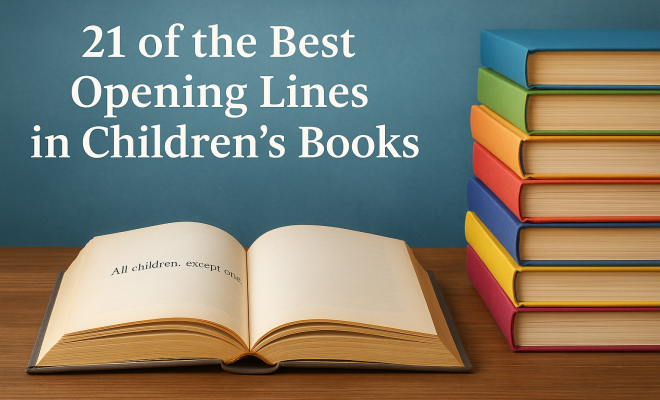
2. “All children, except one, grow up.” – J.M. Barrie, Peter Pan
J.M. Barrie’s Peter Pan begins with a statement that resonates through generations. The phrase captures the universal experience of childhood and its fleeting nature, instantly drawing the reader in. The exception of ‘one’ piques interest and hints at the magical world of Neverland where Peter Pan, the boy who refuses to grow up, resides.
This opening line serves both a narrative purpose and a thematic one, prompting reflections on the nature of childhood and the inevitability of growing up. It sets the tone for a fantastical tale about escapism and the joys of being a child, making it one of the most memorable openings in children’s literature.
3. “It was a bright cold day in April, and the clocks were striking thirteen.” – George Orwell, 1984
While 1984 is not traditionally categorized as a children’s book, its powerful opening line is compelling enough to bridge interests. The juxtaposition of ‘bright’ and ‘cold’ creates a dissonance that evokes curiosity. The mention of clocks striking thirteen warps reality, establishing a sense of unease and inviting readers into a world of dystopia.
This line can teach young readers about the art of contradiction in storytelling. It demonstrates that the beginning of a story can set up complex themes that may resonate differently with each reader, encouraging them to think critically about the text.
4. “It was the best of times, it was the worst of times…” – Charles Dickens, A Tale of Two Cities
Even though Dickens’ A Tale of Two Cities is more suited for older readers, the opening line encapsulates the duality of human experience. The line reflects not only the historical context of the French Revolution but also the universal struggle of good vs. evil. This duality can resonate with children, as they often experience conflicting emotions.
This opening encourages discussions about history, humanity, and personal experiences, making it a valuable tool for young readers. By engaging with such a line, kids can learn to recognize complexities in both literature and life.
5. “The sun shone, having no alternative, on the nothing new.” – Samuel Beckett, Murphy
The beauty of Beckett’s line lies in its simplicity and depth. It plays with the idea of inevitability and the cyclical nature of life, concepts that can be intriguing to children. The sun shining is a universal image, while the phrase ‘on the nothing new’ creates questions about monotony and existence.
While it is more abstract than many children’s books, this line can help older children appreciate literary techniques such as irony and metaphors. It serves as a reminder that even simple statements can carry profound meanings.
6. “It was a dark and stormy night.” – Edward Bulwer-Lytton, Paul Clifford
This infamous opening line has become a cliché in literature, yet it still holds a certain charm. The vivid imagery of a dark and stormy night evokes feelings of suspense and foreboding. It sets the stage for a thrilling tale, instantly engaging readers’ imaginations. We covered age-appropriate literature guide in more detail.
For young writers and readers, this line can serve as an excellent example of how to create atmosphere and mood. Its familiarity allows educators to discuss how to build tension and suspense in storytelling, a vital skill for any budding author.
7. “Once there were four little Rabbits, and their names were—Flopsy, Mopsy, Cotton-tail, and Peter.” – Beatrix Potter, The Tale of Peter Rabbit
Beatrix Potter’s The Tale of Peter Rabbit opens with a charming introduction to its characters. The mention of four little rabbits creates a sense of warmth and familiarity, making it relatable to young readers. Each name is distinctive, allowing children to easily remember them and become invested in their adventures. (See: Children's literature overview.)
This line demonstrates the importance of character introduction in opening lines. Potter’s delightful narrative style teaches children how to create memorable characters that readers will want to follow throughout a story.
8. “It was a pleasure to burn.” – Ray Bradbury, Fahrenheit 451
Another line from a book that straddles the line between young adult and adult literature, Ray Bradbury’s Fahrenheit 451 captures attention immediately. The paradox of finding pleasure in something destructive creates intrigue. This line invites readers to explore themes of censorship and the power of literature. For more on this, see top colleges for children's literature.
This opening challenges young readers to think critically about the implications of censorship and the value of books. It’s a powerful reminder that even in a fictional world, the consequences of choices can lead to profound lessons.
9. “I am an invisible man.” – Ralph Ellison, Invisible Man
Ralph Ellison’s powerful introduction introduces the concept of invisibility not just physically, but socially and emotionally. While not a traditional children’s book, this line resonates with themes relevant to all ages, especially the struggles for identity and recognition.
Opening lines like this can be a springboard for discussions about self-perception, societal roles, and the importance of visibility in a community. It encourages young readers to think deeply about their own identities and how they relate to the world around them.
10. “It is a truth universally acknowledged, that a single man in possession of a good fortune, must be in want of a wife.” – Jane Austen, Pride and Prejudice
Jane Austen’s witty opening from Pride and Prejudice is humorously ironic, instantly captivating readers. It sets up expectations about societal norms and relationships, which can be relatable themes for young readers as they navigate their friendships.
This line serves as a launchpad for discussions about gender roles and societal expectations. It’s an excellent way to engage children in thinking critically about literature and the world around them.
11. “The moment I wake up, before I put on my makeup, I say a little prayer for you.” – Dionne Warwick, I Say a Little Prayer
Though this line is from a song rather than a book, its universal themes of love and devotion resonate strongly within children’s literature. This line can be adapted in many ways, inviting children to think about their own relationships and the emotions connected to them.
Using such lines in creative writing exercises can help young readers explore different themes and styles, encouraging them to express their own feelings through words. It’s a reminder that literature can be inspired by all forms of art.
12. “It is a strange feeling, to be nothing more than an object.” – John Green, Looking for Alaska
John Green’s Looking for Alaska introduces profound existential themes right from the start. The idea of being perceived as ‘nothing more than an object’ pushes readers to consider their own identities and how they are viewed by others.
Such an opening can engage older children in deep discussions about self-worth and societal perceptions. It highlights that the best opening lines in children’s books can also challenge young minds to think critically about identity and existence.
13. “A long time ago in a galaxy far, far away…” – George Lucas, Star Wars
While not a conventional children’s book, this opening line from Star Wars has become a cultural touchstone. It sets up an expansive universe filled with adventure, intrigue, and fascinating characters. The phrase ‘a long time ago’ immediately implies a sense of history and myth, enticing young audiences.
The effectiveness of this line lies in its ability to ignite imagination. It allows readers to envision a world beyond their own, inspiring creativity and curiosity. Discussing such lines can lead to explorations of world-building elements in writing.
14. “I had the craziest dream last night.” – Lewis Carroll, Alice’s Adventures in Wonderland
This whimsical opening from Carroll’s classic sets the tone for the bizarre adventures to come. The phrase ‘craziest dream’ invites readers into a world where the impossible can happen, enticing them to see what Alice will experience in Wonderland.
Alice’s journey teaches children about the power of imagination and creativity. This line encourages young readers to dream big and enjoy the whimsical nature of storytelling.
15. “It’s a good day for a picnic.” – A.A. Milne, Winnie-the-Pooh
A.A. Milne’s Winnie-the-Pooh opens with a cheerful and inviting line that sets a warm tone for the story. The simplicity of this statement resonates with the innocence of childhood and the joy of simple pleasures. (See: Harvard University resources.)
This line can serve as a gentle reminder for children to appreciate the little things in life. It encourages readers to find joy in everyday moments and explore the beauty of friendship and adventure.
16. “On the first day of school, Mrs. McGinty said, ‘Today, we’re going to have a big surprise!'” – Judy Blume, Tales of a Fourth Grade Nothing
Judy Blume’s opening line engages readers with immediate intrigue into what the surprise might be. It creates excitement and sets the stage for the unfolding story. This line resonates with many children experiencing school for the first time.
Such openings can be used to discuss the importance of anticipation in storytelling. They can also encourage young writers to incorporate personal experiences into their narratives, making the stories more relatable.
17. “There once was a girl who wanted to change the world.” – Malala Yousafzai, Malala’s Magic Pencil
Malala Yousafzai’s Malala’s Magic Pencil opens with a line that resonates with empowerment and aspiration. The idea of wanting to change the world captures the hearts of young readers, inspiring them to think about their own dreams and ambitions.
This line encourages discussions about individuality and the power of one voice. It teaches children that they can create change, no matter how small, instilling a sense of agency and purpose in their lives. understanding literature circles offers useful background here.
18. “When I was a boy, my father used to tell me stories about a little girl who lived with her father in a little house on the prairie.” – Laura Ingalls Wilder, Little House on the Prairie
Wilder’s line provides a nostalgic introduction into a story steeped in adventure and family. The imagery of a ‘little house on the prairie’ evokes warmth and simplicity, allowing readers to envision the setting immediately.
This opening invites young readers to engage with themes of family, resilience, and adventure. It also demonstrates how storytelling can be passed from generation to generation, connecting readers with their own experiences.
19. “In the beginning, God created the heavens and the earth.” – The Bible
This opening line from the Bible has echoed through time, encapsulating the essence of creation and existence. Although religious in nature, it offers timeless themes of beginnings and the power of storytelling itself.
Discussing this line can open conversations about ethics, spirituality, and their interpretations across different cultures. It encourages children to think about the bigger questions in life and how stories shape our understanding of the world.
20. “Charlie Bucket had a very small house on one street and a very large family.” – Roald Dahl, Charlie and the Chocolate Factory
Roald Dahl’s Charlie and the Chocolate Factory begins with a simple yet effective line that immediately establishes character and setting. The mention of a ‘very small house’ paired with a ‘very large family’ sets the stage for Charlie’s adventures in a whimsical world.
This line serves as a great example of how to introduce characters and settings in an engaging manner. It teaches young writers to build relatable characters through simple descriptions that resonate with the reader.
21. “A little girl named Dorothy lived in the midst of the great Kansas prairies, with Uncle Henry, who was a farmer, and Aunt Em, who was the farmer’s wife.” – L. Frank Baum, The Wonderful Wizard of Oz
Baum’s introduction to The Wonderful Wizard of Oz sets a familiar and comforting scene. The specificity of the characters and their roles invites readers into Dorothy’s life, making it relatable and grounded before the fantastical elements unfold.
This line exemplifies the importance of grounding a story in reality before introducing fantasy. It shows young readers that even the most magical adventures often begin in ordinary settings, encouraging them to seek wonder in their everyday lives. (See: New York Times articles on literature.)
Exploring the Impact of Opening Lines
Opening lines serve as a powerful tool in storytelling, particularly within children’s literature. They not only capture readers’ attention but also establish the mood, tone, and direction of the narrative. A well-crafted opening line can make a reader feel a range of emotions, from excitement to curiosity, setting the stage for the entire story. For young readers, these lines become windows into new worlds and experiences.
Research indicates that first impressions are crucial; a captivating opening line can lead to a lasting bond with a book. According to a survey conducted by the National Literacy Trust, children who engage with compelling narratives are more likely to develop a love for reading and improve their literacy skills. A strong opening line can make them eager to discover what happens next.
How Opening Lines Can Shape Themes
The best opening lines in children’s books often foreshadow the central themes of the story. For instance, consider the line from Malala’s Magic Pencil about wanting to change the world. This sets up a narrative centered on empowerment, activism, and the importance of education. Similarly, the opening of The Hobbit hints at themes of adventure and self-discovery that unfold throughout the tale.
By analyzing various opening lines, educators can help students identify how authors hint at themes. Discussions around these themes can spark engaging conversations about the characters’ journeys and the moral lessons embedded within the narrative. This can deepen understanding and appreciation for literature.
Frequently Asked Questions (FAQ)
What makes a great opening line in a children’s book?
A great opening line should be intriguing, relatable, and set the tone for the story. It often introduces key elements such as character, setting, or theme while creating curiosity that compels readers to continue. The best lines resonate emotionally, drawing young readers into the narrative world.
Can opening lines influence a child’s desire to read?
Absolutely! Engaging opening lines can capture a child’s interest and make them excited about reading. If a child feels a connection to the story from the very first sentence, they are more likely to continue reading and develop a lifelong love for books.
How can parents and educators use opening lines in teaching?
Parents and educators can use opening lines to introduce literary analysis concepts, such as tone, mood, and theme. They can encourage children to write their own opening lines, promoting creativity and engagement with storytelling. Discussing what makes certain lines effective can also enhance reading comprehension skills.
Are there common elements in successful opening lines?
Many successful opening lines share common elements such as vivid imagery, intriguing questions, or relatable emotions. They often evoke curiosity or a sense of wonder, urging readers to explore the story further. Additionally, they may introduce a unique character or setting that piques interest right away.
Can you give examples of lesser-known opening lines that are effective?
Certainly! One example is from The Phantom Tollbooth by Norton Juster: “There was once a boy named Milo who didn’t know what to do with himself—not just sometimes, but always.” This line instantly relates to many children who feel boredom or lack of direction, establishing a connection to the protagonist’s journey. Another lesser-known but powerful opening is from The Tale of Despereaux by Kate DiCamillo: “Once upon a time, in a castle, there was a princess who had everything.” This line draws readers into a world of fairy tale nostalgia, inviting them to discover the unique story of Despereaux. See also teaching fiction and poetry resources.
The Magic of Closing Thoughts
The best opening lines in children’s books offer a glimpse into captivating worlds filled with adventure, emotion, and life lessons. These lines not only capture our imaginations but also teach young readers about the power of words to inspire thought and reflection. Whether they spark curiosity, evoke empathy, or inspire dreams, these opening lines are a testament to the magic of storytelling. As children turn the pages, they embark on journeys that shape their understanding of themselves and the world around them, proving that a simple line can open the door to countless adventures.
“`
Trending Now
Frequently Asked Questions
What are some famous opening lines in children's books?
Famous opening lines in children's books include J.R.R. Tolkien's 'In a hole in the ground there lived a hobbit' from The Hobbit and J.M. Barrie's 'All children, except one, grow up' from Peter Pan. These lines capture the essence of the stories and ignite curiosity in readers.
Why are opening lines important in children's literature?
Opening lines in children's literature are crucial as they set the tone for the story, spark curiosity, and create vivid imagery. A captivating first sentence can hook young readers, inviting them to explore the narrative further and engage with the characters and themes.
How do opening lines influence a child's reading experience?
Effective opening lines can significantly influence a child's reading experience by drawing them into the story and stimulating their imagination. They create a sense of adventure and wonder, encouraging children to turn the page and discover the world within the book.
What makes a good opening line for a children's book?
A good opening line for a children's book should be intriguing, evoke curiosity, and provide a glimpse into the story's world. It often combines simple yet imaginative language that resonates with young readers, inviting them to embark on an adventure.
Can you give examples of effective opening lines?
Examples of effective opening lines include 'In a hole in the ground there lived a hobbit' from The Hobbit and 'All children, except one, grow up' from Peter Pan. These lines immediately engage readers and encapsulate the themes of adventure and childhood.
Agree or disagree? Drop a comment and tell us what you think.