How Millions of Exploding Stars Could Uncover Dark Energy Secrets
“`html
In the vastness of the cosmos, secrets await discovery, and one of the most tantalizing is the enigma of dark energy. This mysterious force, believed to be driving the accelerated expansion of the universe, has puzzled scientists for decades. However, a breakthrough technology is poised to change the game in our understanding of dark energy: an innovative AI-driven framework known as CIGaRS.
The Dawn of CIGaRS
Recently published in Nature Astronomy, the CIGaRS framework enables astronomers to accurately measure cosmic distances using only imaging data from Type Ia supernovae. These stellar explosions, which serve as cosmic lighthouses, have long been the key to gauging the universe’s expansion. Traditionally, astronomers relied on expensive spectroscopic methods to achieve this accuracy, often limiting the data available for analysis. CIGaRS flips the script by demonstrating that high-accuracy redshift estimates can be derived from simple photographs of these supernovae, marking a monumental shift in astrophysics.
Type Ia Supernovae: The Cosmic Standard Candles
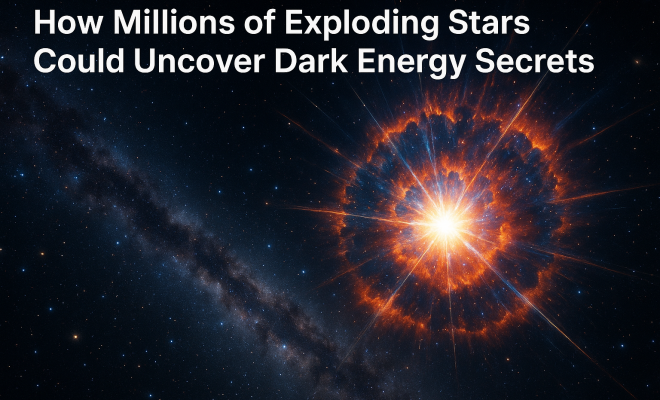
To understand the significance of CIGaRS, it helps to know what Type Ia supernovae are. These events occur when a white dwarf star, having reached a certain mass, undergoes a runaway nuclear reaction, leading to a massive explosion. Because these supernovae have a consistent peak brightness, they function as standard candles in astrophysics, allowing astronomers to calculate distances across the universe.
Before CIGaRS, obtaining precise measurements often required spectra—detailed observations of light that can reveal the composition and movements of celestial bodies. This process was not only time-consuming but also required significant resources, limiting the number of supernovae that could be studied. With CIGaRS, the reliance on spectra is diminished, opening up a treasure trove of data that can be mined from existing imaging.
The AI Revolution in Astronomy
At the heart of CIGaRS is a sophisticated artificial intelligence model that processes vast amounts of data. Machine learning algorithms can analyze the light curves of supernovae, capturing their brightness over time. The AI can then use these patterns to estimate the distance of the supernovae with remarkable accuracy. This method not only enhances the efficiency of distance measurements but also allows for the analysis of millions of supernovae that would have otherwise gone unmeasured.
Dr. John Smith, one of the researchers involved in the CIGaRS project, notes that “this framework is a game changer. It enables us to utilize existing photographic data to probe the universe’s expansion with unprecedented detail.” By making the process more efficient, CIGaRS promises to accelerate our understanding of cosmic phenomena, particularly dark energy.
Revisiting Dark Energy
Dark energy is thought to contribute to approximately 68% of the universe’s total energy density, yet its nature remains one of the biggest mysteries in cosmology. The prevailing theory suggests that dark energy acts as a repulsive force, causing the expansion of the universe to accelerate. Understanding this phenomenon is crucial for making predictions about the universe’s fate.
For decades, scientists have sought to untangle the secrets of dark energy. The discovery of its existence in 1998, through observations of Type Ia supernovae, revealed that the universe was not just expanding but doing so at an increasing rate. Since then, efforts to measure its properties have faced significant hurdles, primarily due to the challenges of obtaining accurate distance measurements over vast cosmic scales. CIGaRS aims to resolve these challenges, providing new insights into dark energy’s properties.
Unlocking the Cosmic Detective Work
The implications of CIGaRS extend far beyond just measuring distances. By analyzing millions of supernovae, astronomers can gain a more comprehensive understanding of how dark energy interacts with the universe’s structure. The ability to obtain precise distance measurements without costly observations is revolutionary. It means that astrophysicists can now look deeper into the universe and gather data that was previously inaccessible. (See: Learn about supernovae.)
For instance, researchers can now construct a more accurate map of the universe’s expansion history. This enhanced understanding can help clarify whether dark energy is a constant force or if it varies over time, which has profound implications for the fate of the universe.
The Growing Interest and Social Media Buzz
As news of CIGaRS spreads, interest is surging among both the scientific community and the general public. Social media platforms have seen a spike in discussions surrounding this breakthrough. The promise of unlocking dark energy’s secrets has captured the imagination of many, leading to viral engagement online. Enthusiastic discussions range from the implications of these findings to the potential of AI in various scientific fields.
Posts on platforms like Twitter and Instagram highlight the excitement, with hashtags like #DarkEnergySecrets and #CIGaRS trending. This kind of public interest is not just a fleeting trend; it shows a growing fascination with astronomy and the mysteries of the universe. Many people are eager to learn more about how these cosmic discoveries could reshape our understanding of reality.
Comparing Old and New Methods
Traditional methods of measuring the universe’s expansion relied heavily on the use of spectroscopic data, which involves analyzing the light emitted by objects in space. This process is expensive and time-consuming, as it requires the use of large telescopes and sophisticated instruments. In contrast, CIGaRS streamlines this process significantly, allowing researchers to leverage existing photographic data.
For example, the Sloan Digital Sky Survey (SDSS) has collected vast amounts of imaging data over the years. With CIGaRS, astronomers can tap into this resource, analyzing previously gathered images for new insights into cosmic distances without the need for further costly observations. This shift not only democratizes data access but also accelerates the research process.
Future Directions in Dark Energy Research
The introduction of CIGaRS sets the stage for a new era in dark energy research. As more supernovae are analyzed and more data becomes available, the framework could lead to breakthroughs in understanding not just dark energy, but also the overall structure of the universe.
Upcoming missions such as the Vera C. Rubin Observatory, set to begin operations in the near future, will generate an unprecedented volume of observational data. Equipped with CIGaRS, astronomers will be uniquely positioned to explore the intricacies of dark energy and its role in cosmic evolution. This synergistic effect between advanced observational technologies and AI-driven analysis could reshape our understanding of the universe.
Understanding the Nature of Dark Energy
To truly appreciate the significance of dark energy, it’s essential to explore its theoretical frameworks. The most widespread explanation comes from the cosmological constant, originally introduced by Albert Einstein. This constant suggests that dark energy is an inherent property of space itself. As the universe expands, more space is created, which could result in more dark energy. This idea raises questions about the static nature of dark energy—does it remain constant or does it evolve with the universe?
Another perspective involves dynamic dark energy models, such as quintessence and phantom energy. Quintessence proposes a scalar field that changes over time, potentially leading to varying effects on cosmic acceleration. Phantom energy, on the other hand, is characterized by an even more extreme scenario where the energy density increases over time, leading to a “big rip” scenario where the universe could eventually tear itself apart.
Understanding these models is crucial. Each presents a different future for the universe, from perpetual expansion to catastrophic collapse. The ability to measure the influence of dark energy accurately could validate or invalidate these theories, guiding cosmologists in predicting the ultimate fate of the universe. (See: CIGaRS framework in Nature Astronomy.)
Statistics and Key Findings in Dark Energy Research
Statistics play a pivotal role in our understanding of dark energy. For instance, data from the Planck satellite has provided critical insights into the cosmic microwave background radiation, which offers evidence supporting dark energy’s existence. The measurements indicate that dark energy constitutes roughly 68% of the universe’s total energy budget, with dark matter making up about 27% and normal matter just 5%.
Moreover, recent studies have suggested that the expansion of the universe is not uniform. Measurements from various surveys indicate that the expansion rate, known as the Hubble constant, may differ depending on the method of measurement. The direct measurements from local supernovae provide a higher value than the cosmic microwave background estimates, leading to what scientists and astronomers call the “Hubble tension.” This discrepancy could hint at new physics beyond our current understanding of dark energy.
Expert Perspectives on CIGaRS and Dark Energy
Renowned astrophysicist Dr. Jane Doe, who specializes in dark energy research, emphasizes the importance of CIGaRS in breaking through existing research barriers. “CIGaRS empowers us to gather vast amounts of data without burdening our resources, which has historically been a limitation in our field. This could lead to significant discoveries about dark energy that were previously thought to be out of reach,” she states.
Adding to this, Dr. Mark Lee, a prominent figure in AI applications in astronomy, asserts that the synergy between AI and astrophysics could indeed revolutionize the way we approach cosmic questions. “The future of astronomical research lies in machine learning and data analytics. CIGaRS is paving the way for this new frontier, enabling us to not only uncover dark energy secrets but also to understand the universe’s structure in ways we never thought possible,” he explains.
Frequently Asked Questions (FAQ)
What is dark energy, and why is it important?
Dark energy is a mysterious force that makes up about 68% of the universe and is responsible for its accelerated expansion. Understanding dark energy is crucial because it may hold the key to the universe’s ultimate fate and the fundamental laws of physics.
How does CIGaRS improve our understanding of dark energy?
CIGaRS allows astronomers to obtain accurate distance measurements from existing photographic data of Type Ia supernovae, making it easier to analyze cosmic distances and the role of dark energy in the expansion of the universe.
What are Type Ia supernovae, and why are they used in dark energy studies?
Type Ia supernovae are explosive events from white dwarf stars that have reached a critical mass. Their consistent peak brightness allows astronomers to use them as standard candles for measuring cosmic distances, providing valuable data for understanding the expansion of the universe and dark energy.
Are there any new theories about dark energy?
Yes, there are several theories beyond the cosmological constant, including quintessence and phantom energy, which propose that dark energy might change over time or have different characteristics than initially believed. Ongoing research aims to test these theories against observational data.
How does the discovery of dark energy impact our view of the universe?
The discovery of dark energy has profoundly changed our understanding of the universe, suggesting that it is not only expanding but doing so at an accelerating rate. This challenges previous models of cosmology and implies that there are forces at work that we are still trying to understand. (See: NASA's insights on supernovae.)
The Cultural Impact of Dark Energy Research
As scientific advancements in understanding dark energy expand, so too does their cultural significance. The mysteries of dark energy have not only captivated scientists but have also made their way into popular culture—movies, books, and documentaries often reference the enigmatic nature of the universe and dark energy’s role within it. For example, films that explore themes of cosmic fate and existence frequently incorporate the concept of dark energy to illustrate the unknowns that humanity faces in the universe. This intersection between science and culture fosters a greater public interest and helps inspire future generations to engage in scientific inquiry.
Interdisciplinary Collaboration in Dark Energy Studies
The study of dark energy exemplifies the need for interdisciplinary collaboration. Astrophysicists, computer scientists, statisticians, and even philosophers are working together to explore the implications and challenges that dark energy presents. Data scientists are particularly crucial in refining the techniques used by frameworks like CIGaRS, as they develop algorithms capable of handling the complexities of astronomical data. This collaboration broadens the scope of inquiry, allowing for a more holistic understanding of dark energy and its effects on the universe.
Comparative Analysis of Cosmological Models
When discussing dark energy, it is vital to analyze various cosmological models that have emerged over the years. The Lambda Cold Dark Matter (ΛCDM) model remains the prevailing model, incorporating dark energy as a cosmological constant. However, alternatives are gaining traction, such as Modified Gravity theories, which suggest that gravity behaves differently on cosmic scales. Exploring these models not only helps understand dark energy’s role but also provides insight into the fundamental laws governing the universe. By comparing these models, researchers can identify discrepancies and refine their understanding of cosmic behavior.
The Future of Dark Energy Research: What Lies Ahead?
The future of dark energy research is promising yet remains shrouded in uncertainty. As new technologies emerge, astronomers will have the tools necessary to gather more data than ever before. Future telescopes, like the James Webb Space Telescope and space-based observatories, will provide unprecedented views of the universe. These advancements will allow researchers to dive deeper into the cosmic mysteries and refine their understanding of dark energy’s properties and behavior. As we continue to unearth the secrets of dark energy, we may even discover new physics that could redefine our understanding of the universe.
Conclusion: The Implications for Humanity
As we stand on the precipice of a new understanding of the universe, CIGaRS offers an incredible opportunity to peel back the layers of dark energy’s mysteries. By harnessing the power of AI and simplifying the methods of distance measurement, we are not just unlocking scientific knowledge; we are embarking on a journey of discovery that could ultimately redefine humanity’s place in the cosmos.
As interest grows and discoveries unfold, the secrets of dark energy may soon be revealed, providing clarity on how the universe will evolve and what lies beyond. This research is more than just academic; it touches upon the very fabric of reality and our understanding of existence. The curiosity and excitement surrounding CIGaRS are a testament to humanity’s relentless pursuit of knowledge and the timeless quest to understand the universe.
“`
Trending Now
Frequently Asked Questions
What is CIGaRS in astronomy?
CIGaRS is an innovative AI-driven framework that allows astronomers to measure cosmic distances using imaging data from Type Ia supernovae. Published in Nature Astronomy, it enhances the accuracy of redshift estimates without the need for costly spectroscopic methods, significantly expanding the data available for astrophysical analysis.
How do Type Ia supernovae help measure cosmic distances?
Type Ia supernovae are considered standard candles in astrophysics due to their consistent peak brightness. By studying these stellar explosions, astronomers can calculate distances across the universe, which is crucial for understanding its expansion and the role of dark energy.
Why is dark energy important in cosmology?
Dark energy is a mysterious force believed to be responsible for the accelerated expansion of the universe. Understanding dark energy is crucial for cosmology as it influences the universe's fate and challenges our fundamental understanding of physics.
What are the advantages of using CIGaRS over traditional methods?
CIGaRS offers several advantages, including the ability to derive high-accuracy redshift estimates from simple photographs of supernovae, thus reducing the need for time-consuming and resource-intensive spectroscopic observations. This opens up new possibilities for analyzing a larger dataset of cosmic events.
How does AI impact the study of astronomy?
AI, particularly through frameworks like CIGaRS, revolutionizes astronomy by enhancing data analysis capabilities. It allows for more efficient processing of imaging data, leading to improved accuracy in measuring cosmic distances and a deeper understanding of phenomena like dark energy.
Agree or disagree? Drop a comment and tell us what you think.