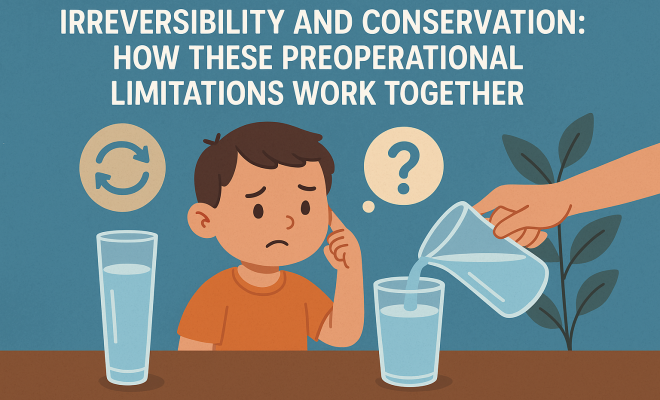
“Irreversibility and Conservation: How These Preoperational Limitations Work Together”
“`html
The concepts of irreversibility in education and conservation are vital in understanding how children think and learn. These preoperational limitations, as outlined by developmental psychologist Jean Piaget, play a crucial role in shaping a child’s cognitive world. Although Piaget’s theories date back to the mid-20th century, their relevance persists in contemporary educational practices. In this article, we will explore how irreversibility and conservation work together, the implications for teaching, and how educators can support children in overcoming these limitations.
Understanding Piaget’s Preoperational Stage
To comprehend the intricacies of irreversibility and conservation, one must first understand Piaget’s theory of cognitive development. According to Piaget, children go through four stages of cognitive growth: sensorimotor, preoperational, concrete operational, and formal operational. The preoperational stage, which typically occurs between the ages of 2 and 7, is characterized by symbolic thinking, egocentrism, and a lack of understanding of the principles of conservation and irreversibility.
The Concept of Irreversibility
Irreversibility refers to the inability of a child to mentally reverse an action or process. For instance, when a child sees a ball of clay being flattened into a pancake shape, they might struggle to understand that the clay can be reshaped back into a ball. This limitation reflects their cognitive ability to grasp that actions can be undone. The understanding of irreversibility is crucial as it affects how children perceive transformations of objects and their properties.
Exploring Conservation
Conservation is a key concept in Piaget’s framework. It refers to the realization that certain properties of objects remain constant, even when their outward appearance changes. Children in the preoperational stage struggle with conservation tasks, such as understanding that the amount of liquid remains the same when poured from a short, wide glass into a tall, narrow one. Their focus often lies on immediate visual appearances rather than underlying principles.
How Irreversibility and Conservation Interact
The interplay between irreversibility and conservation is significant in a child’s cognitive development. When children cannot grasp irreversibility, they find it challenging to understand conservation. For instance, if a child cannot mentally reverse the act of pouring water from one container to another, they might conclude that the amount of water has changed simply based on the different shapes of the containers. This interaction emphasizes how these limitations can impact learning and comprehension.
Practical Implications for Educators
Understanding these cognitive limitations has profound implications for educators. By recognizing the preoperational limitations of their students, teachers can tailor their instructional strategies to meet the needs of young learners. Here are a few practical insights:
- Use Concrete Examples: When teaching conservation, use tangible materials that children can manipulate. For example, using cups of different shapes can help them visualize the concept of volume.
- Encourage Exploration: Allow children to engage in hands-on activities that promote understanding through play. This can include experiments with water or clay, where they can see transformations in real-time.
- Reinforce Reversibility: Engage children in activities that involve reversing actions. For instance, rolling clay into a ball after flattening it helps them experience the concept of irreversibility directly.
Recognizing the Age-Appropriate Expectations
When working with young children, it’s essential to have realistic expectations regarding their cognitive capabilities. Educators must understand that children in the preoperational stage are not ready for abstract reasoning or complex logical thought. Instead, they rely heavily on perceptual features, making it crucial to present concepts in a concrete manner. By acknowledging these limitations, educators can create a supportive environment where learning flourishes without undue pressure. (See: Cognitive development overview on Wikipedia.)
Current Relevance and Applications
The ideas of irreversibility and conservation remain highly relevant in today’s educational landscape. As preschool and early elementary educators aim to foster critical thinking skills, understanding these concepts is essential. Beyond just recognizing physical properties, educators can utilize these insights to enhance social and emotional learning, encouraging children to understand their feelings and the feelings of others, which often also involves concepts of change and reversibility.
Case Studies: Classroom Strategies
Several educators have successfully integrated the principles of irreversibility and conservation into their classrooms. For example, in a kindergarten setting, an educator might introduce a science project that involves measuring different liquids. By pouring liquids between containers of varying shapes and sizes, students can engage in discussions about their observations. The teacher can prompt them with questions such as:
- “Does this cup hold more or less than this one?”
- “If I pour this into another cup, will it fill it up the same way?”
This type of questioning encourages children to think critically about conservation while providing the opportunity to practice reversibility. Moreover, educators can document these activities, allowing for reflection on student growth in understanding these core concepts.
Addressing Common Misconceptions
As educators strive to facilitate understanding of irreversibility and conservation, they often encounter misconceptions among students. For instance, children may believe that simply altering an object’s appearance means its quantity has changed. Addressing these misconceptions requires patience and creativity. One effective approach is to encourage group discussions that allow children to articulate their thoughts and reason through problems together. This collaborative learning environment helps to clarify misunderstandings and reinforces the principles of conservation.
The Role of Play in Learning
Play is an essential component of learning in early childhood education, particularly when it comes to concepts like irreversibility and conservation. Through play, children develop their understanding of the world around them in a natural and engaging way. Activities like building with blocks, playing with water, or even cooking can serve as rich contexts for exploring these concepts. For example, a simple cooking activity can illustrate both conservation (the ingredients maintain their quantities) and irreversibility (once you bake a cake, you cannot ‘un-bake’ it).
Building Connections: Irreversibility and Real-Life Situations
Understanding irreversibility isn’t limited to academic tasks; it extends into everyday experiences. For instance, when a child sees their parent’s physical changes, like a haircut or a new paint color on the walls, they are confronted with the concept of change and its permanence. Discussing these changes with children can illustrate how things can be different now and how they were before, helping them grasp the idea of irreversibility in a more relatable context. Parents and educators can create scenarios where children can physically see and talk about changes, further solidifying their understanding.
Statistical Insights on Cognitive Development
Recent studies have shown interesting trends in young children’s cognitive development regarding irreversibility and conservation. According to a report published in the Journal of Child Psychology and Psychiatry, about 70% of children in the preoperational stage struggle with conservation tasks. This statistic highlights the prevalence of these cognitive limitations and underscores the need for targeted educational strategies. Moreover, longitudinal studies have indicated that early intervention in teaching these concepts can significantly enhance children’s critical thinking skills as they progress into higher cognitive stages.
Expert Perspectives
Educational psychologists emphasize the importance of addressing irreversibility and conservation in early education. Dr. Linda B. Smith, a leading researcher in cognitive development, notes that “early encounters with these concepts form the foundation for later mathematical and scientific reasoning.” Her research indicates that when children have a firm grasp of conservation, they are more likely to excel in subjects that require logical reasoning and problem-solving skills. Dr. Smith advocates for incorporating playful learning environments, as they promote natural exploration of these complex ideas. (See: Learning and development resources from NIH.)
Comparative Analysis: Irreversibility Across Different Cultures
Interestingly, the concept of irreversibility and its understanding can vary across cultures. In some cultures where communal living and collective activities are emphasized, children may develop an understanding of change and permanence through shared experiences. For instance, children involved in community gardening projects learn about the growth and transformation of plants, often discussing how once a plant is harvested, it cannot revert to its original state. This cultural influence can enhance their grasp of irreversibility and conservation.
Strategies for Parents at Home
Parents play a critical role in reinforcing concepts of irreversibility and conservation outside the classroom. Here are a few strategies that parents can adopt:
- Involve Children in Cooking: Cooking is a perfect way to illustrate both conservation and irreversibility. Measuring ingredients teaches them about quantities, while cooking something irreversible, like baking, can help them understand changes.
- Use Nature as a Classroom: Activities like watching the seasonal changes in trees or flowers can help children understand that while things change, they also have permanence in their cycles.
- Encourage Arts and Crafts: Activities that involve modeling with clay or playdough can vividly illustrate irreversibility when shapes are changed, showing the children that once something is created, it can’t just return to what it was without intention.
FAQ on Irreversibility in Education
What is irreversibility in education?
Irreversibility in education refers to a child’s inability to mentally revert an action or process. This concept is crucial in understanding their cognitive development, especially in relation to conservation tasks.
How does irreversibility affect learning?
Children who struggle with irreversibility may find it difficult to understand that actions can be undone, which can impact their ability to grasp concepts like conservation, ultimately affecting their overall learning experience.
At what age do children begin to understand irreversibility?
Children typically begin to grasp the concept of irreversibility as they transition from the preoperational stage (ages 2-7) to the concrete operational stage (ages 7-11), although this can vary by individual development.
Can irreversibility be effectively taught?
Yes, irreversibility can be effectively taught through hands-on activities, play, and real-life examples that encourage children to see and discuss changes, allowing them to experience the concept directly.
What are some activities to teach conservation and irreversibility?
Activities such as measuring liquids, engaging in cooking, playing with clay, and observing changes in nature can help children learn about both conservation and irreversibility in engaging and effective ways.
Enhancing Educational Practices: Modern Approaches
As education evolves, so do the methods to teach complex concepts like irreversibility and conservation. Some modern approaches include:
- Technology Integration: Utilizing educational apps and interactive games can engage children in learning about conservation and irreversibility through virtual simulations. For instance, apps that simulate pouring liquids can help children visualize how shapes affect volume.
- Project-Based Learning: Involving children in long-term projects where they can investigate changes over time—such as growing plants or monitoring weather patterns—can provide real-world context to understand these concepts.
- Mindfulness Practices: Incorporating mindfulness can help children become more aware of changes in their surroundings and their own feelings, deepening their understanding of concepts like change and irreversibility.
Long-Term Effects of Understanding Irreversibility
The comprehension of irreversibility can have lasting impacts on a child’s educational journey. Research shows that children who grasp these concepts early on tend to perform better in mathematics and science later in school. They develop better problem-solving skills and a more robust understanding of logical reasoning. This foundational knowledge becomes integral as they encounter more abstract concepts in higher grades, linking back to their early experiences with irreversibility and conservation.
Creating a Supportive Learning Environment
Creating an environment that nurtures understanding of irreversibility and conservation is key to fostering cognitive growth. This can include:
- Flexible Learning Spaces: Design classrooms that allow for movement and exploration. Learning stations with different materials can encourage children to experiment with concepts of conservation and irreversibility independently.
- Family Engagement: Encourage families to participate in learning activities that reinforce these concepts, creating a bridge between home and school. Workshops or family days centered around hands-on activities can enhance understanding and collaboration.
- Professional Development for Educators: Ongoing training can equip teachers with the latest strategies and understandings about cognitive development, ensuring they are prepared to address these concepts effectively in their classrooms.
Conclusion: Building a Foundation for Future Learning
Understanding the concepts of irreversibility and conservation is critical in shaping how children view the world. By recognizing these preoperational limitations, educators can develop effective strategies to support young learners in overcoming these challenges. As they move into the concrete operational stage, children will rely on these foundational skills to tackle more complex cognitive tasks. Therefore, the work done in early childhood education plays an essential role in fostering critical thinking and reasoning skills that will last a lifetime.
By emphasizing hands-on learning, incorporating play, and allowing for exploration, educators are not just teaching children about conservation and irreversibility; they are instilling a passion for learning that will serve them well beyond the classroom. Embracing these concepts in education ensures that children are equipped to face the complexities of the world with confidence and understanding.
“`
Trending Now
- the complete explanation
- this guide on the relationship between object permanence and cognitive development in infants
- How ADHD Affects Executive Function and Emotional Regulation in High School
- The Role of Nonverbal Communication in…
- this guide on how scaffolding supports english language learners in elementary school
Frequently Asked Questions
What is irreversibility in cognitive development?
Irreversibility in cognitive development refers to a child's inability to mentally reverse an action or process. For example, when a child sees clay being flattened, they may not understand that it can be reshaped back into its original form. This limitation affects how they perceive transformations in objects.
How does conservation relate to children's learning?
Conservation is the understanding that certain properties of objects remain constant despite changes in their appearance. In the preoperational stage, children often struggle with conservation tasks, such as recognizing that the amount of liquid in a different-shaped container remains the same.
What are the stages of Piaget's cognitive development?
Piaget's theory outlines four stages of cognitive development: sensorimotor, preoperational, concrete operational, and formal operational. The preoperational stage, occurring between ages 2 and 7, is characterized by symbolic thinking and limitations such as irreversibility and difficulty understanding conservation.
How can educators support children with preoperational limitations?
Educators can support children facing preoperational limitations by providing hands-on activities that encourage exploration and experimentation. Using visual aids and engaging in discussions about transformations can help children better understand concepts like irreversibility and conservation.
Why are Piaget's theories still relevant today?
Piaget's theories remain relevant as they provide foundational insights into children's cognitive development. Understanding the concepts of irreversibility and conservation helps educators tailor their teaching methods to better support children's learning needs and cognitive growth.
Agree or disagree? Drop a comment and tell us what you think.