The Edvocate

Top Menu

Main Menu

  • Start Here
    • Our Brands
    • Governance
      • Lynch Education Consulting, LLC.
      • Dr. Lynch’s Personal Website
      • Careers
    • Write For Us
    • Books
    • The Tech Edvocate Product Guide
    • Contact Us
    • The Edvocate Podcast
    • Edupedia
    • Pedagogue
    • Terms and Conditions
    • Privacy Policy
  • PreK-12
    • Assessment
    • Assistive Technology
    • Best PreK-12 Schools in America
    • Child Development
    • Classroom Management
    • Early Childhood
    • EdTech & Innovation
    • Education Leadership
    • Equity
    • First Year Teachers
    • Gifted and Talented Education
    • Special Education
    • Parental Involvement
    • Policy & Reform
    • Teachers
  • Higher Ed
    • Best Colleges and Universities
    • Best College and University Programs
    • HBCU’s
    • Diversity
    • Higher Education EdTech
    • Higher Education
    • International Education
  • Advertise
  • The Tech Edvocate Awards
    • The Awards Process
    • Finalists and Winners of The 2026 Tech Edvocate Awards
    • Finalists and Winners of The 2025 Tech Edvocate Awards
    • Finalists and Winners of The 2024 Tech Edvocate Awards
    • Finalists and Winners of The 2023 Tech Edvocate Awards
    • Finalists and Winners of The 2021 Tech Edvocate Awards
    • Finalists and Winners of The 2022 Tech Edvocate Awards
    • Finalists and Winners of The 2020 Tech Edvocate Awards
    • Finalists and Winners of The 2019 Tech Edvocate Awards
    • Finalists and Winners of The 2018 Tech Edvocate Awards
    • Finalists and Winners of The 2017 Tech Edvocate Awards
    • Award Seals
  • Apps
    • GPA Calculator for College
    • GPA Calculator for High School
    • Cumulative GPA Calculator
    • Grade Calculator
    • Weighted Grade Calculator
    • Final Grade Calculator
  • The Tech Edvocate
  • Post a Job
  • AI Powered Personal Tutor

logo

The Edvocate

  • Start Here
    • Our Brands
    • Governance
      • Lynch Education Consulting, LLC.
      • Dr. Lynch’s Personal Website
        • My Speaking Page
      • Careers
    • Write For Us
    • Books
    • The Tech Edvocate Product Guide
    • Contact Us
    • The Edvocate Podcast
    • Edupedia
    • Pedagogue
    • Terms and Conditions
    • Privacy Policy
  • PreK-12
    • Assessment
    • Assistive Technology
    • Best PreK-12 Schools in America
    • Child Development
    • Classroom Management
    • Early Childhood
    • EdTech & Innovation
    • Education Leadership
    • Equity
    • First Year Teachers
    • Gifted and Talented Education
    • Special Education
    • Parental Involvement
    • Policy & Reform
    • Teachers
  • Higher Ed
    • Best Colleges and Universities
    • Best College and University Programs
    • HBCU’s
    • Diversity
    • Higher Education EdTech
    • Higher Education
    • International Education
  • Advertise
  • The Tech Edvocate Awards
    • The Awards Process
    • Finalists and Winners of The 2026 Tech Edvocate Awards
    • Finalists and Winners of The 2025 Tech Edvocate Awards
    • Finalists and Winners of The 2024 Tech Edvocate Awards
    • Finalists and Winners of The 2023 Tech Edvocate Awards
    • Finalists and Winners of The 2021 Tech Edvocate Awards
    • Finalists and Winners of The 2022 Tech Edvocate Awards
    • Finalists and Winners of The 2020 Tech Edvocate Awards
    • Finalists and Winners of The 2019 Tech Edvocate Awards
    • Finalists and Winners of The 2018 Tech Edvocate Awards
    • Finalists and Winners of The 2017 Tech Edvocate Awards
    • Award Seals
  • Apps
    • GPA Calculator for College
    • GPA Calculator for High School
    • Cumulative GPA Calculator
    • Grade Calculator
    • Weighted Grade Calculator
    • Final Grade Calculator
  • The Tech Edvocate
  • Post a Job
  • AI Powered Personal Tutor
  • Psychology says the “cool” parent who negotiates every boundary may leave children unprepared for one adult challenge – The Times of India

  • 60% of College Students Are Battling This Hidden Crisis — Why We Can’t Look Away

  • The Brutal Truth: AI Is Gutting Entry-Level Jobs – Here’s How to Fight Back

  • Entry-Level Coders Face a Brutal AI Reckoning: Here’s How to Survive

  • This Crucial Mistake Is Crushing Computer Science Grads’ Job Hopes

  • This One Thing Is Decimating the Computer Science Job Market for New Grads

  • DEI Training Resources: Alternatives to Traditional Teacher Development Programs

  • The Arbitrary Cancellation of DEI Grants: What It Means for Educators and MBA Programs

  • Navigating Federal Grant Compliance for DEI Initiatives: A Guide for Educators

  • Federal Judge Slams Anti-DEI Directive: A Troubling Precedent for Teacher Training

Digital & Mobile TechnologyEdTech Policy & ReformOnline Learning & eLearning
Home›Digital & Mobile Technology›Sexism in video gaming is just another form of bullying

Sexism in video gaming is just another form of bullying

By Matthew Lynch
June 7, 2017
0
Spread the love

Michael Kasumovic, UNSW and Jeff Kuznekoff, Miami University

Many people have experienced harassment or bullying online. However, the victims of such harassment are disproportionately women.

Women receive up to 10 times more negative comments than men in online chatrooms and three times the negativity when playing online games.

Some have argued this is because women are entering male-dominated spaces that are full of misogynists.

But in a study that we just published, we show that the cause could be something much simpler: the negative and sexist comments expressed by some men are really just a form of bullying, motivated by the fact that they are perceived as being lower in the pecking order.

What’s bullying got to do with it?

We now better understand the factors that affect bullying. Bullying is more common in the presence of strong hierarchies and victims tend to be less powerful and lower in the social order.

Bullying tends to remain a viable strategy when hierarchies exist because it allows individuals to increase their status thereby preventing others from rising above them.

If we look at misogyny from another perspective, could it be a form of inter-sexual bullying that arises when women compete against men? Men who are afraid of losing their position in a hierarchy to a woman may be lashing out, leaning on the most stereotypical traits because they have the effect of reducing a woman’s power.

We set out to explore this idea – using video games.

Playing for the answer

Video games can be a bastion of sexist imagery and aggressive posturing. But unlike most inter-sexual competitive scenarios, in video games it doesn’t matter how physically big and strong you are. All that matters is how well you play.

This make them a perfect place to ask what role hierarchies and perceived status play in inter-sexual aggression.

To do this, we used Halo 3, a futuristic shooter where teams of four players compete against one another in an attempt to kill their opponents as often as possible.

The game records exactly how many kills each player achieves and how often they die. If they’re playing very well, it means they’re likely outperforming others and helping their team. On the other hand, if they’re performing poorly, not only are they likely to be at the bottom of the leaderboard, but they’re also dragging down their team.

Additionally, an algorithm determined by the game’s developers, Bungee, calculates a measure of player skill determined by their long-term performance – analogous to social status in this context.

Since we can record everything that each teammate says during a game, we can also correlate the frequency of positive and negative statements players make towards teammates.

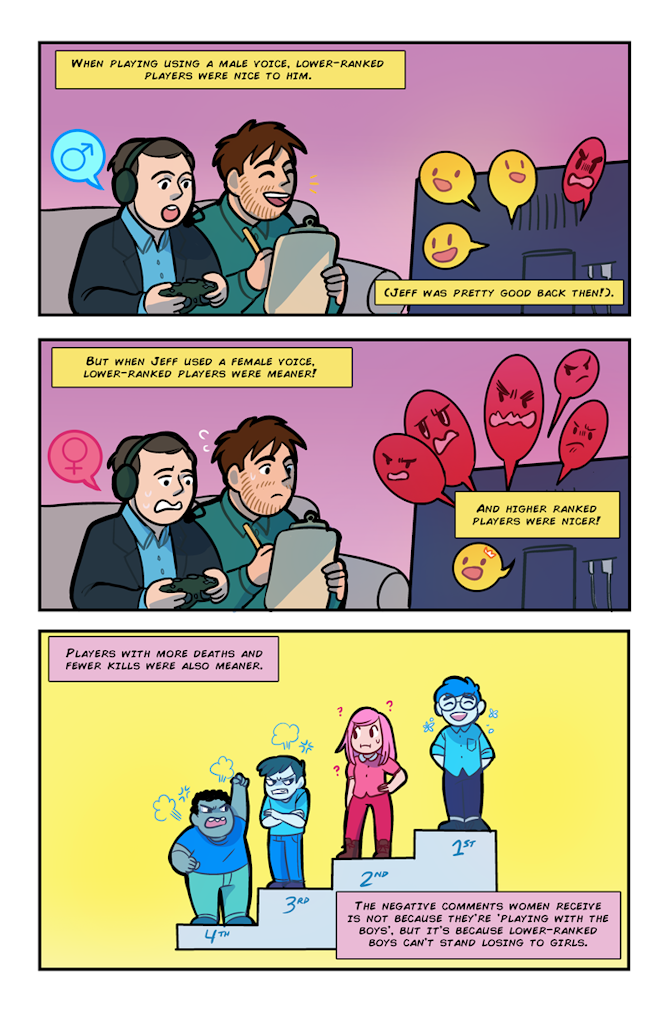
Next comes the fun part. By using a recorded male or female voice, we can see how players respond to teammates of each sex based on their own performance. Jeff played 126 games of Halo 3 using this structure. All the other speaking players on his team were men.

A young woman gamer wears headphones, focused on her screen.
Gaming isn’t always relaxing, and sometimes that tension can spill over into harassment of other gamers.
Maryam Abdulghaffar/Flickr, CC BY

What’s in a voice?

What we found was that Jeff’s teammates who died more often generally made more positive comments towards Jeff. And their performance, good or bad, had no effect on the number of negative comments they directed towards him.

In contrast, when Jeff used a female voice, he received many more negative comments, particularly from players who were performing poorly.

This suggests that men behaved according to a social hierarchy. When they were performing poorly – i.e. they were lower status – they did not challenge a male-voiced teammate, but they did challenge a female-voiced one.

This was supported by our results exploring skill level –- our proxy for an individual’s position in the hierarchy. Skill level didn’t affect how men behaved towards another man, but men lower in skill were less positive in the female-voiced treatment.

Interestingly, higher-skilled men were more positive towards women, but not men.

A diverse group of young people joyfully play video games together.
The predicted relationship of the number of negative comments male players made towards a female- or male-voiced teammate as a function of their skill level.

Who wants a beta male anyway?

The take-home seems to be that, just like bullies, the men most likely to have their position in a hierarchy usurped by a woman turned out to be meaner.

When you look at this situation from an evolutionary perspective, some of the reasoning becomes more clear. Since a man’s mating chances are better determined by his status than his looks, if a woman is usurping a man’s status by outperforming him, it means that he is less likely to be attractive to a potential mate, especially one that is higher than him in the hierarchy.

Although it’s unlikely that men are thinking about mate attraction when playing Halo 3, we think the increased negativity directed towards higher status women by some men is an unconscious response to having their masculinity challenged by a woman. “Losing to a girl” is still deemed unacceptable by many men as it can reduce their status in the eyes of others – both men and women.

The hostile aspects of gaming culture could thus be explained as the search for, and maintenance of, status. One way to ensure that a man doesn’t lose to a woman is to keep women from competing by making them feel unwanted in that environment.

Perhaps this perspective may also help explain the misogyny we see when women enter some male-dominated fields. The aggression may come from lower status men that are trying to keep women out by employing sexist bullying in order to ensure they don’t lose status in the presence of their male colleagues.

Perhaps a solution is what is shown to work in the bullying literature – minimising the existence of a hierarchy by ensuring equality.

Game over?

The one thing that is still quite intriguing is the result that the highly skilled men were more supportive towards women than men.

Are these nice guys behaving this way because they have nothing to fear and are applauding a woman’s entry into the field? Or is it because they have nothing to fear, for now. Would they become more aggressive if they felt threatened? Or are they comfortable in their ability that losing to a woman wouldn’t bother them.

These are questions we don’t know the answer to yet, but we’re willing to play a few thousand games online to find out.

Interested in reading the study in a different format? Then take a look at the comic below! Click on the preview to see the full page. Art by Savanna Ganucheau.

A female character in a fantasy video game wields a large sword.
A diverse group of gamers compete intensely at an esports event.
A female video game character in armor holds a glowing weapon.
A female gamer with headphones smiles while playing online.

The ConversationMichael and Jeff will be on hand for an Author Q&A between 10 and 11am AEST on Friday, July 17. Post your questions in the comments section below.

Michael Kasumovic, Evolutionary Biologist, ARC Future Fellow, UNSW and Jeff Kuznekoff, Assistant Professor, Miami University

This article was originally published on The Conversation. Read the original article.

TagsEdtechedtechchatelearningscreen mediascreen timeSTEAMSTEM
Previous Article

Mobile Phones: Disrupting Education in Africa (2023 ...

Next Article

Boost Innovation: Bridge Engineering and Humanities Education

Matthew Lynch

Related articles More from author

  • Digital & Mobile Technology

    Why Librarians are the Key to Future Ready Schools

    August 27, 2017
    By Matthew Lynch
  • Early Childhood & K-12 EdTechHigher Education EdTech

    Examining Edtech’s Responsibility to Students

    December 27, 2017
    By Matthew Lynch
  • Digital & Mobile TechnologyEarly Childhood & K-12 EdTechHigher Education EdTech

    5 Ways That Edtech is Democratizing Education

    February 2, 2018
    By Matthew Lynch
  • Teachers

    Boost Student Motivation: Engage & Excite Learners for Excellence

    July 30, 2016
    By Matthew Lynch
  • Early Childhood & K-12 EdTech

    How to Set Up Your Digital Classroom for Success

    December 9, 2017
    By Matthew Lynch
  • EdTech & InnovationTrending Topics

    A Digital Future: What Will EdTech Look Like By 2117

    April 9, 2017
    By Matthew Lynch

Search

Registration and Login

  • Log in
  • Entries feed
  • Comments feed
  • WordPress.org

Newsletter

Signup for The Edvocate Newsletter and have the latest in P-20 education news and opinion delivered to your email address!

RSS feed: Matthew on Education Week Matthew on Education Week

  • Au Revoir from Education Futures November 20, 2018 Matthew Lynch
  • 6 Steps to Data-Driven Literacy Instruction October 17, 2018 Matthew Lynch
  • Four Keys to a Modern IT Approach in K-12 Schools October 2, 2018 Matthew Lynch
  • What's the Difference Between Burnout and Demoralization, and What Can Teachers Do About It? September 27, 2018 Matthew Lynch
  • Revisiting Using Edtech for Bullying and Suicide Prevention September 10, 2018 Matthew Lynch

About Us

The Edvocate was created in 2014 to argue for shifts in education policy and organization in order to enhance the quality of education and the opportunities for learning afforded to P-20 students in America. What we envisage may not be the most straightforward or the most conventional ideas. We call for a relatively radical and certainly quite comprehensive reorganization of America’s P-20 system.

That reorganization, though, and the underlying effort, will have much to do with reviving the American education system, and reviving a national love of learning.  The Edvocate plans to be one of key architects of this revival, as it continues to advocate for education reform, equity, and innovation.

Newsletter

Signup for The Edvocate Newsletter and have the latest in P-20 education news and opinion delivered to your email address!

Contact

The Edvocate
910 Goddin Street
Richmond, VA 23230
(601) 630-5238
[email protected]
  • situs togel online
  • dentoto
  • situs toto 4d
  • situs toto slot
  • toto slot 4d
Copyright (c) 2026 Matthew Lynch. All rights reserved.