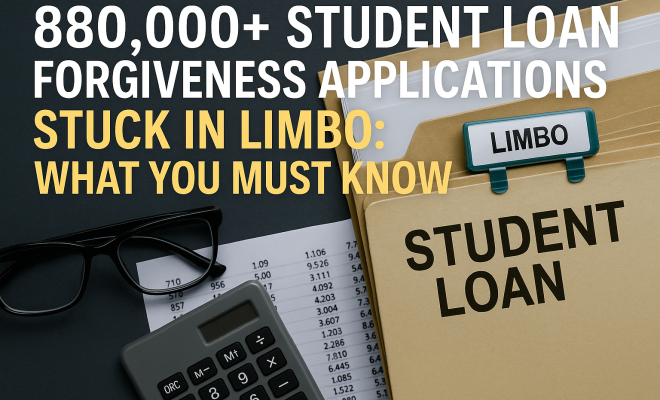
880,000+ Student Loan Forgiveness Applications Stuck in Limbo: What You MUST Know
“`html
If you’re one of the millions of Americans carrying federal student loan debt, you’re likely feeling a knot in your stomach right about now. The landscape of student loan repayment and, crucially, student loan forgiveness, is shifting beneath our feet, creating a massive wave of uncertainty and, frankly, frustration. With new repayment plans rolling out, interest rates climbing, and a truly staggering backlog of nearly a million applications for debt relief, it’s no wonder borrowers feel like they’re caught in a financial purgatory.
This isn’t just about paperwork; it’s about the lives of over 42 million people collectively holding a jaw-dropping $1.6 trillion in student loans. The emotional toll, the financial strain, and the sheer confusion are palpable. Let’s break down exactly what’s happening, why it matters, and what you might be able to do about it.
1. The Looming Backlog: Nearly a Million Applications in Limbo
Here’s the stark reality: the U.S. Education Department is currently sitting on a mountain of over 880,000 applications for student loan forgiveness and income-driven repayment (IDR) plans. That’s not a typo. Nearly a million people are waiting, hoping, and wondering if their applications will ever see the light of day. This isn’t just a number; it represents individuals who have played by the rules, submitted their paperwork, and are now stuck in an administrative black hole.
Think about the implications for a moment. Many of these borrowers have likely structured their financial lives around the expectation of relief, whether through a forgiveness program or a more manageable IDR plan. The delay means they’re not getting the lower payments they might be entitled to, or the complete debt discharge they’ve earned. This creates immense stress, making it nearly impossible to plan for other significant life events like buying a home, saving for retirement, or even just making ends meet.
2. The Demise of SAVE and the Rise of New Plans
Remember the SAVE plan? It was a relatively new income-driven repayment option that offered significant benefits, including lower monthly payments and a faster path to student loan forgiveness for many. Well, as of July 1, 2026, the popular SAVE plan has been eliminated. Yes, you read that right. Just as borrowers were starting to understand and utilize it, it’s gone.
In its place, under something called the ‘One Big Beautiful Bill Act,’ we now have new options: the Repayment Assistance Plan (RAP) and the Tiered Standard Plan. While these are designed to help, any transition of this magnitude inevitably brings confusion. Borrowers who were comfortable with SAVE now have to re-evaluate their entire repayment strategy, trying to understand complex new rules, eligibility criteria, and potential impacts on their financial futures. It’s like changing the rules of the game mid-play, and it leaves many feeling overwhelmed and disadvantaged.
3. Rising Interest Rates: A Heavier Burden on Borrowers
As if navigating new repayment plans and a massive backlog wasn’t enough, federal student loan interest rates are on the rise for the 2026-27 academic year. For instance, undergraduate Stafford Loans, a common type of federal loan, have jumped to 6.52%. While this might seem like a small percentage point increase, it translates to a significantly heavier financial burden over the life of a loan.
Higher interest rates mean that more of your monthly payment goes towards interest rather than chipping away at the principal balance. This makes it harder to pay down debt, prolongs the repayment period, and ultimately increases the total amount you’ll pay back. For borrowers already struggling, even a modest increase can push them closer to the brink, making student loan forgiveness or even just affordable payments feel like an impossible dream.
4. The ‘One Big Beautiful Bill Act’ and Its Aftermath
The ‘One Big Beautiful Bill Act’ is the legislative vehicle behind these significant changes. While such acts often aim to streamline processes or introduce improvements, the immediate aftermath has been anything but smooth for student loan borrowers. The act’s provisions have fundamentally reshaped how federal student loans are managed, repaid, and potentially forgiven.
The name itself, ‘One Big Beautiful Bill Act,’ might suggest a comprehensive and beneficial overhaul, but the reality on the ground is proving far more complex and, for many, detrimental. Understanding the full scope of this legislation and its long-term impact will take time, but right now, it’s contributing to widespread anxiety and a sense of being caught in a bureaucratic tangle that’s difficult to untangle.
5. Why This is Causing Widespread ‘Purgatory’ for Borrowers
The term ‘purgatory’ perfectly encapsulates the current experience for many federal student loan borrowers. You’re neither fully in nor fully out; you’re stuck in an agonizing middle ground. You’ve applied for relief, but it’s not being processed. You’re trying to understand new plans, but the information might feel incomplete or contradictory. Your interest is accruing, but your path to a manageable payment or forgiveness is unclear. (See: U.S. Department of Education.)
This state of limbo is more than just an inconvenience; it’s a significant mental and financial drain. How do you budget when you don’t know what your payment will be? How do you plan for the future when a massive debt hangs over your head, and the promised relief is nowhere in sight? It erodes trust in the system and leaves millions feeling helpless and unheard.
6. Navigating the New Repayment Assistance Plan (RAP)
With SAVE gone, the Repayment Assistance Plan (RAP) is one of the new primary options. While details are still emerging and becoming clearer, RAP is intended to provide relief for borrowers struggling to make payments. It’s crucial for you to understand if you qualify and how its terms compare to what you might have had under SAVE or other previous IDR plans. For more context, see game-changing legislation that could erase your student debt.
Typically, these plans base your monthly payment on your income and family size, often resulting in a lower, more affordable payment. However, the devil is always in the details: what percentage of discretionary income is used? How often is income re-certified? What are the forgiveness timelines? And critically, how will the Education Department handle the processing of these applications, given the current backlog? These are all questions that need clear, timely answers for borrowers to make informed decisions.
7. Understanding the Tiered Standard Plan
The other new option introduced is the Tiered Standard Plan. This plan, as its name suggests, likely involves payments that increase over time, perhaps tied to anticipated increases in a borrower’s income. For some, particularly those early in their careers with lower starting salaries, this could be a viable option, offering lower initial payments.
However, it also requires careful planning and forecasting. Are you confident your income will rise sufficiently to meet the escalating payments? What happens if it doesn’t? Unlike some IDR plans, standard repayment options typically don’t offer the same flexibility or the potential for forgiveness after a set number of years, making it a different kind of commitment. It’s essential to model out the total cost and the payment trajectory to see if this plan truly fits your long-term financial goals.
8. The Viral Impact: Millions Affected, Billions at Stake
This isn’t a niche issue; it’s a national crisis in the making. With over 42 million Americans holding federal student loans, any major shift in policy, interest rates, or processing capabilities creates a ripple effect across the entire economy. The $1.6 trillion in outstanding student debt is a colossal figure, and the ability (or inability) of borrowers to manage this debt has wide-ranging consequences.
When borrowers are burdened by debt and uncertainty, they spend less, save less, and are less likely to participate in other economic activities like buying homes or starting businesses. This situation creates widespread emotional distress and financial urgency, making it a topic that resonates deeply and spreads quickly through communities and online. Everyone seems to know someone affected, and the collective anxiety is palpable.
9. What Borrowers Can Do Amidst the Chaos for Student Loan Forgiveness
So, what can you do if you’re caught in this maelstrom? First, don’t panic, but do act. Contact your loan servicer directly. While the Education Department is backlogged, your servicer is your primary point of contact. Ask specific questions about your current status, any pending applications, and how the new plans (RAP, Tiered Standard) might apply to you. Document every conversation: names, dates, times, and summaries of what was discussed.
Secondly, explore all your options. Don’t assume anything. Use the official student aid website (studentaid.gov) to research the new plans thoroughly. Consider if consolidating your loans makes sense, or if exploring private refinancing options could offer better terms – but be incredibly cautious with private loans, as they typically lack the federal protections and forgiveness pathways. Finally, consider seeking advice from a reputable, non-profit financial counselor or an attorney specializing in student loan law. They can often provide personalized guidance and help you navigate the complexities of student loan forgiveness and repayment strategies.
This current situation demands vigilance and proactive engagement from borrowers. While the system grapples with its challenges, your financial future is too important to leave to chance. Stay informed, stay persistent, and advocate for yourself.
10. Historical Context: The Evolution of Student Loan Forgiveness Programs
To truly understand where we are, it helps to look at where we’ve been. Student loan forgiveness isn’t a brand-new concept; it has evolved significantly over the decades. Originally, federal student loans focused primarily on repayment, with limited avenues for relief. The first major shifts came with programs like Public Service Loan Forgiveness (PSLF), introduced in 2007, aiming to encourage graduates to enter vital public service roles by forgiving their remaining federal loan balance after 120 qualifying payments.
Then came various income-driven repayment (IDR) plans – Income-Based Repayment (IBR), Pay As You Earn (PAYE), and Revised Pay As You Earn (REPAYE) – each offering different formulas for calculating monthly payments based on income and family size, with the promise of forgiveness after 20 or 25 years of payments. These programs were designed to prevent default and make education more accessible, but they were often plagued by complex rules, poor communication from servicers, and administrative errors, leading to many borrowers not receiving the forgiveness they were entitled to. The recent changes, including the short-lived SAVE plan, represent the latest attempt to address these systemic issues, albeit with new challenges.
11. The Economic Ripple Effect of Student Debt: Beyond Individual Households
The $1.6 trillion in student debt isn’t just a burden on individual households; it’s a drag on the entire national economy. When millions of people are dedicating a significant portion of their income to student loan payments, it means less money is available for other economic activities. This directly impacts major life milestones that drive economic growth: people delay buying homes, which affects the housing market and construction industries; they put off starting families, influencing consumer spending on baby products and childcare; and they’re less likely to start small businesses, stifling innovation and job creation. (See: Centers for Disease Control and Prevention.)
Economists have long debated the precise impact, but studies often show a correlation between high student debt and lower rates of homeownership among younger generations, reduced entrepreneurial activity, and slower wealth accumulation. The uncertainty surrounding student loan forgiveness and repayment further exacerbates this, as hesitant consumers are less likely to make large financial commitments when their future payment obligations are unclear. This isn’t just about debt; it’s about the broader health and dynamism of the American economy.
12. The Psychological Toll: Mental Health and Student Debt
Beyond the financial numbers and economic forecasts, there’s a profound human element to the student loan crisis: mental health. The constant pressure of debt, the fear of default, and the administrative confusion can lead to significant stress, anxiety, and even depression. Imagine checking your loan balance only to see it grow despite making payments, or receiving contradictory information from your loan servicer. This creates a feeling of powerlessness and hopelessness. For more context, see crucial bill could transform teacher loan forgiveness.
Many borrowers describe feeling “trapped” by their loans, unable to pursue their desired careers, move to more affordable areas, or take risks that could improve their lives. The emotional burden can be immense, impacting relationships, sleep, and overall well-being. Studies have increasingly highlighted the link between student debt and mental health issues, underscoring that this isn’t just a financial problem, but a public health concern that demands compassionate and effective solutions.
13. Examining the ‘One Big Beautiful Bill Act’ – Promises vs. Reality
Let’s dive a bit deeper into the ‘One Big Beautiful Bill Act.’ On paper, proponents likely argued it was a necessary step to simplify a convoluted system, address previous forgiveness failures, and create a more sustainable framework for federal student aid. Perhaps it aimed to consolidate multiple IDR plans into fewer, more manageable options, or to standardize eligibility criteria. The name itself suggests a grand vision of comprehensive reform.
However, the reality for borrowers is often far removed from legislative intent. The transition period is proving chaotic. We’re seeing a massive backlog, the sudden removal of a popular plan like SAVE, and the introduction of new plans (RAP, Tiered Standard) that require a steep learning curve. The promise of “beautiful” streamlining is currently overshadowed by administrative bottlenecks, communication gaps, and increased anxiety among the very people the act was supposedly designed to help. It’s a classic example where the implementation of policy can dramatically alter its perceived value and effectiveness.
14. Expert Perspectives: What Financial Advisors and Policy Analysts Say
What are the professionals saying about this turbulence? Financial advisors are generally urging caution and proactive engagement. They emphasize the importance of understanding your specific loan types, knowing your income and family size, and meticulously documenting all communications. Many recommend borrowers avoid making hasty decisions, especially regarding private refinancing, until they fully grasp the implications of the new federal plans.
Policy analysts, on the other hand, are often critical of the administrative capacity of the Education Department and its servicers. They point to decades of underfunding and understaffing as root causes for the persistent backlogs and errors. Some argue that frequent legislative changes, while sometimes well-intentioned, often outpace the operational ability to implement them smoothly, leaving borrowers in the lurch. There’s a consensus that clear, consistent communication from official channels is desperately needed to restore trust and alleviate borrower confusion.
15. Comparing Federal vs. Private Student Loans in the Current Climate
With all this federal uncertainty, you might be tempted to consider private student loans. But it’s crucial to understand the fundamental differences. Federal student loans, despite their current issues, come with a robust safety net: income-driven repayment plans, various deferment and forbearance options, and pathways to student loan forgiveness (like PSLF, RAP, and IDR forgiveness). These protections are designed to help you navigate financial hardship.
Private student loans, issued by banks or credit unions, generally do not offer these same protections. They typically have fewer flexible repayment options, no IDR plans, and no federal forgiveness programs. While you might find a lower interest rate if you have excellent credit, you’re trading away the flexibility and safety nets that federal loans provide. In this volatile environment, locking yourself into a private loan without federal protections could be a risky move, especially if your financial situation changes unexpectedly. Always weigh the pros and cons carefully before making any switch.
Frequently Asked Questions (FAQ) about Student Loan Forgiveness and Repayment
Q1: What exactly happened to the SAVE plan?
A1: The SAVE plan, a popular income-driven repayment option, was eliminated as of July 1, 2026, under the provisions of the ‘One Big Beautiful Bill Act.’ Borrowers who were on SAVE will need to transition to one of the new repayment plans, likely the Repayment Assistance Plan (RAP) or the Tiered Standard Plan.
Q2: What are the new primary federal repayment options?
A2: The two main new options are the Repayment Assistance Plan (RAP) and the Tiered Standard Plan. RAP is an income-driven plan designed for borrowers struggling to make payments, while the Tiered Standard Plan likely involves payments that increase over time. For more context, see bill could slash English learner teachers' debt. (See: New York Times on student loans.)
Q3: Why is there such a large backlog of student loan forgiveness applications?
A3: The U.S. Education Department is experiencing a significant backlog of nearly a million applications for student loan forgiveness and income-driven repayment plans. This is largely due to a combination of factors, including understaffing, outdated administrative systems, and the sheer volume of applications following recent policy changes and reviews of past errors.
Q4: Will my interest rate change due to these new policies?
A4: Federal student loan interest rates are set annually by Congress. For the 2026-27 academic year, rates for new loans have risen. While your existing fixed-rate federal loans won’t see a rate change mid-loan, the new policy changes don’t prevent future rate adjustments for new loans or for existing loans that might be consolidated.
Q5: What should I do if I had an application for forgiveness pending when SAVE was eliminated?
A5: If you had a pending application, you should immediately contact your loan servicer. Ask about the status of your application and how the transition to new plans affects your eligibility and processing. Document everything. It’s crucial to ensure your previous application is not lost in the shuffle and that you understand your new options.
Q6: Can I still qualify for Public Service Loan Forgiveness (PSLF)?
A6: Yes, PSLF is generally a separate program from the IDR plans that were modified. If you work for a qualifying government or non-profit organization and meet the other criteria (direct loans, 120 qualifying payments), PSLF remains an option. However, the specific IDR plan you’re on can affect what counts as a “qualifying payment.” You’ll need to confirm that your new repayment plan (RAP or Tiered Standard, if applicable) allows for PSLF-qualifying payments.
Q7: Is it a good idea to consolidate my federal student loans right now?
A7: Loan consolidation can simplify repayment by combining multiple federal loans into one with a single servicer and a single monthly payment. It can also help you become eligible for certain IDR plans or PSLF if you have older loan types. However, consolidation can also reset your payment count towards forgiveness on IDR plans or PSLF. You should carefully weigh the pros and cons, especially given the current changes, and speak with your servicer or a financial advisor before consolidating.
Q8: Should I consider refinancing my federal loans with a private lender?
A8: Be extremely cautious with private refinancing. While it might offer a lower interest rate for borrowers with excellent credit, it means giving up all federal protections, including income-driven repayment plans, deferment/forbearance options, and any federal student loan forgiveness programs (like PSLF or IDR forgiveness). Once you refinance federal loans into private ones, you cannot convert them back. This decision should only be made after thoroughly exhausting all federal options and understanding the loss of protections.
Q9: How can I find out which repayment plan is best for me?
A9: Start by visiting studentaid.gov and using their Loan Simulator tool, if updated with the new plans. Contact your loan servicer to discuss your specific situation and options. Consider consulting with a non-profit student loan counselor or a financial advisor who specializes in student debt. They can help you analyze your income, family size, and long-term financial goals to determine the most suitable plan.
Q10: What if I can’t afford my payments under the new plans?
A10: If you’re struggling to afford your payments, even under the new Repayment Assistance Plan (RAP), don’t ignore it. Contact your servicer immediately to discuss options like deferment or forbearance, which temporarily pause your payments. While interest often accrues during these periods, they can provide breathing room. Your goal should be to get on an affordable income-driven plan to avoid default and protect your credit.
“`
Trending Now
Frequently Asked Questions
Why are student loan forgiveness applications stuck?
Student loan forgiveness applications are stuck due to a significant backlog, with over 880,000 applications awaiting processing by the U.S. Education Department. This delay affects borrowers who have submitted their paperwork, leaving them uncertain about their financial futures.
What should I do if my student loan forgiveness application is pending?
If your student loan forgiveness application is pending, stay informed by regularly checking the status through your loan servicer. It may also help to contact customer service for updates and explore other repayment options while waiting for a decision.
How does the backlog of student loan applications affect borrowers?
The backlog affects borrowers by delaying access to potential relief, leading to financial strain and uncertainty. Many borrowers have based their financial plans on expected forgiveness or lower payments, which the delays disrupt.
What are income-driven repayment plans and their importance?
Income-driven repayment plans adjust monthly payments based on a borrower's income, making student loan repayment more manageable. They are crucial for those struggling with high debt, especially amidst delays in forgiveness applications.
What are the implications of the student loan forgiveness delays?
The implications of student loan forgiveness delays include increased financial stress for borrowers, difficulties in planning for major life events, and uncertainty about future payments, as many rely on these programs for relief.
What's your take on this? Share your thoughts in the comments below — we read every one.