Cygnus X-1: Black Hole Jets Unleash 10,000 Suns of Energy
Introduction
In the realm of astrophysics, few phenomena capture the imagination quite like black holes. These enigmatic objects represent the ultimate extremes of gravitational pull and energy release. Among the most well-studied black holes is Cygnus X-1, the first confirmed black hole discovered in 1964. Recent research spanning 18 years of radio-telescope observations from Oxford University has unveiled astonishing new insights about this cosmic giant. In particular, scientists have determined that Cygnus X-1 is unleashing energy equivalent to that of 10,000 suns, fundamentally enhancing our understanding of black hole behavior and their interaction with surrounding stellar environments.
The Discovery of Cygnus X-1
Cygnus X-1 was first identified in 1964 as a strong X-ray source in the constellation Cygnus, leading to the groundbreaking conclusion that it was a black hole. This discovery was pivotal, marking the first time astronomers had identified a black hole through its X-ray emissions. Positioned approximately 6,000 light-years from Earth, Cygnus X-1 is part of a binary system that includes a massive blue supergiant star designated HDE 226868. The interaction between this supergiant and the black hole has become a focal point for astrophysical studies, particularly in the context of high-energy jets.
Understanding the Jets
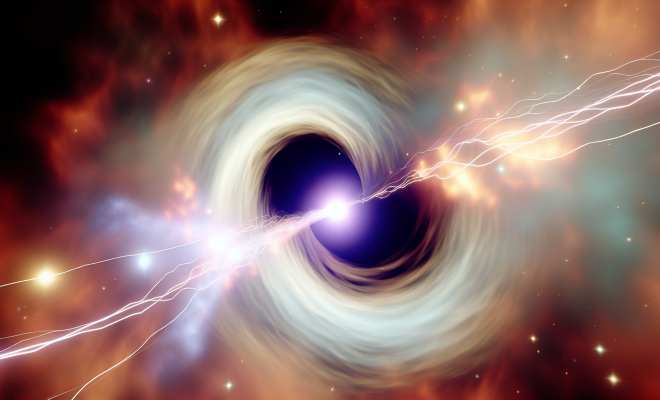
Dr. Steve Raj Prabu, the lead researcher on the recent study, has shed light on the mechanics of the powerful jets emanating from Cygnus X-1. These jets are streams of charged particles that are accelerated to near-light speeds, and their behavior has long puzzled scientists. The new research indicates that approximately 10 percent of the energy from the material falling into the black hole is channeled into these jets, producing a staggering amount of energy.
The Dance of the Jets
One of the most fascinating aspects of these jets is their dynamic nature. As they emerge from the black hole, they appear to ‘dance’ due to the influence of powerful winds originating from the companion supergiant star. These stellar winds distort the shape of the jets, creating intricate structures that vary over time. This interaction not only affects the jets’ morphology but also provides crucial evidence supporting the jet mechanism theory.
The Role of Stellar Winds
The study highlights the significant role that stellar winds play in shaping the jets produced by Cygnus X-1. Stellar winds are streams of charged particles released from stars, and in the case of HDE 226868, these winds are particularly strong due to the star’s massive size and high temperature. This interaction between the winds and the jets leads to a fascinating interplay, where the winds can compress and redirect the jets, resulting in a complex and highly variable structure.
The Importance of Long-term Observations
The research team utilized 18 years of radio-telescope observations to compile a comprehensive dataset, allowing for a detailed analysis of the jets’ behavior. This extensive timeframe is crucial for understanding the long-term dynamics of black hole jets, as they can exhibit significant changes over time due to various factors, including the accretion rate of material and the influence of companion stars.
Technological Advancements
The advancements in radio telescope technology have played a pivotal role in this research. Modern radio telescopes are capable of capturing high-resolution images and collecting vast amounts of data, enabling scientists to study astronomical phenomena with unprecedented detail. The ability to monitor Cygnus X-1 over nearly two decades has provided critical insights into the black hole’s activity and the behavior of its jets.
Implications for Astrophysics
The findings from this study have far-reaching implications for our understanding of black holes and their interaction with their environments. By demonstrating how stellar winds can influence the behavior of black hole jets, researchers are paving the way for new models and theories regarding the evolution of black hole systems. This research not only enhances our knowledge of Cygnus X-1 but also contributes to the broader field of astrophysics, where understanding the mechanics of black holes is essential for unraveling the mysteries of the universe.
The Future of Black Hole Research
As technology continues to advance, the future of black hole research looks promising. Upcoming telescopes and observational programs will allow scientists to study more black holes across different environments, providing further opportunities to refine our understanding of these monumental cosmic entities. The ongoing exploration of Cygnus X-1 serves as a reminder of the incredible discoveries yet to come in the field of astrophysics.
The Role of International Collaboration
The collaborative nature of this research, involving teams from various institutions, underscores the importance of international cooperation in advancing our understanding of complex astronomical phenomena. By pooling resources and expertise, scientists can tackle ambitious projects that yield groundbreaking results, such as the recent findings regarding Cygnus X-1.
Conclusion
In conclusion, the revelations about Cygnus X-1 and its powerful jets represent a significant milestone in the study of black holes. With energy output equivalent to that of 10,000 suns and a complex relationship with its companion star, Cygnus X-1 continues to be a source of fascination for astronomers and astrophysicists alike. As we continue to observe and study these cosmic giants, we are reminded of the universe’s vastness and the intricate processes at play within it. Future research will undoubtedly uncover more secrets about black holes, solidifying their essential role in our understanding of the cosmos.
With each new discovery, we move closer to answering fundamental questions about the nature of space, time, and the enigmatic forces that govern our universe.