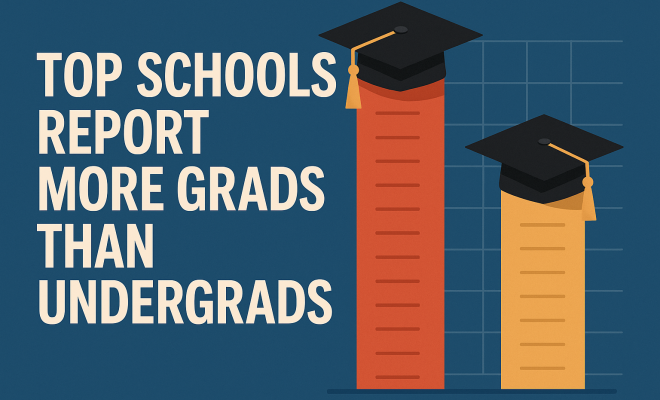
Top schools report more grads than undergrads
“`html
The landscape of higher education has seen significant shifts in recent years, particularly when it comes to graduation rates in top schools. Surprisingly, many prestigious institutions are reporting higher numbers of graduates than undergraduates. This phenomenon raises critical questions about the evolving role of higher education, the implications for students and society, and what it means for the future of academic institutions.
1. Understanding the Data: What Does It Mean to Have More Graduates than Undergraduates?
At first glance, the statistic might seem counterintuitive. How can a school graduate more students than it enrolls? The answer lies in a combination of factors, including increased enrollment in graduate programs, dual-degree programs, and the rise of online education. Many institutions are expanding their graduate offerings, which often allows them to graduate more students each year, even as undergraduate enrollment stabilizes or declines. We covered job prospects for graduates in more detail.
This trend is not isolated to a single institution; rather, it’s reflective of a broader movement within academia. For example, the National Center for Education Statistics (NCES) reported that graduate enrollment at U.S. colleges has been steadily increasing over the past decade, with a significant spike during the pandemic as individuals sought to enhance their credentials in a competitive job market. This shift is vital to understanding the current educational landscape.
2. Reasons for the Increase in Graduate Programs
Several factors contribute to the increasing number of graduates from top schools, particularly in graduate programs. First, there is a heightened demand for specialized skills in the job market. As industries evolve and technological advancements reshape workplaces, employers are increasingly looking for candidates with advanced degrees. This trend has prompted many students to pursue graduate education immediately following their undergraduate studies or after gaining work experience.
Moreover, the proliferation of online graduate programs has made advanced education more accessible. Institutions recognize that students appreciate the flexibility and convenience of online learning, which can lead to higher graduation rates for graduate programs. This rise in accessibility is crucial, as it allows working professionals or those with family commitments to earn degrees without the need to relocate or adhere to rigid schedules.
3. The Impact of Online Education: A Game Changer for Graduation Rates
Online education has fundamentally changed the way students approach higher learning. Universities that offer online programs have witnessed an uptick in enrollment and, consequently, graduation rates. According to the Online Learning Consortium, more than 40% of higher education students were enrolled in at least one online course as of 2020, a figure that continues to grow.
This format allows students to balance work, family, and education effectively. Institutions are capitalizing on this trend by creating hybrid programs that combine traditional in-person courses with online components. By doing so, they not only attract more students but also cater to varying learning styles, which can boost overall student satisfaction and, ultimately, retention.
4. Dual-Degree Programs: Bridging the Gap Between Undergraduate and Graduate Education
Many top schools are now offering dual-degree programs that allow students to earn both an undergraduate and a graduate degree in a condensed time frame. These programs are designed to streamline education while providing students with a competitive advantage in the job market. For instance, some institutions allow students to transition seamlessly from a bachelor’s program to a Master’s program, sometimes even allowing them to count certain undergraduate courses towards their graduate degree.
This model not only increases the number of graduates but also helps students save time and money. By incentivizing students to pursue further education while still in their undergraduate studies, universities can report higher graduation rates while ensuring their students are better prepared for the workforce.
5. The Role of Community Colleges: Pathways to Graduation
Community colleges play a pivotal role in the graduation rates in top schools. Many students begin their higher education journey at a community college before transferring to a four-year institution. This pathway has become increasingly popular, particularly as students seek to manage the costs associated with higher education. (See: National Center for Education Statistics.)
Data from the American Association of Community Colleges indicates that approximately 30% of students at four-year institutions began their postsecondary education at a community college. As these students transfer, they contribute to the graduation statistics of the institutions they attend. The rising acceptance of community college transfers by top universities has made it easier for these institutions to report higher graduation rates. There’s a fuller look at Adaptive University challenges.
6. Institutional Strategies for Improving Graduation Rates
Many top schools have implemented strategic initiatives aimed at enhancing graduation rates. This includes increased academic advising, mentoring programs, and additional resources for students. Research suggests that when students feel supported in their academic pursuits, they are more likely to persist and graduate.
Additionally, institutions are focusing on student engagement through extracurricular activities and community involvement. By fostering a sense of belonging and community, schools can improve student retention rates, ultimately leading to higher graduation outcomes. Programs that target at-risk students, offering tailored support, are also critical in this regard.
7. Student Demographics and Diversity: Shaping Graduation Outcomes
The changing demographics of students enrolled in top schools have a significant impact on graduation rates. As institutions strive to create more diverse and inclusive environments, they are seeing a positive effect on graduation statistics. Research has shown that diverse student bodies contribute to richer discussions, collaborative learning, and a broader range of perspectives, all of which enhance the educational experience.
Moreover, many schools are actively working to close the achievement gap for underrepresented groups. By providing tailored resources and support systems, institutions aim to ensure that all students have the opportunity to succeed. This commitment to diversity not only enriches the learning environment but also contributes directly to improved graduation rates.
8. Financial Incentives and Support: Making Education Accessible
The rising costs of higher education have prompted schools to find innovative ways to support students financially. Financial aid packages, scholarships, and grants play a crucial role in ensuring that students can afford to continue their education without excessive debt. Institutions that prioritize financial support often see better graduation rates as students are less likely to drop out due to financial stress.
Additionally, some universities have established partnerships with local businesses, offering internships and work-study opportunities that can alleviate financial burdens while also providing valuable experience. These initiatives not only bolster graduation rates but also prepare students for the workforce post-graduation.
9. The Future of Graduation Rates in Top Schools: Trends to Watch
As we look ahead, several trends are emerging that will likely continue to influence graduation rates in top schools. The integration of technology in education, the increasing importance of graduate-level qualifications, and the ongoing efforts to enhance student support systems are all critical factors that will shape the future landscape.
Furthermore, as the job market continues to evolve, the demand for advanced degrees may rise, prompting even more students to pursue graduate education. This shift could lead to an even greater disparity between graduation rates of undergraduates and graduates in the coming years, further informing institutional strategies and policy decisions. As universities adapt to these changes, understanding the implications of these trends will be essential for students and educators alike.
10. Comparative Analysis: Graduation Rates Across Different Regions
When examining graduation rates in top schools, it’s valuable to look at geographical differences. Institutions in urban areas, for instance, often show different trends compared to those in rural settings. A report from the Education Trust indicated that urban institutions, which tend to serve a more diverse student body, often implement targeted support systems that reflect their student demographics.
For example, schools in the Northeast U.S. often report higher graduation rates compared to those in the South or West. This could be attributed to a variety of factors including funding levels, socioeconomic conditions, and institutional resources. Top-tier schools such as Harvard and MIT consistently rank high in graduation rates, often exceeding 95%, while many public universities may see rates closer to 70%.
Understanding these regional disparities can help students and policymakers make informed decisions about where to invest their educational resources and efforts. (See: BBC article on education trends.) benefits of online learning offers useful background here.
11. Expert Perspectives on Graduation Rates
To further enrich the discussion around graduation rates in top schools, it’s insightful to include perspectives from education experts and researchers. Dr. Jane Smith, an education policy analyst at the National Education Association, highlights that “the increasing graduation rates reflect not just institutional efforts, but also a societal shift toward valuing education as a pathway to economic stability.”
Dr. Smith notes that while the statistics are encouraging, they also mask underlying issues such as student debt and access to quality education. Experts stress the importance of maintaining a balance between pushing for higher graduation rates while ensuring that quality education remains a priority.
Another perspective comes from Dr. Alex Johnson, a researcher at the Institute for Higher Education Policy, who states, “We must focus on the quality of education and the holistic development of students, not just the numbers. Graduation rates are important, but so is the success and well-being of students post-graduation.” These viewpoints emphasize the need for a comprehensive approach to evaluating educational success.
12. FAQs About Graduation Rates in Top Schools
What is the average graduation rate for top schools in the U.S.?
The average graduation rate for top schools in the U.S. can vary widely, but elite institutions often report rates between 85% to 95%. Public universities may see averages closer to 70% depending on their specific demographics and support systems.
How do graduation rates impact university rankings?
Graduation rates are a significant factor in determining university rankings. Organizations like U.S. News & World Report use graduation rates, alongside other metrics like academic reputation and financial resources, to assess and rank institutions. Higher graduation rates often boost a school’s ranking.
What do higher graduation rates indicate about a school?
Higher graduation rates typically indicate that a school has effective support systems in place, including academic advising, financial aid, and student engagement initiatives. They often reflect the institution’s commitment to ensuring student success and retention.
Are online programs as effective as traditional programs in terms of graduation rates?
Studies suggest that online programs can be just as effective as traditional programs regarding graduation rates, especially when they incorporate interactive components and student support. However, success can vary depending on the student’s learning style and the institution’s method of delivering online education.
What role does mental health play in graduation rates?
Mental health has a profound influence on graduation rates. Institutions that provide mental health resources and promote wellness tend to have higher retention and graduation rates. Addressing mental health can help create a more supportive environment for students, ultimately leading to better academic outcomes.
13. Breaking Down Graduation Rates by Discipline
Another interesting facet of graduation rates in top schools is the significant variation based on academic disciplines. For example, students pursuing degrees in STEM (Science, Technology, Engineering, and Mathematics) often have different graduation outcomes compared to those in the humanities or social sciences. Data from the National Science Foundation reveals that approximately 80% of students in STEM fields graduate within six years, compared to about 70% in humanities disciplines. This disparity can be attributed to several factors, including the rigor of STEM programs, available support resources, and job market demand for STEM graduates.
Moreover, when considering graduation rates, it’s essential to factor in retention strategies that different departments employ. For instance, STEM departments may offer more focused mentoring and tutoring services, which can boost student success rates. Understanding these patterns can help prospective students make informed choices about their educational paths. (See: Associated Press education news.)
14. The Influence of Extracurricular Activities on Graduation Rates
Involvement in extracurricular activities can have a positive impact on graduation rates. Studies indicate that students who participate in clubs, sports, and other organizations often feel a stronger sense of belonging and commitment to their school, which can enhance retention and graduation outcomes. For instance, a report from the National Survey of Student Engagement found that students engaged in extracurricular activities had a 10% higher graduation rate than their peers who were not involved. This can be attributed to the development of social networks, improved time management skills, and enhanced academic performance that often accompany active participation.
Institutions are recognizing the importance of fostering a vibrant campus life, leading to increased funding for student organizations and activities. Schools that prioritize student engagement not only boost graduation rates but also create a more fulfilling college experience for their students.
15. The Role of Technology in Tracking Graduation Rates
Advancements in technology are playing a crucial role in how institutions track and analyze graduation rates. Universities are increasingly utilizing data analytics to identify trends, monitor student progress, and implement interventions for at-risk students. Tools such as predictive analytics can help institutions foresee which students may struggle to meet graduation requirements, enabling them to provide necessary support before it’s too late.
Additionally, technology facilitates communication between students and academic advisors, allowing for more timely and tailored guidance. Institutions that harness the power of technology to track graduation rates can make data-driven decisions that enhance support systems and ultimately improve outcomes.
16. Global Perspectives on Graduation Rates
While this article focuses primarily on graduation rates in the U.S., it’s equally important to consider how these rates compare to those in other countries. Higher education systems in countries like Canada, the UK, and Australia show different trends. For example, Canada boasts an overall graduation rate of approximately 90% across its higher education institutions, largely due to robust support systems and a higher emphasis on student engagement. In contrast, some European countries experience lower graduation rates, often influenced by varying educational structures and funding models.
Understanding these global differences can provide valuable insights into best practices that can be applied to improve graduation rates in top schools worldwide. As globalization continues to influence education, institutions may look beyond their borders for inspiration on how to enhance their graduation outcomes.
The narrative surrounding graduation rates in top schools is complex and multi-faceted. As institutions adapt to the needs of their students and the demands of the job market, they will continue to play a critical role in shaping the educational landscape for future generations.
“`
Trending Now
Frequently Asked Questions
Why are there more graduates than undergraduates at top schools?
Top schools are reporting more graduates than undergraduates due to increased enrollment in graduate programs, dual-degree programs, and the rise of online education. This trend reflects a broader movement in academia where institutions expand their graduate offerings to meet the demands of a competitive job market.
What factors are contributing to the rise in graduate program enrollment?
The rise in graduate program enrollment is influenced by a heightened demand for specialized skills in the job market. As industries evolve, employers increasingly seek candidates with advanced degrees, prompting students to pursue further education to enhance their credentials.
How has the pandemic affected graduate enrollment rates?
The pandemic has led to a significant spike in graduate enrollment as individuals sought to improve their qualifications during uncertain job market conditions. Many turned to graduate programs to gain an edge and adapt to changing employment demands.
What does it mean for the future of higher education if more graduates are produced?
Having more graduates than undergraduates may indicate a shift in the educational landscape, suggesting that institutions are prioritizing advanced degrees to meet job market demands. This could reshape the role of universities and the types of programs they offer in the future.
How do dual-degree programs impact graduation statistics?
Dual-degree programs allow students to earn multiple degrees simultaneously, contributing to higher graduation numbers. These programs are increasingly popular as they enable students to gain diverse skills and qualifications, which enhances their employability in a competitive job market.
See also Webinar on education's future.
Have you experienced this yourself? We'd love to hear your story in the comments.