The Edvocate

Top Menu

Main Menu

  • Start Here
    • Our Brands
    • Governance
      • Lynch Education Consulting, LLC.
      • Dr. Lynch’s Personal Website
      • Careers
    • Write For Us
    • Books
    • The Tech Edvocate Product Guide
    • Contact Us
    • The Edvocate Podcast
    • Edupedia
    • Pedagogue
    • Terms and Conditions
    • Privacy Policy
  • PreK-12
    • Assessment
    • Assistive Technology
    • Best PreK-12 Schools in America
    • Child Development
    • Classroom Management
    • Early Childhood
    • EdTech & Innovation
    • Education Leadership
    • Equity
    • First Year Teachers
    • Gifted and Talented Education
    • Special Education
    • Parental Involvement
    • Policy & Reform
    • Teachers
  • Higher Ed
    • Best Colleges and Universities
    • Best College and University Programs
    • HBCU’s
    • Diversity
    • Higher Education EdTech
    • Higher Education
    • International Education
  • Advertise
  • The Tech Edvocate Awards
    • The Awards Process
    • Finalists and Winners of The 2026 Tech Edvocate Awards
    • Finalists and Winners of The 2025 Tech Edvocate Awards
    • Finalists and Winners of The 2024 Tech Edvocate Awards
    • Finalists and Winners of The 2023 Tech Edvocate Awards
    • Finalists and Winners of The 2021 Tech Edvocate Awards
    • Finalists and Winners of The 2022 Tech Edvocate Awards
    • Finalists and Winners of The 2020 Tech Edvocate Awards
    • Finalists and Winners of The 2019 Tech Edvocate Awards
    • Finalists and Winners of The 2018 Tech Edvocate Awards
    • Finalists and Winners of The 2017 Tech Edvocate Awards
    • Award Seals
  • Apps
    • GPA Calculator for College
    • GPA Calculator for High School
    • Cumulative GPA Calculator
    • Grade Calculator
    • Weighted Grade Calculator
    • Final Grade Calculator
  • The Tech Edvocate
  • Post a Job
  • AI Powered Personal Tutor

logo

The Edvocate

  • Start Here
    • Our Brands
    • Governance
      • Lynch Education Consulting, LLC.
      • Dr. Lynch’s Personal Website
        • My Speaking Page
      • Careers
    • Write For Us
    • Books
    • The Tech Edvocate Product Guide
    • Contact Us
    • The Edvocate Podcast
    • Edupedia
    • Pedagogue
    • Terms and Conditions
    • Privacy Policy
  • PreK-12
    • Assessment
    • Assistive Technology
    • Best PreK-12 Schools in America
    • Child Development
    • Classroom Management
    • Early Childhood
    • EdTech & Innovation
    • Education Leadership
    • Equity
    • First Year Teachers
    • Gifted and Talented Education
    • Special Education
    • Parental Involvement
    • Policy & Reform
    • Teachers
  • Higher Ed
    • Best Colleges and Universities
    • Best College and University Programs
    • HBCU’s
    • Diversity
    • Higher Education EdTech
    • Higher Education
    • International Education
  • Advertise
  • The Tech Edvocate Awards
    • The Awards Process
    • Finalists and Winners of The 2026 Tech Edvocate Awards
    • Finalists and Winners of The 2025 Tech Edvocate Awards
    • Finalists and Winners of The 2024 Tech Edvocate Awards
    • Finalists and Winners of The 2023 Tech Edvocate Awards
    • Finalists and Winners of The 2021 Tech Edvocate Awards
    • Finalists and Winners of The 2022 Tech Edvocate Awards
    • Finalists and Winners of The 2020 Tech Edvocate Awards
    • Finalists and Winners of The 2019 Tech Edvocate Awards
    • Finalists and Winners of The 2018 Tech Edvocate Awards
    • Finalists and Winners of The 2017 Tech Edvocate Awards
    • Award Seals
  • Apps
    • GPA Calculator for College
    • GPA Calculator for High School
    • Cumulative GPA Calculator
    • Grade Calculator
    • Weighted Grade Calculator
    • Final Grade Calculator
  • The Tech Edvocate
  • Post a Job
  • AI Powered Personal Tutor
  • Jaw-Dropping Costs: Raising Kids in 2026 Will Break Your Budget — Here’s How to Survive

  • Dramatic Twist: West Virginia Child Abuse Bill Sparks Fierce Parental Rights Battle

  • This One AI Policy Could Be Catastrophic for Your Kid’s Future

  • Warning: Millions Face Skyrocketing Student Loan Payments — Act Now or Pay the Price

  • This Free Science Video and Lesson Plan Explains How Speakers Work

  • Shocking: This Gunslinging 10-Year-Old’s Viral Fame Sparks Fury and Family Feud

  • Urgent: This Eight-Year Study Just Flipped Everything We Thought About Kids’ Screen Time Upside Down

  • Catastrophic: Why Attacks on Education Surged 50% — And What It Means for 93 Million Children

  • The IRS Just Dropped a Bombshell on Private Schools: Your Tax Exemption Is On the Line

  • The Wild New Alliance: Why Democrats and Republicans Are Uniting on Child Care Support

Uncategorized
Home›Uncategorized›NASA Chief Reignites Pluto Planet Debate: Will It Be Reinstated?

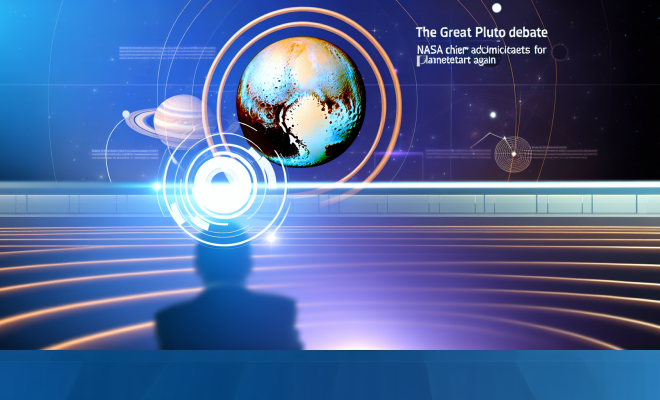
NASA Chief Reignites Pluto Planet Debate: Will It Be Reinstated?
By Matthew Lynch
April 30, 2026
0
Spread the love

Introduction

The status of Pluto has long been a contentious issue in the realm of astronomy, igniting passionate discussions among scientists, enthusiasts, and the general public alike. Recently, the debate has taken on new vigor as NASA Administrator Jared Isaacman has publicly expressed his support for Pluto’s reinstatement as a full-fledged planet. This statement, made during a testimony before lawmakers, challenges the 2006 International Astronomical Union (IAU) decision that reclassified Pluto as a dwarf planet. As discussions around this topic heat up, it’s essential to explore the history, implications, and criteria surrounding planetary classification.

The Historical Context

To understand the current debate, it’s important to look back at how Pluto’s classification has evolved over time. Discovered in 1930 by Clyde Tombaugh, Pluto was initially hailed as the ninth planet of our solar system. For over seven decades, it held this status until the dawn of the 21st century when astronomers began to reevaluate the definitions of what constitutes a planet.

The 2006 Reclassification

In August 2006, the IAU convened in Prague to establish a formal definition of a planet. The outcome was a new classification that excluded Pluto from the planet category. According to the IAU:

  • A planet must orbit the sun.
  • A planet must be spherical in shape due to its own gravity.
  • A planet must have cleared its orbit of other debris.

Pluto failed to meet the third criterion, as it shares its orbital neighborhood with other objects in the Kuiper Belt. Consequently, it was demoted to a dwarf planet, a classification that includes other celestial bodies such as Eris and Haumea.

The Implications of Reclassification

The decision to reclassify Pluto was met with widespread backlash and disappointment, particularly among the public and many in the scientific community. For many, Pluto has always been a planet, representing a significant chapter in the story of our solar system. The emotional connection to Pluto has fueled a movement advocating for its reinstatement.

Impact on Education and Public Perception

The reclassification of Pluto has also had implications for education. Textbooks and educational materials had to be revised, leading to confusion among students and educators alike. Many children who learned about the solar system were left disheartened by the news that their beloved ninth planet was no longer recognized as such.

Jared Isaacman’s Position

During his recent testimony, Jared Isaacman voiced his support for Pluto’s return to planet status, reigniting the debate among astronomers and space enthusiasts. Isaacman, known for his role as an entrepreneur and private astronaut, emphasized the need for a reevaluation of the criteria used to define planets.

A Call for Redefining Criteria

Isaacman’s statement has sparked discussions about whether the current criteria for planetary classification are too rigid. He argued that the emotional and cultural significance of Pluto should not be overlooked. As we delve deeper into our solar system and discover more about the objects within it, it may be time to reconsider how we define a planet.

Scientific Perspectives

The scientific community remains divided over the issue of Pluto’s status. Some astronomers support Isaacman’s call for a reevaluation, while others argue that the IAU’s criteria provide a necessary framework for classification.

Arguments for Pluto’s Reinstatement

  • Cultural Significance: Pluto holds a special place in popular culture, symbolizing exploration and discovery.
  • Scientific Interest: Pluto is a unique world with its own geological features, atmospheres, and moons, making it worthy of study as a planet.
  • Expanding Knowledge: As our understanding of celestial bodies evolves, so too should our definitions.

Arguments Against Reinstatement

  • Consistency in Classification: Maintaining a clear and consistent definition of a planet helps in the study and understanding of our solar system.
  • Scientific Rigor: The current criteria are based on observable characteristics that can be objectively measured.
  • Precedent: Reinstating Pluto could open the floodgates for other celestial bodies to demand similar recognition, complicating the classification system.

Public Reactions and Support

Since Isaacman’s statement, public support for Pluto’s reinstatement has surged. Petitions have emerged online, rallying thousands of signatures in favor of reclassifying Pluto as a planet. Social media platforms have been flooded with discussions, memes, and polls asking whether Pluto should regain its planetary status.

The Role of Advocacy Groups

Organizations dedicated to space education and advocacy have also jumped into the fray. Groups like the Planetary Society and various astronomy clubs are encouraging conversations about planetary classification and its implications for science education.

Future of Pluto and Planetary Classification

As the debate continues, it raises broader questions about how we define celestial bodies and the criteria we use. The possibility of a new IAU meeting to address the classification of Pluto has been discussed, but as of now, no formal plans have been set in motion.

New Discoveries and Technological Advances

With missions like NASA’s New Horizons, which flew by Pluto in July 2015, our understanding of this distant world has expanded significantly. The data collected has revealed a complex and dynamic environment, showcasing the potential for more discoveries that could influence future classifications.

Conclusion

The debate over Pluto’s status is far from over. As NASA Administrator Jared Isaacman’s statement suggests, the conversation is evolving, with new voices advocating for a reassessment of what it means to be a planet. Whether or not Pluto will regain its status as the ninth planet in our solar system remains uncertain, but what is clear is that Pluto will continue to hold a special place in the hearts and minds of many. As we venture further into the cosmos, the discussions around Pluto—and the criteria that define planetary status—will likely remain a topic of interest and contention.


Previous Article

S&P 500: Market Predictions & Outlook for ...

Next Article

Ethiopia & Japan Partner for Space Exploration ...

Matthew Lynch

Related articles More from author

  • Uncategorized

    The 10 Best Private Piano Lessons Near Me

    July 5, 2026
    By Matthew Lynch
  • Uncategorized

    IHG’s Strategic Share Buyback: Boosting Value in 2026

    April 1, 2026
    By Matthew Lynch
  • Uncategorized

    What GPA Do You Need for Advanced Placement Classes?

    June 14, 2026
    By Matthew Lynch
  • Uncategorized

    3 best practices in teaching you should be using

    June 30, 2026
    By Matthew Lynch
  • Uncategorized

    Avoid These Big College Funding Mistakes, Say Financial Advisors

    January 2, 2025
    By Matthew Lynch
  • Uncategorized

    Indian Stocks Rally in 2026 as Oil Prices Fall Amid US-Iran Peace Hopes

    April 15, 2026
    By Matthew Lynch

Search

Registration and Login

  • Log in
  • Entries feed
  • Comments feed
  • WordPress.org

Newsletter

Signup for The Edvocate Newsletter and have the latest in P-20 education news and opinion delivered to your email address!

RSS feed: Matthew on Education Week Matthew on Education Week

  • Au Revoir from Education Futures November 20, 2018 Matthew Lynch
  • 6 Steps to Data-Driven Literacy Instruction October 17, 2018 Matthew Lynch
  • Four Keys to a Modern IT Approach in K-12 Schools October 2, 2018 Matthew Lynch
  • What's the Difference Between Burnout and Demoralization, and What Can Teachers Do About It? September 27, 2018 Matthew Lynch
  • Revisiting Using Edtech for Bullying and Suicide Prevention September 10, 2018 Matthew Lynch

About Us

The Edvocate was created in 2014 to argue for shifts in education policy and organization in order to enhance the quality of education and the opportunities for learning afforded to P-20 students in America. What we envisage may not be the most straightforward or the most conventional ideas. We call for a relatively radical and certainly quite comprehensive reorganization of America’s P-20 system.

That reorganization, though, and the underlying effort, will have much to do with reviving the American education system, and reviving a national love of learning.  The Edvocate plans to be one of key architects of this revival, as it continues to advocate for education reform, equity, and innovation.

Newsletter

Signup for The Edvocate Newsletter and have the latest in P-20 education news and opinion delivered to your email address!

Contact

The Edvocate
910 Goddin Street
Richmond, VA 23230
(601) 630-5238
[email protected]
  • situs togel online
  • dentoto
  • situs toto 4d
  • situs toto slot
  • toto slot 4d
Copyright (c) 2026 Matthew Lynch. All rights reserved.