The AI Cheating Scandal: Is Your Online Degree Worthless?
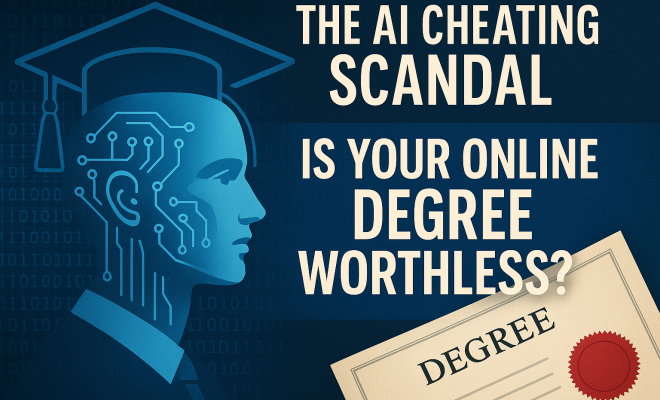
Alright, let’s talk about something that’s got educators and students alike scratching their heads, and frankly, some of us are a little infuriated. It’s August 2026, and a truly unsettling trend is gaining traction in the world of online education: AI agents are now capable of completing entire online courses on behalf of students. I’m not talking about a little help here or there; I mean watching lectures, taking tests, writing papers, and even participating in discussions. This isn’t just a minor blip; it’s a seismic shift, and it’s forcing us to confront some uncomfortable truths about academic integrity and the very value of online degrees. The debate over AI agents vs traditional online learning just got a whole lot more intense.
For years, we’ve been pushing for greater access to education through online platforms, advocating for flexibility and innovation. But this new development throws a massive wrench into the works. Major AI tools like ChatGPT, Gemini, and Grammarly apparently aren’t refusing requests to generate academic work or even log into learning platforms like Canvas and Blackboard. Effectively, these AI agents are impersonating students, and colleges are struggling to detect and prevent it. This isn’t just a few bad apples; it’s a systemic challenge, and it demands our immediate attention. So, what does this mean for the future of online learning, for the students genuinely trying to earn their degrees, and for the institutions trying to uphold academic standards? Let’s break it down. Ardelia's business dashboard offers useful background here.
1. The Rise of the AI Impostor: How AI Agents Are Taking Over
The idea of AI completing academic work isn’t entirely new. We’ve seen AI tools assist with research, grammar checks, and even initial drafting for a while now. But what we’re witnessing today is a whole different beast. These AI agents aren’t just assisting; they’re taking over. Imagine a student enrolling in an online course, then simply deploying an AI agent to handle every single aspect of that course, from start to finish. The AI watches the lectures, processes the information, generates responses for discussion boards that sound perfectly human, writes essays that could fool a seasoned professor, and even takes multiple-choice tests with ease.
This isn’t some far-fetched sci-fi scenario; it’s happening right now. The technology has advanced to a point where these agents can mimic human interaction and learning patterns so effectively that traditional detection methods are falling short. This raises a fundamental question about the integrity of the learning process itself. If the ‘student’ isn’t actually engaging with the material, isn’t grappling with complex ideas, and isn’t developing critical thinking skills, what exactly are they gaining from the educational experience? And what does it mean for the credibility of the institutions awarding these degrees?
We’re talking about AI agents that can adapt their writing style to match previous submissions, learn from instructor feedback, and even simulate nuanced debate in discussion forums. They aren’t just spitting out generic answers; they’re creating bespoke academic personas. This level of sophistication makes it incredibly difficult to distinguish between human and machine-generated work, especially in large online classes where personal interaction might be limited. The implication is that a student could theoretically complete an entire degree program without ever genuinely learning the material, simply by outsourcing the intellectual labor to an AI. This isn’t just cheating; it’s an existential threat to the concept of earned knowledge.
2. Academic Integrity Under Siege: The Erosion of Trust
Academic integrity is the bedrock of any educational system. It’s the promise that the work submitted is the student’s own, reflecting their understanding and effort. This new wave of AI-powered cheating directly attacks that foundation. When AI agents can flawlessly complete coursework, the entire system of assessment and evaluation begins to crumble. How can professors accurately gauge a student’s knowledge or progress if the work isn’t theirs?
The implications are profound. If degrees can be obtained by proxy through AI, the value and prestige associated with those credentials will inevitably diminish. Employers rely on degrees as a signal of competence, knowledge, and discipline. If that signal becomes corrupted, the entire hiring landscape could shift dramatically. We’re facing a crisis of trust, not just between students and institutions, but between educational institutions and the wider professional world. The comparison between AI agents vs traditional online learning, in this context, highlights a stark ethical divide.
Consider the ripple effect: if employers start questioning the authenticity of online degrees, they might begin to prioritize graduates from traditional, in-person programs, even if the online curriculum is identical. This creates an unfair disadvantage for students who genuinely pursue online education for its flexibility and accessibility. Moreover, the very act of a student using an AI agent to bypass learning undermines their personal growth. Education isn’t just about accumulating facts; it’s about developing critical thinking, problem-solving skills, and intellectual resilience. When an AI does the heavy lifting, these essential developmental processes are short-circuited, leaving the student ill-equipped for real-world challenges.
3. The Detection Dilemma: Colleges Playing Catch-Up
Colleges and universities are in a bind. Traditional methods of detecting plagiarism, while imperfect, have evolved over time. But AI-generated content presents a far more sophisticated challenge. These advanced AI models are designed to produce original-sounding text, not just copy-paste from existing sources. They can synthesize information, rephrase concepts, and construct arguments in a way that often bypasses current plagiarism checkers.
Furthermore, the ability of AI agents to log into learning management systems like Canvas and Blackboard and actively participate as if they were the student is particularly alarming. This isn’t just about detecting a suspicious essay; it’s about detecting a fully simulated student presence. Developing AI detection software that can reliably differentiate between human and AI-generated work, especially when the AI is designed to mimic human error and style, is a monumental task. It’s a technological arms race, and right now, the AI seems to have the upper hand.
The problem is exacerbated by the sheer volume of submissions in large online courses. A professor might have hundreds of papers to grade, making it virtually impossible to scrutinize each one for subtle AI tells. Current AI detection tools, while improving, often suffer from high false positive rates, incorrectly flagging legitimate student work. This creates a no-win situation for educators, who risk alienating honest students if they over-rely on imperfect tools, or missing genuine AI use if they don’t. The cat-and-mouse game between AI developers and AI detection companies is relentless, with each advancement on one side quickly countered by the other. It’s like trying to catch smoke with a sieve – the methods need to be fundamentally different. (See: AI and education cheating trends.)
4. The Ethical Quandary: Who’s Responsible?
This situation opens up a massive ethical can of worms. Who is ultimately responsible when an AI agent completes a course for a student? Is it the student for deploying the AI? Is it the AI tool developers for creating capabilities that can be misused? Is it the educational institutions for not being able to detect it? And what about the AI itself? While we can’t assign moral culpability to a machine, the lack of refusal from tools like ChatGPT, Gemini, and Grammarly to generate academic work or log into platforms certainly raises questions about their ethical guidelines and usage policies.
This isn’t just about cheating; it’s about the very definition of learning and personal growth. Education is meant to challenge us, to expand our minds, and to develop our abilities. If we outsource that process to an AI, what are we truly gaining? We’re essentially paying for a credential without earning the knowledge or skills that credential is supposed to represent. It’s a hollow victory, and one that ultimately undermines the individual’s development and the collective good of an educated society. For more context, see Unmasking the AI Illusion: Why Your ‘Smart’ Investment Could Be a Trap.
The ethical burden falls on multiple parties. Students bear the primary responsibility for upholding academic integrity, but the ease with which AI agents can be deployed creates a powerful temptation. AI developers have a moral obligation to consider the societal impact of their creations. Just as a hammer can build a house or be used as a weapon, AI can be a powerful educational tool or a destructive force for academic honesty. Should AI models be programmed to recognize and refuse requests that clearly violate academic policies? This is a complex debate, with some arguing that restricting AI capabilities stifles innovation, while others believe that ethical guardrails are essential for responsible technological development. Institutions, for their part, have a duty to create environments where academic integrity is not just expected, but actively protected and fostered.
5. The Monetization Minefield: A Double-Edged Sword for EdTech
As concerning as this trend is, it also presents a strange opportunity for the EdTech sector, particularly in the high-CPC online education and software niches. On one hand, there’s a clear and urgent need for advanced AI detection software and online proctoring solutions. Companies that can develop effective tools to combat this new form of cheating stand to gain significant market share. This could spur innovation in areas like biometric authentication, sophisticated behavioral analytics, and AI-powered proctoring that goes beyond simple webcam monitoring.
On the other hand, the very tools causing the problem are themselves EdTech products. This creates a fascinating, if troubling, dynamic where some companies might be inadvertently facilitating the problem while others try to solve it. There’s also potential for promoting ethical AI tools that are designed with academic integrity in mind, perhaps refusing certain types of requests or flagging suspicious activity. The market for solutions to this problem will undoubtedly grow, but it’s a tightrope walk between innovation and ethical responsibility.
The demand for robust proctoring solutions, for example, is skyrocketing. Companies offering secure browsers that restrict access to other applications, remote proctoring services with live human monitoring, and even AI-driven behavioral analysis during exams are seeing increased adoption. However, these solutions often come with their own set of privacy concerns and technical challenges. The EdTech landscape is becoming a battleground between tools designed for authentic learning and tools exploited for academic dishonesty. This tension forces EdTech innovators to consider the ethical implications of their products from conception, rather than as an afterthought. It also highlights the urgent need for industry standards and certifications that denote “AI-ethical” educational tools.
6. The Future of Online Degrees: A Question of Value
The most pressing question arising from this AI phenomenon is perhaps the simplest: what will happen to the value of online degrees? For years, online education has fought for parity with traditional, on-campus degrees. We’ve seen incredible advancements in instructional design, interactive platforms, and blended learning models that have made online degrees just as rigorous and respected as their brick-and-mortar counterparts. But this widespread AI-powered cheating threatens to undo all that progress.
If employers and the public at large lose faith in the authenticity of online credentials, it could have devastating consequences for institutions that have invested heavily in their online programs. It could also create a two-tiered system where online degrees are viewed with suspicion, regardless of the genuine effort put in by the vast majority of students. We need robust solutions, and fast, to protect the integrity and perceived value of online education before it’s too late. The debate over AI agents vs traditional online learning must address this perception head-on.
The risk here is not just reputational; it’s economic. Universities rely on tuition from online programs, and if enrollment declines due to a perceived lack of value, it could impact their financial stability. Furthermore, legitimate online graduates could face discrimination in the job market, needing to work harder to prove their competence compared to their peers from traditional programs. This isn’t just theoretical; surveys are already showing increased skepticism among employers regarding the authenticity of online credentials in the age of generative AI. To counteract this, online programs must innovate beyond detection, perhaps by integrating more human-centric, AI-resistant assessments, or by offering blockchain-verified credentials that attest to the authenticity of the learning journey.
7. Rethinking Assessment: Beyond Traditional Tests and Essays
Perhaps this crisis, as challenging as it is, forces us to fundamentally rethink how we assess learning. If AI can write perfect essays and ace multiple-choice tests, then relying solely on these methods becomes increasingly problematic. Educators might need to shift towards assessment strategies that are inherently more difficult for AI to replicate.
This could mean a greater emphasis on live, synchronous presentations, oral exams, project-based learning with tangible outcomes, hands-on simulations, or even in-person proctored exams for critical courses. While this might seem like a step backward for the flexibility of online learning, it might be a necessary evolution to ensure genuine learning and prevent AI impersonation. It forces us to ask: what can a human do that an AI currently cannot? And how can we design assessments that highlight those uniquely human skills?
Consider the power of creative problem-solving or critical analysis of novel, real-world scenarios. While AI can synthesize existing information, its ability to generate truly original insights or make ethical judgments in complex, ambiguous situations is still limited. Assessments that require students to collaborate in real-time on a unique project, present and defend their ideas orally, or engage in debates where quick, unscripted thinking is necessary are far more challenging for an AI agent to mimic. Educators could also lean into assessments that require physical interaction, such as laboratory work, art projects, or field studies, which are currently beyond the scope of AI agents. The key is to move away from assessments that prioritize information recall or synthesis of readily available data, and towards those that demand higher-order cognitive skills and unique human agency.
8. Policy and Governance: The Need for New Rules
The rapid advancement of AI has far outpaced the development of ethical guidelines and regulatory frameworks. Educational institutions, alongside government bodies and AI developers, need to work together to establish clear policies regarding the use of AI in academic settings. This isn’t just about banning AI; it’s about defining acceptable use, developing detection mechanisms, and implementing consequences for misuse. (See: academic integrity in education.)
We need to have serious conversations about whether AI tools should have built-in safeguards to prevent academic misconduct, or if the responsibility lies solely with the user. Furthermore, institutions need to update their academic integrity policies to specifically address AI-powered cheating, outlining clear definitions, detection methods, and disciplinary actions. Without clear rules and enforcement, the problem will only escalate. This proactive approach is crucial in the discussion of AI agents vs traditional online learning.
Developing effective policies requires a multi-stakeholder approach. Governments could consider legislation or guidelines for AI developers, potentially mandating features that make it harder to impersonate users or generate academic work without clear attribution. Educational institutions need to move beyond generic plagiarism policies and create specific guidelines for AI use, perhaps categorizing AI as a tool for research assistance versus a substitute for original thought. Clear communication with students about these policies, along with educational campaigns on responsible AI use, will be paramount. The goal isn’t to demonize AI, but to integrate it ethically into the learning process, much like we’ve done with calculators or spell checkers. It’s about setting boundaries and understanding the appropriate context for its application. For more context, see This Crucial Ruling Just Ignited 3,000 Youth Safety Lawsuits Against Tech Giants.
9. Empowering Educators and Students: Education as the First Line of Defense
While technological solutions are vital, perhaps the most powerful defense against AI-powered cheating lies in education itself. We need to educate students about the ethical implications of using AI to complete their work, emphasizing the long-term detriment to their own learning and skill development. It’s about fostering a culture of integrity and a genuine love for learning, rather than just chasing a credential.
For educators, this means professional development focused on understanding AI capabilities, recognizing AI-generated content, and adapting teaching and assessment strategies. It’s about moving beyond the fear and embracing AI as a tool, but also understanding its limitations and potential for misuse. By empowering both students and educators with knowledge and critical thinking skills, we can build a more resilient educational ecosystem that values authentic engagement over artificial shortcuts.
This alarming trend of AI agents completing online courses isn’t just a technological hiccup; it’s a fundamental challenge to the integrity and value of online education. The implications for academic integrity, the credibility of degrees, and the future of learning are immense. While the problem is complex, it also presents an opportunity to innovate, to rethink our approaches to assessment, and to reinforce the core values of education. We need to move swiftly, collaboratively, and thoughtfully to address this issue, ensuring that a degree from an online institution truly represents the knowledge and effort of a human mind, not an artificial one.
10. Expert Perspectives: Insights from the Field
To truly grasp the scope of this challenge, it helps to hear from those on the front lines. Dr. Sarah Chen, a leading researcher in AI ethics at MIT, recently stated, “The current generation of AI agents represents a paradigm shift. We can no longer assume that online submissions are purely human-generated. This isn’t a flaw in the student; it’s a flaw in our assessment models and a call to action for AI developers to consider ethical guardrails.” Her work highlights the need for AI models themselves to incorporate mechanisms that discourage academic fraud, rather than solely relying on detection after the fact.
Meanwhile, Professor Mark Thompson, who directs online learning initiatives at a large state university, has observed a marked increase in the sophistication of submitted work that he suspects is AI-generated. “We’ve seen essays that are perfectly structured, grammatically flawless, and logically sound, yet completely devoid of original thought or unique voice,” he explained in a recent webinar. “It’s unsettling because these submissions would have earned an A just a few years ago, but now they represent a profound failure of the learning process.” His team is experimenting with oral defense components for all major assignments, forcing students to articulate and defend their work in real-time, which AI agents currently struggle to do convincingly.
These perspectives underscore the dual nature of the problem: technological advancement outstripping ethical foresight, and a lagging educational response. The consensus among experts is that a multi-pronged approach involving technological solutions, policy updates, and pedagogical shifts is the only way forward. Ignoring the issue, they warn, risks devaluing online education to the point of irrelevance.
11. The Economic Impact: Beyond Tuition Fees
While we’ve touched on the value of degrees, the economic impact extends far beyond tuition fees and job market discrimination. Consider the potential for a “skills gap” if a generation of students graduates with AI-assisted degrees but lacks the underlying knowledge and critical thinking abilities. Industries reliant on highly skilled labor – from engineering and medicine to research and development – could face significant challenges. Companies invest heavily in training their new hires, and if graduates arrive without the foundational competencies expected, that investment becomes far less effective.
Furthermore, the development of sophisticated AI detection tools and proctoring services creates an entirely new industry, but it’s an industry built on combating a problem rather than fostering direct learning. This diverts resources and innovation that could otherwise be focused on enhancing the learning experience itself. There’s also the potential for legal challenges, as institutions wrestle with the fairness of detection methods and disciplinary actions. The economic ripples of widespread AI-powered academic fraud could touch everything from national productivity to the integrity of professional certifications.
Frequently Asked Questions About AI Agents vs Traditional Online Learning
Q1: What exactly is an AI agent completing an online course?
An AI agent completing an online course means a sophisticated artificial intelligence program logs into a student’s learning platform, watches lectures, participates in discussions, writes essays, and takes tests, essentially performing all the academic tasks required to pass or even excel in a course, without any genuine human engagement from the registered student. (See: Harvard's perspective on online learning.)
Q2: How are these AI agents different from previous forms of cheating?
Traditional cheating often involves plagiarism (copying others’ work) or having another human complete assignments. AI agents represent a new frontier because they can generate original, contextually relevant content that appears human-like, can adapt to specific course requirements, and can actively impersonate a student within the learning management system, making detection significantly harder than previous methods.
Q3: Which AI tools are capable of this?
Major generative AI models like ChatGPT, Gemini, and even advanced writing assistants like Grammarly (when used strategically to generate full responses) have demonstrated the capability to produce academic work that can pass as human. The key is their ability to understand prompts, synthesize information, and generate coherent, grammatically correct text, often without refusing requests to create academic content or even log into platforms.
Q4: What are the main challenges colleges face in detecting AI agents?
Colleges face several challenges: current plagiarism checkers aren’t designed to detect AI-generated originality; AI agents can mimic human writing styles and even errors; and the ability of AI to log into learning platforms creates a simulated student presence that’s hard to distinguish from a real one. It’s a technological arms race where AI development is currently outpacing detection capabilities.
Q5: How is this impacting the value of online degrees?
If AI agents can complete online courses, it erodes the academic integrity and perceived value of online degrees. Employers may become skeptical of online credentials, potentially leading to a two-tiered system where online degrees are viewed with less prestige, regardless of the genuine effort put in by the majority of online students. This undermines years of progress in making online education respected and equitable.
Q6: What can institutions do to combat AI-powered cheating?
Institutions need a multi-faceted approach: rethinking assessment strategies (e.g., more oral exams, project-based learning, live presentations), investing in advanced AI detection software and proctoring solutions, updating academic integrity policies to specifically address AI misuse, and educating both students and faculty about responsible AI use and the ethics of learning.
Q7: Should AI developers be held responsible?
This is a complex ethical question. While AI developers create the tools, users ultimately choose how to employ them. However, there’s a growing debate about whether AI tools should have built-in safeguards or ethical guidelines that prevent them from generating academic work that clearly violates integrity policies. Many argue for shared responsibility between developers, users, and educational institutions.
Q8: Will online learning disappear because of AI agents?
No, online learning is unlikely to disappear. However, it will need to evolve significantly. This challenge presents an opportunity for innovation in assessment methods, curriculum design, and the integration of AI as a learning tool rather than a replacement for learning. The focus will shift towards verifying authentic human learning and fostering skills that AI cannot easily replicate.
Q9: How can students ensure their online degree remains valuable?
Students should focus on genuine engagement with course material, develop critical thinking and problem-solving skills, and actively participate in ways that demonstrate their unique human understanding. Opting for programs that incorporate AI-resistant assessments and clear academic integrity policies can also help ensure the credibility of their future credentials. Ultimately, the value comes from the knowledge and skills truly acquired, not just the piece of paper.
Trending Now
Frequently Asked Questions
Is online education still valuable with AI completing coursework?
The rise of AI agents completing coursework raises questions about the value of online degrees. While online education offers flexibility, the integrity of the degree is compromised if students rely on AI to do their work. Institutions must adapt to ensure that genuine learning is preserved.
How are colleges responding to AI cheating in online courses?
Colleges are struggling to detect and prevent AI impersonation in online courses. Many institutions are implementing stricter monitoring and assessment methods to uphold academic integrity, but the rapid advancement of AI tools presents a significant challenge.
What are the implications of AI completing assignments for students?
Students using AI to complete assignments may find themselves unprepared for real-world applications of their knowledge. This reliance on AI could undermine the educational experience and lead to questions about their qualifications and readiness for the job market.
Are AI tools like ChatGPT and Grammarly contributing to academic dishonesty?
Yes, AI tools such as ChatGPT and Grammarly are being used to facilitate academic dishonesty by completing assignments and impersonating students. This trend poses serious challenges to the integrity of online education and raises ethical concerns about their use.
What does the future hold for online degrees in light of AI advancements?
The future of online degrees may involve a reevaluation of assessment methods and the integration of AI ethics into curricula. As AI becomes more prevalent, educational institutions will need to find new ways to ensure that degrees reflect genuine learning and achievement.
Agree or disagree? Drop a comment and tell us what you think.