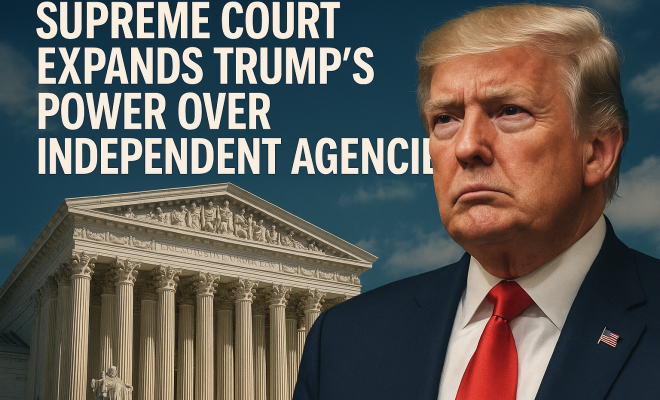
Supreme Court Expands Trump’s Power Over Independent Agencies in 2026
“`html
Introduction: A Shift in Power
On June 29, 2026, the U.S. Supreme Court handed down a ruling that fundamentally alters the balance of power between the executive branch and independent regulatory agencies. This decision effectively expands President Trump’s authority, allowing him greater control over bodies like the Federal Trade Commission (FTC) and the Securities and Exchange Commission (SEC). The implications of this ruling spark intense debate about political influence, accountability, and the future of governance in America.
The Ruling Explained
The ruling strikes down a longstanding precedent which had shielded independent agencies from direct political control. For decades, Congress enacted laws that insulated these agencies from presidential whims, a safeguard intended to ensure that regulations remain unbiased and rooted in expertise rather than political agendas. However, the Supreme Court’s recent decision dismantles this barrier, signaling a shift toward greater executive power.
This ruling comes amid a backdrop of heightened political tension and concerns over the erosion of checks and balances. The justices who voted in favor of the ruling have sparked controversy, as critics argue that the decision undermines the very foundation of democratic governance.
Understanding Independent Agencies
Independent agencies, such as the FTC and SEC, were created to protect the public interest by regulating sectors that require a level of expertise and impartiality. These bodies operate with a degree of independence to buffer them from political pressures that could compromise their missions. The FTC, for example, is tasked with protecting consumers from deceptive practices and maintaining competition, while the SEC oversees securities markets to protect investors.
Historically, these agencies have been vital in fostering accountability and transparency in areas where the potential for abuse is high. Allowing a president to exert more influence over these agencies raises questions about the integrity of their operations and the potential for political favoritism in regulatory enforcement.
The Justices and Their Motives
The ruling was passed with a narrow majority, which has raised eyebrows among legal experts and political analysts alike. Justice Clarence Thomas, known for his originalist perspective, played a pivotal role in articulating the legal rationale for this decision. His argument hinged on the belief that the Constitution does not explicitly provide for the insulation of independent agencies from presidential control.
Chief Justice John Roberts also sided with the majority, emphasizing the need for accountability in government entities. Critics, however, argue that this line of reasoning is problematic. They warn that reducing the independence of these agencies could lead to regulatory capture, where regulations and policies are shaped to benefit specific political interests rather than the public good.
The Political Fallout
The political ramifications of this ruling are already being felt. Supporters of Trump have cheered the decision as a victory for executive power, framing it as a necessary reform to cut through bureaucratic red tape. Meanwhile, opponents fear that this ruling could lead to an unprecedented level of political interference in critical regulatory frameworks.
Organizations that once relied on the independence of agencies like the SEC and FTC are now bracing themselves for a potentially more politicized environment. Legal experts suggest that this ruling could create an atmosphere of uncertainty, as agencies might feel pressured to align their actions with the administration’s political agenda.
Reactions from Experts
Reactions to the ruling have been swift and varied. Some legal scholars argue that this decision sets a dangerous precedent, undermining the ability of independent agencies to function without partisan influence. Others view it as a necessary correction, arguing that the previous insulation of these agencies allowed for inefficiencies and a lack of accountability.
Professor Linda Green, a constitutional scholar at Yale Law School, expressed deep concern, stating, “This ruling chips away at the very essence of what independent agencies were designed to achieve. By allowing political pressure to infiltrate these bodies, we risk losing public trust in regulatory processes.” (See: Centers for Disease Control and Prevention.)
The Historical Context
This ruling is not emerging in a vacuum. The concept of independent agencies took root in the early 20th century, intended as a response to the growing complexity of the economy and the need for specialized regulatory knowledge. Agencies like the FTC were established to provide expertise that legislators often lack, a recognition of the limitations of direct political control in specialized fields.
Over the years, successive administrations have attempted to exert influence over these bodies, but Congress has historically intervened to maintain their independence. The Supreme Court’s decision marks a significant departure from this trend, suggesting that the political tide is shifting back toward a more centralized executive authority.
Potential Impacts on Regulatory Actions
As President Trump gains greater control over independent agencies, the immediate question becomes: what will this mean for regulatory actions? Agencies like the SEC, which enforce regulations designed to protect investors, may now face pressures to align their enforcement actions with the administration’s priorities.
For instance, during Trump’s presidency, the SEC has been criticized for rolling back certain regulations aimed at protecting investors, raising concerns about potential conflicts of interest. If the Supreme Court ruling leads to even more pronounced political influence, the integrity of these regulations could be further compromised.
The Future of Independent Oversight
The implications of this ruling extend beyond immediate regulatory actions. There is a growing fear among critics that this decision erodes the very foundation of independent oversight, which is essential for preserving democratic accountability. When agencies operate under the thumb of political pressures, the risk of corruption and favoritism escalates.
Moving forward, the future of independent oversight hinges on public response. If citizens demand greater accountability and transparency from their government, it could create the political will necessary to restore some of the independence that has been lost. Grassroots movements advocating for regulatory integrity may play a crucial role in reshaping the conversation around independent agencies.
The Broader Implications for Governance
What does this ruling mean for the broader landscape of American governance? The ramifications of increasing executive control over independent agencies can extend into various aspects of policymaking and public administration. Critics have pointed out that such a shift could lead to a more aggressive politicization of what should be nonpartisan regulatory functions.
For example, environmental regulations enforced by agencies like the Environmental Protection Agency (EPA) may now be susceptible to political manipulation, as future administrations could prioritize economic growth over ecological sustainability. This could result in deregulation that favors industries at the expense of public health and environmental protections.
Case Studies: Past Interventions and Consequences
To understand the potential outcomes of this ruling, we can look to recent case studies where independent agency decisions have been influenced by political agendas. One prominent example is the rollback of net neutrality regulations by the Federal Communications Commission (FCC) in 2017. This controversial decision was widely criticized as being motivated more by political interest than by empirical evidence of market conditions. The aftermath saw significant disparities in internet access and quality, particularly affecting lower-income communities.
Another example is the SEC’s handling of financial regulations post-2008 financial crisis. The agency faced pressure to ease restrictions on large financial institutions, which critics argue led to a lack of accountability and ultimately contributed to the stock market volatility observed during the pandemic recovery phase.
Public Confidence in Regulatory Agencies
Public confidence in regulatory bodies is essential for their effectiveness. When the perception arises that agencies are being unduly influenced by political considerations, it can lead to a cycle of distrust. Polls have shown that public confidence in independent regulatory bodies has fluctuated significantly over the past two decades, often in response to perceived politicization of their decisions.
Recent surveys suggest that nearly 60% of Americans believe that independent agencies are likely to be swayed by political interests, according to a 2023 Gallup poll. This perception can lead to apathy among citizens who feel their interests are not being represented, thereby disengaging from the democratic process.
Expert Perspectives on Accountability
Experts from various fields provide critical perspectives on maintaining accountability in the wake of this ruling. Dr. Emily Carter, a political scientist specializing in governance, emphasizes the need for structural changes to ensure independent agencies can withstand political pressures. She suggests increased transparency measures, such as mandatory public reporting on agency activities and decision-making processes. (See: New York Times coverage on Supreme Court rulings.)
“Accountability isn’t just about oversight; it’s about ensuring that the public can see and understand the decisions being made in their name,” Dr. Carter states. “We need to create a system where agencies can operate independently but are still held accountable to the public.”
Potential Legislative Responses
In response to the ruling, lawmakers may seek to introduce legislation aimed at reinstating some protections for independent agencies. This could involve amending existing laws to reinforce the nonpartisan nature of these bodies and limit the scope of executive influence. Advocacy groups are likely to mobilize around this issue, pushing for a robust public discourse about the necessity of independent oversight.
Additionally, bi-partisan support could emerge for measures that enhance agency accountability while preserving their independence. Ideas such as establishing independent review boards or implementing stricter lobbying regulations may gain traction in Congress as legislators grapple with the implications of the Supreme Court’s ruling.
FAQ Section
What are independent agencies, and why are they important?
Independent agencies are regulatory bodies created by Congress to oversee specific sectors of the economy and protect public interests. They operate with a degree of autonomy to minimize political influence, which is crucial for maintaining impartiality and expertise in regulation.
How does the Supreme Court ruling affect the independence of these agencies?
The ruling allows the president greater control over independent agencies, potentially undermining their ability to operate free from political influence. This could lead to politicized decision-making that prioritizes the administration’s agenda over public interest.
What are the potential risks of increased presidential control over independent agencies?
Increased presidential control risks regulatory capture, where policies and regulations benefit specific political interests rather than serving the public good. This could lead to weakened protections for consumers, investors, and the environment.
How might the public respond to this ruling?
The public response is crucial. Citizens may advocate for greater accountability from their government and push for legislative measures to restore independence to regulatory agencies. Grassroots movements could emerge to raise awareness and mobilize support for reforms.
What can be done to ensure accountability in independent agencies?
To ensure accountability, experts recommend implementing transparency measures, such as public reporting of agency decisions and activities. Legislative action to reinforce the independence of regulatory bodies is also essential in countering the effects of political influence.
The Role of the Courts in Regulatory Independence
As the Supreme Court has clarified its stance on independent agencies, the role of lower courts becomes even more significant. They will now be tasked with interpreting this ruling and applying it to cases that come before them. This could result in a patchwork of decisions that further complicate the regulatory landscape.
Some legal experts suggest that lower courts may lean towards a more conservative interpretation of this ruling, potentially entrenching the president’s influence even further. Cases involving agency actions that are challenged in court may see judges more likely to side with the executive branch, given the Supreme Court’s precedent. This could create a scenario where the independence of agencies is systematically eroded through judicial interpretations.
International Perspectives on Regulatory Autonomy
The debate surrounding independent agencies isn’t confined to the United States. Many countries grapple with similar issues regarding the balance of power between the executive and regulatory bodies. For example, in the European Union, regulatory agencies such as the European Central Bank (ECB) and the European Securities and Markets Authority (ESMA) are designed to operate independently of political pressures. Their independence is considered vital for maintaining market stability and public trust. (See: BBC News on political influence.)
Comparatively, the U.S. has historically allowed for more direct political influence on its independent agencies. Observing international frameworks can provide valuable insights into how to enhance the independence of U.S. agencies. It raises questions about whether the U.S. might benefit from reforms that draw inspiration from the EU model, establishing clearer boundaries for political involvement in regulatory actions.
Public Advocacy and Engagement
As the implications of the Supreme Court ruling unfold, public advocacy will play a critical role in shaping the future of independent agencies. Advocacy organizations, think tanks, and grassroots movements are already mobilizing to address the potential risks posed by the increased presidential control over these agencies.
Campaigns focusing on the importance of independent oversight can help raise awareness among the general public. By educating citizens about the vital functions of these agencies and the potential consequences of political interference, advocates can galvanize support for reforms aimed at preserving their independence.
Public forums, town hall meetings, and online platforms provide spaces for citizens to voice their concerns and advocate for accountability in regulatory processes. Engaging constituents in discussions about the importance of transparency and fairness in governance can foster a more informed electorate ready to hold their leaders accountable.
Looking Ahead: Transparency and Reform
With the landscape of power dynamics shifting, the need for transparency in government actions has never been more crucial. Citizens and lawmakers alike must prioritize measures that ensure independent agencies remain shielded from political manipulation. This could involve instituting stronger conflict-of-interest laws, enhancing whistleblower protections, and requiring public disclosure of lobbying activities.
Moreover, it may be worth considering the establishment of an independent commission to assess and recommend reforms for independent agencies. Such a commission could provide impartial recommendations aimed at fortifying the independence and effectiveness of these bodies amidst political pressures.
Conclusion: A Call for Vigilance
The Supreme Court’s decision to expand President Trump’s power over independent agencies is a watershed moment in the evolution of American governance. As we witness the ramifications of this ruling unfold, it is essential for citizens, lawmakers, and advocacy groups alike to remain vigilant. The landscape of regulatory oversight has shifted dramatically, raising critical questions about the balance of power and the future of democracy in the United States.
While there are arguments on both sides regarding the merits of this ruling, the potential for political interference in independent oversight poses a significant threat to public trust. It is now up to the American people to hold their government accountable and ensure that regulatory bodies remain committed to serving the public interest rather than political expediency.
“`
Trending Now
Frequently Asked Questions
What did the Supreme Court ruling on June 29, 2026 change?
The Supreme Court ruling on June 29, 2026, expanded President Trump's authority over independent regulatory agencies, such as the FTC and SEC, by dismantling longstanding protections that shielded these agencies from direct political control, thereby altering the balance of power between the executive branch and these agencies.
How does the ruling affect independent agencies like the FTC and SEC?
The ruling allows greater presidential control over independent agencies like the FTC and SEC, which were previously insulated from political influence. This change raises concerns about the potential for political agendas to compromise the impartiality and expertise that these agencies are meant to uphold.
What are independent agencies and why are they important?
Independent agencies, such as the FTC and SEC, are created to regulate sectors requiring expertise and impartiality. They protect public interests by ensuring accountability and transparency, helping to prevent abuses of power in areas like consumer protection and securities markets.
What are the implications of the Supreme Court's decision?
The implications of the Supreme Court's decision include a significant shift towards greater executive power, raising concerns about the erosion of checks and balances and the potential influence of political agendas on regulatory practices traditionally rooted in expertise.
Why is there controversy surrounding the Supreme Court ruling?
The controversy stems from critics arguing that the ruling undermines democratic governance by opening the door for political influence over independent agencies, which were designed to operate free from such pressures, thereby threatening their impartiality and effectiveness.
What’s your take on this? Share your thoughts in the comments below — we read every one.