The Edvocate

Top Menu

Main Menu

  • Start Here
    • Our Brands
    • Governance
      • Lynch Education Consulting, LLC.
      • Dr. Lynch’s Personal Website
      • Careers
    • Write For Us
    • Books
    • The Tech Edvocate Product Guide
    • Contact Us
    • The Edvocate Podcast
    • Edupedia
    • Pedagogue
    • Terms and Conditions
    • Privacy Policy
  • PreK-12
    • Assessment
    • Assistive Technology
    • Best PreK-12 Schools in America
    • Child Development
    • Classroom Management
    • Early Childhood
    • EdTech & Innovation
    • Education Leadership
    • Equity
    • First Year Teachers
    • Gifted and Talented Education
    • Special Education
    • Parental Involvement
    • Policy & Reform
    • Teachers
  • Higher Ed
    • Best Colleges and Universities
    • Best College and University Programs
    • HBCU’s
    • Diversity
    • Higher Education EdTech
    • Higher Education
    • International Education
  • Advertise
  • The Tech Edvocate Awards
    • The Awards Process
    • Finalists and Winners of The 2025 Tech Edvocate Awards
    • Finalists and Winners of The 2024 Tech Edvocate Awards
    • Finalists and Winners of The 2023 Tech Edvocate Awards
    • Finalists and Winners of The 2021 Tech Edvocate Awards
    • Finalists and Winners of The 2022 Tech Edvocate Awards
    • Finalists and Winners of The 2020 Tech Edvocate Awards
    • Finalists and Winners of The 2019 Tech Edvocate Awards
    • Finalists and Winners of The 2018 Tech Edvocate Awards
    • Finalists and Winners of The 2017 Tech Edvocate Awards
    • Award Seals
  • Apps
    • GPA Calculator for College
    • GPA Calculator for High School
    • Cumulative GPA Calculator
    • Grade Calculator
    • Weighted Grade Calculator
    • Final Grade Calculator
  • The Tech Edvocate
  • Post a Job
  • AI Powered Personal Tutor

logo

The Edvocate

  • Start Here
    • Our Brands
    • Governance
      • Lynch Education Consulting, LLC.
      • Dr. Lynch’s Personal Website
        • My Speaking Page
      • Careers
    • Write For Us
    • Books
    • The Tech Edvocate Product Guide
    • Contact Us
    • The Edvocate Podcast
    • Edupedia
    • Pedagogue
    • Terms and Conditions
    • Privacy Policy
  • PreK-12
    • Assessment
    • Assistive Technology
    • Best PreK-12 Schools in America
    • Child Development
    • Classroom Management
    • Early Childhood
    • EdTech & Innovation
    • Education Leadership
    • Equity
    • First Year Teachers
    • Gifted and Talented Education
    • Special Education
    • Parental Involvement
    • Policy & Reform
    • Teachers
  • Higher Ed
    • Best Colleges and Universities
    • Best College and University Programs
    • HBCU’s
    • Diversity
    • Higher Education EdTech
    • Higher Education
    • International Education
  • Advertise
  • The Tech Edvocate Awards
    • The Awards Process
    • Finalists and Winners of The 2025 Tech Edvocate Awards
    • Finalists and Winners of The 2024 Tech Edvocate Awards
    • Finalists and Winners of The 2023 Tech Edvocate Awards
    • Finalists and Winners of The 2021 Tech Edvocate Awards
    • Finalists and Winners of The 2022 Tech Edvocate Awards
    • Finalists and Winners of The 2020 Tech Edvocate Awards
    • Finalists and Winners of The 2019 Tech Edvocate Awards
    • Finalists and Winners of The 2018 Tech Edvocate Awards
    • Finalists and Winners of The 2017 Tech Edvocate Awards
    • Award Seals
  • Apps
    • GPA Calculator for College
    • GPA Calculator for High School
    • Cumulative GPA Calculator
    • Grade Calculator
    • Weighted Grade Calculator
    • Final Grade Calculator
  • The Tech Edvocate
  • Post a Job
  • AI Powered Personal Tutor
  • 5 Ways Project-Based Learning Creates an Engaging Alternative Education Classroom

  • How Do Great Educational Leaders Stay Great?

  • How community schools can beat summer learning loss for low-income students

  • How Colleges Are Helping Undocumented Students

  • How College Mentors Can Foster Student Success

  • How college and career ready is your child?

  • How Coaching Can Impact Teachers, Principals, and Students

  • How Can You Take the Distance Out of Distance Learning?

  • How Can You Ignite English Language Learners’ Passion to Read & Learn?

  • How Can We Increase Minority Graduation Rates at Our Nation’s Colleges?

Early ChildhoodEdTech & InnovationElementary Education
Home›Early Childhood›Why schools should provide one laptop per child

Why schools should provide one laptop per child

By Matthew Lynch
November 11, 2016
0
Spread the love

Binbin Zheng, Michigan State University and Mark Warschauer, University of California, Irvine

A recent international study by the Organization for Economic Cooperation and Development found no positive evidence of impact of educational technology on student performance.

It did not find any significant improvement in reading, math or science in countries that heavily invested in technology to improve student achievement. In fact, the report found that technology perhaps even widened the achievement gaps.

Does this mean we should abandon attempts to integrate technology in schools?

We are researchers of technology and learning in K-12 environments, and our research suggests this would be shortsighted.

Impact of one-to-one laptop programs

For the last 10 years, our research team has been investigating what are called “one-to-one” programs, where all the students in a classroom, grade, school or district are provided laptop computers for use throughout the school day, and often at home, in different school districts across the United States.

The largest one-to-one laptop program in the world is OLPC (One Laptop per Child), which mainly targets developing countries, with the mission “to create educational opportunities for the world’s poorest children.” In the United States, the Maine Learning Technology Initiative (MLTI) launched a one-to-one laptop initiative in fall 2002, which made Maine the first state to use technology to transform teaching and learning in classrooms statewide. Later, these programs were extended to other school districts as well.

In addition to our own extensive observations, we conducted a synthesis of the results of 96 published global studies on these programs in K-12 schools during 2001-2015. Among them, 10 rigorously designed studies, mostly from the U.S., were included, to examine the relationship between these programs and academic achievement. We found significant benefits.

We found students’ test scores in science, writing, math and English language arts improved significantly.

And the benefits were not limited to test scores.

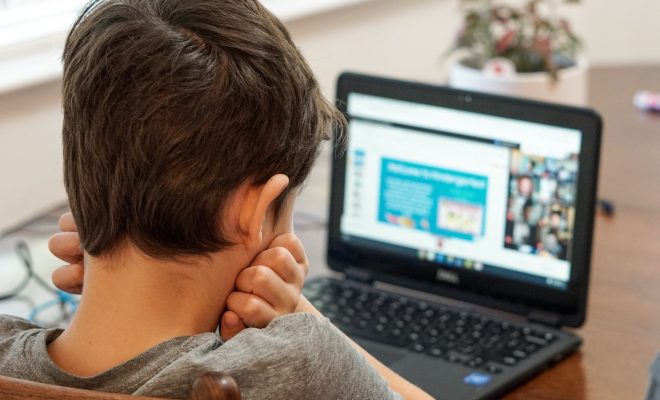
Laptop use led to significant benefits for students.Tim & Selena Middleton, CC BY

We found students with laptops wrote more frequently across a wider variety of genres. They also received more feedback on their writing. In addition, we found they edited and revised their papers more often, drew on a wider range of resources to write, and published or shared their work with others more often.

Student surveys, teacher interviews and classroom observations in these studies revealed that students with access to laptops worked more autonomously and gained experience in project-based learning. This allowed them to synthesize and critically apply knowledge.

For example, researcher Chrystalla Mouza found that elementary school students with access to laptops were able to create electronic storybooks and publish reports in language arts classrooms.

One-to-one laptop programs also enhanced students’ 21st-century skills – skills needed in an information age – such as the ability to locate and use internet resources. Students also improved their collaborative learning skills – that is, they were more capable of working collaboratively with others.

Research led by Deborah L. Lowther at University of Memphis found that when students were given a problem and related answer to consider, students with laptops exhibited higher problem-solving skills than those in the comparison group.

A closer look at the OECD report also reveals that students in the United States performed particularly well on technology-based tasks such as online navigation, digital reading and using computers to solve math problems.

Can laptop use reduce educational gap?

However, our study did not find firm evidence on whether these one-to-one laptop programs helped lessen the academic gap between academically advantaged and disadvantaged students.

Earlier studies have found that laptop programs could help shorten the achievement gap between low-income students and their peers. We did not find such positive evidence in all programs.

One possible explanation is that difficulty in using technology sometimes places an extra load on already challenged students. In contrast, wealthier students are usually more tech-savvy so they can maximize the benefits of using computers to support learning.

Not all laptop programs are effective

One issue here is that not all programs are successful. In our study, although most programs were successful, there were some stark failures as well.

These tended to be in school districts that treated computers like magical devices that would solve educational problems merely through their distribution, without sufficient planning on how they could best be deployed to improve learning.

Some schools phased out their laptop program. Mere access to a computer does not improve learning. Schoolchildren image via www.shutterstock.com

Some of these schools, after observing no progress with laptops, decided to phase them out. For example, Liverpool Central School District, a public school district in a suburban community near Syracuse, New York, decided to drop the laptop program from fall 2007.

A school district in Philadelphia had to abandon its program after being sued over its use of laptop webcams to capture pictures of students at home. The district claimed it was an effort to track down missing laptops.

For schools and classrooms that are already poorly organized, merely having access to a computer connected to the internet will not improve learning. However, for classrooms that focus on improving students’ writing, analysis, research, problem solving and critical thinking, those same internet-connected computers could be invaluable tools.

Technology to train future citizens

Perhaps we could learn a lesson from the business world. When computers were first introduced into corporations, it took a number of years to increase productivity.
Today it is hard to imagine any field of commerce or knowledge production succeeding while shunning computers.

Well-organized programs that make individual computers available to students are already getting excellent test score results. Such programs are critical for helping students develop necessary skills for the future. These programs deserve our support.

The Conversation

Binbin Zheng, Assistant Professor, Michigan State University and Mark Warschauer, Professor of Education and Informatics, University of California, Irvine

This article was originally published on The Conversation. Read the original article.

TagsedchatEducationeduchatk12ntchat
Previous Article

Diverse Conversations: An Online Course to Recruit ...

Next Article

4 Tips Cash-Strapped Districts Can Use to ...

Matthew Lynch

Related articles More from author

  • Parental InvolvementPolicy & ReformTeachers

    Hard Evidence: at what age are children ready for school?

    January 17, 2016
    By Matthew Lynch
  • EdTech & Innovation

    Benefits and Drawbacks of Technology in the Classroom

    April 13, 2017
    By Matthew Lynch
  • Equity

    Why has Japan’s massacre of disabled gone unnoticed? For answers, look to the past

    December 13, 2016
    By Matthew Lynch
  • DiversityEquity

    Epidemic of rights abuse fails black kids across the US

    February 15, 2016
    By Matthew Lynch
  • Higher Education

    Does Tenure Matter? It Depends on Who You Ask

    January 6, 2018
    By Matthew Lynch
  • Best Colleges and Universities

    2023 Best and Worst Colleges for LBGTQ Students

    May 1, 2019
    By Matthew Lynch

Search

Registration and Login

  • Register
  • Log in
  • Entries feed
  • Comments feed
  • WordPress.org

Newsletter

Signup for The Edvocate Newsletter and have the latest in P-20 education news and opinion delivered to your email address!

RSS Matthew on Education Week

  • Au Revoir from Education Futures November 20, 2018 Matthew Lynch
  • 6 Steps to Data-Driven Literacy Instruction October 17, 2018 Matthew Lynch
  • Four Keys to a Modern IT Approach in K-12 Schools October 2, 2018 Matthew Lynch
  • What's the Difference Between Burnout and Demoralization, and What Can Teachers Do About It? September 27, 2018 Matthew Lynch
  • Revisiting Using Edtech for Bullying and Suicide Prevention September 10, 2018 Matthew Lynch

About Us

The Edvocate was created in 2014 to argue for shifts in education policy and organization in order to enhance the quality of education and the opportunities for learning afforded to P-20 students in America. What we envisage may not be the most straightforward or the most conventional ideas. We call for a relatively radical and certainly quite comprehensive reorganization of America’s P-20 system.

That reorganization, though, and the underlying effort, will have much to do with reviving the American education system, and reviving a national love of learning.  The Edvocate plans to be one of key architects of this revival, as it continues to advocate for education reform, equity, and innovation.

Newsletter

Signup for The Edvocate Newsletter and have the latest in P-20 education news and opinion delivered to your email address!

Contact

The Edvocate
910 Goddin Street
Richmond, VA 23230
(601) 630-5238
[email protected]
  • situs togel online
  • dentoto
  • situs toto 4d
  • situs toto slot
  • toto slot 4d
Copyright (c) 2025 Matthew Lynch. All rights reserved.