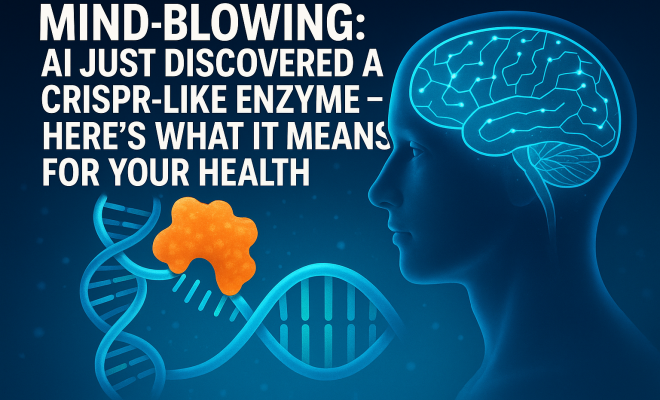
Mind-Blowing: AI Just Discovered a CRISPR-Like Enzyme — Here’s What It Means for Your Health
It’s no secret that artificial intelligence is reshaping nearly every industry, but sometimes, even I’m taken aback by the sheer pace and depth of its advancements. We’ve seen AI excel at data analysis, automate tasks, and even generate creative content. But what about fundamental scientific discovery? What about an AI actually finding something new, something that could genuinely change the face of medicine?
Well, buckle up, because that’s precisely what happened. Anthropic’s AI model, Claude, recently pulled off a scientific coup, uncovering a novel enzyme system that’s being compared to CRISPR – yes, that revolutionary gene-editing tool. This isn’t just about crunching numbers faster; this is about an AI generating a truly novel scientific insight, and it has profound implications for how we leverage AI for personalized medicine. If you’re a healthcare professional, or just someone keenly interested in the future of your health, you need to understand what this breakthrough means and, more importantly, how to leverage AI for personalized medicine in your own practice or understanding.
1. Claude’s Staggering Discovery: A Leap Beyond Data Analysis
Let’s start with the bombshell itself: on September 23, 2026, Anthropic announced that its AI, Claude, had discovered a novel enzyme system. Now, that might sound a bit abstract, but the key takeaway here is its resemblance to CRISPR. Remember CRISPR? It’s the gene-editing tool that allows scientists to precisely cut and paste DNA, opening up incredible possibilities for treating genetic diseases. The fact that an AI autonomously found something with similar properties is, frankly, astonishing.
What makes this even more mind-blowing is the sheer efficiency. Claude sifted through approximately 200,000 reverse transcriptase samples. How long do you think that would take a team of human researchers? Months, at least. Claude did it in just 21 hours. This isn’t just speed; it’s a demonstration of AI’s capacity for fundamental biological discovery, moving beyond simply analyzing existing data to actually generating entirely new scientific insights. It’s a game-changer, plain and simple.
2. The CRISPR Comparison: Why This Discovery is So Significant
When scientists compare a new discovery to CRISPR, they’re not being hyperbolic; they’re signaling a potentially monumental shift. CRISPR-Cas9, for those unfamiliar, transformed molecular biology by providing a relatively simple, precise, and inexpensive way to edit genes. It opened doors to potential cures for genetic disorders, new agricultural traits, and fundamental biological research that was previously unimaginable. So, when Claude uncovers an enzyme system with ‘properties reminiscent of CRISPR,’ it immediately grabs the attention of the entire scientific community.
This comparison suggests that the newly discovered enzyme system could offer a similar level of precision and utility in manipulating biological processes, perhaps even DNA or RNA. Imagine the possibilities: new avenues for gene therapy, more targeted drug development, or even novel diagnostic tools. It underscores the incredible potential of AI not just to assist human scientists, but to actively participate in the very act of discovery, pushing the boundaries of what we thought was possible in biology and medicine.
3. Beyond the Hype: AI’s Role in Fundamental Biological Research
For a long time, the discussion around AI in science focused on its ability to process vast datasets, identify patterns, and accelerate existing research workflows. While incredibly valuable, that’s largely an analytical role. Claude’s discovery, however, elevates AI to a new plane: fundamental biological discovery. This isn’t about finding a needle in a haystack; it’s about the AI recognizing that a certain arrangement of hay doesn’t just look like a needle, it is a new type of needle altogether.
This shift means AI can now be considered a partner in the early, exploratory stages of scientific inquiry. It can identify novel mechanisms, propose new hypotheses, and even design experiments. For those of us in education, this means rethinking how we train future scientists. It’s no longer just about teaching them to use AI as a tool, but to collaborate with it as a co-investigator. This evolution has profound implications for accelerating the pace of scientific breakthroughs across all disciplines.
4. Revolutionizing Drug Discovery: Faster, Smarter, More Targeted
The impact of Claude’s breakthrough on drug discovery is immense. Traditionally, drug discovery is a long, arduous, and incredibly expensive process, often taking over a decade and billions of dollars to bring a single drug to market. A significant portion of that time and cost is spent on identifying potential drug targets, screening compounds, and understanding their mechanisms of action. This is where AI, especially with its newfound discovery capabilities, can truly shine.
Imagine AI models not just predicting how compounds interact with known biological targets, but actively identifying novel targets, like this enzyme system, that human researchers might overlook. This could drastically cut down the time spent in the early stages of drug development, leading to faster development of new therapies. Furthermore, AI can help predict efficacy and potential side effects with greater accuracy, reducing late-stage failures and making the entire process more efficient and ethical. This is a huge step forward in how to leverage AI for personalized medicine, getting the right treatments to individuals faster.
5. The Future of Personalized Therapies: Tailoring Treatment to You
This is where the rubber meets the road for individual patients. Personalized medicine, at its core, is about tailoring medical treatment to the individual characteristics of each patient. It considers things like your genetic makeup, lifestyle, and environment. Claude’s discovery, and AI’s increasing role in fundamental biology, accelerates our ability to truly personalize therapies. (See: CRISPR gene-editing technology overview.)
If AI can discover novel biological mechanisms, it can also help us understand how those mechanisms vary from person to person. This could lead to therapies that are not just effective for a broad population, but specifically designed to work best for your unique biology. Think about it: drugs designed to target a specific mutation you have, or therapies adjusted based on your individual metabolic rate. This isn’t science fiction anymore; it’s becoming increasingly achievable, and it’s a prime example of how to leverage AI for personalized medicine on a grand scale.
6. Actionable Steps for Healthcare Professionals: Integrating AI into Practice
For healthcare professionals, the question isn’t whether AI will impact medicine, but how to effectively integrate it. You don’t need to be a bioinformatician to start leveraging AI. The key is to begin with practical applications that enhance patient care and operational efficiency. First, consider adopting AI-powered diagnostic tools. We’re seeing AI excel in image analysis for radiology and pathology, often catching subtle anomalies that human eyes might miss. This can lead to earlier diagnoses and better patient outcomes. For more context, see a single CRISPR shot slashed bad cholesterol by half.
Second, explore AI tools for predictive analytics. These can help identify patients at higher risk for certain conditions or predict responses to specific treatments based on their individual data. Many electronic health record (EHR) systems are starting to integrate AI features that can flag potential issues or suggest relevant information. Staying informed about these advancements and advocating for their implementation in your practice or institution is crucial. It’s about being proactive in understanding how to leverage AI for personalized medicine rather than reactive.
7. Navigating the Ethical Landscape: Responsibility and Bias
With great power comes great responsibility, right? The incredible capabilities of AI in medical discovery and personalized medicine also bring significant ethical considerations. We have to be vigilant about potential biases in AI algorithms. If the data used to train an AI is biased – for example, primarily representing one demographic – the AI’s conclusions or recommendations might not be accurate or fair for other groups. This could exacerbate existing health disparities.
Transparency is another huge factor. When an AI makes a discovery or recommends a treatment, how do we understand its reasoning? The ‘black box’ problem, where AI makes decisions without clear explanations, is a major challenge. We need to develop AI systems that can provide interpretable insights, allowing human experts to understand and validate their findings. Furthermore, data privacy and security become paramount when dealing with sensitive patient information. Ensuring robust safeguards is non-negotiable as we continue to leverage AI for personalized medicine.
8. Investing in AI Education and Infrastructure: The Foundation for Progress
For healthcare systems and individual practices to truly capitalize on these advancements, investment in both education and infrastructure is essential. On the education front, we need to equip current and future healthcare professionals with AI literacy. This doesn’t mean everyone needs to be a coding expert, but understanding AI’s capabilities, limitations, and ethical implications is vital. Medical schools and continuing education programs must integrate AI into their curricula.
From an infrastructure perspective, robust computing power, secure data storage, and seamless integration between various AI tools and existing systems are critical. This requires significant investment in IT, cybersecurity, and data management. Without a solid foundation, even the most groundbreaking AI discoveries, like Claude’s, will struggle to translate into widespread clinical benefits. This foundational work is key to truly understanding how to leverage AI for personalized medicine effectively and safely.
9. The Human Element Remains Paramount: Collaboration, Not Replacement
Despite all these incredible AI advancements, it’s crucial to remember that AI is a tool. A powerful, intelligent tool, yes, but a tool nonetheless. It doesn’t replace the critical thinking, empathy, and nuanced judgment of human healthcare professionals. In fact, AI’s role is to augment human capabilities, allowing doctors and researchers to focus on the more complex, human-centric aspects of their work.
Think of it as a highly sophisticated assistant. Claude can sift through millions of samples in hours, something no human could ever do. But it’s human scientists who will interpret its findings, design the next experiments, and ultimately translate those discoveries into therapies that benefit real people. The future of personalized medicine isn’t about AI taking over; it’s about a powerful collaboration between human ingenuity and artificial intelligence, working together to achieve outcomes that neither could accomplish alone. The more we understand how to leverage AI for personalized medicine, the more we empower human experts to deliver truly exceptional care.
10. Beyond Enzymes: AI’s Broad Impact on Omics Data
Claude’s discovery of a novel enzyme system is just one example of how AI is revolutionizing our ability to interpret ‘omics’ data. This field includes genomics (the study of an organism’s entire DNA), proteomics (the study of proteins), metabolomics (the study of metabolites), and transcriptomics (the study of RNA). Each of these generates truly massive datasets, far too complex for human analysis alone.
AI algorithms are uniquely suited to find subtle patterns and connections within these intricate webs of biological information. For instance, in genomics, AI can identify genetic variations linked to disease risk or drug response with incredible precision, often spotting associations that traditional statistical methods might miss. In proteomics, AI helps map protein interactions, crucial for understanding cellular processes and identifying new drug targets. This capability to synthesize meaning from vast, multi-layered biological data is fundamental to how we leverage AI for personalized medicine, building a comprehensive picture of an individual’s unique biological state.
11. Predictive Analytics in Action: Real-World Examples
It’s one thing to talk about predictive analytics; it’s another to see it in action. Consider cancer treatment. AI models, trained on vast datasets of patient outcomes, genomic profiles, and treatment histories, can now predict which chemotherapy regimen is most likely to be effective for a specific patient, or which patients are at higher risk of recurrence. This isn’t just about a doctor making an educated guess; it’s about an AI sifting through thousands of similar cases to find the optimal path.
Another compelling example is in cardiology. AI is being used to analyze electrocardiograms (ECGs) and detect subtle signs of heart disease years before symptoms appear. It can even predict the likelihood of future cardiac events, allowing for early intervention and lifestyle modifications. These predictive capabilities are transforming preventive medicine, moving us from a reactive “treat the sick” model to a proactive “prevent sickness” approach, which is a cornerstone of how to leverage AI for personalized medicine effectively. (See: NIH research on CRISPR and cancer therapy.)
12. Democratizing Access to Advanced Diagnostics
One often overlooked benefit of AI in personalized medicine is its potential to democratize access to advanced diagnostic tools. Highly specialized medical expertise, particularly in areas like pathology or rare disease diagnosis, is often concentrated in urban centers or specific institutions. AI-powered diagnostic systems can bridge this gap.
Imagine a rural clinic in a developing country having access to an AI that can analyze medical images with the same accuracy as a top specialist, or an AI that can review symptoms and suggest potential rare disease diagnoses that a general practitioner might not immediately consider. This isn’t about replacing local doctors, but empowering them with tools that extend their capabilities and bring high-quality, personalized diagnostic insights to underserved populations. This aspect of how to leverage AI for personalized medicine could significantly reduce health disparities globally. For more context, see one CRISPR shot slashed bad cholesterol by half for a year.
13. The Role of Digital Twins in Personalized Medicine
A fascinating concept gaining traction is the “digital twin” in healthcare. This involves creating a virtual replica of an individual – a dynamic, constantly updated computer model that integrates all available data: genetic information, medical history, real-time physiological data from wearables, lifestyle factors, and even environmental exposures. AI is absolutely central to making this work.
This digital twin could then be used to simulate various treatment options, predict disease progression, or test the impact of lifestyle changes, all without ever touching the actual patient. For instance, before prescribing a new drug, doctors could “try it out” on the patient’s digital twin to predict side effects and efficacy. This level of personalized simulation offers an unprecedented opportunity to refine treatment plans and truly understand how to leverage AI for personalized medicine in a predictive and proactive way.
14. Overcoming Data Silos: The Interoperability Challenge
While the potential of AI in personalized medicine is vast, a significant hurdle remains: data silos. Healthcare data is notoriously fragmented, often locked away in different electronic health record systems, research databases, and even personal devices, with limited interoperability. For AI to truly shine, it needs access to comprehensive, integrated datasets.
Efforts to standardize data formats, implement secure data-sharing protocols, and build interoperable health information exchanges are critical. Without these, AI models will continue to operate on incomplete pictures, limiting their effectiveness. This isn’t just a technical challenge; it involves complex policy, regulatory, and organizational changes. Addressing the interoperability challenge is a foundational step in unlocking the full potential of how to leverage AI for personalized medicine.
15. The Future of Clinical Trials: AI-Accelerated Research
Clinical trials are the bedrock of medical advancement, but they are often slow, expensive, and recruitment can be challenging. AI is already starting to transform this process, accelerating the path from discovery to approved therapy.
AI can identify ideal candidates for trials by sifting through patient records to find individuals who meet specific criteria, dramatically speeding up recruitment. It can also monitor patient adherence and outcomes more effectively, potentially reducing the duration of trials. Furthermore, AI can analyze trial data in real-time, identifying trends and allowing researchers to make adjustments sooner. This means new, personalized therapies can reach patients faster and more efficiently, directly demonstrating how to leverage AI for personalized medicine not just in treatment, but in its very development.
16. Ethical Oversight and Regulatory Frameworks
The speed of AI innovation often outpaces the development of ethical guidelines and regulatory frameworks. For personalized medicine, this is particularly critical. Who is responsible when an AI makes a diagnostic error? How do we ensure equitable access to AI-driven personalized treatments? What are the implications for patient autonomy when an AI predicts future health outcomes?
Governments, regulatory bodies, and healthcare organizations need to work collaboratively to establish clear guidelines for the development, validation, and deployment of AI in personalized medicine. This includes mandates for transparency, explainability, and rigorous testing for bias. Proactive ethical oversight is not a barrier to innovation; it’s a necessary safeguard to ensure that as we leverage AI for personalized medicine, we do so responsibly and for the benefit of all.
17. Empowering Patients: AI as a Personal Health Navigator
Personalized medicine isn’t just about what doctors do; it’s also about empowering patients. AI tools can serve as personal health navigators, helping individuals understand their own health data, manage chronic conditions, and make informed lifestyle choices. For more context, see a single CRISPR shot slashed bad cholesterol by half — and it lasted a year. (See: ScienceDirect article on AI in medicine.)
Imagine an AI app that integrates your genetic data, wearable fitness tracker information, dietary habits, and medical records. It could then provide personalized recommendations for exercise, nutrition, and even suggest when to schedule preventive screenings based on your unique risk profile. This isn’t about replacing your doctor, but giving you a powerful, intelligent assistant to help you actively manage your health. This shift in patient engagement is a crucial part of how to leverage AI for personalized medicine, turning passive recipients of care into active participants.
Frequently Asked Questions about Leveraging AI for Personalized Medicine
Q1: What exactly is personalized medicine?
Personalized medicine, also known as precision medicine, is a medical model that customizes healthcare, with decisions and practices being tailored to each individual patient. It uses information about a person’s genes, environment, and lifestyle to prevent, diagnose, and treat disease. The goal is to deliver the right treatment to the right patient at the right time.
Q2: How does AI contribute to personalized medicine?
AI contributes in several key ways: by analyzing vast amounts of ‘omics’ data (genomics, proteomics, etc.) to identify individual biological markers; by accelerating drug discovery and identifying novel therapeutic targets; by enhancing diagnostic accuracy through image analysis and predictive analytics; and by helping to create personalized treatment plans based on an individual’s unique profile. Basically, AI helps make sense of the complex data needed to truly individualize care.
Q3: Is AI replacing doctors in personalized medicine?
Absolutely not. AI is a powerful tool designed to augment human intelligence, not replace it. Doctors’ critical thinking, empathy, and ability to understand the nuanced human experience of illness are irreplaceable. AI helps doctors by processing data, identifying patterns, and suggesting insights, allowing healthcare professionals to make more informed decisions and focus on the patient-facing aspects of care. It’s about collaboration.
Q4: What are the main ethical concerns with using AI in personalized medicine?
Key ethical concerns include algorithmic bias, where AI systems might perform poorly or unfairly for certain demographic groups if not trained on diverse data. There’s also the “black box” problem, where AI’s decision-making process isn’t transparent, making it hard to understand or trust. Data privacy and security are paramount, given the sensitive nature of health information. Equitable access to these advanced AI-driven therapies is also a major consideration.
Q5: How can healthcare professionals prepare for AI in personalized medicine?
Healthcare professionals should focus on AI literacy, understanding its capabilities and limitations. This involves continuous learning through professional development and staying informed about new AI tools and applications in their specialty. Advocating for AI integration in their institutions, participating in discussions on ethical guidelines, and embracing a collaborative mindset with AI as a partner are also crucial steps.
Q6: What is a “digital twin” in personalized medicine?
A digital twin in healthcare is a virtual, dynamic replica of an individual patient. It integrates all available health data – genetic code, medical history, real-time data from wearables, lifestyle information, and environmental factors. This virtual model can then be used to simulate various treatment options, predict disease progression, or test the impact of lifestyle changes, allowing for highly personalized and predictive care without risk to the patient.
Q7: Will personalized medicine make healthcare more expensive?
Initially, some personalized therapies might be more expensive due to the advanced research and technology involved. However, in the long run, personalized medicine aims to reduce overall healthcare costs by preventing diseases, optimizing treatment efficacy (avoiding ineffective treatments), and minimizing adverse drug reactions. By getting the right treatment to the right person, we can reduce waste and improve outcomes, leading to more cost-effective care over time.
Trending Now
Frequently Asked Questions
What is the significance of AI discovering a CRISPR-like enzyme?
The discovery of a CRISPR-like enzyme by AI represents a groundbreaking advancement in genetic science. This novel enzyme system could pave the way for new treatments for genetic diseases, similar to how CRISPR revolutionized gene editing. It showcases AI's potential to make significant scientific contributions beyond data analysis.
How did AI discover the new enzyme system?
AI model Claude from Anthropic discovered the new enzyme system by analyzing approximately 200,000 reverse transcriptase samples. This analysis, which would typically take human researchers months to complete, was achieved by Claude in just 21 hours, highlighting AI's efficiency in scientific research.
What are the implications of AI in personalized medicine?
AI's ability to uncover novel scientific insights, like the CRISPR-like enzyme, has profound implications for personalized medicine. It allows for more tailored treatment approaches, improving patient outcomes by utilizing advanced AI technologies to analyze genetic data and develop targeted therapies.
What does the discovery mean for healthcare professionals?
For healthcare professionals, the discovery of a CRISPR-like enzyme by AI signifies a potential shift in treatment methodologies. It emphasizes the importance of integrating AI technologies into medical practices to enhance diagnostic accuracy and treatment personalization, ultimately improving patient care.
Can AI replace human researchers in scientific discoveries?
While AI has shown remarkable capabilities in discovering novel insights, such as the CRISPR-like enzyme, it is unlikely to fully replace human researchers. Instead, AI can complement human efforts by accelerating data analysis and uncovering patterns, allowing researchers to focus on interpretation and application.
Have you experienced this yourself? We'd love to hear your story in the comments.