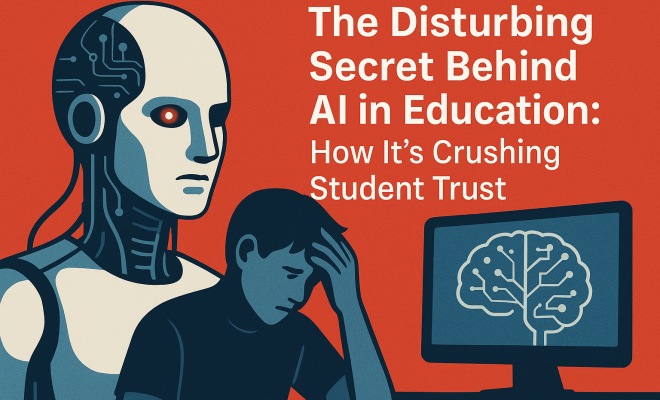
The Disturbing Secret Behind AI in Education: How It’s Crushing Student Trust
“`html
When you think about the rapid rise of AI in education, what’s the first thing that comes to mind? For many, it’s the promise of personalized learning, smart tutoring systems, or perhaps even automating tedious grading tasks. But there’s a darker, less-talked-about side to this technological revolution, one that’s quietly eroding the very foundation of effective learning: the relationship between students and teachers.
A recent report from the Center for Digital Thriving at Harvard Graduate School of Education threw a spotlight on this unsettling trend. It turns out that teachers’ intense, almost obsessive, focus on sniffing out AI-generated cheating is doing more than just catching a few bad apples; it’s actively damaging the trust and rapport they share with their students. This isn’t just about a few rogue students trying to game the system; it’s about a systemic shift that’s turning classrooms into suspicious battlegrounds, and frankly, it’s a conversation we desperately need to have.
1. The Erosion of Trust: A Classroom Under Scrutiny
Imagine being a student, pouring your effort into an assignment, only to have your teacher look at your work with an almost accusatory gaze, wondering if a bot wrote it. This isn’t hyperbole; it’s the reality for many students today. The Harvard report highlights that the overwhelming emphasis on detecting AI cheating is creating an environment of suspicion, and that suspicion, left unchecked, poisons the well of trust that’s so crucial for learning.
Teachers, understandably, feel caught between a rock and a hard place. They’re tasked with upholding academic integrity in an era where sophisticated AI tools can generate essays, code, and even art in seconds. The pressure to identify AI-assisted work is immense, leading some educators to adopt a ‘guilty until proven innocent’ mindset. But what does this do to a student who’s genuinely put in the work? It fosters resentment, disengagement, and a sense that their efforts aren’t valued, only scrutinized.
2. Bans and Pauses: A Cry for Time and Clarity
It’s not just individual teachers struggling with this new paradigm. Major school districts across the United States have taken drastic measures. New York City, for instance, implemented a temporary ban on student AI use, a move echoed by the Los Angeles Unified School District, which also paused its use of AI tools. These aren’t minor decisions; they reflect a profound uncertainty and a desperate need for educators and administrators to get a handle on what AI truly means for the classroom.
These bans and pauses are more than just reactionary measures; they’re a tacit admission that the educational system wasn’t ready for the lightning-fast emergence of generative AI. They represent a collective deep breath, an attempt to assess the actual impact of these tools before fully integrating them. It’s an opportunity, however fraught, to establish clear guidelines, ethical frameworks, and pedagogical approaches that can harness the benefits of AI without sacrificing the core values of education.
3. Microsoft’s Pledge: A Glimmer of Hope for Privacy
In this swirling vortex of concern, one major tech player has stepped forward with a notable commitment: Microsoft. They’ve pledged to adhere to stringent AI privacy and safety standards specifically for their educational products. Crucially, they’ve promised not to use student data for training their AI systems and to avoid creating features designed to foster emotional dependency.
This commitment is a big deal, especially when we talk about the ethical implications of AI in education. Student data, from performance metrics to communication patterns, is incredibly sensitive. The idea that this data could be used to train AI models without explicit consent, or worse, to create tools that manipulate student emotions, is frankly chilling. Microsoft’s stance offers a potential blueprint for responsible AI development in EdTech, setting a bar that other companies should absolutely strive to meet.
4. Google’s Gemini: The Elephant in the EdTech Room
While Microsoft is making pledges, Google, a truly dominant force in EdTech with its ubiquitous Google Classroom, is facing increasing scrutiny. Their decision to enable the Gemini chatbot for many K-12 students in Google Classroom has raised some serious eyebrows. The question everyone’s asking is: Where are Google’s similar privacy protections? Do they have the same robust commitments as Microsoft regarding student data and emotional dependency?
Google’s presence in schools is massive, integrating deeply into daily learning routines. The implications of a powerful AI like Gemini being so readily accessible to young students, without clear, publicly stated, and stringent privacy safeguards, are significant. It places a huge burden on schools and parents to understand the risks, and it certainly fuels the skepticism that many educators already feel about big tech’s role in the classroom. Transparency and explicit commitments are paramount here, and Google needs to address these concerns head-on. (See: Harvard Graduate School of Education.)
5. Academic Integrity: The Shifting Sands of Authenticity
The core of this debate often circles back to academic integrity. What does ‘original work’ even mean in an era where AI can produce polished text in an instant? This isn’t just about catching cheaters; it’s about redefining what learning looks like and how we assess it. If an AI can write an essay, what’s the value of a student spending hours crafting one?
Educators are being forced to rethink assignments, assessment methods, and even the very purpose of homework. Perhaps the focus needs to shift from rote memorization and simple information recall to higher-order thinking skills like critical analysis, problem-solving, and creative synthesis – tasks that, for now, remain uniquely human. The challenge of AI in education isn’t just about detection; it’s about adaptation and innovation in pedagogy. For more context, see AI Learning Experience Architects and their impact on education.
6. Student Well-being: The Unseen Costs of Constant Suspicion
Let’s not forget the human element here. Beyond the academic concerns, the constant suspicion surrounding AI use takes a toll on student well-being. Imagine the stress of knowing that every piece of writing you submit might be viewed through a lens of doubt. This creates anxiety, discourages creativity, and can make students feel alienated from their teachers and the learning process itself.
A healthy student-teacher relationship is built on trust, mutual respect, and a shared goal of learning. When that foundation is shaken by widespread suspicion, students may become less likely to ask for help, less engaged in class discussions, and ultimately, less motivated to learn. We’re talking about the potential for a generation of students who view their teachers less as mentors and more as digital detectives, and that’s a truly troubling prospect.
7. Ethical Implications: The Uncharted Territory of AI Ethics in Education
The rapid evolution of AI technology means we’re constantly venturing into uncharted ethical territory. Beyond privacy and academic integrity, there are questions about bias in AI algorithms, the potential for digital divides, and the long-term impact on human cognitive development. Are we creating a generation that relies too heavily on AI for critical thinking, potentially stunting their own intellectual growth?
The ethical framework for AI in education is still very much under construction. Who decides what’s acceptable use? Who ensures fairness and equity? What are the implications for students with learning disabilities who might genuinely benefit from AI assistance, but then face the same suspicion as those trying to cheat? These aren’t easy questions, and they demand careful, inclusive dialogue involving educators, ethicists, policymakers, and, crucially, students themselves.
8. Monetization Opportunities: Navigating the EdTech Landscape
Despite the challenges, the integration of AI into education also presents significant commercial opportunities within the EdTech and software niches. For businesses and innovators, the growing demand for solutions to these problems is undeniable. We’re seeing a boom in interest for tools that can genuinely help educators, rather than just add to their headaches.
Consider the market for sophisticated AI detection software that offers more nuanced analysis than simple plagiarism checkers, helping teachers differentiate between AI assistance and outright fraud. Then there’s the burgeoning need for robust cybersecurity solutions tailored for schools, protecting sensitive student data from ever-evolving threats. Beyond that, the demand for online courses focused on AI literacy and ethics is skyrocketing, catering to teachers who want to understand and responsibly integrate AI, as well as students who need to learn how to use these powerful tools ethically. Commercial intent searches for ‘best AI tools for education’ or ‘student data privacy software’ are clearly indicating a hungry market ready for innovative, trustworthy solutions.
9. Rethinking Pedagogy: Beyond Detection, Towards Integration
Ultimately, the conversation around AI in education can’t just be about detection and prohibition. It has to evolve into a discussion about thoughtful integration. How can we leverage AI to enhance learning, rather than just viewing it as a threat to academic honesty? This requires a fundamental rethinking of pedagogy, moving away from assignments easily generated by AI towards those that require uniquely human skills.
Imagine projects that require students to critically evaluate AI-generated content, identify its biases, and improve upon it. Picture lessons where AI acts as a research assistant, allowing students to delve deeper into complex topics and spend more time on analysis and synthesis. The key is to teach students how to use AI responsibly and effectively, treating it as a tool, much like a calculator or a word processor, rather than a forbidden shortcut. This transformative approach demands creativity, courage, and a willingness to embrace change from educators at all levels.
10. The Promise of Personalized Learning: A Deeper Dive
While the focus often drifts to the downsides, the original promise of AI in education—personalized learning—remains incredibly compelling. Imagine an AI system that genuinely understands each student’s unique learning style, pace, and knowledge gaps. It’s not just about adapting content; it’s about tailoring the entire learning journey. For example, an AI could identify that one student struggles with algebraic concepts and then provide targeted practice problems, interactive tutorials, and even different explanations of the same concept until mastery is achieved. Another student, excelling in that same area, might be presented with advanced challenges or applications of algebra to real-world problems. (See: Associated Press on AI in education.)
This goes beyond simple differentiation. It’s about creating a truly adaptive learning environment where every student gets the right support at the right time. Think about intelligent tutoring systems that can offer immediate, specific feedback, much like a human tutor, but available 24/7. These systems could analyze student responses, pinpoint misconceptions, and guide them through problem-solving processes step-by-step. The potential for accelerating learning and ensuring no student is left behind is immense, provided these tools are developed and implemented with ethical considerations and student well-being at their core.
11. AI as an Assistant for Teachers: Beyond Grading
We often talk about AI automating grading, but its potential as a teacher’s assistant extends far beyond that. Imagine an AI helping teachers analyze student engagement data from online platforms, identifying patterns that suggest disinterest or confusion. This could free up teachers to intervene proactively, rather than waiting for grades to drop. For more context, see the rise of AI in EdTech and its implications for teachers.
AI could also assist in curriculum development by suggesting relevant, up-to-date resources, or even helping design diverse assessment types that cater to different learning styles. For instance, an AI could help generate a variety of question formats for a quiz, ensuring it’s not just multiple-choice, but includes open-ended questions, scenario-based problems, or even creative tasks. Furthermore, AI tools could help manage administrative tasks like scheduling parent-teacher conferences, organizing classroom resources, or even drafting personalized communication to parents about student progress. This support system could significantly reduce teacher burnout, allowing educators to focus more on direct student interaction and innovative instruction, which is where their human expertise truly shines.
12. Addressing the Digital Divide: Ensuring Equitable Access to AI Tools
A critical ethical consideration that often gets overlooked is the digital divide. As AI tools become more integrated into education, how do we ensure that all students, regardless of their socioeconomic background or geographical location, have equitable access to these powerful resources? If AI-powered personalized learning becomes the gold standard, what happens to students in underfunded schools or those without reliable internet access at home?
This isn’t just about providing devices; it’s about ensuring consistent connectivity, adequate training for both students and teachers, and access to high-quality, ethically developed AI software. Without proactive measures, AI in education risks exacerbating existing inequalities, creating an even wider gap between those who can leverage advanced learning tools and those who cannot. Policymakers, EdTech companies, and school districts must collaborate to develop strategies that guarantee inclusive access and digital literacy for everyone, turning the digital divide into a bridge of opportunity.
13. The Role of AI Literacy: A New Core Competency
Just as critical thinking and media literacy are essential skills for students today, AI literacy is rapidly becoming a core competency. This isn’t just about knowing how to use AI tools; it’s about understanding how they work, their capabilities, their limitations, and their ethical implications. Students need to learn to critically evaluate AI-generated content, recognizing potential biases, inaccuracies, or even outright fabrications.
Teachers need to equip students with the skills to prompt AI effectively, to refine its outputs, and to use it as a powerful research and creative assistant rather than a substitute for their own thought processes. This means explicitly teaching about data privacy, algorithmic bias, and the responsible use of AI for academic and personal tasks. Integrating AI literacy into the curriculum from an early age will prepare students not only for higher education but also for a future workforce where interacting with AI will be commonplace.
14. Comparative Perspectives: AI Integration Models Globally
It’s helpful to look at how other countries are approaching AI in education. For instance, China has invested heavily in AI-powered adaptive learning platforms, with some schools using facial recognition to monitor student engagement (a controversial practice from a privacy standpoint). Their focus is often on large-scale data collection to optimize learning paths and identify at-risk students.
In contrast, Nordic countries tend to prioritize human-centric AI design, focusing on tools that augment teacher capabilities and enhance student creativity, with strong emphasis on data privacy and ethical guidelines. The European Union, through initiatives like the AI Act, is also developing comprehensive regulations to ensure AI systems are trustworthy, safe, and respect fundamental rights. Learning from these diverse approaches can help us forge a balanced path, avoiding the pitfalls while harnessing the benefits of AI in our own educational systems. It’s not a one-size-fits-all solution, and understanding global trends provides valuable context.
15. The Future of Assessment: Beyond Traditional Exams
With AI’s ability to generate content, traditional forms of assessment like essays and take-home exams are increasingly vulnerable. This forces us to reconsider how we truly measure learning. The future of assessment might involve more project-based learning, portfolios, oral presentations, or even interactive simulations where students demonstrate understanding through application rather than mere recall or written output. For more context, see careers reshaped by AI advancements in education. (See: New York Times on trust in education.)
Imagine assessments where students are given an AI-generated solution to a complex problem and tasked with identifying its flaws, improving it, and justifying their changes. Or assessments that require students to collaborate with AI to produce a creative work, then explain their iterative process and the specific contributions of both human and machine. This shift would align perfectly with the need for higher-order thinking skills and move away from tasks that AI can easily replicate, pushing students to engage in deeper, more meaningful demonstrations of their knowledge and abilities.
Frequently Asked Questions About AI in Education
Q1: Is AI in education primarily a threat or an opportunity?
It’s both. AI presents incredible opportunities for personalized learning, administrative efficiency, and access to resources. However, it also poses significant threats to academic integrity, student privacy, and the fundamental trust between students and teachers if not implemented thoughtfully and ethically. The key is to mitigate the threats while maximizing the opportunities through careful planning and responsible development.
Q2: How can schools prevent AI cheating effectively without damaging trust?
Preventing AI cheating requires a multi-faceted approach. First, redesign assignments to focus on critical thinking, creativity, and personal reflection that AI struggles to replicate. Emphasize process over product, requiring students to show drafts, research notes, or explain their thought process. Second, teach AI literacy so students understand appropriate use. Third, foster open communication where students feel comfortable discussing AI tools with teachers. Finally, consider using AI detection tools as a guide, not definitive proof, and always pair them with human judgment and conversations with students.
Q3: What are the biggest privacy concerns with AI in schools?
The biggest privacy concerns include the collection and storage of sensitive student data (academic performance, behavioral patterns, personal information), how that data is used (especially for training AI models), and the potential for data breaches. There’s also concern about AI models creating “emotional dependency” or personalized advertising, and ensuring compliance with regulations like FERPA and GDPR. Schools need clear policies, transparent communication, and robust security measures.
Q4: How can teachers be trained to use AI effectively and ethically?
Comprehensive professional development is crucial. This training should cover what AI is, how it works, practical applications in the classroom (like differentiating instruction or automating tasks), ethical considerations (bias, privacy), and strategies for teaching AI literacy to students. It should also involve hands-on practice with various AI tools and opportunities for peer collaboration to share best practices and address concerns.
Q5: Will AI replace teachers?
No, AI is highly unlikely to replace teachers. While AI can automate certain tasks and provide personalized learning support, it cannot replicate the human elements essential to education: empathy, emotional intelligence, mentorship, fostering community, and inspiring critical thinking in nuanced ways. AI is a tool to augment teachers’ capabilities, free up their time for deeper student interaction, and enhance the learning experience, not to replace the irreplaceable human connection in the classroom.
The emotionally charged debate surrounding AI in education is far from over. It’s a complex, multifaceted issue with no easy answers. But one thing is clear: if we allow the fear of cheating to overshadow the fundamental importance of trust and genuine connection in the classroom, we risk doing irreparable harm to the very fabric of learning. We need to move beyond suspicion and towards a future where AI serves as an ally in education, not an adversary that drives a wedge between students and their teachers.
“`
Trending Now
- the complete explanation
- this guide on the ai revolution in edtech: why these courses are your path to a high-demand career
- this guide on the ai revolution in edtech: 10 careers reshaped by cognilearn’s breakthrough
- our breakdown of this crucial act could drastically cut the cost of becoming an english learner teacher
Frequently Asked Questions
How is AI impacting student trust in classrooms?
AI is creating an environment of suspicion in classrooms, as teachers focus heavily on detecting AI-generated work. This scrutiny can damage the trust between students and teachers, leading to resentment and disengagement among students who feel their efforts are doubted.
What are the negative effects of AI on education?
The rise of AI in education has led to increased suspicion and scrutiny in classrooms, undermining the trust necessary for effective learning. Teachers' focus on identifying AI-assisted work can create an adversarial atmosphere, negatively impacting student engagement and motivation.
Why are teachers concerned about AI-generated cheating?
Teachers are concerned about AI-generated cheating because it poses a challenge to academic integrity. The pressure to identify and combat this issue can lead to a mindset where students are presumed guilty, which ultimately harms the student-teacher relationship.
What did the Harvard report say about AI in education?
The Harvard report highlighted that the intense focus on detecting AI cheating is damaging the trust between students and teachers. It reveals a systemic shift in classrooms, turning them into suspicious environments that hinder effective learning.
How can trust be rebuilt in AI-affected classrooms?
To rebuild trust in classrooms affected by AI scrutiny, educators can focus on open communication, foster a supportive environment, and emphasize the value of genuine student effort. Encouraging collaboration and understanding can help alleviate the tension surrounding AI-generated work.
Agree or disagree? Drop a comment and tell us what you think.