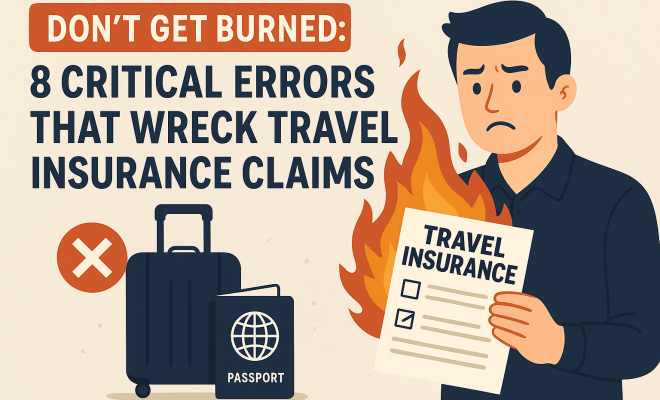
Don’t Get Burned: 8 Critical Errors That Wreck Travel Insurance Claims
Travel is an adventure, a chance to explore new places, soak in different cultures, and make memories that last a lifetime. But let’s be honest, sometimes things go sideways. Flights get canceled, luggage goes missing, or, heaven forbid, you get sick or injured far from home. That’s where travel insurance is supposed to be your safety net, right? It’s meant to protect your investment and give you peace of mind.
Yet, I’ve seen countless stories, and frankly, it’s heartbreaking, of travelers who thought they were covered only to have their claims denied when they needed them most. A recent article really hammered this home, highlighting a particularly costly mistake many Americans make: buying travel insurance too late. This isn’t just a minor oversight; it can invalidate crucial time-sensitive benefits, like waivers for pre-existing conditions or eligibility for ‘Cancel For Any Reason’ (CFAR) coverage. You see, people often assume ‘travel protection’ means comprehensive coverage, but they fail to read the fine print, the contractual rules, and those all-important deadlines. This oversight can cost you thousands, especially on those big, bucket-list trips or if you’re an older traveler with more complex health considerations.
It’s a common scenario: you’ve spent months planning, saved up your hard-earned money, and then, a hiccup. Maybe a family emergency forces a cancellation, or an unexpected medical issue arises abroad. You confidently file a claim, only to be met with a rejection letter. Why? Because you’ve fallen into one of the many traps that can turn a seemingly solid travel insurance policy into a worthless piece of paper. The good news is, with a little foresight and attention to detail, you can learn how to avoid travel insurance mistakes and ensure your policy actually works when you need it. Let’s break down the most common pitfalls and, more importantly, how to steer clear of them.
1. Buying Insurance Too Late: The Deadline Disaster
This is probably the biggest, most expensive mistake people make, and it’s one that a recent article brought sharply into focus. Many travelers procrastinate, thinking they can just grab a policy a week or two before their trip. What they don’t realize is that some of the most valuable benefits in travel insurance are time-sensitive and come with strict enrollment windows, often within 10-21 days of your initial trip deposit.
Take, for instance, a pre-existing condition waiver. If you or a family member has a medical condition that could potentially flare up during your trip, you absolutely need this waiver. Without it, any medical claim related to that condition will likely be denied. To get this waiver, you typically have to purchase your insurance very early in the trip planning process – usually within that initial 10-21 day window after your first payment for the trip. The same goes for ‘Cancel For Any Reason’ (CFAR) coverage, which is a fantastic add-on that offers unparalleled flexibility. If you want the option to cancel your trip for literally any reason and still get a significant portion of your money back, you almost always have to buy CFAR coverage within that same tight initial booking window.
Missing these deadlines means you forfeit these crucial protections, leaving you exposed to significant financial risk. It’s not enough to just buy a policy; you need to buy the *right* policy *at the right time*. So, as soon as you put down that deposit for your flight or hotel, make travel insurance one of your very next considerations. Don’t wait until you’re packing your bags; by then, it’s often too late for the most important benefits.
2. Not Understanding What ‘Cancel For Any Reason’ (CFAR) Really Means: The Misunderstood Lifeline
CFAR coverage is often misunderstood, yet it’s one of the most powerful tools in a traveler’s arsenal, especially in an unpredictable world. Many people hear ‘Cancel For Any Reason’ and assume it means a 100% refund no matter what. That’s a common misconception, and it’s a critical mistake when trying to figure out how to avoid travel insurance mistakes. While CFAR does offer incredible flexibility, it typically reimburses only 50% to 75% of your non-refundable trip costs, not the full 100%.
Furthermore, as mentioned, CFAR isn’t just something you can add on at the last minute. It’s almost always an optional upgrade to a standard comprehensive policy, and you usually have to purchase it within a very specific timeframe, often 10-21 days of your initial trip deposit. If you miss that window, you won’t be eligible for it. This type of coverage is invaluable for those who want maximum flexibility – maybe you’re worried about work commitments, a change of heart, or simply a global event that doesn’t trigger standard trip cancellation coverage. It’s a premium product for a reason, offering peace of mind that goes beyond typical covered perils.
When considering CFAR, always read the specific policy wording to understand the reimbursement percentage, the exact purchase deadlines, and any other conditions. Don’t just assume. This coverage is a game-changer for many, but only if you understand its nuances and act quickly to secure it. It’s an investment, yes, but for many, it’s one that pays dividends in flexibility and reduced stress.
3. Ignoring the Fine Print and Policy Exclusions: The Devil in the Details
Ah, the fine print. Who really reads those dense policy documents, right? Well, you should. Seriously. This is where most travelers get tripped up. Assuming what your policy covers without actually reading it is a recipe for disaster. Every travel insurance policy comes with a list of covered perils and, just as importantly, a list of exclusions. (See: CDC travel health information.)
For example, many policies won’t cover certain high-risk activities like skydiving, bungee jumping, or even scuba diving unless you purchase an additional rider. Some might exclude claims related to civil unrest, acts of terrorism (depending on the specific wording), or natural disasters if they were already known events before you purchased the policy. And let’s not forget the specifics around medical coverage: does it cover emergency evacuation? What’s the deductible? Is there a maximum age limit for medical claims? These are not trivial questions; they are the difference between being covered and being left with a massive bill.
I can’t stress this enough: before you click ‘buy,’ download and read the full policy document. Pay close attention to the sections on ‘Exclusions’ and ‘Covered Perils.’ If something isn’t clear, call the insurance provider and ask for clarification. Don’t be shy; it’s your money and your peace of mind on the line. Understanding these details is fundamental to learning how to avoid travel insurance mistakes.
4. Underinsuring or Overinsuring Your Trip: The Goldilocks Problem
Finding the ‘just right’ amount of coverage can be tricky, but it’s crucial for smart financial planning. Underinsuring your trip means you haven’t accounted for all your non-refundable expenses, leaving you with a financial gap if you need to cancel or cut your trip short. This often happens when travelers only consider the cost of flights and hotels, forgetting about pre-paid tours, cruise fares, concert tickets, or even the cost of a visa application.
On the flip side, overinsuring means you’re paying for more coverage than you actually need, which is essentially throwing money away. For example, if you have a robust credit card that offers excellent rental car insurance, you might not need to pay extra for that coverage on your travel insurance policy. Or, if your health insurance already covers you internationally, you might not need as high a medical coverage limit from your travel insurer, though emergency evacuation is almost always a smart idea.
A good rule of thumb is to list every single non-refundable expense you’ve paid for or are obligated to pay. This includes not just big-ticket items like flights and accommodation but also smaller, often overlooked costs. Then, compare this total to the coverage limits offered by various policies. Remember, the goal isn’t just to buy *any* insurance, but to buy the *right* amount of insurance for *your specific trip* and *your specific needs*. This thoughtful approach is key to how to avoid travel insurance mistakes.
5. Failing to Disclose Pre-Existing Medical Conditions: The Honesty Clause
This is a major red flag for insurance companies and a guaranteed way to get a claim denied. Many travelers, perhaps hoping to save a few dollars or fearing they won’t be covered, intentionally or unintentionally fail to disclose pre-existing medical conditions when purchasing a policy. This is a huge mistake. Insurance operates on good faith, and if you’re not transparent about your health history, the policy can be deemed void.
A pre-existing condition is generally defined as any illness, injury, or medical condition for which you’ve received diagnosis, care, or treatment, or had symptoms, during a specified period (often 60-180 days) before purchasing your policy. If a medical emergency arises during your trip and it’s linked to an undisclosed pre-existing condition, your insurer will likely deny the claim. They’ll look at your medical records, and if there’s a discrepancy, you’re out of luck.
The solution, as difficult as it might seem, is simple: be honest. If you have a pre-existing condition, declare it. Then, crucially, purchase your policy within the early booking window (often 10-21 days of your initial trip deposit) to qualify for a pre-existing condition waiver. This waiver ensures that your existing conditions will be covered if they cause a problem on your trip, provided you meet the policy’s specific requirements, such as being medically stable at the time of purchase. Transparency here is not just good practice; it’s essential for your coverage to be valid.
6. Not Documenting Everything for a Claim: The Paper Trail Paradox
When something goes wrong on a trip, our minds are usually racing with stress and frustration. The last thing we often think about is meticulously documenting every detail. But when it comes to filing an insurance claim, documentation is king. A lack of proper records is one of the quickest ways to see a legitimate claim stall or be denied.
Think about it: if your luggage is lost, can you provide a detailed list of its contents and their approximate value? Do you have receipts for those items? Did you get a property irregularity report from the airline? If you have a medical emergency, do you have all the hospital bills, doctor’s notes, and a clear diagnosis? What about proof of payment for medical services? For trip cancellations, do you have confirmation from the airline or tour operator about the cancellation, and receipts for all your non-refundable expenses?
The key here is to be proactive. Before your trip, make copies of all important documents: passport, visa, flight and hotel confirmations, and any pre-paid tour bookings. Keep digital copies on your phone and in cloud storage. During the trip, if an incident occurs, immediately start gathering evidence. Take photos, get written statements, collect receipts, and keep a detailed log of events, including dates, times, and names of people you spoke with. The more evidence you have, the smoother your claim process will be. This attention to detail is a prime example of how to avoid travel insurance mistakes.
7. Assuming Your Credit Card or Homeowner’s Policy is Enough: The False Sense of Security
Many people mistakenly believe their existing credit card benefits or homeowner’s insurance policy will sufficiently cover them for travel mishaps. While some premium credit cards do offer a degree of travel protection – like rental car insurance, lost luggage coverage, or even basic trip cancellation for very specific perils – these benefits are almost always secondary and far more limited than a dedicated travel insurance policy. They often come with lower coverage limits, more stringent exclusions, and a much narrower range of covered events. (See: New York Times travel insurance tips.)
For instance, a credit card might cover you if your flight is delayed for 12 hours, but it likely won’t offer comprehensive medical coverage for an illness abroad, let alone emergency medical evacuation. Similarly, while your homeowner’s insurance might cover lost luggage, it often has a high deductible and might not apply once you’re outside your home country. Relying solely on these supplemental coverages is a gamble, especially for expensive international trips or if you have specific health concerns.
It’s always a good idea to understand what your existing policies offer, but don’t let that lull you into a false sense of security. Use them as a baseline, but fill the gaps with a comprehensive travel insurance policy that specifically addresses your travel risks, health needs, and trip investment. A standalone policy is designed to be primary coverage for travel-related issues, offering far greater protection and peace of mind.
8. Not Contacting Your Insurer Immediately When an Issue Arises: The Procrastination Trap
When something goes wrong, our first instinct might be to try and fix it ourselves, or perhaps wait until we’re back home to deal with the paperwork. This is a mistake. Most travel insurance policies have specific clauses requiring you to notify them within a certain timeframe after an incident occurs, often within 24 to 72 hours. Delaying notification can jeopardize your claim.
Immediate contact isn’t just about meeting a deadline; it’s also about getting guidance. Your insurance provider’s 24/7 assistance line isn’t just for emergencies; it’s there to help you navigate tricky situations. They can advise you on what steps to take, what documentation to collect, and even pre-authorize certain expenses, like emergency medical treatment or evacuation. This can be incredibly helpful when you’re in an unfamiliar country, dealing with a crisis.
Before you leave, make sure you have your insurance provider’s contact information – policy number, emergency phone numbers, and email address – readily accessible, both digitally and on a physical card. Don’t wait until you’re back home to sort things out. Proactive communication with your insurer is a critical step in ensuring your claim is processed smoothly and successfully. It’s an often-overlooked but vital aspect of how to avoid travel insurance mistakes.
9. Comparing Policies Solely on Price: The Penny-Wise, Pound-Foolish Error
It’s tempting to just pick the cheapest policy you find, isn’t it? After all, saving a few bucks upfront can feel like a win. But when it comes to travel insurance, going for the lowest price without comparing what you’re actually getting is a classic blunder. The cheapest policy often has the lowest coverage limits, the most exclusions, and the fewest benefits. It’s like buying a discount parachute; you really want it to work when you need it.
Think about the real value. A policy that costs a little more might offer significantly higher medical coverage, a better per-item limit for lost luggage, or even cover things like missed connections or travel delays that a basic plan won’t touch. For example, if you’re carrying expensive camera gear, a policy with a $200 per-item limit for lost luggage isn’t going to cut it. You need to compare the *value* and *scope* of coverage against your specific travel needs and the potential risks of your trip, not just the premium cost. Use comparison websites, but don’t just sort by price. Dig into the details of each policy’s benefits, limitations, and exclusions. This due diligence ensures you’re getting actual protection, not just a piece of paper.
10. Neglecting to Buy Annual Multi-Trip Insurance for Frequent Travelers: The Efficiency Oversight
If you’re someone who takes multiple trips a year, whether for business or pleasure, buying a single-trip policy for each journey can become a huge hassle and, often, more expensive. Many travelers overlook the efficiency and cost savings of an annual multi-trip insurance policy. These policies are designed for frequent flyers, covering all your trips within a 12-month period, up to a certain duration per trip (e.g., 30 or 60 days).
An annual policy typically covers things like medical emergencies, trip cancellation/interruption, lost luggage, and travel delays for all your journeys within the year. It saves you the time and effort of buying a new policy every time you book a trip and can be significantly more cost-effective if you travel three or more times annually. Of course, you still need to ensure the annual policy’s coverage limits and benefits align with your travel style – especially if you have one particularly long or expensive trip planned that might exceed the per-trip limits of an annual plan. But for the regular traveler, this is a smart move that prevents repeated mistakes and ensures continuous peace of mind.
11. Ignoring the Destination’s Specific Risks: The Blind Spot
Every travel destination comes with its own unique set of risks, and a failure to consider these when buying insurance is a common oversight. Are you going somewhere with a high incidence of petty crime? You might want higher limits for personal belongings. Is your destination prone to hurricanes or earthquakes during your travel period? You’ll need to check if your policy covers natural disaster-related cancellations or interruptions, and if so, under what conditions (e.g., if the event was unforeseen at the time of purchase). (See: WHO travel and health fact sheet.)
Consider the political stability of the region. Some policies exclude coverage for travel to areas under government travel advisories or those experiencing civil unrest. What about local healthcare standards? In some countries, medical facilities might be far from what you’re used to, making a robust emergency medical evacuation benefit absolutely essential. Before you buy, do a quick check of your destination’s current events and typical risks. The U.S. State Department website is a great resource for travel advisories. Tailoring your policy to these specific risks is a crucial step in ensuring adequate protection.
FAQs: Your Top Questions About Avoiding Travel Insurance Mistakes
Q1: When is the absolute latest I can buy travel insurance?
While you can often buy a basic travel insurance policy even the day before you leave, buying it this late is a huge mistake. Many of the most valuable benefits, like pre-existing condition waivers and ‘Cancel For Any Reason’ (CFAR) coverage, have strict early purchase windows, typically within 10-21 days of your initial trip deposit. If you miss these deadlines, those crucial benefits won’t be available to you.
Q2: What’s the difference between trip cancellation and trip interruption?
Trip cancellation covers you if you have to cancel your trip *before* you leave for a covered reason (e.g., illness, family emergency, job loss). Trip interruption, on the other hand, covers you if you have to cut your trip short and return home *after* you’ve already started traveling, also for a covered reason. Both are vital, but they protect different stages of your journey.
Q3: Does travel insurance cover pandemics like COVID-19?
This is a complex area, and it depends heavily on the specific policy and when it was purchased. Many standard policies now include some coverage for COVID-19 related medical emergencies. However, ‘Cancel For Any Reason’ (CFAR) is generally the only way to get coverage if you simply change your mind about traveling due to a pandemic concern, or if a destination imposes new restrictions that don’t trigger standard cancellation benefits. Always read the policy wording carefully regarding epidemics and pandemics.
Q4: My credit card offers some travel benefits. Is that enough?
While some premium credit cards offer basic travel benefits like rental car insurance or lost luggage coverage, they are almost always secondary and far more limited than a comprehensive travel insurance policy. They rarely offer robust emergency medical coverage, especially for evacuation, or broad trip cancellation/interruption reasons. It’s best to consider credit card benefits as supplemental, not a replacement for a dedicated policy, especially for international or expensive trips.
Q5: How do I know if I need a pre-existing condition waiver?
If you, a traveling companion, or a close family member (whose health might impact your trip) has had a medical condition, illness, or injury for which they’ve received diagnosis, care, or treatment, or experienced symptoms, within a look-back period (often 60-180 days) prior to purchasing your policy, you likely have a pre-existing condition. To get coverage for issues related to this condition, you’ll need to declare it and usually purchase your policy early in the booking process to qualify for a waiver.
Navigating the world of travel insurance doesn’t have to be a bewildering experience. By understanding these common pitfalls and taking proactive steps, you can secure the right coverage for your adventures. Remember, the goal isn’t just to buy a policy, but to buy a policy that will genuinely protect you and your investment when the unexpected happens. Do your homework, read the fine print, and don’t hesitate to ask questions. Your peace of mind, and potentially your wallet, will thank you for it.
Trending Now
Frequently Asked Questions
What are the common mistakes to avoid with travel insurance?
Common mistakes include buying travel insurance too late, not reading the policy details, overlooking pre-existing condition waivers, assuming all travel disruptions are covered, and failing to document incidents properly. Being aware of these pitfalls can help ensure your claims are honored when you need them most.
How late can you buy travel insurance?
The timing for purchasing travel insurance is crucial. Ideally, you should buy it shortly after booking your trip to secure benefits like pre-existing condition waivers and 'Cancel For Any Reason' coverage. Waiting until closer to your departure date can result in losing these important protections.
What happens if you file a travel insurance claim too late?
Filing a travel insurance claim too late can lead to denial of your claim. Most policies have specific timeframes within which claims must be submitted, often requiring documentation within a certain number of days after an incident occurs. Failing to meet these deadlines can invalidate your coverage.
Is travel insurance worth it?
Yes, travel insurance can be worth it, especially for significant investments in travel. It provides financial protection against unexpected events like trip cancellations, medical emergencies, and lost luggage. However, it’s essential to understand the policy's details and limitations to ensure it meets your needs.
What should you check before buying travel insurance?
Before purchasing travel insurance, check the policy details for coverage limits, exclusions, and deadlines. Pay special attention to terms regarding pre-existing conditions, cancellation policies, and whether 'Cancel For Any Reason' is included. Understanding these factors will help ensure you are adequately protected.
Have you experienced this yourself? We'd love to hear your story in the comments.