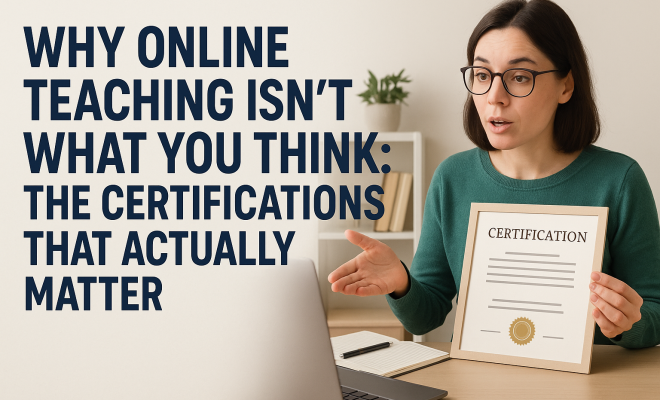
Why Online Teaching Isn’t What You Think: The Certifications That Actually Matter
The allure of online teaching is powerful, isn’t it? The freedom, the flexibility, the chance to reach students from anywhere. It’s no wonder that more than half of all postsecondary students are now taking at least one distance course. That kind of demand naturally makes you think the online professor job market must be wide open, a veritable playground of opportunities. You’d be forgiven for that assumption, but let me tell you, it’s a mirage. The reality is far more brutal than most job seekers ever anticipate. While listings for remote adjunct positions might seem plentiful, the competition is absolutely fierce. We’re talking about hiring managers seeing upwards of 2,000 applicants for a single online teaching role in some cases. That’s not just competitive; it’s a full-on battle. And even if you land a gig, there’s a hidden risk: online sections can be canceled, leaving you high and dry. So, how do you stand out in such a crowded field? It boils down to one critical factor: demonstrating specialized expertise and commitment. This isn’t just about having a degree; it’s about proving you’re equipped for the unique demands of virtual education. That’s where the best online teaching certifications come into play. They aren’t just resume boosters; they’re essential tools for navigating this incredibly tight market and securing a stable, rewarding position.
1. Certified Online Instructor (COI): Proving Your Pedagogical Prowess
Let’s kick things off with the Certified Online Instructor (COI) credential. This isn’t just another certificate; it’s a comprehensive program designed to validate your understanding of effective online pedagogy. Think about it: teaching in a virtual environment is fundamentally different from standing in front of a classroom. You’re dealing with different communication dynamics, engagement strategies, and technological requirements. A COI certification signals to hiring committees that you’ve not only recognized these differences but have actively sought out the training to master them.
Programs like the one offered by the Learning Resources Network (LERN) or various university-affiliated continuing education departments delve deep into areas such as instructional design for online delivery, fostering student interaction in asynchronous environments, and leveraging various learning management systems (LMS) effectively. It’s about more than just knowing how to use Zoom; it’s about structuring an entire course to maximize learning outcomes in a digital space. This kind of specialized knowledge is invaluable and can genuinely set you apart when thousands of applicants are vying for the same role.
The Impact of COI on Student Engagement
One of the biggest challenges in online learning is maintaining student engagement. It’s easy for students to feel isolated or disconnected if the course isn’t designed with interaction in mind. COI programs specifically address this by teaching strategies for building community, facilitating meaningful discussions, and creating collaborative activities in a virtual space. For example, you’ll learn how to use discussion forums not just for basic questions, but for deeper peer-to-peer learning and critical analysis. You’ll also explore tools that allow for group projects and presentations that truly mimic in-person collaboration. This focus on engagement isn’t just about making the course fun; it’s about improving learning outcomes and reducing attrition rates, which are key metrics for any online program. Institutions value instructors who can keep students motivated and involved from start to finish.
2. Quality Matters (QM) Certification: The Gold Standard for Course Design
When we talk about the best online teaching certifications, Quality Matters (QM) absolutely has to be on the list. If you’re serious about online education, you’ve likely heard of it. QM isn’t just a certification for individuals; it’s a nationally recognized rubric and peer review process for evaluating the quality of online and blended courses. Earning a QM certification, particularly in areas like ‘Applying the QM Rubric’ or ‘Peer Reviewer Certification,’ demonstrates a deep commitment to quality assurance in online learning. It tells potential employers that you understand what makes a truly effective and engaging online course, not just from a theoretical standpoint, but from a practical, evaluative one.
Hiring managers are constantly looking for instructors who can not only teach but also contribute to the overall quality and reputation of their online programs. A QM certification indicates you’re familiar with best practices in course design, accessibility, and student assessment within a digital framework. It’s a powerful signal that you can design and deliver courses that meet rigorous standards, which is a huge asset in an environment where student retention and satisfaction are paramount. Many institutions are even adopting QM standards for their own course development, making this certification increasingly essential.
QM and Accessibility in Online Learning
A crucial aspect of Quality Matters is its strong emphasis on accessibility. In today’s educational landscape, ensuring that all students, regardless of ability, can access and participate in online courses isn’t just a best practice; it’s often a legal requirement. QM training covers how to design courses that comply with accessibility standards like WCAG (Web Content Accessibility Guidelines). This means understanding how to properly format text, use alt-text for images, provide captions for videos, and ensure navigation is straightforward for assistive technologies. An instructor with QM certification isn’t just delivering content; they’re ensuring that content is available to everyone, creating a truly inclusive learning environment. This expertise is highly sought after by institutions committed to diversity, equity, and inclusion.
3. Certificate in Online Teaching and Learning (COTL): A Holistic Approach
The Certificate in Online Teaching and Learning (COTL) is another robust option among the best online teaching certifications. While similar in spirit to the COI, COTL programs often offer a broader and more academic approach, frequently housed within university departments of education or instructional technology. These programs typically involve a series of graduate-level courses that cover a wide spectrum of topics relevant to online pedagogy and instructional design.
You’ll likely find coursework in areas such as learning theories applied to online environments, advanced instructional technologies, assessment strategies for distance education, and even the administrative and ethical considerations of online learning. This holistic approach prepares you not just to teach a course, but to understand the larger ecosystem of online education. It’s particularly appealing to institutions looking for educators who can contribute to program development, curriculum design, and even faculty mentoring in the online space. A COTL can transform you from simply an online instructor into a true online learning specialist.
Ethical Considerations in Online Teaching
The COTL’s focus on ethical considerations is particularly relevant today. Online learning introduces unique challenges related to academic integrity, data privacy, and appropriate online behavior. For instance, how do you prevent cheating in an online exam while respecting student privacy? What are the ethical implications of using AI tools in grading or content generation? COTL programs equip educators to navigate these complex issues, teaching them how to establish clear expectations for academic honesty, protect student data, and foster a respectful and inclusive online community. This foresight and understanding of ethical frameworks can prevent problems before they start, making you an invaluable asset to any institution’s online learning department.
4. Certified Professional in Learning and Performance (CPLP): Beyond the Classroom
Now, let’s talk about the Certified Professional in Learning and Performance (CPLP) from the Association for Talent Development (ATD). While not exclusively focused on academic online teaching, the CPLP is incredibly valuable, especially if you’re looking to broaden your horizons beyond traditional higher education or if you want to bring a corporate training perspective to your online teaching. The ATD CPLP focuses on the entire talent development lifecycle, from instructional design and delivery to evaluating learning impact and managing learning programs. (See: Online Teaching Resources from the U.S. Department of Education.)
Why is this relevant for online teaching? Because many of the principles of effective adult learning, performance improvement, and technology-driven instruction are transferable across sectors. If you have a CPLP, you’re signaling to potential employers that you understand how to create learning experiences that drive measurable outcomes, a skill highly prized in any educational setting, including higher education. It demonstrates a sophisticated understanding of learning science and practical application, which can be a significant differentiator in a competitive market, particularly for specialized or professional online programs.
Applying Performance Consulting to Online Courses
The CPLP’s emphasis on performance consulting is a game-changer for online educators. Instead of just delivering content, a CPLP-certified instructor can analyze learning needs from a performance perspective. This means asking: What specific behaviors or skills do students need to acquire to achieve a certain outcome? How can the online course be structured to directly facilitate that performance improvement? This approach moves beyond rote memorization to skill mastery and real-world application, which is particularly vital in professional or vocational online programs. By focusing on measurable performance outcomes, CPLP holders can design online learning experiences that are not only effective but also clearly demonstrate their value to students and institutions alike. For more context, see revolutionize your job search.
5. Online Learning Consortium (OLC) Certifications: A Community of Practice
The Online Learning Consortium (OLC) is a professional organization dedicated to advancing quality online learning, and their certifications are highly respected within the field. OLC offers a range of certificates and workshops, from foundational courses in online teaching to more advanced specializations in areas like instructional design, leadership, and research. What makes OLC certifications particularly compelling is their emphasis on a community of practice and continuous professional development.
When you earn an OLC certification, you’re not just getting a piece of paper; you’re often engaging with a network of experienced online educators and researchers. This means you’re not only learning best practices but also staying current with emerging trends and technologies in online education. For hiring managers, an OLC certification indicates you’re committed to ongoing learning and actively participating in the larger online learning community, which is a big plus for institutions looking for dynamic and forward-thinking faculty.
OLC and the Future of Immersive Learning
OLC often pioneers discussions and training around emerging technologies like virtual reality (VR) and augmented reality (AR) in online education. As these immersive learning technologies become more accessible, instructors who understand how to integrate them effectively will be in high demand. OLC workshops frequently cover topics like designing virtual field trips, creating interactive 3D simulations, or using AR for hands-on learning experiences. Having an OLC certification, especially one with a focus on emerging tech, shows you’re not just current but actively thinking about the future of online pedagogy. This forward-thinking approach makes you incredibly attractive to institutions aiming to be at the cutting edge of digital education.
6. Google Certified Educator (Levels 1 & 2): Mastering Essential Tech Tools
While not a direct ‘online teaching’ certification in the traditional sense, the Google Certified Educator program (Levels 1 and 2) offers a powerful credential that can significantly enhance your appeal as an online instructor. In a world where virtual classrooms heavily rely on digital tools, demonstrating proficiency with widely used platforms like Google Workspace (Docs, Sheets, Slides, Classroom, Meet, etc.) is absolutely crucial. These certifications prove you’re not just tech-literate, but you can effectively integrate these tools into your teaching practice to create engaging and collaborative learning experiences.
Think about it: many institutions, from K-12 to higher education, are deeply embedded in the Google ecosystem. An instructor who can seamlessly navigate and leverage these tools for assignments, communication, and real-time collaboration saves an institution time and resources. It shows you’re ready to hit the ground running without extensive training on basic platform functionalities. In a pool of thousands, showing this immediate utility and readiness with common edtech tools can certainly give you an edge, signaling that you’re prepared for the practicalities of online course delivery.
Leveraging Google Tools for Differentiated Instruction
The Google Certified Educator program doesn’t just teach you how to use the tools; it encourages you to think about how they can enhance learning. A key benefit for online instructors is the ability to leverage Google tools for differentiated instruction. For example, you can use Google Classroom to assign different resources or tasks to individual students based on their needs, or create collaborative documents in Google Docs where students can work together at their own pace. Google Forms can be used for quick checks for understanding, allowing you to adapt your teaching in real-time. This ability to personalize the online learning experience using readily available tools is a huge advantage, making you a more versatile and effective online instructor.
7. Microsoft Certified Educator (MCE): Demonstrating Tech-Driven Pedagogy
Similar to the Google certifications, the Microsoft Certified Educator (MCE) credential focuses on technology literacy and integration, but from a Microsoft ecosystem perspective. This certification validates that educators have the global ICT (Information and Communication Technology) literacy competencies needed to provide a rich, customized learning experience for students. It covers six content domains: applying 21st-century learning skills, understanding ICT in education, using technology to enhance student thinking, collaboration, self-regulation, and skilled communication.
For online teaching, the MCE is particularly valuable because it emphasizes pedagogically sound approaches to using technology. It’s not just about knowing how to use Microsoft Teams or OneNote, but understanding *why* and *how* to use them effectively to foster deeper learning and engagement in a virtual setting. Given that many institutions also operate heavily within the Microsoft environment, having an MCE can signal your readiness to leverage these tools to their fullest potential, making you a more attractive candidate for online roles.
MCE and Fostering 21st-Century Skills Online
The MCE specifically targets 21st-century learning skills like critical thinking, communication, collaboration, and creativity. In an online environment, developing these skills requires intentional design and effective use of technology. For instance, an MCE-certified instructor would know how to set up collaborative projects in Microsoft Teams, encouraging students to co-create documents or presentations. They’d also understand how to use tools like OneNote for digital portfolios, allowing students to demonstrate creativity and self-reflection. This focus on skills beyond just content knowledge is what sets MCE apart, making you a desirable candidate for institutions looking to prepare students for a dynamic future.
8. Instructional Design Certificates: Building Better Learning Experiences
Beyond simply teaching, a deep understanding of instructional design can be a game-changer for online educators. Certificates in Instructional Design, often offered by university continuing education departments or specialized online learning academies, equip you with the skills to systematically design, develop, and deliver effective learning experiences. This goes beyond just content delivery; it encompasses everything from conducting needs analyses and writing clear learning objectives to selecting appropriate instructional strategies and developing robust assessment methods. (See: Research on Online Teaching Practices.)
Why is this critical for online teaching? Because a well-designed online course is paramount to student success and satisfaction. Hiring managers are increasingly looking for instructors who can contribute to the quality and structure of their online programs, not just deliver pre-made content. An instructional design certificate demonstrates you can think critically about how learners interact with material in a virtual space, how to create engaging multimedia content, and how to structure activities that genuinely foster learning. This expertise can elevate you from a good instructor to a valuable asset in curriculum development.
The Role of Storyboarding in Online Course Development
Instructional design certificates often introduce you to powerful techniques like storyboarding, which is incredibly useful for online course development. Storyboarding involves mapping out the entire course flow, module by module, outlining content, activities, assessments, and even media elements. This visual planning process ensures coherence, prevents redundancy, and helps create a logical learning path for students. For an online instructor, being able to storyboard a course means you can visualize the student experience from start to finish, identifying potential pitfalls and optimizing engagement before the course even launches. This proactive approach to course development is a significant advantage in the competitive online education market. For more context, see AI's brutal impact on graduate jobs.
9. Certificates in Specific Learning Management Systems (LMS): Mastering Your Platform
Finally, let’s talk about certifications in specific Learning Management Systems (LMS). While less broad than other options, demonstrating expertise in platforms like Canvas, Blackboard, Moodle, or Brightspace can be incredibly powerful. Many institutions are heavily invested in a particular LMS, and having an instructor who is already proficient saves them significant training time and resources. These certifications, often offered directly by the LMS providers or through authorized training partners, validate your ability to navigate the system, manage course content, facilitate discussions, create assignments, and utilize all the platform’s features effectively.
In a tight job market where every advantage counts, being able to walk into an online teaching role and immediately leverage the institution’s chosen LMS without a steep learning curve is a huge benefit. It shows practicality, readiness, and a professional commitment to the tools of the trade. While you might not need one of these for every application, if you know an institution uses a specific LMS, getting certified in that system can be a smart, strategic move that sets you apart from the thousands of other applicants.
LMS Certifications and Data Analytics for Student Success
Beyond just managing content, advanced LMS certifications often cover how to leverage the platform’s analytics features. Modern LMS systems gather a wealth of data on student activity, engagement, and performance. An instructor proficient in using these analytics can identify at-risk students early, track participation patterns, and even pinpoint areas where course content might be confusing. This data-driven approach to teaching allows you to make informed interventions and continuously improve the online learning experience. Being able to demonstrate this analytical capability is a powerful signal to employers that you’re not just delivering content, but actively optimizing for student success.
Choosing Your Path: Factors to Consider
With so many excellent online teaching certifications available, how do you decide which one is right for you? It’s not a one-size-fits-all answer. Your choice should align with your career goals, the type of institution you’re targeting, and your current skill set. Here are a few key factors to weigh:
- Your Target Institution Type: Are you aiming for K-12 online schools, community colleges, four-year universities, or corporate training roles? Some certifications, like Google or Microsoft Certified Educator, might be more prevalent in K-12, while QM or OLC are staples in higher education. CPLP is fantastic if you’re looking at corporate or professional development.
- Your Current Experience Level: If you’re new to online teaching, a foundational certificate like COI or an introductory OLC program might be a great starting point. If you have some experience but want to deepen your expertise in design or specific technologies, an Instructional Design certificate or an LMS-specific cert could be more beneficial.
- Cost and Time Commitment: These certifications vary widely in cost, from a few hundred dollars for a Google certification to several thousand for a university-based COTL. The time commitment also differs, from self-paced modules that take weeks to graduate-level courses that span months or even a year. Be realistic about what you can afford and how much time you can dedicate.
- Specific Skill Gaps: Honestly assess where you feel weakest in online teaching. Is it engagement strategies? Course design? Tech proficiency? Choose a certification that directly addresses those gaps.
- Employer Recognition: While all the certifications listed are valuable, some carry more weight with specific employers. Research the institutions you’re interested in and see if they mention preferred certifications in their job descriptions or faculty development initiatives.
Don’t feel pressured to get every single one. A strategic selection of one or two highly relevant certifications can make a significant difference. The goal is to build a compelling narrative for potential employers that showcases your dedication and specialized skills in online education.
The Evolving Landscape: AI and Online Teaching Certifications
The rapid rise of artificial intelligence (AI) tools like ChatGPT, Google Bard, and other generative AI platforms is fundamentally reshaping education, and online teaching is no exception. This isn’t just a trend; it’s a paradigm shift. As an online educator, you can’t afford to ignore AI; you need to understand how to leverage it ethically and effectively. While dedicated “AI in online teaching” certifications are still emerging, many of the existing best online teaching certifications are beginning to integrate AI considerations into their curricula. This is a critical area to watch.
For instance, instructional design certificates might now include modules on using AI for content generation (e.g., drafting rubrics, generating quiz questions, or creating personalized learning paths) while also addressing the ethical pitfalls of academic dishonesty. COTL programs are starting to discuss AI’s role in adaptive learning systems and intelligent tutoring. Even basic tech certifications like Google Certified Educator are expanding to include AI features within their suite of tools, like AI-powered writing assistants or data analysis capabilities. Being able to articulate how you’ll use AI to enhance learning, personalize instruction, and streamline administrative tasks—rather than simply forbidding it—will be a massive differentiator in the coming years. Look for programs that emphasize critical thinking about AI, its pedagogical applications, and its ethical implications.
The Long-Term Value: Why These Certifications Pay Off
Investing in the best online teaching certifications isn’t just about landing that first job; it’s about building a sustainable and adaptable career in a rapidly evolving field. The skills you gain are foundational and transferable. You’re learning to design effective learning experiences, manage digital classrooms, and leverage technology for pedagogical advantage – abilities that are increasingly valuable in any educational context, online or blended. (See: BBC Coverage on Online Education Trends.)
Beyond the immediate job market advantage, these certifications foster a mindset of continuous professional development. They connect you to communities of practice, exposing you to new ideas, research, and emerging technologies. This ongoing learning keeps your skills sharp and ensures you remain a relevant and effective educator, even as the landscape of online learning continues to transform. Think of it as future-proofing your career. In a world where online education is no longer a niche but a core component of the global learning ecosystem, these certifications are your passport to long-term success and impact.
Frequently Asked Questions About Online Teaching Certifications
Q1: Are online teaching certifications truly necessary? Can’t my master’s degree or Ph.D. suffice?
While a master’s degree or Ph.D. demonstrates subject matter expertise, it often doesn’t specifically address the unique pedagogical and technological demands of online instruction. As I mentioned, the online job market is brutal; institutions often receive thousands of applications. An online teaching certification signals to hiring committees that you’ve invested in specialized training for virtual environments, making you stand out from candidates who only have traditional academic credentials. It shows you understand instructional design for digital spaces, engagement strategies for remote learners, and proficiency with relevant technologies. It’s about demonstrating readiness for the specific challenges of online education, which traditional degrees rarely cover in depth.
Q2: How long does it typically take to complete an online teaching certification?
The duration varies significantly depending on the type and depth of the certification. Some foundational certifications, especially those focused on specific tools like Google Certified Educator, can be completed in a matter of weeks of dedicated study. More comprehensive certificates, like a university-based Certificate in Online Teaching and Learning (COTL) or an ATD CPLP, might involve a series of graduate-level courses and could take several months to a year, or even longer, to complete. It really depends on whether it’s a self-paced module, a series of workshops, or an academic program with structured courses.
Q3: What’s the cost range for these certifications?
Costs are as varied as the programs themselves. Basic technology certifications (like Google or Microsoft Educator) might range from free (if you self-study for the exam) to a few hundred dollars for official training and exam fees. LERN’s Certified Online Instructor (COI) programs often fall in the range of $500 to $1,500. Quality Matters (QM) individual certifications or workshops typically cost a few hundred dollars each, though institutions often cover these fees for their faculty. University-based Certificates in Online Teaching and Learning (COTL) can be the most expensive, often aligning with graduate credit tuition rates, ranging from a few thousand to upwards of $10,000 or more depending on the institution and number of credits. The ATD CPLP involves fees for resources, exams, and potentially preparatory courses, often totaling a few thousand dollars.
Q4: Can I get these certifications online, or do I need to attend in-person?
Almost all the best online teaching certifications are offered entirely online. This makes perfect sense, right? If you’re training to teach online, the training itself should ideally model effective online learning. This flexibility is a huge benefit, allowing you to pursue these credentials while managing other professional and personal commitments.
Q5: Is it better to get a general online teaching certification or one focused on a specific LMS (like Canvas or Blackboard)?
Both have their merits, and the best approach often involves a combination. A general certification (like COI, COTL, or OLC) provides a broad understanding of online pedagogy, instructional design principles, and engagement strategies that apply across any platform. This gives you a strong theoretical and practical foundation. An LMS-specific certification, on the other hand, demonstrates practical proficiency in a particular system, which is incredibly valuable if you’re applying to an institution that heavily uses that LMS. If you can only choose one to start, a general online teaching certification is often a good first step, as the principles learned are universally applicable. You can then add an LMS-specific certification once you know which platforms your target institutions prefer.
Q6: Do these certifications expire, requiring renewal?
Some certifications do have an expiration or renewal requirement to ensure your skills remain current. For example, the ATD CPLP requires recertification every three years, involving professional development activities and continuing education. Quality Matters (QM) certifications often involve workshops that grant you individual recognition, but maintaining institutional QM adoption might require ongoing faculty training. Google and Microsoft Certified Educator certifications are often tied to specific product versions and may need updating as the platforms evolve. It’s always best to check the specific certification provider’s guidelines regarding expiration and renewal processes.
So, there you have it. The online teaching market is far more competitive than many realize, and simply having a degree isn’t enough anymore. To truly stand out and secure a stable, fulfilling online teaching role, you need to invest in specialized training. The best online teaching certifications aren’t just fancy additions to your resume; they are essential credentials that demonstrate your commitment, expertise, and readiness for the unique challenges and opportunities of virtual education. Don’t just hope for an online teaching job; equip yourself to earn it.
Trending Now
Frequently Asked Questions
What certifications are important for online teaching?
Key certifications for online teaching include the Certified Online Instructor (COI) credential, which demonstrates expertise in online pedagogy. Other valuable certifications focus on technological proficiency and student engagement strategies, helping you stand out in a competitive job market.
Is online teaching a good career choice?
While online teaching offers flexibility and the ability to reach diverse students, the competition is intense. Many applicants vie for each position, making it essential to have specialized certifications and a strong understanding of online education dynamics to secure a stable role.
How competitive is the online teaching job market?
The online teaching job market is extremely competitive, with some positions attracting over 2,000 applicants. This saturation means that having specialized certifications and demonstrating a commitment to effective online education are crucial for standing out to hiring committees.
What skills do you need for online teaching?
Successful online teaching requires skills in effective communication, engagement strategies, and technological proficiency. Additionally, understanding the unique dynamics of virtual classrooms is vital, making certifications like the Certified Online Instructor (COI) beneficial for aspiring educators.
Can online teaching positions be canceled?
Yes, online teaching positions can be canceled, often due to low enrollment or institutional changes. This unpredictability highlights the importance of securing multiple teaching opportunities and having a strong professional profile, including relevant certifications, to mitigate risks.
What did we miss? Let us know in the comments and join the conversation.