Devastating New US Teens Education Report: AI Blamed as Reading Plummets 14 Points
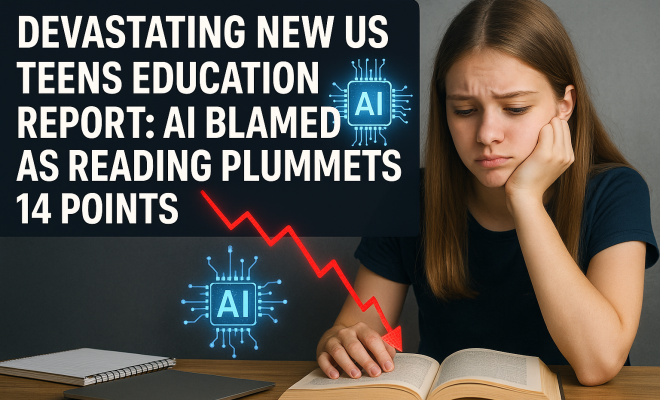
You might think our kids are digital natives, effortlessly gliding through the information age. But a recent international assessment, the Programme for International Student Assessment (PISA), has just delivered a sobering dose of reality. Released this week, on September 9, 2026, the PISA report isn’t just a collection of numbers; it’s a blaring alarm bell for anyone invested in the future of American youth. The headline news? U.S. teens are significantly falling behind their global peers in reading and math, and the implications are far-reaching. This isn’t a minor dip; it’s a concerning trend, particularly for reading, which saw a staggering 14-point drop since the 2022 assessment. That decline pushed the U.S. down seven places in the global rankings, and frankly, it should make us all sit up and pay attention to what this US teens education report is truly telling us.
What’s particularly startling about this latest PISA data is its direct finger-pointing at a culprit many of us have welcomed into our daily lives: artificial intelligence. The report suggests that the pervasive influence of AI is actively eroding critical thinking skills, especially those needed to evaluate information and think critically. Beyond AI, there’s another insidious trend highlighted: a near doubling of what the report terms “hasty reading” instances since 2018. This isn’t just skimming; it’s a rapid, superficial consumption of text that results in poor comprehension and even worse, a failure to retain information. For educators and parents alike, this US teens education report serves as a stark “wakeup call,” emphasizing the urgent need for greater parental involvement and a return to fundamental habits like daily reading to combat the ever-growing tide of digital distractions and AI’s subtle, yet profound, negative effects on foundational literacy.
The Alarming Decline in Reading Scores: A Deep Dive into the Numbers
Let’s really unpack those reading scores, because the 14-point drop since 2022 isn’t just a statistic; it represents a significant portion of a student’s learning capacity. To put it in perspective, a 14-point decrease on a standardized test is akin to losing more than half a year of learning. Imagine the cumulative effect of that across an entire generation of students. This isn’t just about reading for pleasure; it’s about the ability to comprehend complex instructions, synthesize information from various sources, and engage with the world critically. When reading scores plummet, it’s not an isolated problem; it cascades into every other academic area, from history and science to even math, where word problems and analytical texts demand strong comprehension skills.
The PISA assessment is designed to measure how well 15-year-old students in various countries are prepared to meet real-world challenges, not just how well they can regurgitate facts. So, when the U.S. slides seven places globally, it’s a strong indicator that our students are becoming less equipped to navigate the complexities of modern life compared to their peers in other developed nations. This isn’t about being “smart” or “dumb”; it’s about fundamental skill acquisition. What are other countries doing right that we’re missing? Is it curriculum design, teacher training, or perhaps cultural attitudes towards learning and technology? This US teens education report forces us to ask tough questions about our educational priorities and how we’re preparing students for a future that will undoubtedly demand more, not less, critical literacy.
AI’s Unexpected Role in Eroding Critical Thinking
It sounds almost counterintuitive, doesn’t it? Artificial intelligence, a marvel of human ingenuity, is being implicated in the decline of human critical thinking. Yet, the PISA report makes a direct link, suggesting that the pervasive presence of AI in students’ lives is actively hindering their ability to evaluate information and think critically. Think about it: AI-powered search engines often deliver pre-digested answers, chatbots can generate essays, and algorithms curate content feeds, often without challenging the user’s existing biases. When students rely heavily on these tools, they may bypass the arduous but crucial process of sifting through multiple sources, discerning bias, cross-referencing facts, and forming their own reasoned conclusions.
Consider a student faced with a research assignment. In the past, they might have spent hours in a library, comparing different encyclopedias, academic journals, and books, actively engaging with conflicting viewpoints. Today, a quick prompt to an AI chatbot can yield a coherent, albeit potentially superficial or biased, summary in seconds. While efficient, this process often skips the cognitive heavy lifting. The brain, like any muscle, strengthens with use. If we outsource the effort of critical evaluation to machines, are we inadvertently atrophying our children’s cognitive muscles? This US teens education report challenges us to consider the long-term educational cost of convenience and the subtle ways technology, even beneficial technology, can undermine foundational skills if not used thoughtfully.
The Rise of “Hasty Reading” and Its Consequences
Perhaps one of the most insidious findings in the PISA report is the near doubling of “hasty reading” instances since 2018. This isn’t just about reading quickly; it’s about reading without purpose or retention. Picture this: a student scrolls rapidly through a news article, glancing at headlines and the first sentences of paragraphs, believing they’ve absorbed the content. In reality, they’ve processed very little. They might recognize keywords but miss the nuances, the logical flow, or the underlying arguments. This superficial engagement prevents true comprehension and makes it incredibly difficult to recall information later or apply it to new contexts.
Why is this happening? Digital environments, with their constant stream of notifications, hyperlinks, and bite-sized content, train our brains for rapid, shallow processing. We’re conditioned to scan, jump, and move on. This mode of interaction, while efficient for navigating vast amounts of information, is antithetical to deep reading, which requires sustained attention, reflection, and the ability to make connections. When students apply this “hasty reading” habit to academic texts, they inevitably struggle. They’ll read an entire chapter but recall only fragmented ideas, making it difficult to participate in discussions, write analytical essays, or solve complex problems. This US teens education report clearly shows that the way our children interact with digital text is fundamentally changing how they read, and not for the better. (See: CDC Youth Risk Behavior Survey.)
The “Wakeup Call” for Educators and Parents: A Shared Responsibility
The PISA report isn’t just an academic exercise; it’s a clarion call. It explicitly labels its findings a “wakeup call” for both educators and parents, highlighting that this challenge isn’t solely the responsibility of schools. Our educational system, from curriculum designers to classroom teachers, must critically examine how digital literacy is taught and how students are encouraged to engage with information. Are we adequately equipping them to be discerning consumers of digital content? Are we teaching them how to leverage AI as a tool without letting it replace their own cognitive effort?
But the onus doesn’t stop at the school gates. Parents play an equally, if not more, critical role. The home environment is where reading habits are often formed, where screen time is managed (or not), and where the importance of deep learning can either be fostered or neglected. If children are spending hours passively consuming content on screens without guided interaction or encouragement for deeper engagement, it’s an uphill battle for schools to counteract those ingrained habits. This US teens education report underscores that addressing this crisis requires a unified front, a partnership between home and school, to re-prioritize foundational skills in an increasingly digital world.
Re-establishing Daily Reading Habits in a Digital Age
One of the report’s key recommendations to counteract these negative trends is surprisingly traditional: the importance of daily reading habits. In an era dominated by screens, the simple act of sitting down with a physical book or a long-form article, free from digital distractions, feels almost revolutionary. Yet, this practice is crucial for developing sustained attention, building vocabulary, improving comprehension, and fostering empathy through narrative. It’s about training the brain to focus, to follow a coherent argument, and to engage deeply with ideas without the constant ping of notifications or the urge to click away.
For parents, this means actively carving out time for reading, modeling reading behavior themselves, and making diverse reading materials accessible. It might involve establishing “screen-free” reading times, encouraging library visits, or subscribing to magazines and newspapers that offer more than just soundbites. For schools, it means integrating more opportunities for sustained, deep reading into the curriculum, perhaps through literature circles, independent reading programs, or research projects that demand engagement with lengthy, complex texts. We have to make reading, real reading, a priority again. This US teens education report is a stark reminder that while technology advances, the fundamental building blocks of literacy remain timeless.
The Broader Impact: From Academic Performance to Civic Engagement
The implications of declining reading and critical thinking skills extend far beyond just academic grades. A populace that struggles with reading comprehension and critical evaluation is a populace vulnerable to misinformation, demagoguery, and manipulation. In a democratic society, the ability to understand complex issues, evaluate political rhetoric, and engage in informed debate is paramount. If our teens are struggling to discern fact from fiction, or to understand the nuances of policy discussions, what does that mean for the future of our civic discourse and the health of our democracy?
Furthermore, these skills are essential for future economic success. The jobs of tomorrow, even those in technical fields, will demand strong analytical abilities, problem-solving skills, and the capacity to learn and adapt quickly. These are all rooted in foundational literacy and critical thinking. Employers consistently cite communication and critical thinking as top desired skills, yet this US teens education report suggests our education system might be moving in the opposite direction. We’re not just talking about students getting lower test scores; we’re talking about a generation potentially less equipped to thrive in a rapidly changing world, both professionally and personally.
Comparing the US to Global Peers: What Can We Learn?
When the U.S. falls seven places in global rankings, it begs the question: what are the countries above us doing differently? While PISA doesn’t offer a direct roadmap, it does provide a comparative lens. Many top-performing nations often emphasize rigorous, foundational education from an early age, focusing on deep conceptual understanding rather than rote memorization. They may also have different cultural attitudes towards education, often placing a high value on academic achievement and intellectual pursuits.
It’s not about blindly copying another nation’s system, but rather about critically examining our own. Are we adequately funding our schools? Are we attracting and retaining the best teachers? Are our curricula aligned with the demands of the 21st century while still prioritizing fundamental skills? Do we foster a culture of inquiry and intellectual curiosity, or are we overly focused on standardized testing? This US teens education report should prompt a national conversation, drawing lessons from global best practices while tailoring solutions to our unique context. We have to learn from others without losing sight of our own strengths. (See: Associated Press news coverage.)
Strategies for Moving Forward: A Path to Rebuilding Literacy
So, what can we actually do? The situation, while serious, isn’t insurmountable. First, we need to educate parents and students about the dangers of “hasty reading” and the critical importance of deep engagement with text. This means conscious efforts to put down devices and pick up books, even for short periods daily. Schools can implement explicit instruction in digital literacy, teaching students not just how to use AI, but how to interrogate its outputs, understand its limitations, and develop critical discernment skills.
Curriculum design needs to evolve. We should integrate more opportunities for analytical reading and writing across all subjects, not just English class. Project-based learning that requires extensive research, synthesis of information, and critical evaluation can also help. Furthermore, fostering a love of reading from an early age through robust library programs, diverse book selections, and engaging literacy initiatives is crucial. We must recognize that literacy isn’t a static skill but a dynamic one that requires continuous cultivation. The insights from this US teens education report are a call to action, demanding innovation and a renewed commitment to the core principles of education.
The Role of Teacher Training and Professional Development
Let’s also talk about the unsung heroes in this equation: our teachers. They’re on the front lines, navigating classrooms filled with students who are growing up in this hyper-digital world. To effectively combat the trends identified in the PISA report, teachers need robust training and ongoing professional development. This isn’t just about learning new technologies; it’s about understanding the cognitive science behind digital distraction and how to teach deep reading and critical thinking in an AI-saturated environment. Are we providing educators with the tools, strategies, and support they need to model effective digital citizenship and critical literacy? Many teachers themselves are still grappling with the rapid evolution of AI and its implications for their pedagogy. Investing in their continuous learning is paramount. This means workshops on integrating AI ethically, training on fostering sustained attention, and resources for developing curricula that explicitly teach students to question and evaluate information, rather than just consume it.
Addressing Socioeconomic Disparities in Digital Literacy
It’s important to acknowledge that the impact of digital tools and “hasty reading” isn’t felt equally across all student populations. Socioeconomic disparities play a significant role. Students from lower-income backgrounds might have less access to high-quality, diverse reading materials at home, or less parental guidance on managing screen time. They might also lack the digital literacy skills to discern reliable information from misinformation, making them even more vulnerable to the negative effects highlighted in the PISA report. Any effective strategy to rebuild literacy must explicitly address these disparities. This could involve increasing funding for school libraries in underserved communities, providing digital literacy programs for parents, and ensuring equitable access to technology and the internet, coupled with guidance on its thoughtful use. The US teens education report acts as a reminder that educational challenges are rarely isolated and often intersect with broader societal inequalities.
Expert Perspectives: What Leading Educators Are Saying
When you look at this US teens education report, it’s clear the academic community is paying close attention. Dr. Eleanor Vance, a prominent educational psychologist specializing in cognitive development, notes, “We’ve seen a shift from ‘information scarcity’ to ‘information overload.’ Our brains haven’t evolved to process this firehose of data effectively without explicit training. The PISA results aren’t surprising when you consider how little time is often dedicated to teaching information discernment and deep processing in schools today.” Similarly, Professor David Chen, a curriculum specialist, emphasizes, “It’s not about banning technology; it’s about teaching intentionality. We need to empower students to be masters of their digital tools, not servants to them. That means teaching them when to use AI for efficiency and when to engage their own cognitive effort for true understanding.” Their insights underscore the need for a balanced, thoughtful approach that doesn’t demonize technology but rather integrates it wisely, always prioritizing fundamental human cognitive skills.
The Long-Term Economic Consequences: A Workforce Prepared for the Future?
Let’s think about the future workforce for a minute. The jobs that pay well and offer stability in the coming decades will increasingly demand adaptability, complex problem-solving, and the ability to critically analyze information. If today’s teens are showing a decline in these very skills, what does that mean for the competitiveness of the American workforce? Companies aren’t just looking for people who can follow instructions; they need employees who can innovate, think creatively, and learn new systems quickly. These are all deeply intertwined with strong literacy and critical thinking. A workforce that struggles with reading technical manuals, understanding complex reports, or evaluating data will inevitably fall behind. This US teens education report isn’t just about school grades; it’s a barometer for our nation’s future economic vitality and our ability to maintain a leadership position in a global economy that values knowledge and innovation.
Frequently Asked Questions About the US Teens Education Report
Q1: What exactly is the PISA assessment?
The Programme for International Student Assessment (PISA) is a worldwide study conducted by the Organisation for Economic Co-operation and Development (OECD). It measures 15-year-old students’ reading, mathematics, and science literacy every three years. The goal is to assess how well students are prepared to meet real-world challenges, not just how much they’ve memorized from a textbook. It gives countries a snapshot of their education system’s effectiveness compared to others globally.
Q2: Why is a 14-point drop in reading scores so significant?
A 14-point drop on the PISA scale is quite substantial. Education researchers often equate a 20-point change on PISA to roughly one year of schooling. So, a 14-point drop means U.S. students, on average, are performing at a level that’s nearly three-quarters of a year behind where they were just four years ago. This isn’t just a minor fluctuation; it indicates a systemic decline in fundamental literacy skills that impacts students’ ability to learn across all subjects.
Q3: How is AI specifically linked to the decline in critical thinking?
The report suggests AI contributes by making it too easy for students to get answers without engaging in the critical thinking process. When AI tools provide immediate summaries or generated text, students bypass the cognitive effort of researching multiple sources, evaluating their credibility, synthesizing information, and forming their own conclusions. This can lead to a reliance on AI, potentially atrophying the very skills needed for independent thought and discernment.
Q4: What’s the difference between “hasty reading” and skimming?
Skimming is a deliberate strategy used to quickly grasp the main idea of a text or find specific information. It’s a conscious act with a purpose. “Hasty reading,” as described in the report, is more of an unconscious, superficial engagement with text, often driven by the fast-paced nature of digital environments. It lacks intentionality and typically results in poor comprehension and retention, unlike effective skimming which still aims for some level of understanding.
Q5: What are practical steps parents can take at home?
Parents can make a big difference! Try to establish dedicated “screen-free” reading times for your kids, even if it’s just 15-20 minutes a day. Model reading behavior yourself – let your children see you reading physical books or long articles. Encourage visits to the library, discuss what they’re reading, and provide a variety of reading materials. Talk about the information they encounter online, helping them question sources and identify bias. Most importantly, limit passive screen time and encourage active engagement with content.
Q6: Does this mean we should remove technology from schools?
Not at all. Technology, including AI, has immense potential to enhance learning. The key isn’t removal, but rather intentional and critical integration. Schools need to teach students how to use AI as a tool for learning and exploration, while simultaneously reinforcing the essential human skills of critical thinking, deep reading, and independent analysis. It’s about balance and ensuring technology serves learning, rather than replacing fundamental cognitive effort.
Ultimately, the PISA report is a moment of reckoning. It forces us to confront uncomfortable truths about how our technological advancements and societal habits are impacting the very foundations of learning. The decline in reading and math scores, directly linked to AI and the rise of superficial engagement with information, isn’t just an academic problem; it’s a societal one. It challenges us to rethink our relationship with technology, to re-emphasize the timeless value of deep reading and critical thought, and to actively partner across homes and schools to ensure that the next generation of US teens isn’t just digitally fluent, but truly literate and critically engaged with the complex world around them. This isn’t just about test scores; it’s about preparing our children for a meaningful and successful future.
Trending Now
Frequently Asked Questions
Why are US teens reading scores declining?
US teens' reading scores have declined significantly due to factors like the pervasive influence of artificial intelligence, which is believed to erode critical thinking skills. The recent PISA report indicates a 14-point drop in reading abilities since 2022, pushing American students down in global rankings.
What impact does AI have on students' reading skills?
The PISA report suggests that artificial intelligence negatively affects students' reading skills by diminishing their ability to think critically and evaluate information. This reliance on AI tools may lead to superficial reading habits, inhibiting deep comprehension and retention.
What is 'hasty reading' and how has it changed?
'Hasty reading' refers to rapid, superficial reading that results in poor comprehension. The PISA report highlights a near doubling of hasty reading instances among teens since 2018, indicating a worrying trend in how students engage with texts amid digital distractions.
How can parents help improve their kids' reading skills?
Parents can help improve their children's reading skills by encouraging daily reading habits, engaging in discussions about texts, and limiting distractions from technology. The PISA report emphasizes the need for greater parental involvement to counteract negative trends in literacy.
What are the implications of the PISA report for US education?
The PISA report highlights a concerning decline in US teens' reading and math skills, calling for urgent reforms in education. It underscores the need for renewed focus on critical thinking, reading comprehension, and parental engagement to ensure students can compete globally.
What did we miss? Let us know in the comments and join the conversation.