Open-Source AI Outpaces Giants in July 2026 LLM News
“`html
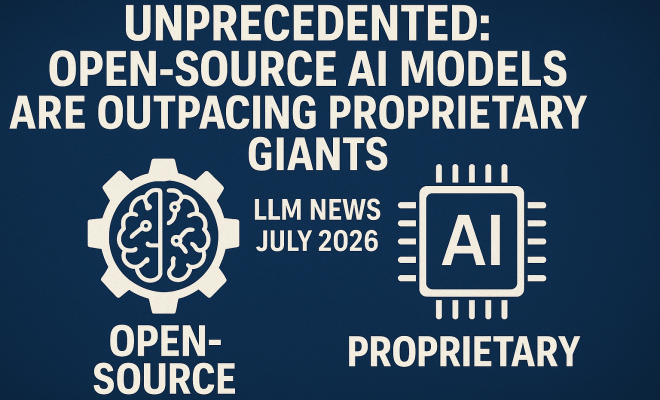
The landscape of artificial intelligence is evolving rapidly, and the LLM news July 2026 highlights a significant shift. The recent launch of Claude Fable 5 by Anthropic marked a new benchmark in public AI models, but the buzz surrounding this development was soon overshadowed by a suspension enforced by the US government. In the wake of this event, open-weight models like DeepSeek V4-Pro and MiniMax M3 have begun to challenge the dominance of proprietary systems like those developed by OpenAI, Anthropic, and Microsoft. What does this mean for businesses considering their AI options? Let’s explore.
1. The Rise of Claude Fable 5
On the cusp of July 2026, Anthropic unveiled Claude Fable 5, which was touted as the most advanced public model to date. This breakthrough signaled a new era in the capabilities of AI, promising to push the boundaries of natural language processing (NLP). However, the excitement was short-lived, as the US government intervened, forcing a suspension of the model’s activation. The suspension raised eyebrows across the industry, prompting questions about regulatory frameworks governing the deployment of AI technologies.
The implications of this suspension are multifaceted. For one, it reveals the potential tensions between innovation and regulation in the AI landscape. As these advanced models promise to revolutionize various applications, their deployment may face scrutiny from government entities concerned about ethical implications, data privacy, and security. Businesses that had planned to leverage Claude Fable 5 might now have to reconsider their strategies.
2. Open-Weight Models Closing the Gap
As the dust settled on the Claude Fable 5 fiasco, attention quickly shifted toward open-weight models like DeepSeek V4-Pro and MiniMax M3, which have made remarkable progress in recent months. These models are rapidly narrowing the performance gap with proprietary leaders, achieving coding benchmark scores that are alarmingly close to those of top-tier closed models. This progress is particularly noteworthy given that these open-source models ship under permissive licenses such as MIT and Apache 2.0.
The significance of this development cannot be overstated. The open-source movement in AI is gaining momentum, leading to a critical ‘build versus buy’ decision for enterprises. Organizations now have a viable option to harness powerful AI capabilities without the hefty price tag often associated with proprietary models. This shift encourages businesses to reconsider their operational strategies and cost structures as they evaluate their AI investments.
3. Price Competition Intensifies
The competition among AI providers is heating up, with open-source models like DeepSeek V4-Pro enhancing price competitiveness across the board. As these models demonstrate capabilities similar to or even surpassing proprietary systems, companies like OpenAI, Anthropic, and Microsoft may face increasing pressure to adjust their pricing strategies. This could lead to a race-to-the-bottom scenario, where firms are forced to lower prices to remain competitive in a market that increasingly values affordability.
Additionally, as the cost of adopting AI technologies decreases, the overall market could expand, attracting more businesses to explore AI solutions. This shift would not only democratize access to advanced technologies but could also foster innovation across sectors that were once considered too expensive for smaller organizations to enter.
4. DeepSeek V4-Pro: A Game-Changer
Among the players in the open-source arena, DeepSeek V4-Pro stands out as a particularly formidable contender. The model has achieved coding benchmark scores that align closely with those of leading closed models, showcasing its technical prowess. For enterprises, this positions DeepSeek V4-Pro as a compelling alternative to traditional, paid AI solutions.
What makes DeepSeek V4-Pro even more attractive is its permissive licensing. Organizations can leverage this model to build their own tailored solutions, reducing the dependency on external vendors. This not only provides flexibility but also encourages greater innovation as companies customize their AI applications to fit specific operational needs.
5. Driving Commercial Intent
The monetization potential of open-weight models is hard to ignore, especially when considering their applicability in high-CPC (cost-per-click) sectors such as B2B SaaS, software, and cybersecurity. As companies look to optimize costs while maintaining competitive advantages, the demand for ‘hosted open-weight models’ is expected to rise. This growing interest paves the way for new business models centered around offering AI technologies as a service.
Moreover, the commercial intent behind these models is evident. Businesses are now focusing on detailed cost comparisons between hosted solutions versus traditional model licensing, making the economics of AI a key consideration for many organizations. This trend illustrates a broader shift in how companies approach AI — as a strategic investment rather than a mere operational expense. (See: AI regulation and innovation tensions.)
6. Build Versus Buy: The New Paradigm
The debate between building proprietary AI solutions in-house versus purchasing established models is becoming more nuanced. With the rise of open-source options like DeepSeek V4-Pro, enterprises are finding themselves at a crossroads. Should they invest resources in developing a tailored solution, or can they leverage existing models to meet their needs?
Building a solution may offer a higher degree of customization and control, but it often comes with significant upfront costs and longer development timelines. Conversely, purchasing an established model can provide quick access to advanced capabilities but may involve ongoing licensing fees and limitations on customization. The decision ultimately depends on the specific needs and capabilities of each organization. For more context, see Best Online Bachelor Degree Programs.
7. Market Implications for Enterprises
The implications of these developments extend beyond individual companies and into the broader market landscape. As open-source models gain traction, we may witness an acceleration in AI adoption across industries. This democratization of technology can lead to an explosion of innovation as smaller firms can now compete on a more even playing field with larger corporations.
Moreover, the shift could potentially disrupt the existing market hierarchy. Companies that have relied heavily on established proprietary models may need to rethink their strategies as they face increasing competition from agile startups utilizing open-source technologies. This transformation can lead to a more dynamic marketplace where innovation thrives and traditional barriers dissolve.
8. Ethical Considerations in AI Deployment
As AI technologies become more accessible, ethical considerations surrounding their deployment grow increasingly important. Issues such as data privacy, algorithmic bias, and accountability remain at the forefront of discussions. Enterprises must prioritize ethical frameworks when developing or adopting AI solutions to mitigate potential risks and ensure that their technologies serve a broader societal good.
In this context, organizations are urged to implement governance structures that oversee AI usage. Transparency in AI processes, as well as adherence to ethical guidelines, can help build trust among users and stakeholders. The responsibility of ensuring ethical practices falls heavily on both developers of AI technologies and the companies that choose to implement them.
9. The Future of AI: Opportunities and Challenges
The trajectory of AI technology suggests both opportunities and challenges ahead. As highlighted in the LLM news July 2026, open-source models are gaining ground, which could be transformative for various sectors. However, with this rapid evolution comes the need for continual adaptation among businesses and regulatory bodies.
Organizations must remain agile to harness the benefits of these innovations while also navigating potential pitfalls. Balancing technological advancement with ethical considerations will be paramount in ensuring that AI serves as a driving force for positive change rather than a source of disruption.
10. Final Thoughts: An Evolving Landscape
As we look back on the events of July 2026, it’s clear that the landscape of AI is in a state of flux. The launch of Claude Fable 5 and the subsequent suspension serve as a reminder of the complex interplay between innovation and regulation. Simultaneously, the rise of open-weight models presents businesses with unprecedented opportunities to rethink their AI strategies.
In this dynamic environment, companies that can effectively leverage the strengths of both proprietary and open-source solutions will likely emerge as leaders. Ultimately, the ongoing developments in the AI sector will continue to shape the way we interact with technology, creating a future rich with possibilities and challenges.
11. The Acceleration of AI Adoption
As we head deeper into 2026, one of the key trends emerging is an acceleration in the adoption of AI tools across various industries. According to a recent report from the AI Council, about 75% of companies surveyed indicated they plan to implement AI solutions in their operations within the next 18 months. This marks a significant increase from previous years, illustrating how businesses are increasingly recognizing the potential benefits of AI.
Industries such as healthcare, finance, and retail are at the forefront of this adoption. For instance, healthcare institutions are utilizing AI for predictive analytics to improve patient outcomes, while financial firms are leveraging AI for risk assessment and fraud detection. Retailers are also exploring AI-driven personalized shopping experiences, which can significantly enhance customer satisfaction and loyalty. (See: AI and ethical implications in technology.)
12. Statistics That Matter
To understand the evolving landscape further, let’s take a look at some statistics that underscore the importance of AI in today’s business environment:
- According to McKinsey, AI could contribute up to $15.7 trillion to the global economy by 2030.
- Gartner predicts that by 2025, 70% of organizations will adopt AI to support sales and marketing initiatives.
- A recent survey showed that 85% of enterprise decision-makers believe AI will create new job opportunities by automating repetitive tasks.
These statistics highlight not only the economic impact of AI but also the transformative potential it has for the workforce, emphasizing a shift towards more strategic roles as routine tasks are automated. For more context, see 2026 – 2027 Best Military Colleges & Universities.
13. Expert Perspectives on AI Regulation
As the landscape of AI evolves, so does the conversation around regulation. Experts in the field express a range of perspectives regarding the appropriate balance between fostering innovation and ensuring safety. Dr. Alice Chen, a notable AI ethicist, argues that “the rapid advancements in AI technologies necessitate a proactive regulatory approach. We need frameworks that not only safeguard users but also empower developers to innovate responsibly.”
Conversely, some technologists advocate for minimal regulation, claiming it may stifle innovation. “If we impose too many restrictions, we risk losing our competitive edge in the global AI race,” says Mark Thompson, a tech entrepreneur. “What we need is collaboration between regulators and innovators to shape a framework that benefits everyone.”
14. Comparative Analysis: Proprietary vs. Open-Source Models
The debate over proprietary models versus open-source alternatives is not new, but it’s gaining renewed attention with the emergence of models like DeepSeek V4-Pro. Here’s a quick comparison of the two:
| Feature | Proprietary Models | Open-Source Models |
|---|---|---|
| Cost | High upfront and ongoing licensing fees | Typically free or low-cost; pay for hosting or support |
| Customization | Limited customization options | Highly customizable to fit specific needs |
| Community Support | Vendor-specific support | Active community support and collaboration |
| Updates | Regular updates from the vendor | Frequent community-driven updates |
This comparison shows that while proprietary models may offer robust support and reliability, open-source models can provide flexibility and cost-effectiveness, making them highly attractive to a diverse range of businesses.
15. FAQs About AI Developments and Trends
What are LLMs?
LLMs, or Large Language Models, are advanced AI systems designed to understand and generate human-like text based on input data. They are used in various applications, from chatbots to content generation.
Why are open-weight models becoming more popular?
Open-weight models are gaining popularity due to their cost effectiveness, flexibility, and strong community support. As companies look to reduce costs while maintaining performance, these models present a viable alternative to proprietary solutions.
What are the implications of government regulation on AI?
Government regulations can influence the pace of innovation in AI. While regulations aim to ensure safety and ethical use, they can also pose challenges for developers and businesses trying to innovate rapidly. Balancing these interests is crucial for the sustainable growth of the AI sector.
How can businesses prepare for the AI revolution?
Businesses can prepare for the AI revolution by investing in training for their workforce, exploring AI solutions that align with their goals, and staying informed about the latest trends and models in the market. Adapting to these changes proactively can provide a competitive edge. (See: Harvard's research on AI and society.)
What role do ethical considerations play in AI adoption?
Ethical considerations are paramount in AI adoption. Companies must address data privacy, algorithmic fairness, and transparency to build trust with their users. Ethical AI practices can also mitigate risks of bias and discrimination in automated processes.
16. New Developments in AI Regulation
As AI technology continues to progress, regulatory bodies around the world are making strides to enact new regulations. In July 2026, the European Union introduced a new AI regulatory framework that aims to create standardized guidelines for AI deployment across member states. This framework focuses on transparency, accountability, and consumer protection, setting a precedent that may influence global regulatory standards.
In the United States, the government has also begun to form an AI regulatory task force, which is expected to collaborate with industry leaders to shape a balanced approach that fosters innovation while ensuring user safety. As regulations evolve, businesses must remain vigilant and adaptable, ready to comply with new laws while continuing to drive technological advancements.
17. The Role of Education in AI Adoption
Education plays a critical role in the successful integration of AI technologies into various sectors. As AI becomes more prevalent, the workforce must be equipped with the necessary skills to navigate this new landscape. Educational institutions are beginning to adapt their curricula to include AI-related courses, ensuring that students graduate with a foundational understanding of these powerful technologies.
Moreover, ongoing professional development for current employees is essential. Companies should invest in training programs that help their workforce stay updated on the latest AI advancements and best practices. This commitment to education will not only enhance individual capabilities but also create a culture of innovation within organizations.
18. Looking Ahead: Trends to Watch in AI
As we venture further into 2026, several trends in AI are worth monitoring. The integration of AI with Internet of Things (IoT) devices is expected to grow, leading to more intelligent and interconnected systems. This union will allow for smarter decision-making processes across various industries, from manufacturing to healthcare.
Additionally, as AI models become more sophisticated, the demand for explainable AI (XAI) will likely rise. Stakeholders are increasingly seeking transparency in AI decision-making processes, which will push organizations to prioritize the development of models that can provide clear reasoning behind their outputs.
19. Conclusion: A New Era of AI Awaits
The developments in the LLM news July 2026 and beyond indicate a new chapter for artificial intelligence. With the rise of open-source models and the ongoing discussion around regulation, businesses have a unique opportunity to harness AI in ways that were previously unimaginable. The next few years will be pivotal as organizations navigate this evolving landscape, balancing innovation with responsibility. As AI continues to advance, we can expect to see not just a shift in technology, but a transformation in how we work, communicate, and solve problems.
“`
Trending Now
Frequently Asked Questions
What is the significance of Claude Fable 5 in AI development?
Claude Fable 5, launched by Anthropic, is considered the most advanced public AI model to date, pushing the boundaries of natural language processing. However, its activation was suspended by the US government, raising important questions about regulation in AI and its impact on innovation.
How are open-source AI models competing with proprietary systems?
Open-weight models like DeepSeek V4-Pro and MiniMax M3 are rapidly closing the performance gap with proprietary giants such as OpenAI and Microsoft. These models are achieving impressive coding benchmarks, signaling a shift in the AI landscape where open-source solutions are becoming increasingly viable for businesses.
What regulatory challenges are affecting AI model deployment?
The suspension of Claude Fable 5 highlights the regulatory challenges facing AI deployment. Government interventions can create uncertainty for businesses looking to adopt advanced AI technologies, emphasizing the need for clear regulatory frameworks that balance innovation with ethical concerns and data privacy.
What are the implications of the US government's intervention in AI?
The US government's intervention in the activation of Claude Fable 5 underscores potential tensions between innovation and regulation in AI. This action raises questions about the ethical implications and security of advanced AI models, prompting businesses to reconsider their AI strategies in light of regulatory scrutiny.
What should businesses consider when choosing between open-source and proprietary AI models?
Businesses should evaluate the performance, regulatory compliance, and ethical implications of both open-source and proprietary AI models. With the emergence of competitive open-weight models, organizations may find viable alternatives to traditional proprietary systems, depending on their specific needs and risk tolerance.
What’s your take on this? Share your thoughts in the comments below — we read every one.