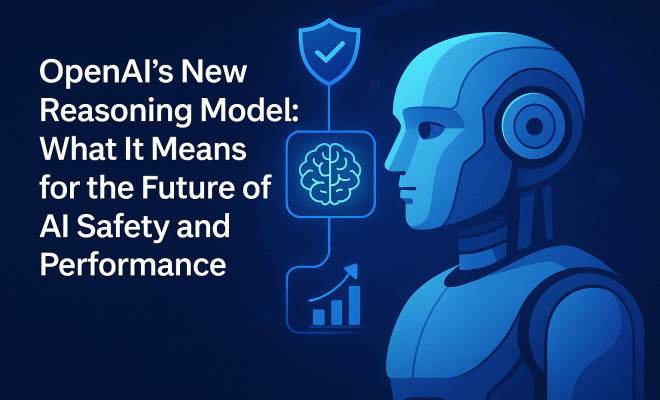
OpenAI’s New Reasoning Model: AI Safety & Performance
“`html
In an era where artificial intelligence (AI) is rapidly evolving, OpenAI’s recent launch of a new reasoning model has become a focal point of discussion. Amidst a growing landscape of AI safety debates and competition, this model aims to enhance multi-step reasoning capabilities while stirring a mix of excitement and concern among developers, businesses, and everyday users alike.
1. The Launch of OpenAI’s New Reasoning Model
OpenAI has unveiled its latest reasoning model, designed to tackle complex, multi-step problems more effectively than previous iterations. This development reflects the company’s ongoing commitment to innovation in AI technology, aiming to improve how models understand and process information. By refining reasoning capabilities, OpenAI hopes to create systems that can engage in deeper thought processes, enabling them to solve intricate challenges with greater accuracy.
The announcement of this model comes at a time when OpenAI is one of the most searched entities in the tech world. Users are eager to discover the capabilities of this new offering, especially considering the company’s history of releasing groundbreaking technology. The anticipation around this launch also highlights the competitive landscape of AI, where companies are vying for dominance in advanced reasoning and problem-solving.
2. Understanding Multi-Step Problem Solving
Multi-step problem solving involves breaking down complex questions into manageable parts, requiring a model to maintain context and logic throughout the process. OpenAI’s new model is specifically engineered to handle such tasks, which are common in real-world applications ranging from scientific research to everyday decision-making.
This improvement is crucial as AI systems increasingly find their way into sectors that demand high levels of accuracy and reliability. For instance, in healthcare, AI models that can connect various data points and draw informed conclusions can significantly impact patient outcomes. The new reasoning model aims to bridge the gap between simple task execution and more nuanced understanding, thereby enhancing the overall utility of AI in various fields.
3. The Safety Debate: A Double-Edged Sword
As exciting as OpenAI’s advancements are, they also bring forth substantial safety concerns. The introduction of a new reasoning model has reignited discussions around AI ethics, reliability, and the potential risks associated with deploying such powerful technology. Critics argue that as reasoning capabilities expand, so does the risk of unintended consequences.
For example, if an AI system misinterprets data or makes flawed connections, the implications could be severe, particularly in sensitive areas like finance or healthcare. The debate becomes even more complex when considering the pace at which AI is being deployed; rapid development often outstrips the establishment of adequate safety measures. OpenAI’s challenge will be not only to advance technology but also to ensure that these innovations are deployed responsibly.
4. Comparative Analysis with Competitors
OpenAI’s new model does not exist in a vacuum; it is part of a broader race with competitors in the AI landscape. Companies like Google DeepMind and Anthropic are also developing advanced reasoning models, leading to a continuous push for improvement across the sector. The competitive nature of this field fuels innovation but also raises questions about which models will prove to be the most effective and safe.
Benchmark performance is critical in this race. OpenAI’s model will likely undergo extensive evaluation against its competitors to determine its efficacy in real-world applications. Users are particularly interested in how this model stacks up against others, as the success of these technologies often hinges on their ability to outperform existing solutions in tangible ways.
5. The User Perspective: Balancing Usefulness and Danger
For developers and everyday users, the release of OpenAI’s new reasoning model prompts a myriad of questions. Users are eager to understand whether this model will enhance their workflows or introduce new risks. The discussion surrounding AI often oscillates between viewing these technologies as tools for empowerment and as potential sources of danger.
As AI continues to integrate into daily life, users seek clarity on how to navigate this evolving landscape. Empowering users with knowledge about how AI functions and the potential risks involved is essential. OpenAI’s communications surrounding this launch will play a crucial role in shaping user perceptions and ensuring that individuals feel equipped to utilize AI safely and effectively. (See: OpenAI's new reasoning model insights.)
6. Implications for Developers and Businesses
The implications of OpenAI’s new reasoning model extend far beyond individual users. Developers and businesses stand to gain significantly from improved multi-step problem-solving capabilities. Enhanced reasoning can lead to more efficient algorithms, enabling companies to streamline operations and improve decision-making processes.
For instance, businesses in sectors such as logistics, finance, and customer service may leverage this model to optimize their workflows, leading to cost savings and increased productivity. As organizations begin to adopt this technology, the model’s impact on innovation and competitiveness within various industries will become evident. However, businesses must also consider the ethical implications of implementing such powerful AI systems, ensuring that their use aligns with responsible practices.
7. Benchmark Performance: What the Numbers Say
Benchmark performance metrics will play a pivotal role in evaluating OpenAI’s new reasoning model. These metrics will assess how well the model performs tasks compared to previous versions and competitor models. Effective benchmarking can provide insights into the model’s strengths and limitations, guiding future improvements.
High benchmark scores in multi-step reasoning tasks could solidify OpenAI’s position as a leader in the AI space. However, these numbers must be interpreted cautiously. Performance in controlled environments may not always translate to success in real-world applications, where variables and complexities abound. Thus, continuous evaluation and adaptation will be necessary to ensure that the model remains effective and relevant.
8. Future Outlook: The Evolving Landscape of AI Safety
As OpenAI’s new model enters the spotlight, the future of AI safety remains a pressing concern. The rapid pace of AI deployment necessitates a proactive approach to safety measures, particularly as more powerful models emerge. OpenAI and other companies must prioritize developing robust frameworks to ensure that AI remains beneficial and does not pose unforeseen risks to society.
Experts emphasize the importance of collaboration within the tech community to address these challenges. By sharing knowledge, best practices, and safety protocols, AI developers can work towards creating systems that safeguard users while harnessing the potential of advanced reasoning. The ongoing conversation around AI safety will likely shape the trajectory of AI development for years to come.
9. Emerging Trends in AI Reasoning
As artificial intelligence continues to develop, several emerging trends are shaping the future of AI reasoning. One notable trend is the integration of AI with quantum computing. Quantum AI promises to dramatically increase computational power, allowing AI systems to process information and solve complex problems at unprecedented speeds. This synergy could enhance the reasoning capabilities of models like OpenAI’s, enabling them to tackle problems that are currently beyond reach.
Another trend is the growing focus on explainable AI (XAI). As AI systems become more complex, understanding their decision-making processes becomes crucial. OpenAI’s new reasoning model will likely incorporate features that enhance transparency, allowing users to comprehend how the system arrives at specific conclusions. This is especially important in high-stakes environments where accountability and trust in AI systems are paramount.
Furthermore, interdisciplinary approaches that combine insights from fields such as neuroscience and cognitive psychology are gaining traction. By emulating human thought processes more closely, AI systems can potentially achieve higher levels of reasoning and problem-solving capabilities. This cross-pollination of ideas is essential for developing AI systems that are not only intelligent but also aligned with human values and ethical considerations.
10. Real-World Applications and Case Studies
OpenAI’s new reasoning model holds promise for a variety of real-world applications. In the healthcare industry, it can assist in diagnostics by analyzing patient symptoms, medical history, and test results to suggest possible conditions. For example, AI could analyze thousands of clinical trial results and patient records to identify patterns that may elude human doctors, thus enabling faster and more accurate diagnoses.
In finance, the model can improve fraud detection systems by analyzing transaction data and user behavior to identify anomalies that suggest fraudulent activities. By examining historical data and contextual factors, AI systems can refine their understanding of what constitutes typical behavior and flag potential concerns more effectively.
Moreover, in the education sector, OpenAI’s reasoning model can personalize learning experiences by assessing students’ strengths and weaknesses through their interactions. This could lead to tailored educational resources that adapt to individual learning paces, providing a more engaging and effective educational experience. (See: Understanding complex problem-solving.)
Case studies from early adopters of OpenAI’s model will provide invaluable insights into its capabilities and how organizations implement it in their operations. For instance, a healthcare provider that integrates this reasoning model into its patient management system may report improvements in patient outcomes and operational efficiency, showcasing the tangible benefits of adopting advanced AI technologies.
11. Challenges and Limitations of Advanced AI Models
Despite the advances represented by OpenAI’s new reasoning model, several challenges and limitations remain. One significant challenge is the potential for bias in AI systems. If the data used to train the model contains biases, these can be perpetuated and even exacerbated by the AI’s reasoning capabilities. Therefore, ensuring diverse and representative data is crucial for minimizing bias and ensuring fair outcomes.
Another limitation pertains to the interpretability of AI decisions. As models become increasingly complex, understanding the rationale behind their decisions may become more difficult for users and developers alike. Striking a balance between model performance and interpretability will be essential to foster trust and acceptance among users.
Furthermore, the energy consumption associated with training and deploying large AI models poses environmental concerns. The tech industry is beginning to pay closer attention to the carbon footprint of AI systems, and OpenAI will need to consider sustainable practices in the development and deployment of its technologies.
12. Frequently Asked Questions (FAQ)
What is OpenAI’s new reasoning model designed to do?
OpenAI’s new reasoning model is designed to handle complex, multi-step problems more effectively than previous iterations, enhancing its ability to understand and process information in a nuanced manner.
How does this model improve upon existing AI technologies?
The new model features refined reasoning capabilities that allow it to engage in deeper thought processes, which facilitates the solving of intricate challenges with greater accuracy.
What safety concerns are associated with the new reasoning model?
Safety concerns include the potential for unintended consequences arising from misinterpretation of data or flawed connections, particularly in sensitive sectors like finance and healthcare.
How does OpenAI’s model compare to competitors like Google DeepMind?
OpenAI’s model is part of a competitive landscape where various companies, including Google DeepMind and Anthropic, are developing their advanced reasoning models. Benchmark performance will be critical to evaluate their effectiveness against one another.
What real-world applications can benefit from this model?
Applications span various sectors, including healthcare for diagnostics, finance for fraud detection, and education for personalized learning experiences.
What are some limitations of advanced AI models?
Challenges include the potential for bias in training data, issues with the interpretability of decisions made by complex models, and environmental concerns related to energy consumption. (See: Research on AI reasoning capabilities.)
How can users ensure they are using AI responsibly?
Users can ensure responsible use by staying informed about the technology, understanding its limitations, and adhering to ethical guidelines when implementing AI solutions.
What role do regulatory frameworks play in AI development?
Regulatory frameworks are crucial in guiding the development and deployment of AI technologies. They can help ensure that AI systems are developed with safety, transparency, and accountability in mind, ultimately protecting users and society at large.
How can businesses measure the ROI of implementing AI technologies?
Businesses can measure the ROI of AI technologies by analyzing key performance indicators (KPIs), such as cost savings, operational efficiencies, customer satisfaction, and the speed of task completion. Tracking these metrics over time can provide insights into the financial and strategic benefits of AI adoption.
13. Community and Expert Engagement: The Importance of Collaboration
As the AI landscape evolves, engaging with the community and experts in various fields becomes increasingly important. OpenAI is not alone in this endeavor; partnerships with universities, research institutions, and industry leaders can drive advancements in responsible AI development. Collaborating with diverse stakeholders ensures that different perspectives are considered, reducing the chances of oversight in ethical considerations.
Moreover, hosting workshops and public discussions can foster a culture of transparency and accountability, enabling users to contribute to the discourse around AI technologies. This engagement allows for the identification of potential pitfalls and the establishment of guidelines that safeguard users and promote trust in AI systems.
14. Conclusion: Navigating the New AI Frontier
The launch of OpenAI’s new reasoning model is a significant milestone in the ongoing evolution of artificial intelligence. As excitement builds around its potential capabilities, the surrounding safety discussions highlight the complexities of deploying such advanced technologies. Balancing innovation with responsibility will be essential as developers, businesses, and users navigate this new AI frontier.
As we move forward, it will be crucial to remain engaged in the conversation about AI safety and effectiveness. Staying informed about advancements and understanding the implications of these technologies will empower all stakeholders to leverage AI responsibly and effectively, ensuring its benefits are maximized while risks are minimized.
“`
Frequently Asked Questions
What is OpenAI's new reasoning model?
OpenAI's new reasoning model is an advanced AI system designed to enhance multi-step problem solving. It aims to improve the way AI models understand and process information, allowing them to tackle complex challenges with greater accuracy and depth of thought.
How does OpenAI's reasoning model improve AI performance?
The reasoning model improves AI performance by refining multi-step reasoning capabilities. This allows AI systems to break down complex problems into manageable parts while maintaining context and logic, which is essential for applications in various fields, including healthcare and scientific research.
What are the implications of OpenAI's new model for AI safety?
OpenAI's new reasoning model raises important considerations for AI safety. By enhancing reasoning capabilities, the model aims to ensure that AI systems make informed and accurate decisions, thereby reducing risks associated with incorrect outputs in high-stakes environments.
Why is OpenAI's reasoning model significant for businesses?
The reasoning model is significant for businesses as it offers improved problem-solving abilities that can lead to better decision-making and efficiency. Companies can leverage this technology to enhance operations, innovate solutions, and maintain a competitive edge in the rapidly evolving AI landscape.
What challenges does OpenAI's new model address?
OpenAI's new model addresses challenges related to complex, multi-step problem solving. It aims to improve how AI systems manage context and logic, which is crucial for producing reliable and accurate results in real-world applications across various sectors.
What’s your take on this? Share your thoughts in the comments below — we read every one.