7 Mind-Blowing Saturn Facts: Reshape Your Solar System View
“`html
When gazing at the night sky, few celestial wonders capture our imagination quite like Saturn. This majestic planet, known for its stunning rings and vibrant atmospheric features, has fascinated astronomers and casual stargazers alike for centuries. Understanding Saturn goes beyond mere visuals; it reveals profound insights about the formation and evolution of our solar system. In this article, we will explore Saturn facts that highlight its unique characteristics, its role in planetary science, and the latest discoveries that continue to astound scientists and enthusiasts.
1. A Giant Among Giants
Saturn stands as the sixth planet from the Sun and is the second-largest planetary body in our solar system, right after Jupiter. With a diameter of about 86,881 miles (139,822 kilometers), Saturn is nearly 10 times wider than Earth. If Earth were the size of a nickel, Saturn would be roughly the size of a basketball. This immense size presents numerous challenges for scientists, especially in understanding the planet’s complex atmospheric dynamics and internal structure.
What makes Saturn’s size even more fascinating is its relatively low density. In fact, Saturn is the only planet in our solar system that is less dense than water—meaning that if there were a bathtub large enough, Saturn would float! This low density is primarily due to its composition, which is largely made up of hydrogen and helium. Understanding Saturn’s density and structure helps scientists learn more about planetary formation and the characteristics of gas giants in general.
2. The Stunning Rings of Saturn
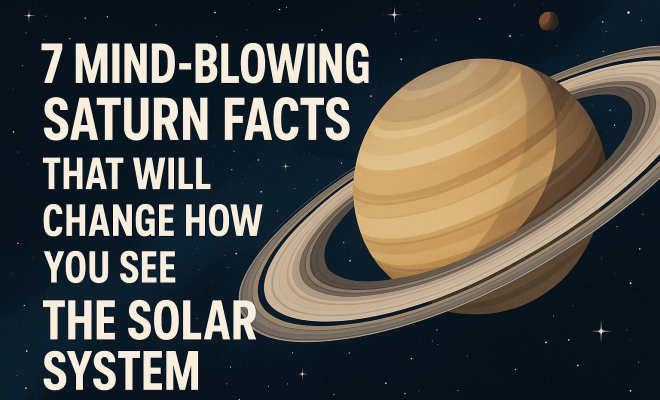
One of the most recognizable Saturn facts is its stunning rings. These rings are primarily composed of billions of small chunks of ice and rock, many of which are coated with a layer of dust. The rings stretch out thousands of kilometers from the planet but are incredibly thin—no more than about 30 feet (10 meters) thick in some places. Scientists believe that the rings may be remnants of comets, asteroids, or even the remains of moons that broke apart due to Saturn’s gravitational pull.
The rings are categorized into several main sections, named alphabetically in the order they were discovered. The A and B rings are the brightest and most prominent, while the C ring is fainter. There are also many smaller rings, known as D, E, F, and G rings. The intricate structures within these rings are also subjects of intense study, as they might offer insights into the gravitational interactions between Saturn’s moons and the ring particles.
Recent research has shown that the rings are not static; they are dynamic and constantly changing. Observations from the Cassini spacecraft indicated that the rings are gradually being pulled into Saturn by its gravitational forces, a process called “ring rain.” Scientists estimate that the rings could disappear entirely in about 100 million years, a relatively short time in cosmic terms. This raises questions about the lifespan of ring systems in other celestial bodies and whether we might see similar phenomena elsewhere. (See: Saturn on Wikipedia.)
3. A Stormy Atmosphere
Saturn’s atmosphere is another area of intense interest for researchers. It is characterized by high-velocity winds, reaching speeds of up to 1,100 miles per hour (1,800 kilometers per hour). This atmosphere is primarily composed of hydrogen, with about 30% helium and trace amounts of other gases, such as methane and ammonia. Its distinctive yellow-brown color comes from ammonia crystals and other hydrocarbons.
One of the most astonishing atmospheric phenomena on Saturn is its massive storms. These storms can last for weeks or even months, with some capable of covering vast areas of the planet’s surface. The most famous storm, known as the Great White Spot, is a periodic storm that appears roughly every 30 Earth years. Observations from the Cassini spacecraft revealed that this storm can expand to a size larger than Earth itself!
Additionally, Saturn’s atmosphere contains intriguing features like jet streams that can flow at different speeds, creating a banded appearance similar to that of Jupiter. These jet streams are driven by differential rotation, meaning that the planet’s equator spins faster than its poles. This phenomenon contributes to Saturn’s distinctive weather patterns and complex cloud formations. Examining these interactions helps scientists model atmospheric dynamics in gas giants and improve weather prediction techniques for both planetary and terrestrial applications.
4. Moons of Wonder
Saturn boasts an impressive collection of moons—over 80 confirmed at last count. One of the most notable is Titan, the second-largest moon in the solar system, trailing only Jupiter’s Ganymede. Titan is particularly intriguing due to its thick atmosphere and surface lakes of liquid methane and ethane, creating a unique and alien landscape. Titan’s atmosphere is denser than Earth’s, and it contains organic compounds that could provide clues about the origins of life.
Another fascinating moon is Enceladus, which has gained attention for its geologically active surface and the presence of water vapor plumes erupting from its southern polar region. These plumes suggest that beneath its icy crust, Enceladus may harbor a subsurface ocean. This discovery has profound implications for astrobiology, potentially providing a habitat for life beyond Earth. Studies of Enceladus could lead to breakthroughs in our understanding of life’s adaptability in extreme environments.
Other interesting moons include Mimas, known for its resemblance to the Death Star from Star Wars, and Dione, which features bright ice cliffs and a mix of heavily cratered regions and younger surfaces. Each moon offers unique geological features and potential clues to the history of the Saturnian system. The vast diversity among Saturn’s moons presents a unique opportunity for comparative planetology—understanding how different geological processes occur in different environments.
5. The Cassini Mission: A New Era of Discovery
The Cassini-Huygens mission, which ran from 1997 to 2017, greatly enhanced our understanding of Saturn and its system. Launched as a collaboration between NASA, the European Space Agency, and the Italian Space Agency, Cassini provided unprecedented data and imagery of Saturn, its rings, and its moons. (See: NASA's Cassini mission overview.)
Throughout its 13-year mission, Cassini made several groundbreaking discoveries, including the detection of organic molecules on Titan, the identification of intricate ring structures, and the observation of seasonal changes in Saturn’s atmosphere. Perhaps most notably, the spacecraft’s Grand Finale involved a series of daring dives between Saturn and its rings, allowing scientists to gather data about the planet’s atmosphere and gravitational field before the mission concluded with a controlled plunge into Saturn.
Moreover, Cassini’s findings have reshaped our understanding of the processes that govern planetary atmospheres and ring systems. Data collected have allowed scientists to model how Saturn’s atmosphere behaves and interacts with its magnetic field, revealing a complex interplay of forces that shape not only Saturn but other gas giants in our solar system. The mission’s success sets the stage for future explorations, emphasizing the importance of long-term space missions in uncovering the secrets of our solar system.
6. Saturn in Mythology and Culture
Saturn’s influence extends beyond science and astronomy; it has deep roots in mythology and culture. In Roman mythology, Saturn is the god of agriculture, wealth, and time. His Greek equivalent is Cronus, who is often depicted as a figure wielding a sickle, symbolizing harvest. This cultural connection has led to many references to Saturn in literature, art, and astrology, where it is often associated with discipline and responsibility.
The planet’s striking appearance has also made it a subject of fascination in popular culture. From its portrayal in science fiction to its appearance in movies and television shows, Saturn remains a powerful symbol of the mysteries of the universe. Its iconic rings and unique features continue to spark interest and stimulate the imagination.
Furthermore, Saturn has inspired countless artists, musicians, and writers. The planet has become synonymous with beauty and wonder, often representing the unknown in philosophical discussions and artistic explorations. Its presence in various cultural narratives emphasizes humanity’s quest for knowledge and understanding of the cosmos. As we analyze the interplay between science and art, Saturn serves as a profound example of how celestial bodies can influence human creativity and thought.
7. Saturn’s Future: What Lies Ahead
As technology advances, the study of Saturn and its many wonders continues to evolve. Future missions are being planned to further explore Saturn’s moons, particularly Enceladus and Titan. These missions aim to investigate the potential for life in the subsurface oceans of these moons and to understand the complex processes that govern their geology and atmospheres. NASA’s proposed Dragonfly mission, for instance, aims to send a rotorcraft lander to Titan, exploring its surface and atmosphere in unprecedented detail. (See: Scientific research on Saturn's atmosphere.)
Beyond exploration, Saturn serves as a testing ground for theories of planetary formation and dynamics. Scientists are particularly keen on understanding the interactions between Saturn and its rings, which may offer clues about the evolution of planetary systems throughout the universe. The ongoing analysis of data from the Cassini mission continues to provide insights that could reshape our understanding of ring dynamics and their behavior over time.
Additionally, emerging technologies such as improved spectrometers and advanced imaging techniques could enhance our capabilities to study Saturn and its moons from Earth and space. This could pave the way for more detailed analyses of the chemical compositions of the rings and atmospheres, leading to deeper insights into their histories and the conditions that have shaped them over billions of years. As we advance our observational tools, the potential for groundbreaking discoveries about Saturn is limitless.
8. FAQs About Saturn
- How far is Saturn from the Sun? Saturn is approximately 886 million miles (1.4 billion kilometers) away from the Sun, making it the sixth planet in the solar system.
- What are Saturn’s rings made of? The rings are primarily composed of ice particles, rocky debris, and dust, varying in size from microscopic grains to large boulders.
- Can Saturn support life? While Saturn itself is not a candidate for life, its moons, particularly Enceladus and Titan, offer exciting possibilities for harboring life due to the presence of water and complex organic chemistry.
- How long is a day on Saturn? A day on Saturn is approximately 10.7 hours long, making it one of the fastest rotating planets in our solar system.
- What is the temperature on Saturn? Saturn’s atmosphere is extremely cold, with temperatures dropping to about -288 degrees Fahrenheit (-178 degrees Celsius) at the cloud tops.
- How does Saturn’s gravity compare to Earth’s? Saturn’s gravity is about 1.065 times that of Earth’s. This means that if you weigh 100 pounds on Earth, you would weigh roughly 106.5 pounds on Saturn.
- What is the magnetic field of Saturn like? Saturn has a magnetic field that is 578 times stronger than Earth’s, which is believed to be generated by the motion of metallic hydrogen in its interior.
- Is Saturn visible from Earth? Yes, Saturn is one of the five planets visible to the naked eye from Earth. It can be observed at different times throughout the year, depending on its position in relation to the Earth and the Sun.
- What makes Saturn’s atmosphere unique? Saturn’s atmosphere stands out due to its extreme winds, complex weather patterns, and the presence of massive storms that can rival the size of Earth.
- How do scientists study Saturn’s rings and moons? Scientists use a combination of Earth-based telescopes and spacecraft missions, like Cassini, to gather data and analyze the composition and dynamics of Saturn’s rings and moons.
- What are the challenges of exploring Saturn? The vast distance, harsh environmental conditions, and the complexity of Saturn’s system pose significant challenges for exploration, requiring advanced technology and long-term planning.
9. Conclusion: The Ever-Evolving Planet
From its magnificent rings to its diverse moons, Saturn is a treasure trove of scientific inquiry and discovery. The Saturn facts presented here illustrate not only the planet’s incredible features but also its significance in our understanding of planetary science and the broader cosmos. As ongoing research continues to unveil new information about this enigmatic giant, we are reminded of the vastness and complexity of our solar system and the potential for surprises that lie beyond our current knowledge.
As we look forward to future explorations and discoveries, Saturn will undoubtedly remain a focal point of interest for both scientists and the general public, bridging the gap between casual curiosity and serious scientific investigation. Its iconic status ensures that as new findings emerge, Saturn will continue to be a viral topic in the realms of astronomy and beyond. The ongoing quest to understand Saturn not only enriches our knowledge of this extraordinary planet but also enhances our grasp of the intricate workings of the universe itself.
“`
Frequently Asked Questions
What are some interesting facts about Saturn?
Saturn is the second-largest planet in our solar system, known for its stunning rings made of ice and rock. It has a diameter nearly 10 times that of Earth and is less dense than water, meaning it could float in a giant bathtub. These characteristics provide insights into planetary formation and the nature of gas giants.
Why is Saturn known for its rings?
Saturn's rings are composed of billions of small chunks of ice and rock, many covered in dust. They extend thousands of kilometers from the planet but are incredibly thin, measuring only about 30 feet thick in some areas. This unique structure makes them one of the most visually striking features in our solar system.
How does Saturn compare to other planets?
Saturn is the sixth planet from the Sun and the second largest after Jupiter. Its immense size and low density—being less dense than water—offer unique challenges for scientists studying its atmospheric dynamics and internal structure, setting it apart from terrestrial planets like Earth.
What is the composition of Saturn?
Saturn is primarily composed of hydrogen and helium, which contribute to its low density. This gaseous composition is typical of gas giants and provides valuable information about the processes involved in planetary formation within our solar system.
Can Saturn float in water?
Yes, Saturn is the only planet in our solar system with a density less than that of water. If there were a bathtub large enough, Saturn would indeed float, highlighting its unique composition and structure compared to other planets.
What’s your take on this? Share your thoughts in the comments below — we read every one.