HD 20794 Super-Earth: Exploring a Nearby Habitable Exoplanet
“`html
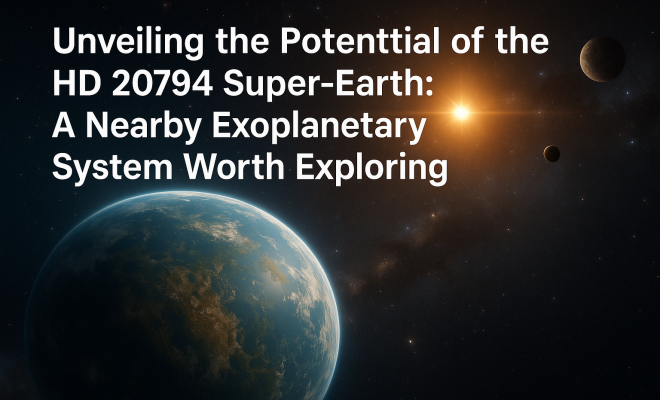
The cosmos is a vast and mysterious expanse, and within it lies a treasure trove of secrets waiting to be uncovered. One such discovery is the HD 20794 super-Earth, a fascinating exoplanet situated in a compact multi-planet system orbiting a nearby G-type dwarf star. Recent research has brought to light the structural characteristics and elemental abundances of this star, raising intriguing questions about the planets it harbors. As we delve deeper into this exciting celestial find, we will explore the implications of its discovery, the potential for habitability, and what it could mean for our understanding of planetary systems.
The HD 20794 System: An Overview
HD 20794 is a relatively close star in our galactic neighborhood, located approximately 63 light-years away in the constellation Grus. This metal-poor G-type dwarf star is particularly bright, making it an excellent candidate for astronomical studies. Its compact planetary system consists of three confirmed exoplanets, each with distinct characteristics.
The three planets identified in this system have orbital periods of 18.3, 89.7, and 647.6 days, with minimum masses ranging from 2.15 to 5.82 Earth masses. The HD 20794 super-Earth is particularly noteworthy due to its location and mass, as it could potentially reside within the star’s habitable zone—an area where conditions may be suitable for liquid water to exist, a crucial ingredient for life as we know it.
Moreover, the proximity of HD 20794 enhances its significance for future observational studies, allowing scientists to utilize space telescopes like the James Webb Space Telescope (JWST) to analyze its atmosphere and composition in greater detail. Understanding the dynamics of such a system can offer potential insights into the formation and evolution of similar exoplanetary systems across the galaxy.
The Composition and Structure of HD 20794
The study of HD 20794 provides a window into the elemental makeup and structural properties of this star. As a metal-poor star, HD 20794 has significantly lower metallicity compared to the Sun. This characteristic has implications for the formation of its planets, as the availability of heavy elements is pivotal in the development of rocky bodies.
Metallicity plays a critical role in planet formation, where higher metallicity typically correlates with a greater likelihood of forming terrestrial planets. In contrast, HD 20794’s lower metallicity may suggest a different evolutionary pathway for its planetary system, potentially leading to unique characteristics among its planets, including the super-Earth.
Recent studies have provided estimates of the specific elemental abundances found in HD 20794, indicating a deficit in elements such as iron and silicon. This deficiency could have influenced the types of planets that formed around the star and their subsequent development. For example, lower iron content may suggest that the planets are composed of different rock types or have altered mantle compositions when compared to Earth-like planets.
Planetary Characteristics and Orbital Dynamics
The three planets in the HD 20794 system exhibit varying sizes and orbital distances from their host star. The inner planet, with a minimum mass of 2.15 Earth masses, completes an orbit every 18.3 days, indicating a close proximity to the star. The second planet, with a minimum mass of 2.98 Earth masses, has an orbital period of 89.7 days, while the outer planet, with a mass of 5.82 Earth masses, takes a significantly longer 647.6 days to complete a single orbit.
This dynamic arrangement of planets suggests a compact system with a potential for gravitational interactions that could influence their orbital stability and evolution over time. The configuration of these planets also raises intriguing questions about their atmospheres and surface conditions, particularly concerning the super-Earth’s potential habitability.
Another fascinating aspect of their orbital dynamics is the potential for resonance. In some multi-planet systems, planets can be locked in a gravitational resonance where their orbital periods are related by a ratio of small integers, leading to a stable system over long time scales. Future research could determine whether such resonances exist in the HD 20794 system, which might provide insights into the long-term stability of its orbits.
The Habitable Zone and Its Importance
One of the most exciting aspects of the HD 20794 super-Earth is its potential location within the habitable zone of its parent star. The habitable zone, often referred to as the “Goldilocks zone,” is the region around a star where conditions are just right for liquid water to exist on a planet’s surface. This is a critical factor in assessing the planet’s ability to support life. (See: Super-Earth definition and characteristics.)
For HD 20794, the habitable zone is determined by the star’s luminosity and temperature. Given the star’s characteristics, researchers believe that the inner and possibly the second planet may lie within this zone, allowing for the possibility of suitable conditions for life. This is especially intriguing given the super-Earth’s mass, which suggests it could maintain a thicker atmosphere compared to smaller rocky planets.
Estimating the habitable zone for HD 20794 takes into account various stellar properties, such as the effective temperature and radius of the star. Models predict a habitable zone that may extend from about 0.07 to 0.12 astronomical units (AU), which is considerably closer than Earth’s distance from the Sun. These models suggest that the super-Earth could experience a greenhouse effect, potentially allowing liquid water to persist on its surface despite its proximity to the star.
Elemental Abundances and Planetary Formation
The elemental abundances of HD 20794 play a significant role in understanding the formation and composition of its planets. The study highlights a deficiency in heavier elements, which could lead to distinct planetary characteristics. The density and composition of the super-Earth, for instance, may differ substantially from that of Earth.
Understanding the elemental makeup can also shed light on the atmospheric conditions of the super-Earth. A planet’s atmosphere is crucial for temperature regulation and can influence the potential for life. If the HD 20794 super-Earth has retained a significant atmosphere, it may offer a suitable environment for biological processes.
In particular, the presence of water vapor, carbon dioxide, and other greenhouse gases in the super-Earth’s atmosphere could support temperature regulation conducive to life. Researchers are keenly interested in identifying whether the planet has experienced tectonic activity, which could contribute to maintaining a dynamic atmosphere over geological time scales.
Recent advancements in spectroscopic technologies are paving the way for more precise measurements of atmospheric compositions, offering clues about the planet’s climate and potential habitability. The ongoing exploration of exoplanets emphasizes the importance of identifying planetary systems that can host environments similar to those on Earth.
Comparative Analysis With Other Exoplanetary Systems
The HD 20794 system showcases similarities and differences when compared to other exoplanetary systems, particularly those with super-Earths located within habitable zones. For example, systems like TRAPPIST-1 and Proxima Centauri are also noteworthy for their multiple planet configurations and their potential for habitability.
However, the uniqueness of HD 20794 lies in its metal-poor nature and the specific arrangement of its planets. While many exoplanetary systems are rich in heavy elements, the elemental scarcity in HD 20794 may provide insights into alternative pathways of planetary development, highlighting the diversity of planetary systems in our galaxy.
In contrast, TRAPPIST-1 features seven terrestrial planets, three of which are located in the habitable zone, but it is a cooler dwarf star compared to HD 20794. This raises questions about the climatic conditions of planets orbiting different types of stars. Understanding how various factors such as stellar type, metallicity, and distance from the habitable zone interact will contribute to a deeper comprehension of planetary formation and habitability.
Implications for Future Research
The discovery of the HD 20794 super-Earth and its planetary companions opens new avenues for future research. As telescopes and detection methods improve, astronomers are increasingly equipped to study the atmospheres and potential biosignatures of exoplanets. The proximity of HD 20794 also allows for more detailed observations that could enhance our understanding of its planets’ characteristics.
Future studies may focus on atmospheric composition through transit observations, allowing researchers to determine the presence of gases like oxygen and methane, which could indicate biological activity. Moreover, continued monitoring of the system can provide insights into the long-term stability of the planetary orbits and the effects of stellar activity on the planets.
Additionally, the investigation of the HD 20794 system could serve as a benchmark for studying similar metal-poor stars and their planetary systems. Understanding how these stars interact with their planets might yield new models for planetary evolution, especially in environments that differ significantly from those around solar-type stars. (See: NASA's exoplanet exploration overview.)
Public Interest and the Search for Extraterrestrial Life
Public interest in exoplanets has surged in recent years, particularly with the discovery of Earth-like planets in habitable zones. The HD 20794 super-Earth, with its proximity and the potential for habitability, captures the imagination of both scientists and the public alike. The prospect of finding extraterrestrial life remains one of humanity’s greatest quests, and discoveries like this fuel that passion.
As we continue to explore these distant worlds, the story of the HD 20794 system serves as a reminder of our place in the universe and the possibilities that lie beyond our planet. Engaging the public in this journey is crucial, as it fosters a sense of wonder and curiosity about the cosmos.
Efforts to communicate the significance of such discoveries through outreach programs, documentaries, and educational initiatives can inspire the next generation of scientists and astronaut explorers. The quest for finding life beyond Earth not only has scientific implications but also philosophical and existential dimensions that resonate with people worldwide.
Frequently Asked Questions (FAQ)
What is a super-Earth?
A super-Earth is an exoplanet that has a mass larger than Earth’s but significantly less than that of Uranus or Neptune. Typically, super-Earths range from about 1.5 to 10 Earth masses and can potentially have rocky surfaces or even substantial atmospheres.
How was HD 20794 discovered?
HD 20794 was discovered using radial velocity methods, which measure the star’s wobble due to the gravitational influence of its orbiting planets. Observations using spectrographs have allowed astronomers to detect the presence of these planets and determine their minimum masses and orbital periods.
Is the HD 20794 super-Earth habitable?
While HD 20794 is located in the habitable zone of its star, further studies are needed to determine its actual habitability. Key factors include the presence of an atmosphere, surface conditions, and whether liquid water can exist on its surface.
What are the challenges of studying exoplanets like HD 20794?
Studying exoplanets poses various challenges, including their vast distances from Earth, the faintness of their host stars, and the need for advanced technology to analyze light spectra for atmospheric compositions. Additionally, understanding the complex interactions of multiple planets in a system adds layers of difficulty to research.
What could the discovery of HD 20794 mean for the search for extraterrestrial life?
The HD 20794 super-Earth adds to the growing catalog of exoplanets that may have conditions conducive to life. Continued exploration of such systems enhances our understanding of where life might arise in the universe and helps refine the criteria for identifying potentially habitable worlds.
Comparative Studies of HD 20794 and Similar Exoplanets
To further understand the HD 20794 super-Earth, it’s important to compare it with other similar exoplanets and systems. For instance, the K2-18b, another super-Earth located about 124 light-years away, has garnered significant interest due to its position in the habitable zone and the detection of water vapor in its atmosphere. This comparison emphasizes the value of studying atmospheric conditions and chemical compositions, as both factors are critical to assessing the potential for life.
Moreover, the super-Earth LHS 1140 b, which is around 40% larger than Earth and orbits a cool dwarf star, offers insights into the characteristics of rocky planets within habitable zones. Understanding the differences and similarities between these exoplanets can help refine models of planetary formation and habitability. The variations in their elemental composition, atmospheric conditions, and stellar influences present a broader framework for analyzing the HD 20794 system. (See: Research on habitable zones.)
Furthermore, as research progresses, scientists can begin to hypothesize about the historical climates of these planets. For example, if the HD 20794 super-Earth possesses a thick atmosphere, it may have experienced greenhouse gas effects similar to those theorized for early Earth. These comparisons can provide a clearer picture of the evolutionary trajectories of exoplanets in varying environments.
Potential Techniques for Future Observations
Investigating the HD 20794 super-Earth and its planetary neighbors will require innovative observational techniques. The upcoming generation of telescopes, such as the Extremely Large Telescope (ELT) and the Nancy Grace Roman Space Telescope, will be crucial in examining the atmospheres of these distant worlds. Techniques like transmission spectroscopy can be employed to analyze the light filtered through a planet’s atmosphere during transit, revealing the composition and potential signatures of habitability.
Moreover, direct imaging methods could allow astronomers to capture images of the exoplanets themselves, providing crucial data regarding their surface conditions and atmospheric properties. These advanced techniques will not only enhance our understanding of the HD 20794 system but will also contribute to the broader field of exoplanet research and the search for extraterrestrial life.
Potential for Tectonic Activity on HD 20794 Super-Earth
One of the fascinating aspects of the HD 20794 super-Earth is its potential for tectonic activity. Tectonic processes play a crucial role in regulating a planet’s atmosphere and climate over geological timescales. If the HD 20794 super-Earth has a tectonically active surface, it may exhibit volcanic activity, which can contribute to the recycling of carbon and other essential elements, maintaining an atmosphere that could support life.
Studies of other super-Earths have shown that those with substantial mass and gravitational pull often have geological processes that are similar to Earth. The super-Earth’s ability to retain heat from its formation, along with any radioactive decay occurring within its core, might further drive tectonic activity. Understanding the geological and tectonic features of HD 20794 could provide insights into the planet’s evolution and its capacity to sustain life.
Conclusion: The Future of HD 20794 Super-Earth Exploration
In conclusion, the HD 20794 super-Earth stands out as a fascinating component of a nearby multi-planet system that warrants further study. Its unique characteristics, including its location in the habitable zone and the elemental abundances of its host star, provide a rich field for research and exploration. As scientists continue to investigate this intriguing system, we may soon uncover new insights into the conditions that could support life beyond Earth.
This exciting discovery not only enhances our understanding of planetary formation and evolution but also highlights the importance of continued exploration in our quest to find life beyond our solar system. The HD 20794 super-Earth serves as a beacon of hope, reminding us that the search for extraterrestrial life is not just a dream but a tangible reality waiting to be explored.
“`
Trending Now
Frequently Asked Questions
What is the HD 20794 super-Earth?
The HD 20794 super-Earth is an exoplanet located about 63 light-years away in the constellation Grus. It is part of a compact multi-planet system orbiting a G-type dwarf star and is notable for its potential habitability due to its location within the star's habitable zone.
Why is HD 20794 significant for astronomical studies?
HD 20794 is significant because it is a relatively close star with a bright, metal-poor composition, making it ideal for detailed astronomical studies. Its proximity allows for advanced observations using telescopes like the James Webb Space Telescope to analyze the planets' atmospheres and compositions.
How many planets are in the HD 20794 system?
The HD 20794 system contains three confirmed exoplanets, each with varying orbital periods and minimum masses. These planets range from 2.15 to 5.82 Earth masses, contributing to our understanding of diverse planetary systems.
What is the potential for habitability on HD 20794?
The HD 20794 super-Earth may reside within the habitable zone of its star, an area where conditions could allow for the existence of liquid water, a key ingredient for life. This potential habitability makes it a prime candidate for further exploration.
What can we learn from studying the HD 20794 exoplanetary system?
Studying the HD 20794 exoplanetary system can provide insights into the formation and evolution of planetary systems in the galaxy. It helps astronomers understand the structural characteristics and elemental abundances of stars and their planets.
Have you experienced this yourself? We’d love to hear your story in the comments.