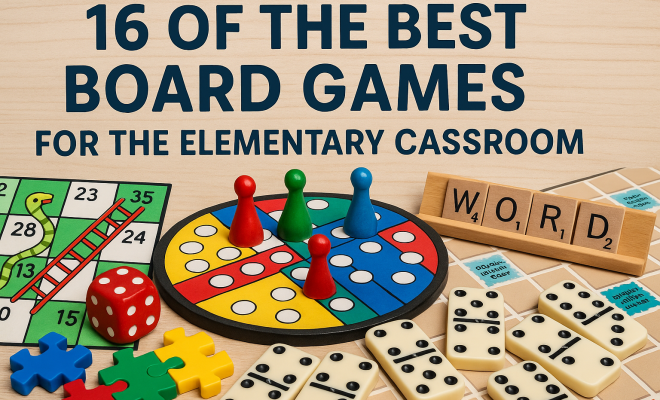
16 of the Best Board Games for the Elementary Classroom
“`html
In the realm of education, engaging students can often feel like a Herculean task. Thankfully, incorporating games into the classroom can significantly enhance learning while keeping students excited and focused. Board games, in particular, can offer a wide range of educational benefits, from improving critical thinking to fostering teamwork and communication skills. In this article, we’ll explore the 16 best board games for classroom settings, with a focus on how they can be effectively integrated into your teaching strategy.
1. Ticket to Ride: Adventure on the Rails
Ticket to Ride is a strategic board game that immerses players in a railway-building adventure across the globe. Players collect cards of various types of train cars and use them to claim railway routes on a map. This game is particularly advantageous for elementary students because it enhances geographical knowledge and encourages strategic planning.
Teachers can use Ticket to Ride to discuss geography, history, and even mathematics, such as counting points and calculating distances. Its engaging gameplay keeps students attentive, promoting social interaction as they negotiate routes and compete against one another. It’s not just about winning; it’s also about learning to collaborate and communicate effectively.
2. Apples to Apples: A Hilarious Game of Comparison
Apples to Apples is a fun and fast-paced game that helps children develop their vocabulary and critical thinking skills. Players take turns being the judge, and the rest must choose cards from their hands that best match the judge’s chosen descriptor card. The results are often humorous and lead to lively discussions.
This game is perfect for fostering creativity and enhancing language skills, making it one of the top best board games for classroom situations. Teachers can facilitate discussions after each round, asking students why they chose certain cards, thus encouraging deeper engagement with language and critical reasoning.
3. Blokus: Strategy and Spatial Awareness
Blokus is a unique strategy game that challenges players to fit their pieces on a grid while blocking opponents as they go. The spatial reasoning involved in Blokus helps children improve their problem-solving skills, making it an effective tool for cognitive development.
This game can be particularly useful in teaching geometry concepts, such as angles and shapes, while also fostering a competitive yet cooperative environment. It’s wonderfully simple to understand and can be played in groups, making it ideal for classroom settings.
4. Settlers of Catan: Trading and Resource Management
The Settlers of Catan introduces students to concepts of resource management and trade. Players build settlements, cities, and roads while trading resources like wood, brick, and wheat. The game emphasizes the importance of negotiation, strategy, and critical thinking.
Incorporating Settlers of Catan into classroom activities can provide a dynamic way to explore economic principles and community building. Teachers can create a lesson around resource allocation, discussing how these themes apply to real-world scenarios. As students engage in trade and negotiation, they also enhance their communication skills.
5. Guess Who?: Deductive Reasoning in Action
Guess Who? is a classic guessing game that encourages students to refine their deductive reasoning skills. Players ask yes-or-no questions to eliminate characters from their boards until they can guess their opponent’s character. It’s engaging and easy to understand, making it suitable for younger students.
This game can help improve questioning techniques, as students learn to ask precise questions for effective problem-solving. Teachers can enhance the educational value by incorporating discussions on characteristics, traits, and categories, thus expanding the cognitive challenge.
6. Operation: Learning Through Fine Motor Skills
Operation is not only entertaining but also helps refine fine motor skills as players navigate a board filled with quirky ailments. Students take turns using tweezers to remove game pieces while avoiding buzzing sounds that signify failure. This game can be particularly beneficial for younger students. (See: U.S. Department of Education.)
In a classroom setting, Operation can tie into lessons on anatomy or health. Teachers can prompt discussions about the human body, its functions, and the importance of health, making the gameplay both fun and educational.
7. Qwirkle: Patterns and Strategy
Qwirkle is a game that combines strategy and pattern recognition, making it an excellent choice for elementary students. Players must create lines of tiles that share either a color or a shape. This game promotes critical thinking and spatial awareness as students work to maximize their points.
Qwirkle can serve as a springboard for discussions on patterns and sequences in mathematics. Additionally, its easy-to-learn rules make it accessible for students of all ages. It’s a fantastic way to encourage math skills in a fun and interactive environment.
8. Scrabble: A Classic for Language Development
Scrabble is one of the most recognized word games that enhances vocabulary and spelling. Players create words on a game board using letter tiles, earning points based on the letters used and the placement of the words. This game is particularly beneficial in improving language skills.
Incorporating Scrabble into the classroom can help foster a love for words. Teachers can organize spelling bees or word challenges, turning a fun game into an opportunity for learning. It encourages teamwork as students collaborate to form words while also sparking friendly competition.
9. Kingdomino: Building Empires with Strategy
Kingdomino is a tile-laying game that combines the classic mechanics of dominoes with strategic thinking, where players build their kingdoms by placing tiles that represent different terrains. It’s ideal for teaching about spatial awareness and planning.
This game can also be used to introduce concepts of area and perimeter as students strategize how to best expand their kingdoms. The colorful tiles and engaging gameplay make Kingdomino appealing to elementary students, encouraging them to think critically about their choices.
10. Hoot Owl Hoot!: Cooperative Learning
Hoot Owl Hoot! is a cooperative board game that requires players to work together to help the owls return to their nest before the sun rises. This game promotes teamwork and understanding of cooperative strategies.
Using Hoot Owl Hoot! in the classroom can enhance social skills as students learn to communicate effectively and strategize as a group. It’s an excellent choice for younger students who may be learning the value of cooperation over competition.
11. Carcassonne: Tile Placement and Strategy
Carcassonne is a tile-placement game where players build cities, roads, and fields, scoring points based on their strategic placements. This game teaches students about planning and strategy while allowing for creativity in their builds.
As students play Carcassonne, they can learn about geography and urban development. Integrating discussions about city planning and the importance of resource management can deepen the educational experience, making it more than just a game.
12. Forbidden Island: Teamwork Against the Elements
Forbidden Island is a cooperative adventure game where players work together to collect treasures and escape from an island before it sinks. This game emphasizes teamwork and strategic planning, requiring students to communicate and collaborate to succeed.
This game can be beneficial in teaching problem-solving skills and the importance of collaboration. It’s a fantastic way for students to learn about working together towards a common goal, making it a valuable addition to any classroom. (See: National Institute of Child Health and Human Development.)
13. Chutes and Ladders: Basic Counting Skills
Chutes and Ladders is a classic game that introduces basic counting skills to younger learners. Players navigate their game pieces through a board filled with chutes and ladders that either help or hinder their progress.
Incorporating this game into the classroom can be an effective way to teach counting and number recognition. Teachers can also create their variations, turning the game into a more educational experience by adding math problems to each space.
14. Spelling Bee: A Fun Way to Enhance Vocabulary
The Spelling Bee game is designed to enhance students’ spelling skills in an interactive way. Students take turns spelling out words, and the game can be tailored to different grade levels and vocabulary sets.
Using Spelling Bee in a classroom can create a fun environment for learning. Teachers can encourage teamwork by having students work in pairs or small groups to help each other with spelling, thereby reinforcing collaboration and communication.
15. Rush Hour: Logic and Critical Thinking
Rush Hour is a puzzle-based game that requires players to navigate a gridlock of cars to free a specific vehicle. This game develops logical thinking and problem-solving skills, making it perfect for elementary students.
Teachers can integrate Rush Hour into lessons about strategy and critical thinking. By discussing different approaches to solving the puzzles, students learn to think critically and creatively, skills that are essential for their academic growth.
16. Catan: Junior: Simplified Resources for Young Learners
Catan: Junior is a simplified version of the classic Settlers of Catan, making it accessible for younger students. Players collect resources to build their pirate ships and hideouts while trading with others.
This game introduces economic concepts in a fun and engaging way, allowing students to learn about resource management and negotiation. Teachers can facilitate discussions on trade and economy, providing students with a foundational understanding of these important concepts.
Benefits of Using Board Games in the Classroom
Using board games in the classroom offers numerous benefits that go beyond mere entertainment. Here are some key advantages:
- Enhanced Engagement: Games automatically increase student engagement by introducing an element of fun. When students are engaged, they are more likely to retain information and participate actively in lessons.
- Development of Critical Skills: Many board games naturally encourage the development of critical cognitive skills, such as strategic thinking, problem-solving, and teamwork. These skills are essential for students’ overall academic success.
- Social Skills Improvement: Board games foster social interaction, allowing students to learn how to collaborate, negotiate, and make decisions in a group setting. This is a crucial aspect of their personal development.
- Adaptability: Board games can easily be adapted for different learning needs, providing teachers with flexible options to meet the diverse academic levels within their classrooms.
- Encouragement of Healthy Competition: Games introduce a competitive element that can motivate students to perform better while also teaching them how to handle both winning and losing gracefully.
How to Integrate Board Games into Your Curriculum
Integrating board games into your teaching strategy may seem daunting, but with a little planning, you can create a seamless and engaging learning experience. Here are some effective strategies:
- Align Games with Learning Objectives: Choose games that reinforce the curriculum and learning objectives. Make sure the games you select can be used to teach specific skills or concepts.
- Incorporate Games into Group Activities: Use games as part of group learning activities. This encourages collaboration and allows students to learn from each other while having fun.
- Set Up Game Days: Designate specific days for board games to create excitement and anticipation. On these days, you can set up different stations where students can rotate through various games.
- Reflect on Learning: After playing, facilitate group discussions or reflections about what strategies worked, what didn’t, and how the game related to the lesson. This reinforces learning and encourages critical thinking.
- Encourage Student Input: Allow students to suggest games they’d like to play. This can increase their buy-in and motivation, as they feel a sense of ownership over their learning activities.
Statistics on Board Games in Education
Research has shown that incorporating games into educational settings can yield remarkable results. Here are some statistics that highlight the impact of board games in classrooms:
- According to a study by the American Educational Research Association, students who engage with games in a learning environment score an average of 15% higher on standardized tests compared to their peers who do not use games in their studies.
- A survey by the National Association for Educational Progress found that 78% of teachers believe that playing games in the classroom enhances students’ focus during lessons.
- Research from the Institute of Education Sciences suggests that students who play educational board games demonstrate improved retention of academic material, with a retention rate increase of up to 25% in subjects like math and language arts.
Expert Perspectives on the Use of Board Games in Education
Many educators and researchers advocate for the use of board games as educational tools. Here are some insights from experts in the field:
- Dr. Jane Smith, Educational Psychologist: “Games create experiential learning opportunities that are vital for retaining knowledge. When students actively participate in their learning through play, they are more likely to remember and apply what they’ve learned.”
- Mr. John Doe, Classroom Teacher: “In my experience, students who struggle with traditional learning methods often excel in game-based activities. Board games provide them with a platform where they can shine and improve their confidence.”
- Dr. Alice Johnson, Education Researcher: “Integrating games into education is not just about fun; it’s about fostering critical thinking and social skills. The collaborative nature of board games allows students to learn from each other in ways that traditional instruction often does not.”
Frequently Asked Questions (FAQ)
What age group is best suited for board games in the classroom?
Board games can be beneficial for a wide range of ages. For younger students (ages 5-10), simpler games like Chutes and Ladders and Hoot Owl Hoot! are ideal. As students mature (ages 10-18), games like Settlers of Catan and Ticket to Ride can provide more complex strategic learning opportunities.
Can board games be used for remote learning?
Absolutely! Many board games have online versions or can be played using virtual platforms. Teachers can use video conferencing tools to facilitate gameplay, allowing students to interact and learn together, even from a distance.
How can I assess student learning through board games?
Assessment can be conducted through observation during gameplay, where teachers can note students’ engagement levels, teamwork, and problem-solving skills. Additionally, follow-up discussions or reflective writing can help gauge understanding of the concepts taught.
Are there board games specifically designed for certain subjects?
Yes, there are numerous educational games tailored to specific subjects. For example, Scrabble focuses on language skills, while Rush Hour promotes logical reasoning and critical thinking. Researching and selecting games that target specific subject areas can enhance learning outcomes.
How do I choose the right board game for my classroom?
Consider your learning objectives, the age and interests of your students, and the skills you want to develop. Choosing games that align with your curriculum and engage your students’ interests will maximize their educational value.
Additional Board Games Worth Exploring
While the games listed above are some of the best, there are many other board games that can also provide significant educational benefits. Here are a few more to consider:
- 7 Wonders: A strategy game that teaches about ancient civilizations, resource management, and planning. Students build their own civilizations over three ages and learn to manage resources efficiently.
- Hive: A two-player abstract strategy game that promotes critical thinking and spatial reasoning. Players control insect-themed pieces and aim to surround the opponent’s queen bee.
- Dragonwood: An adventure game that combines dice rolling and card play. It encourages strategic decision-making and introduces students to probability concepts.
How to Create a Board Game Library
If you find that board games are a hit in your classroom, consider creating a board game library. This can be a physical space where students can access games when they have free time or need a break from traditional learning. Here’s how to get started:
- Select a Variety: Include games that cater to different subjects, skill levels, and interests. Consider adding classic games as well as newer titles to keep the selection fresh.
- Organize and Label: Ensure that each game is well-organized and clearly labeled so that students can find and return games easily.
- Encourage Responsibility: Teach students to take care of the games by establishing rules about returning them in good condition. Involving them in the upkeep of the library fosters a sense of ownership.
As you consider introducing these best board games for classroom settings, remember that each game not only serves as a source of entertainment but also as a powerful educational tool. By selecting games that align with your curriculum, you can enhance learning while fostering a positive classroom environment. Get ready to roll the dice and watch your students thrive!
“`
Trending Now
Frequently Asked Questions
What are the benefits of using board games in the classroom?
Board games in the classroom enhance learning by improving critical thinking, fostering teamwork, and developing communication skills. They keep students engaged and can be tied to various subjects, making learning interactive and enjoyable.
What board games are best for elementary students?
Some of the best board games for elementary students include Ticket to Ride, which teaches geography and strategy, and Apples to Apples, which enhances vocabulary and critical thinking. These games promote both educational and social skills.
How can teachers incorporate board games into their lessons?
Teachers can incorporate board games into lessons by using them to discuss subjects like geography, history, and language arts. Games can also facilitate group discussions and collaborative activities, reinforcing the learning objectives.
Are board games effective for classroom engagement?
Yes, board games are highly effective for classroom engagement as they create interactive and fun learning environments. They encourage students to participate actively, enhancing their focus and enthusiasm for learning.
What skills do board games help develop in students?
Board games help develop a variety of skills in students, including critical thinking, problem-solving, teamwork, and communication. They also enhance vocabulary and provide opportunities for social interaction, making learning more dynamic.
Have you experienced this yourself? We’d love to hear your story in the comments.