
The Edvocate

Top Menu

Main Menu

  • Start Here
    • Our Brands
    • Governance
      • Lynch Education Consulting, LLC.
      • Dr. Lynch’s Personal Website
      • Careers
    • Write For Us
    • Books
    • The Tech Edvocate Product Guide
    • Contact Us
    • The Edvocate Podcast
    • Edupedia
    • Pedagogue
    • Terms and Conditions
    • Privacy Policy
  • PreK-12
    • Assessment
    • Assistive Technology
    • Best PreK-12 Schools in America
    • Child Development
    • Classroom Management
    • Early Childhood
    • EdTech & Innovation
    • Education Leadership
    • Equity
    • First Year Teachers
    • Gifted and Talented Education
    • Special Education
    • Parental Involvement
    • Policy & Reform
    • Teachers
  • Higher Ed
    • Best Colleges and Universities
    • Best College and University Programs
    • HBCU’s
    • Diversity
    • Higher Education EdTech
    • Higher Education
    • International Education
  • Advertise
  • The Tech Edvocate Awards
    • The Awards Process
    • Finalists and Winners of The 2025 Tech Edvocate Awards
    • Finalists and Winners of The 2024 Tech Edvocate Awards
    • Finalists and Winners of The 2023 Tech Edvocate Awards
    • Finalists and Winners of The 2021 Tech Edvocate Awards
    • Finalists and Winners of The 2022 Tech Edvocate Awards
    • Finalists and Winners of The 2020 Tech Edvocate Awards
    • Finalists and Winners of The 2019 Tech Edvocate Awards
    • Finalists and Winners of The 2018 Tech Edvocate Awards
    • Finalists and Winners of The 2017 Tech Edvocate Awards
    • Award Seals
  • Apps
    • GPA Calculator for College
    • GPA Calculator for High School
    • Cumulative GPA Calculator
    • Grade Calculator
    • Weighted Grade Calculator
    • Final Grade Calculator
  • The Tech Edvocate
  • Post a Job
  • AI Powered Personal Tutor

logo

The Edvocate

  • Start Here
    • Our Brands
    • Governance
      • Lynch Education Consulting, LLC.
      • Dr. Lynch’s Personal Website
        • My Speaking Page
      • Careers
    • Write For Us
    • Books
    • The Tech Edvocate Product Guide
    • Contact Us
    • The Edvocate Podcast
    • Edupedia
    • Pedagogue
    • Terms and Conditions
    • Privacy Policy
  • PreK-12
    • Assessment
    • Assistive Technology
    • Best PreK-12 Schools in America
    • Child Development
    • Classroom Management
    • Early Childhood
    • EdTech & Innovation
    • Education Leadership
    • Equity
    • First Year Teachers
    • Gifted and Talented Education
    • Special Education
    • Parental Involvement
    • Policy & Reform
    • Teachers
  • Higher Ed
    • Best Colleges and Universities
    • Best College and University Programs
    • HBCU’s
    • Diversity
    • Higher Education EdTech
    • Higher Education
    • International Education
  • Advertise
  • The Tech Edvocate Awards
    • The Awards Process
    • Finalists and Winners of The 2025 Tech Edvocate Awards
    • Finalists and Winners of The 2024 Tech Edvocate Awards
    • Finalists and Winners of The 2023 Tech Edvocate Awards
    • Finalists and Winners of The 2021 Tech Edvocate Awards
    • Finalists and Winners of The 2022 Tech Edvocate Awards
    • Finalists and Winners of The 2020 Tech Edvocate Awards
    • Finalists and Winners of The 2019 Tech Edvocate Awards
    • Finalists and Winners of The 2018 Tech Edvocate Awards
    • Finalists and Winners of The 2017 Tech Edvocate Awards
    • Award Seals
  • Apps
    • GPA Calculator for College
    • GPA Calculator for High School
    • Cumulative GPA Calculator
    • Grade Calculator
    • Weighted Grade Calculator
    • Final Grade Calculator
  • The Tech Edvocate
  • Post a Job
  • AI Powered Personal Tutor
  • Samsung Galaxy Watch 7: A Game Changer in Health Monitoring or Just Another Gadget?

  • Bitcoin Approaches $71,000 Amid Geopolitical Changes and Regulatory Advances

  • Bitcoin Fluctuates Amid Geopolitical Tensions: April 9, 2026 Market Analysis

  • Urgent CISA Alert: Critical Vulnerability in Ivanti EPMM Poses Serious Threat to Mobile Management Security

  • April 2026 Sees Alarming Surge in Cybersecurity Incidents: Major Data Breaches and Supply Chain Attacks

  • Navigating the New Frontier: How Parents Can Talk to Kids About Gaming and Gambling Risks

  • Artemis II Crew Reflects on Transformative Lunar Journey as They Prepare for Re-Entry

  • NASA Monitors House-Sized Asteroid Set for Close Encounter with Earth in 2026

  • Oil Prices Surge Amid Geopolitical Tensions as Asian Markets Retreat

  • Indian Stock Markets Plunge Amid Rising Oil Prices and Geopolitical Tensions

Uncategorized
Home›Uncategorized›NASA Monitors House-Sized Asteroid Set for Close Encounter with Earth in 2026

NASA Monitors House-Sized Asteroid Set for Close Encounter with Earth in 2026
By Matthew Lynch
April 9, 2026
0
Spread the love

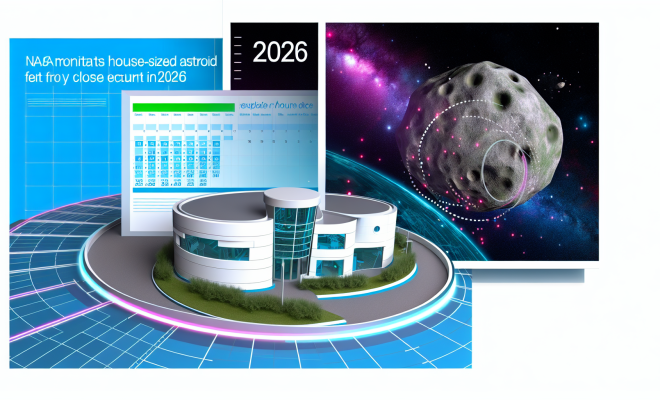
On April 9, 2026, a house-sized asteroid known as 2026 GD will make a close approach to Earth, passing at a distance of approximately 156,000 miles—significantly closer than the Moon. While this celestial event has garnered attention, experts from NASA assure us that there is no cause for alarm.

Understanding Asteroid 2026 GD

Asteroid 2026 GD measures around 54 feet in diameter, which is roughly the size of a single-family home. Despite its relatively small size, the asteroid has been categorized as a near-Earth object (NEO), a classification that includes any small solar system body whose orbit brings it into proximity with Earth.

NASA’s Monitoring and Assessment

NASA has a dedicated program for tracking NEOs, which involves continuously observing and assessing potential threats to our planet. The agency’s Near-Earth Object Observations (NEOO) program plays a crucial role in identifying and tracking these celestial bodies. This program is vital in determining whether any asteroids pose a risk to Earth.

In the case of asteroid 2026 GD, NASA has confirmed that it poses no danger during its upcoming flyby. The asteroid is being closely monitored as part of routine tracking efforts, allowing scientists to gather more data about its trajectory and characteristics.

The Significance of Close Approaches

While a house-sized asteroid flying close to Earth might sound alarming, it is not uncommon for such objects to pass our planet. NASA and other space agencies routinely track numerous NEOs, many of which fly by at varying distances. In fact, the relatively close approach of 2026 GD provides scientists with a valuable opportunity to study the object’s composition and behavior.

  • Size: At approximately 54 feet wide, 2026 GD is considered small in astrological terms.
  • Distance: The asteroid will pass 156,000 miles from Earth, which is about two-thirds of the distance to the Moon.
  • No Threat: NASA has indicated that there is no imminent risk associated with this asteroid.

Notable Past Close Encounters

Historically, Earth has had numerous encounters with asteroids of varying sizes. For instance, in February 2023, another NEO named 2023 CX1 passed within 62,000 miles of Earth. These events are critical for understanding how often such objects come near our planet and what measures, if any, need to be taken for future threats.

NASA and other space agencies are also exploring ways to prevent potential impacts from larger asteroids. The Double Asteroid Redirection Test (DART) mission, which successfully altered the orbit of the asteroid Didymos in 2022, is one such effort aimed at developing techniques for planetary defense.

Why Should We Care?

Monitoring asteroids like 2026 GD is essential not only for planetary defense but also for expanding our understanding of the solar system. Each close encounter provides scientists with the chance to collect data that can inform future missions and research.

The Future of Asteroid Tracking

As technology advances, so too does our ability to detect and track these objects. The ongoing development of telescopes and observational technologies enhances our capacity to identify potential threats well in advance of their approach. The goal is to ensure that even as more NEOs are discovered, we can accurately assess their risk to Earth.

In conclusion, while the close approach of asteroid 2026 GD on April 9, 2026, may sound concerning, it is an excellent reminder of the importance of ongoing monitoring and research in the field of astronomy. With NASA and other organizations at the forefront of these efforts, we can rest assured that our planet is being closely watched for any potential threats from space.

As we look toward the future, the study of asteroids and other NEOs will continue to provide valuable insights into the workings of our solar system and the potential risks that lie beyond our atmosphere.


Previous Article

Oil Prices Surge Amid Geopolitical Tensions as ...

Next Article

Artemis II Crew Reflects on Transformative Lunar ...

Matthew Lynch

Related articles More from author

  • Uncategorized

    Iranian Hackers Target Israeli Organizations in Widespread Password-Spraying Attack

    April 8, 2026
    By Matthew Lynch
  • Early Childhood & K-12 EdTechUncategorized

    iPads in Education: Tool or Toy?

    December 15, 2016
    By Matthew Lynch
  • Uncategorized

    Daydream Secures $15 Million Series A to Revolutionize SEO with AI Technology

    April 3, 2026
    By Matthew Lynch
  • Uncategorized

    When Teachers Bully One Another

    January 2, 2025
    By Matthew Lynch
  • Uncategorized

    19 Preschool Math Games and Activities To Start Them Off Right

    January 2, 2025
    By Matthew Lynch
  • Uncategorized

    Best Online Tools for Dungeons & Dragons Enthusiasts

    January 2, 2025
    By Matthew Lynch

Search

Registration and Login

  • Register
  • Log in
  • Entries feed
  • Comments feed
  • WordPress.org

Newsletter

Signup for The Edvocate Newsletter and have the latest in P-20 education news and opinion delivered to your email address!

RSS Matthew on Education Week

  • Au Revoir from Education Futures November 20, 2018 Matthew Lynch
  • 6 Steps to Data-Driven Literacy Instruction October 17, 2018 Matthew Lynch
  • Four Keys to a Modern IT Approach in K-12 Schools October 2, 2018 Matthew Lynch
  • What's the Difference Between Burnout and Demoralization, and What Can Teachers Do About It? September 27, 2018 Matthew Lynch
  • Revisiting Using Edtech for Bullying and Suicide Prevention September 10, 2018 Matthew Lynch

About Us

The Edvocate was created in 2014 to argue for shifts in education policy and organization in order to enhance the quality of education and the opportunities for learning afforded to P-20 students in America. What we envisage may not be the most straightforward or the most conventional ideas. We call for a relatively radical and certainly quite comprehensive reorganization of America’s P-20 system.

That reorganization, though, and the underlying effort, will have much to do with reviving the American education system, and reviving a national love of learning.  The Edvocate plans to be one of key architects of this revival, as it continues to advocate for education reform, equity, and innovation.

Newsletter

Signup for The Edvocate Newsletter and have the latest in P-20 education news and opinion delivered to your email address!

Contact

The Edvocate
910 Goddin Street
Richmond, VA 23230
(601) 630-5238
[email protected]
  • situs togel online
  • dentoto
  • situs toto 4d
  • situs toto slot
  • toto slot 4d
Copyright (c) 2025 Matthew Lynch. All rights reserved.
