Three Asteroids Safely Approach Earth in 2026: NASA Confirms
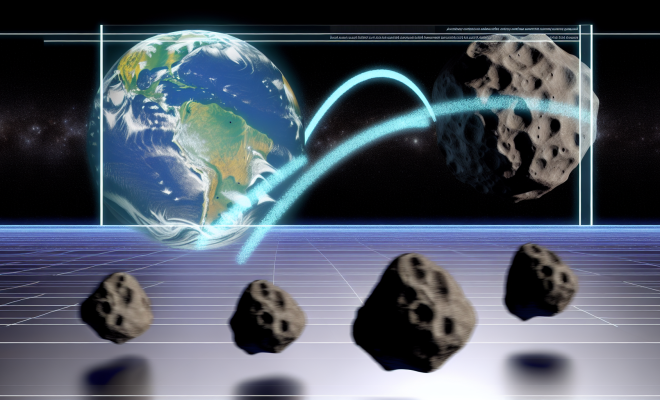
On March 31, 2026, Earth will witness a remarkable celestial event as three asteroids make their way past our planet. However, NASA has reassured the public that there is no risk of collision, allowing both scientists and space enthusiasts to focus on the scientific significance of the event rather than any potential dangers.
Details of the Asteroids
The three asteroids in question are designated as 2026 FJ, 2026 FZ6, and 2026 FV3. Each of these asteroids varies in size and distance from Earth:
- 2026 FJ: This asteroid is comparable in size to a school bus, measuring approximately 30 feet across. It will make its closest approach at a distance of about 1.8 million miles from Earth.
- 2026 FZ6: A medium-sized asteroid, 2026 FZ6 will pass at a distance of around 2.5 million miles from our planet.
- 2026 FV3: The largest of the trio, 2026 FV3 measures about 72 feet in diameter and is expected to fly by at a distance of approximately 2.6 million miles.
NASA’s Monitoring Capabilities
This event highlights NASA’s advanced capabilities in monitoring near-Earth objects (NEOs). With the increasing number of asteroids being discovered and tracked, the agency’s ability to assess potential threats to Earth has improved significantly over the years. NASA’s Planetary Defense Coordination Office (PDCO) plays a crucial role in this effort, utilizing a network of telescopes and advanced technology to identify and characterize asteroids that venture close to our planet.
Significance of Tracking Asteroids
The close approaches of asteroids present a unique opportunity for scientists to study these celestial bodies. By tracking their paths and analyzing their compositions, researchers can gather valuable data that enhances our understanding of the solar system and aids in planetary defense preparations.
Asteroids are remnants from the early formation of the solar system, and studying them can provide insights into the conditions that existed billions of years ago. Understanding their composition also helps in assessing the potential risks they may pose in the future. For instance, if a larger asteroid were to head towards Earth, having detailed information about its size, structure, and trajectory would be invaluable for devising mitigation strategies.
Public Interest and Safety Reassurance
Despite the lack of risk associated with the March 31 flybys, public interest in asteroids remains high. NASA’s reassurance that these asteroids will not pose any danger allows audiences to shift their focus from fear to fascination. Engaging the public through educational initiatives and outreach programs has become a priority for NASA, as it seeks to inspire the next generation of scientists and engineers.
In addition to NASA’s PDCO, other organizations such as the European Space Agency (ESA) and various observatories around the world are also involved in monitoring near-Earth objects. This collaborative effort ensures that the global scientific community remains vigilant in tracking and studying asteroids.
Future of Planetary Defense
The ongoing study of asteroids and NEOs is critical for future planetary defense initiatives. As technology improves, our ability to detect and analyze these celestial bodies will only get better. This includes developing new methods for deflecting a potentially hazardous asteroid should one be discovered on a collision course with Earth.
Moreover, upcoming missions, such as NASA’s Double Asteroid Redirection Test (DART), aim to test our capability to alter an asteroid’s trajectory. Such tests are essential for preparing for possible future threats and ensuring the long-term safety of our planet.
Conclusion
The March 31, 2026, close encounters with asteroids 2026 FJ, 2026 FZ6, and 2026 FV3 serve as a reminder of the dynamic environment of our solar system. As the scientific community continues to monitor and study these celestial objects, we gain invaluable knowledge that not only enhances our understanding of the universe but also strengthens our planetary defense capabilities. While the asteroids pose no immediate threat, their flybys are an exciting opportunity for research and public engagement, reinforcing the importance of vigilance and preparation in the face of potential cosmic challenges.