Webb Telescope Unveils Dazzling Spiral Galaxy Core
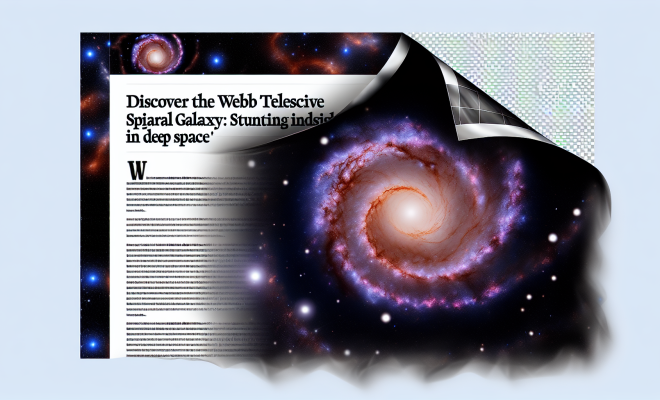
The cosmos continues to captivate our imagination, and NASA’s Webb Space Telescope is at the forefront of this exploration. Recently, it unveiled a breathtaking image of the core of a spiral galaxy that dazzles with brilliance. This remarkable capture not only highlights the advanced capabilities of the telescope but also showcases a vibrant cosmic tapestry that invites both scientific inquiry and public fascination.
Peering into the Heart of the Galaxy
The Webb Telescope spiral galaxy image provides an unprecedented look at the heart of a galaxy, revealing intricate details that were previously obscured by cosmic dust. The advanced infrared technology of the telescope enables astronomers to penetrate this dust, unveiling hidden stellar formations and the activity of a supermassive black hole at the galactic center.
The Advanced Technology Behind Webb
NASA’s Webb Space Telescope, which launched on December 25, 2021, is equipped with state-of-the-art instruments that allow it to observe the universe in infrared wavelengths. This capability is crucial for studying celestial objects that are otherwise hidden from view in visible light. The telescope features a 6.5-meter segmented primary mirror that collects more light than its predecessors, enabling it to capture detailed images of distant galaxies, star-forming regions, and planetary atmospheres.
- Infrared Sensitivity: Webb’s infrared sensors can detect heat emitted by objects in space, allowing for a clearer view through dust clouds.
- High Resolution: The telescope’s design provides high-resolution images, which are essential for studying the structure and dynamics of galaxies.
- Versatile Instruments: Webb is equipped with multiple instruments, each designed for specific types of observations, including spectroscopy and imaging.
Unveiling Cosmic Mysteries
The stunning image captured by the Webb Telescope spiral galaxy has been generating significant engagement on social media platforms. Users are sharing the visuals with awe, highlighting the beauty and complexity of the cosmos. The image not only serves as a scientific tool but also as a source of inspiration for people interested in astronomy and space exploration.
The Role of Social Media in Science Communication
In today’s digital age, social media plays a pivotal role in disseminating scientific discoveries. The spectacular imagery from the Webb Telescope has sparked widespread interest and discussion, with platforms like Twitter, Instagram, and Facebook becoming venues for sharing knowledge and enthusiasm about space. Engaging visuals create a ‘wow factor’ that encourages users to share and discuss, leading to organic conversations about our universe.
- Increased Accessibility: The web allows a broader audience to access and appreciate scientific findings.
- Community Engagement: Online discussions foster a sense of community among astronomy enthusiasts and the general public.
- Educational Opportunities: Social media serves as a platform for educational outreach, helping to explain complex astronomical concepts in simpler terms.
The Significance of the Webb Telescope’s Observations
The Webb Telescope spiral galaxy revelation represents a significant scientific achievement, merging cutting-edge technology with visually compelling content. By providing detailed insights into the structure and behavior of galaxies, the telescope helps astronomers test theories about galactic formation and evolution.
Understanding Galactic Formation
Studying spiral galaxies, such as the one observed by Webb, is crucial for understanding how galaxies form and evolve over cosmic time. Spiral galaxies are characterized by their distinct arms that wind outward from the center, a feature that is thought to arise from gravitational interactions and the dynamics of star formation.
By analyzing the newly captured images, astronomers can glean information about:
- Star Formation Rates: The clarity of the images allows scientists to measure how quickly stars are being formed within the galaxy.
- Black Hole Activity: Observing the supermassive black hole at the center can provide insights into its influence on the surrounding stellar environment.
- Dust and Gas Distribution: Understanding the distribution of dust and gas is essential for comprehending the fuel available for future star formation.
Public Fascination with Space Exploration
The recent image from the Webb Telescope has tapped into the public’s fascination with space exploration. Astronomical discoveries have always held a place in human curiosity, and advancements in technology have only amplified this interest. The ability to view the universe in unprecedented detail has reignited enthusiasm for scientific inquiry and exploration.
Inspiring Future Generations
The captivating imagery produced by the Webb Telescope spiral galaxy not only excites current astronomy enthusiasts but also inspires future generations of scientists, engineers, and explorers. As young minds are exposed to the wonders of the universe through stunning visuals, they become motivated to pursue careers in STEM fields, contributing to the ongoing exploration of space.
Conclusion: A New Era of Cosmic Exploration
The Webb Telescope spiral galaxy imagery marks the beginning of a new era in our understanding of the cosmos. As astronomers continue to analyze the intricate details captured by this advanced instrument, we can expect to uncover more secrets about our universe and our place within it. As technology progresses, the potential for discovery is limitless, and the Webb Telescope is paving the way for future explorations that will undoubtedly inspire and engage people around the world.
As we look towards the stars, the Webb Telescope reminds us that the universe is vast and filled with mysteries waiting to be uncovered. Each image and each finding fuels our collective curiosity—a reminder that exploration is not just about the destinations we reach, but also the journey of discovery itself.