The Edvocate

Top Menu

Main Menu

  • Start Here
    • Our Brands
    • Governance
      • Lynch Education Consulting, LLC.
      • Dr. Lynch’s Personal Website
      • Careers
    • Write For Us
    • Books
    • The Tech Edvocate Product Guide
    • Contact Us
    • The Edvocate Podcast
    • Edupedia
    • Pedagogue
    • Terms and Conditions
    • Privacy Policy
  • PreK-12
    • Assessment
    • Assistive Technology
    • Best PreK-12 Schools in America
    • Child Development
    • Classroom Management
    • Early Childhood
    • EdTech & Innovation
    • Education Leadership
    • Equity
    • First Year Teachers
    • Gifted and Talented Education
    • Special Education
    • Parental Involvement
    • Policy & Reform
    • Teachers
  • Higher Ed
    • Best Colleges and Universities
    • Best College and University Programs
    • HBCU’s
    • Diversity
    • Higher Education EdTech
    • Higher Education
    • International Education
  • Advertise
  • The Tech Edvocate Awards
    • The Awards Process
    • Finalists and Winners of The 2025 Tech Edvocate Awards
    • Finalists and Winners of The 2024 Tech Edvocate Awards
    • Finalists and Winners of The 2023 Tech Edvocate Awards
    • Finalists and Winners of The 2021 Tech Edvocate Awards
    • Finalists and Winners of The 2022 Tech Edvocate Awards
    • Finalists and Winners of The 2020 Tech Edvocate Awards
    • Finalists and Winners of The 2019 Tech Edvocate Awards
    • Finalists and Winners of The 2018 Tech Edvocate Awards
    • Finalists and Winners of The 2017 Tech Edvocate Awards
    • Award Seals
  • Apps
    • GPA Calculator for College
    • GPA Calculator for High School
    • Cumulative GPA Calculator
    • Grade Calculator
    • Weighted Grade Calculator
    • Final Grade Calculator
  • The Tech Edvocate
  • Post a Job
  • AI Powered Personal Tutor

logo

The Edvocate

  • Start Here
    • Our Brands
    • Governance
      • Lynch Education Consulting, LLC.
      • Dr. Lynch’s Personal Website
        • My Speaking Page
      • Careers
    • Write For Us
    • Books
    • The Tech Edvocate Product Guide
    • Contact Us
    • The Edvocate Podcast
    • Edupedia
    • Pedagogue
    • Terms and Conditions
    • Privacy Policy
  • PreK-12
    • Assessment
    • Assistive Technology
    • Best PreK-12 Schools in America
    • Child Development
    • Classroom Management
    • Early Childhood
    • EdTech & Innovation
    • Education Leadership
    • Equity
    • First Year Teachers
    • Gifted and Talented Education
    • Special Education
    • Parental Involvement
    • Policy & Reform
    • Teachers
  • Higher Ed
    • Best Colleges and Universities
    • Best College and University Programs
    • HBCU’s
    • Diversity
    • Higher Education EdTech
    • Higher Education
    • International Education
  • Advertise
  • The Tech Edvocate Awards
    • The Awards Process
    • Finalists and Winners of The 2025 Tech Edvocate Awards
    • Finalists and Winners of The 2024 Tech Edvocate Awards
    • Finalists and Winners of The 2023 Tech Edvocate Awards
    • Finalists and Winners of The 2021 Tech Edvocate Awards
    • Finalists and Winners of The 2022 Tech Edvocate Awards
    • Finalists and Winners of The 2020 Tech Edvocate Awards
    • Finalists and Winners of The 2019 Tech Edvocate Awards
    • Finalists and Winners of The 2018 Tech Edvocate Awards
    • Finalists and Winners of The 2017 Tech Edvocate Awards
    • Award Seals
  • Apps
    • GPA Calculator for College
    • GPA Calculator for High School
    • Cumulative GPA Calculator
    • Grade Calculator
    • Weighted Grade Calculator
    • Final Grade Calculator
  • The Tech Edvocate
  • Post a Job
  • AI Powered Personal Tutor
  • 10 Women’s History Books for Kids in Elementary, Middle, or High School

  • How To Manage Non-Renewed Teachers As a School Leader

  • 9 Things Parents Should Never Say in an Email to Teachers

  • Print This Free Kindness Activity Guide for Your Classroom

  • Classroom Posters: Supporting English Language Learners

  • The Ultimate Guide to College Scholarships

  • These Hilarious Quotes From Students Will Have You Rolling

  • Easy Classroom Activities You Can Rinse and Repeat Using Adobe Express for Educators

  • Project-Based Learning Transforms Classroom Dynamics

  • Free Smithsonian Science Activity Guide

Higher EducationTrending Topics
Home›Higher Education›The Myth of the College Dropout

The Myth of the College Dropout

By Matthew Lynch
June 3, 2017
0
Spread the love

Jonathan Wai, Duke University and Heiner Rindermann, Chemnitz University of Technology

When Facebook founder Mark Zuckerberg was asked to give this year’s commencement address at Harvard, he asked for advice from Bill Gates.

Zuckerberg said, “They know we didn’t actually graduate, right?”

To which Gates replied, “Oh, that is the best part! They actually give you a degree!”

This recent exchange between two famous Harvard dropouts might lead you to think college doesn’t matter. Numerous media stories and even famous billionaires are glamorizing dropouts or encouraging kids to skip college entirely.

While it’s true there are successful college dropouts, statistically speaking, they are not the norm. As researchers in education and talent, we found that the vast majority of the country’s success stories are college graduates, such as Sheryl Sandberg (Harvard), Jeff Bezos (Princeton) and Marissa Mayer (Stanford).

The myth of the mega-successful college dropout

In a recent study, we investigated how many of the wealthiest and most influential people graduated college. We studied 11,745 U.S. leaders, including CEOs, federal judges, politicians, multi-millionaires and billionaires, business leaders and the most globally powerful men and women.

We also examined how many people graduated from an “elite school.” (Our definition included the eight Ivy League schools, plus many of the top national universities and liberal arts colleges consistently high in the U.S. News rankings for both undergraduate and graduate education.)

We found about 94 percent of these U.S. leaders attended college, and about 50 percent attended an elite school. Though almost everyone went to college, elite school attendance varied widely. For instance, only 20.6 percent of House members and 33.8 percent of 30-millionaires attended an elite school, but over 80 percent of Forbes’ most powerful people did. For whatever reason, about twice as many senators – 41 percent – as House members went to elite schools.

For comparison, based on census and college data, we estimate that only about 2 to 5 percent of all U.S. undergraduates went to one of the elite schools in our study. The people from our study attended elite schools at rates well above typical expectations.

Do elite schools matter?

This year, elite schools saw an increase in applications and selectivity. Research suggests there is no difference in adult income between students who attended highly selective schools and students with similar SAT scores who attended less selective schools. At least for long-term earnings, where you go may not be critical, as long as you attend and graduate.

Yet, our data show that for students with talent and motivation to make it to the top of U.S. society, an elite college might just help you get there – whether it’s the networks you acquire or the brand on your resume.

While looking at over 11,000 successful leaders, we rarely encountered people who came from extremely poor or disadvantaged backgrounds. Helping disadvantaged talented students enter elite schools could promote diversity among future leaders.
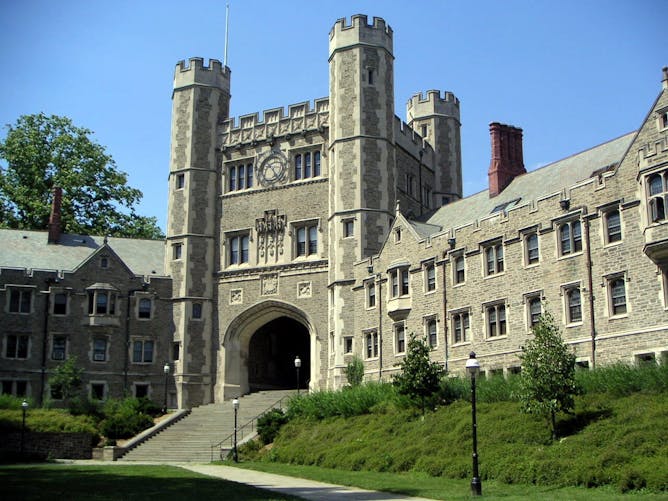
Princeton University had a record-setting number of applicants for its class of 2021.
Sindy Lee / flickr, CC BY-NC-ND

College matters

Admittedly, the educational path of the cream of the crop may not apply to most people. So, going to college may not be the right or even the best path for everyone. However, if you’re a student thinking about not going to college or considering dropping out, remember that even Gates and Zuckerberg got into college. Even if you’re not aiming for mega success, doing the work to get into and graduate from college today may open important doors.

The ConversationPerhaps in the future, college may not be as important to employers. But for now, college dropouts who rule the world are rare exceptions – not the rule.

Jonathan Wai, Research Scientist, Duke University and Heiner Rindermann, Professor of Educational and Developmental Psychology, Chemnitz University of Technology

This article was originally published on The Conversation. Read the original article.

TagscollegeCollege chatHigher Education
Previous Article

Pass or Fail: Retention Has Long-Term Effects ...

Next Article

Does it pay to get a double ...

Matthew Lynch

Related articles More from author

  • Higher Education

    Which Universities Have the Highest Dropout Rates?

    April 5, 2018
    By Matthew Lynch
  • Uncategorized

    Nominations Are Now Being Accepted for The 2017 Tech Edvocate Awards

    August 8, 2017
    By Matthew Lynch
  • Uncategorized

    Twitter Accusations Strain HBCUs Relationship

    October 11, 2016
    By Matthew Lynch
  • Policy & Reform

    Do we know where Republicans stand on education?

    February 12, 2016
    By Matthew Lynch
  • DiversityEquityHBCU'sHigher EducationMatthew Lynch

    Black Men and College Advantages: Fair or Unfair?

    November 4, 2015
    By Matthew Lynch
  • EquityMatthew Lynch

    Diversity in College Faculty Just as Important as Student Body

    December 5, 2015
    By Matthew Lynch

Search

Registration and Login

  • Register
  • Log in
  • Entries feed
  • Comments feed
  • WordPress.org

Newsletter

Signup for The Edvocate Newsletter and have the latest in P-20 education news and opinion delivered to your email address!

RSS Matthew on Education Week

  • Au Revoir from Education Futures November 20, 2018 Matthew Lynch
  • 6 Steps to Data-Driven Literacy Instruction October 17, 2018 Matthew Lynch
  • Four Keys to a Modern IT Approach in K-12 Schools October 2, 2018 Matthew Lynch
  • What's the Difference Between Burnout and Demoralization, and What Can Teachers Do About It? September 27, 2018 Matthew Lynch
  • Revisiting Using Edtech for Bullying and Suicide Prevention September 10, 2018 Matthew Lynch

About Us

The Edvocate was created in 2014 to argue for shifts in education policy and organization in order to enhance the quality of education and the opportunities for learning afforded to P-20 students in America. What we envisage may not be the most straightforward or the most conventional ideas. We call for a relatively radical and certainly quite comprehensive reorganization of America’s P-20 system.

That reorganization, though, and the underlying effort, will have much to do with reviving the American education system, and reviving a national love of learning.  The Edvocate plans to be one of key architects of this revival, as it continues to advocate for education reform, equity, and innovation.

Newsletter

Signup for The Edvocate Newsletter and have the latest in P-20 education news and opinion delivered to your email address!

Contact

The Edvocate
910 Goddin Street
Richmond, VA 23230
(601) 630-5238
[email protected]
  • situs togel online
  • dentoto
  • situs toto 4d
  • situs toto slot
  • toto slot 4d
Copyright (c) 2025 Matthew Lynch. All rights reserved.